AI Automation vs. Hiring: Which Has a Shorter Payback Period for Service Businesses?
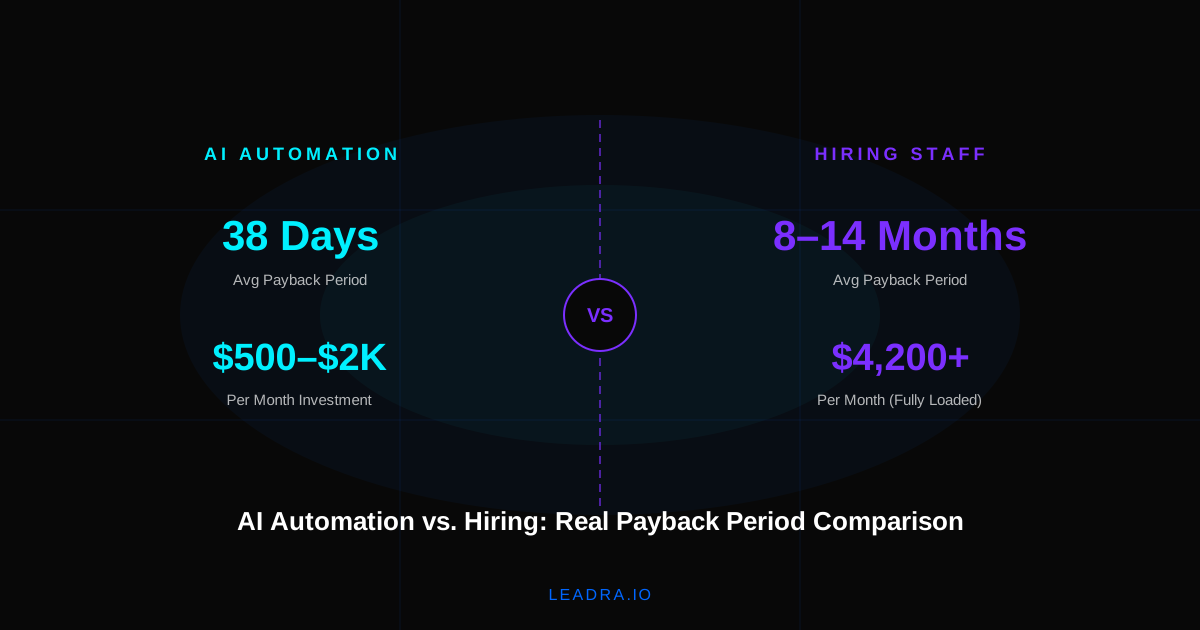
The question every service business owner asks before pulling the trigger on AI: "Would I be better off just hiring someone?" Here's a side-by-side cost and payback comparison — with real numbers, not estimates.
You're getting more leads than you can handle. Your phone rings during dinner and no one answers. You need someone — or something — to cover the gap.
Most owners jump straight to "I need to hire." It feels like the obvious move. But before you post that job listing, run these numbers. The payback period for a new hire vs. AI automation in a service business is not even close.
The Real Cost of Hiring One Person
Most business owners dramatically undercount the cost of a new hire. The job listing says $18/hour. The actual number is much higher.
Here's what one full-time front-desk or sales rep actually costs a service business:
| Cost Category | Monthly Amount | Annual Amount |
|---|---|---|
| Base wages ($18–$22/hr, full-time) | $3,120–$3,813 | $37,440–$45,760 |
| Payroll taxes (FICA, FUTA, SUTA) | $390–$475 | $4,680–$5,700 |
| Health insurance contribution | $300–$600 | $3,600–$7,200 |
| Recruiting / job ads / time | $125 (amortized) | $1,500 |
| Onboarding and training time | $200 (amortized) | $2,400 |
| Software seats, uniforms, supplies | $100–$200 | $1,200–$2,400 |
| Total (fully loaded) | $4,235–$5,213 | $50,820–$62,560 |
That's before turnover. According to the Society for Human Resource Management, replacing a front-line employee costs 50–100% of their annual salary. If your hire leaves at month six — and in service businesses, turnover runs 30–50% annually — you pay that recruiting and training cost again.
And the hidden cost no one counts: the new hire isn't productive on day one. Most service business hires take 60–90 days to reach full competency. During that ramp-up, you're paying full wages for reduced output.
The Real Cost of AI Automation
AI automation systems for service businesses are not all the same. Some are point solutions (just a chatbot, just a review tool). The ones that actually move revenue are full-stack systems that handle lead response, appointment booking, follow-up sequences, and reactivation — the same work a front-desk hire would do, but 24/7.
| Automation Level | What's Included | Monthly Cost |
|---|---|---|
| Basic (missed call text-back + review requests) | Single-channel lead recovery | $297–$497 |
| Mid-tier (AI voice agent + SMS follow-up + booking) | After-hours capture + nurture | $697–$1,197 |
| Full-stack (voice + SMS + email + CRM + SEO content) | Complete revenue engine | $1,497–$2,497 |
The full-stack tier replaces what most service businesses hire a front-desk coordinator to do — plus adds capabilities no human employee can match (instant 2 AM responses, unlimited simultaneous conversations, SEO content that generates leads while you sleep).
There are no payroll taxes. No health insurance. No turnover. No sick days. Month 12 costs the same as month 1.
Payback Period: AI Automation vs. Hiring
Payback period is the number of months before your investment generates more revenue than it costs. Here's how it plays out in real service businesses.
| Business Type | AI Automation Payback | New Hire Payback | Speed Advantage |
|---|---|---|---|
| Dental practice | 30–45 days | 9–12 months | 8–10x faster |
| HVAC contractor | 38–60 days | 8–11 months | 7–9x faster |
| Roofing contractor | 14–30 days | 10–14 months | 12–15x faster |
| Med spa / aesthetics | 30–60 days | 8–12 months | 6–9x faster |
| Salon / barbershop | 45–75 days | 7–10 months | 5–7x faster |
| Plumbing company | 45–75 days | 8–12 months | 6–8x faster |
Why does AI automation pay back so much faster? Two reasons. First, the investment is 60–75% lower than a hire — so you need far less added revenue to break even. Second, the revenue impact starts on day one. An AI voice agent capturing after-hours calls doesn't need 60 days to ramp up.
A Real Example: Charlotte HVAC Company
An HVAC company in Charlotte's Ballantyne area was fielding about 40 calls per month that went unanswered after 5 PM. Average ticket size: $1,800 (system tune-up + repair). Their close rate on answered calls was 62%.
They considered two options:
Option A: Hire a Part-Time Dispatcher
- • $22/hr × 20 hrs/week = $1,760/mo
- • Payroll taxes: +$220/mo
- • Only covers 4 PM–8 PM, 5 days/week
- • 60-day ramp-up before full productivity
- • Estimated capture: 14–18 of 40 missed calls
- • Added revenue (estimated): $15,120–$20,160/mo
- Break-even: Month 6–8
Option B: AI Voice Agent + Booking System
- • Full-stack AI system: $1,497/mo
- • Covers 24/7, including weekends
- • Live from day one, no ramp-up
- • Estimated capture: 28–34 of 40 missed calls
- • Added revenue (month 1): $31,248–$37,944
- • No payroll taxes, no benefits, no turnover
- Break-even: Day 38
They chose Option B. Month one revenue from after-hours calls alone: $34,200. AI system cost: $1,497. Net gain: $32,703. By month three, the AI system had generated $97,600 in recovered revenue — from a $4,491 total investment.
The part-time dispatcher option would have cost $5,940 over the same three months and recovered a fraction of the revenue — because it couldn't cover weekends or 8 PM–midnight, which is when 40% of after-hours calls came in.
What AI Can't Replace (And When You Actually Need to Hire)
This is not an argument to never hire. It's an argument to automate first, then hire for the right reasons.
AI automation is better than a human hire for:
- ✓Responding to leads in under 60 seconds, 24/7
- ✓Handling unlimited simultaneous phone calls or texts
- ✓Following up 6–8 times without burning out or giving up
- ✓Sending review requests immediately after every completed job
- ✓Reactivating dormant clients at scale (500 contacts in 48 hours)
- ✓Answering the same FAQs with perfect consistency every time
You should hire when you need:
- →A technician or service provider to do the physical work
- →Complex problem-solving that requires judgment in unique situations
- →Relationship management with high-value accounts
- →Leadership and team management as you scale
- →A skilled tradesperson, sales closer, or specialist role
The smartest operators automate the repetitive revenue tasks first — lead response, follow-up, booking, review collection — then hire skilled people to fulfill the increased volume those automations create. That sequence produces the fastest growth with the lowest risk.
The 5 Factors That Determine Your Payback Speed
Not every service business sees the same payback speed. Here's what determines how fast AI automation pays for itself:
After-hours call volume
If you miss 20+ calls per month outside business hours, AI payback happens fastest. An AI voice agent earning one additional job per week from missed calls can break even in under 30 days.
Average job or ticket value
Roofing ($8,000–$20,000 average) and dental ($1,200–$4,000 per new patient) see faster payback than businesses with $50–$200 average tickets. Higher ticket = fewer recovered leads needed to break even.
Current follow-up speed
Studies show leads contacted within 5 minutes are 100x more likely to convert than those contacted after 30 minutes. If you're currently following up in hours or days, the conversion lift from AI automation is immediate and dramatic.
Dormant client base size
If you have 500+ past customers who haven't been contacted in 90+ days, a reactivation campaign can generate $10,000–$30,000 in the first 30 days. This alone often covers 6–12 months of AI system cost.
Review count and reputation gap
Businesses with under 50 Google reviews in competitive markets see significant lead volume increases from AI-driven review generation. Each new positive review can drive 1–3 additional organic leads per month.
Frequently Asked Questions
Is AI automation cheaper than hiring an employee for a service business?
Yes. A full-time employee costs $4,200–$5,200 per month fully loaded. AI automation runs $500–$2,000 per month. Beyond cost, AI requires no recruiting, no training time, no payroll taxes, and no health insurance. Month 12 costs the same as month 1.
How long does it take for AI automation to pay for itself vs. hiring?
AI automation typically pays for itself in 30–90 days for service businesses. A new hire takes 8–14 months to break even when you include recruiting costs, 60–90 days of ramp-up time, and the period before they're fully productive. That's a 6–15x difference in payback speed depending on your industry.
What can AI automation do that hiring someone can't?
AI works 24/7 at no extra cost, responds to leads in under 60 seconds at 2 AM, handles unlimited simultaneous conversations, never calls in sick, and runs reactivation campaigns to 500+ contacts at once. A human employee is irreplaceable for skilled trade work, complex judgment calls, and client relationships — but those are different roles entirely.
Should I hire or automate first for my service business?
Automate first. Most service businesses lose 30–40% of potential revenue to slow follow-up, missed calls, and zero lead nurture — before they ever need another person. Plug those leaks with AI first. Once your pipeline is full and your conversion rates are optimized, hire skilled people to fulfill the additional work.
Related Resources
- AI Automation Payback Period for Small Businesses: Industry Benchmarks and a 4-Step Calculator
- AI ROI Calculator for Small Business: What to Expect in 2026
- What ROI Can I Expect from AI Marketing Automation?
- AI Implementation Timeline: How to Go Live in 14 Days
See What AI Automation Would Return in Your Business
Leadra.io builds done-for-you AI automation systems for service businesses. We guarantee 90 new clients or you don't pay. Most clients break even in the first 30–45 days.