AI Consultant vs. AI Implementation Team: Which One Do You Actually Need?
One gives you a 40-page deck. The other gives you a working system that books appointments while you sleep. Before you write a check, you need to know the difference.
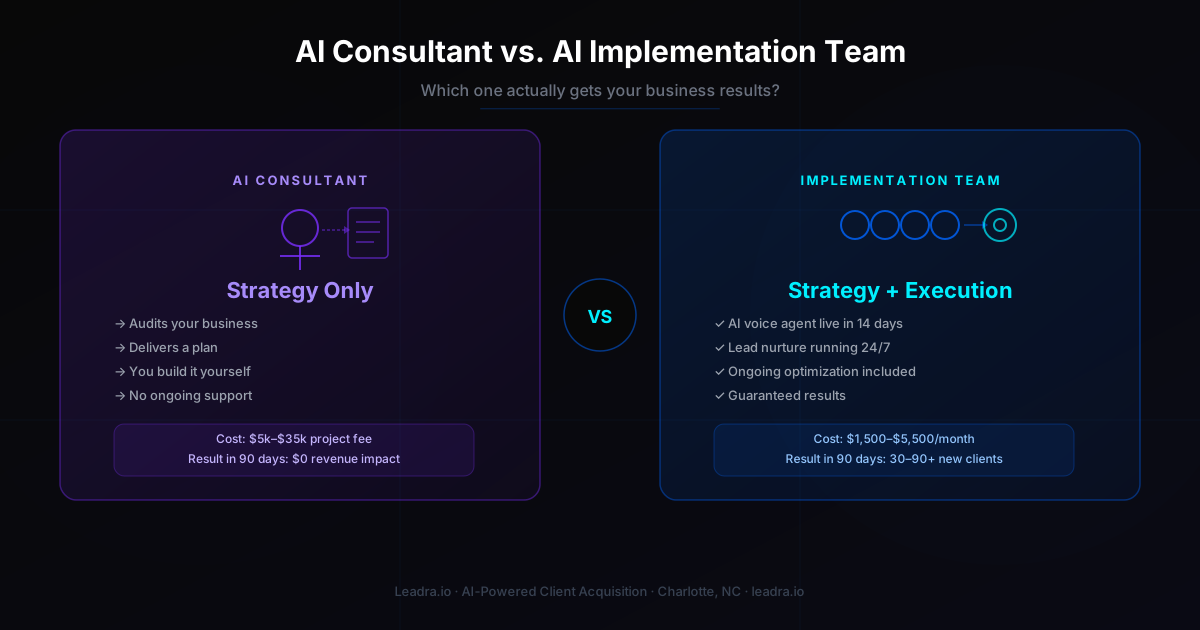
Most business owners searching for AI help get sold one of two things: a consultant who charges by the hour to tell them what to do, or an implementation team that actually builds and runs the AI systems. These are not the same thing. They have completely different price structures, deliverables, and outcomes — and picking the wrong one is an expensive mistake.
According to McKinsey's 2025 AI adoption report, 72% of businesses that hired AI consultants for strategy work still had no working AI system deployed 6 months later. The strategy sat in a document. Meanwhile, businesses that went directly to implementation-focused teams saw working systems in 2–6 weeks. The gap in outcomes is significant.
This guide breaks down exactly what each option delivers, what each one costs, and which one makes sense for your situation.
What an AI Consultant Actually Does
An AI consultant is typically a solo practitioner or small firm that specializes in advising businesses on AI strategy. Their job is to assess your current operations, identify where AI can help, and produce a roadmap. Most consultants do not write code, configure tools, or maintain systems after the engagement ends.
A typical AI consultant engagement looks like this:
Discovery & Audit
The consultant interviews you and your team, reviews your current tech stack, maps your workflows, and identifies pain points. This takes 1–3 weeks depending on business complexity.
Strategy Development
They produce a prioritized list of AI use cases — which automations to build, which tools to use, what the expected ROI looks like. This is typically delivered as a presentation or written report.
Vendor Recommendations
The consultant recommends specific software vendors, AI platforms, and tools. They may help you evaluate demos or negotiate contracts.
Handoff
You receive the strategy document and vendor shortlist. Implementation is your responsibility — either hiring someone to build it or managing it yourself.
The critical gap:
When the consultant leaves, you have a plan but no working system. If your business doesn't have a technical team to execute the plan, that document generates zero revenue. You've paid for advice and still have the same problem you started with.
What AI Consultants Charge
| Engagement Type | Typical Deliverable | Cost |
|---|---|---|
| Hourly advisory | Q&A sessions, vendor feedback | $150–$500/hr |
| AI audit + strategy | Written roadmap, vendor recommendations | $5,000–$15,000 |
| Full strategy project | Detailed implementation plan, ROI model | $15,000–$35,000 |
| Ongoing advisory retainer | Monthly check-ins, strategy updates | $3,000–$8,000/mo |
Note that none of these engagements include building anything. The consultant's fee covers thinking and documentation. Execution is a separate budget item — and often a larger one.
What an AI Implementation Team Does
An AI implementation team — typically structured as an AI agency — is a group of specialists who build, deploy, and maintain AI systems for your business. Strategy is included, but it's a means to an end. The deliverable is a working system, not a document.
A standard AI implementation engagement for a service business includes:
Business process audit and AI opportunity mapping
AI voice agent setup (answers calls, qualifies leads, books appointments)
Missed-call SMS text-back system (responds in under 60 seconds)
Lead nurture sequences — 8–12 touches via SMS and email
CRM integration and pipeline automation
Online booking system configuration and testing
Dormant client reactivation campaign
Automated post-service review requests
SEO content published to your website monthly
Monthly performance report with revenue attribution
The critical difference: the team doesn't leave after delivering a strategy. They run the system, optimize it based on real performance data, and keep it working as your business grows.
What a deployed system looks like in practice:
- • A new lead fills out your contact form at 11 PM
- • AI sends a personalized SMS within 45 seconds
- • If no response, follows up at 8 AM the next morning
- • Sequence continues for 14 days across 7–12 touchpoints
- • Lead books an appointment without you touching it
- • After the appointment, a review request goes out automatically
This runs 24/7 with zero manual effort. A consultant can design it. An implementation team makes it real.
Head-to-Head: AI Consultant vs. Implementation Team
| Factor | AI Consultant | Implementation Team |
|---|---|---|
| Primary deliverable | Strategy document | Working AI system |
| Time to first result | Never (you still have to build) | 14–21 days |
| Builds anything | No | Yes |
| Ongoing management | No | Yes (included) |
| Performance accountability | Advice only — no guarantee | Often guarantees results |
| Total cost (first 6 months) | $8,000–$40,000+ (no system) | $9,000–$33,000 (full system running) |
| Revenue impact in 90 days | $0 (no system deployed) | Measurable (leads, bookings, reactivations) |
| Right for businesses with a tech team | Yes | Yes (faster anyway) |
| Right for businesses without a tech team | No | Yes |
When an AI Consultant Actually Makes Sense
There are legitimate situations where a consultant — rather than an implementation team — is the right first move. Be honest about whether your situation matches any of these:
You already have developers on staff
If your company has internal software developers or a dedicated IT team, a consultant can give them clear direction on what to build. The consultant designs the strategy; your team executes it. This only works if your developers actually have bandwidth and the right skills.
You are evaluating AI for a large organization
Enterprise companies with complex compliance requirements, multi-system integrations, and long procurement cycles often need a consultant to produce the business case and vendor evaluation framework before any implementation begins.
You need executive alignment first
Sometimes the blocker isn't technical — it's organizational. A consultant can facilitate workshops, build consensus, and produce the ROI model that gets leadership to approve the budget for a full implementation.
You are building a proprietary AI product
If you are creating AI-powered software to sell — not using AI to run your own service business — you may need specialized product strategy advice before committing to an implementation approach.
For most small service businesses — dental practices, HVAC companies, law firms, gyms, cleaning companies, med spas, roofing contractors — none of those four conditions apply. You need AI running in your business, not a plan sitting in a Google Drive folder.
A Real Example: Dental Practice, Charlotte NC
A two-location dental practice in Charlotte hired an AI consultant in Q1 2026 for $12,000. After six weeks, they received a 34-page strategy document recommending an AI voice agent, a lead nurture system, a patient reactivation campaign, and a new review-generation process. All good recommendations.
The problem: the practice had no one to build it. They spent the next three months trying to piece together vendors — one for the voice agent, another for SMS automation, a third for reviews. Each had a different login, different data, no integration. By month five, they had a partial system that was generating inconsistent results and requiring 6+ hours per week of manual management.
They reached out to Leadra.io in month six. We rebuilt the entire system in 16 days. It was fully integrated, automated, and required zero manual input from the practice staff. By the end of month three with a working system, they had added 34 new patients, reactivated 28 dormant patients, and collected 19 new five-star reviews across both locations.
Consultant Path (Months 1–6)
- • $12,000 in consultant fees
- • 6-week engagement, 34-page strategy doc
- • 3 months trying to implement independently
- • Partial system, 6+ hrs/week manual effort
- • 0 measurable revenue impact from AI
- • Total: $12,000 + internal time cost
Leadra.io Implementation (Months 7–9)
- • Live in 16 days
- • $2,997/month (2 locations)
- • 34 new patients in first 90 days
- • 28 dormant patients reactivated
- • 19 new 5-star reviews
- • Zero manual effort from practice staff
The consultant's strategy was correct. The gap was execution. An implementation team doesn't make you choose between strategy and results — you get both.
The Hybrid Option: Does It Exist?
Some businesses use both: a consultant to define the long-term AI roadmap at the executive level, and an implementation team to execute specific systems. This works well for businesses doing $5M+ in annual revenue where AI is being deployed across multiple departments simultaneously.
The consultant functions as a fractional CTO for AI — sitting in on strategy meetings, evaluating new tool categories, and ensuring the implementation team's work aligns with company-wide goals. The implementation team focuses on execution. Combined cost: $4,000–$12,000 per month for both.
For businesses under $3M in annual revenue, this structure is overkill. You don't need AI strategy separated from AI execution. You need one team that does both and is accountable for the results.
How to Evaluate an AI Implementation Team
Not all implementation teams are the same. Before signing anything, get clear answers to these questions:
"What does the system look like on day 14?"
Why it matters: A legitimate team can describe exactly what will be live and working within two weeks. Vague answers mean they're still figuring it out.
"Do you guarantee results — and what happens if we don't hit the number?"
Why it matters: Leadra.io guarantees 90 new patients or clients in 90 days or you don't pay. Any implementation team confident in their system will back it with something concrete.
"How many businesses in my industry have you deployed for?"
Why it matters: Industry-specific experience means fewer surprises. A team that has deployed for 50 dental practices knows which sequences convert and which don't.
"Who manages the system after it's live — and is that included?"
Why it matters: Some agencies charge a setup fee, deploy a system, and then bill separately for changes. Clarify what 'ongoing optimization' means and whether it's in the retainer.
"Can I see performance data from a current client?"
Why it matters: Not client names — actual metrics. Open rates, response rates, lead volume, appointment bookings. Any team with real results can share anonymized performance benchmarks.
Related Resources
- AI Agency vs. Hiring an In-House AI Engineer: Full Cost Breakdown (2026)
- 12 Questions to Ask Before Hiring an AI Marketing Agency
- What a 14-Day AI Implementation Rollout Actually Looks Like
- AI Automation vs. Hiring: Payback Period Comparison for Service Businesses
Frequently Asked Questions
What is the difference between an AI consultant and an AI implementation team?
An AI consultant is typically one person who audits your business, recommends an AI strategy, and hands you a plan. An AI implementation team actually builds the system, deploys the automations, integrates the tools, and runs ongoing optimization. Consultants advise — implementation teams execute.
How much does an AI consultant cost vs. an AI implementation team?
AI consultants typically charge $150–$500 per hour or $5,000–$25,000 for a project engagement. An AI implementation team through an agency costs $1,500–$5,500 per month depending on scope. Consultants are cheaper upfront but deliver no working system — you still pay separately for someone to build what they recommend.
When should a small business hire an AI consultant vs. an implementation team?
Hire an AI consultant if you have an internal tech team and need strategic direction. Choose an AI implementation team if you want a working system — AI voice agents, lead nurture automations, booking tools — deployed and running without building anything yourself. Most small businesses need the latter.
Can an AI implementation team replace a consultant entirely?
Yes, for most small businesses. A good AI implementation team starts with a business audit, builds a tailored strategy, then executes it — all in one engagement. You get the strategy and the working system. A standalone consultant delivers the strategy but leaves the execution to you.
Bottom Line
An AI consultant tells you what to do. An AI implementation team does it. If you have developers to execute a strategy, a consultant might make sense. If you don't — which covers most small businesses — you will pay for a document and still have no working system.
The businesses closing the most new clients and growing fastest in 2026 are not the ones with the best strategy documents. They're the ones with AI running 24/7 in their business — answering calls, following up on leads, reactivating dormant clients, and generating reviews while the owner focuses on delivering the service.
That requires an implementation team, not a consultant. The strategy is included. The results are what you pay for.
Get a Working AI System — Not Just a Plan
Leadra.io builds done-for-you AI marketing and client acquisition systems for service businesses. We guarantee 90 new clients in 90 days — or you don't pay. Most businesses go live in under 3 weeks.