AI Automation Budget by Growth Stage: What Pressure Washing Companies Should Spend at Each Revenue Level
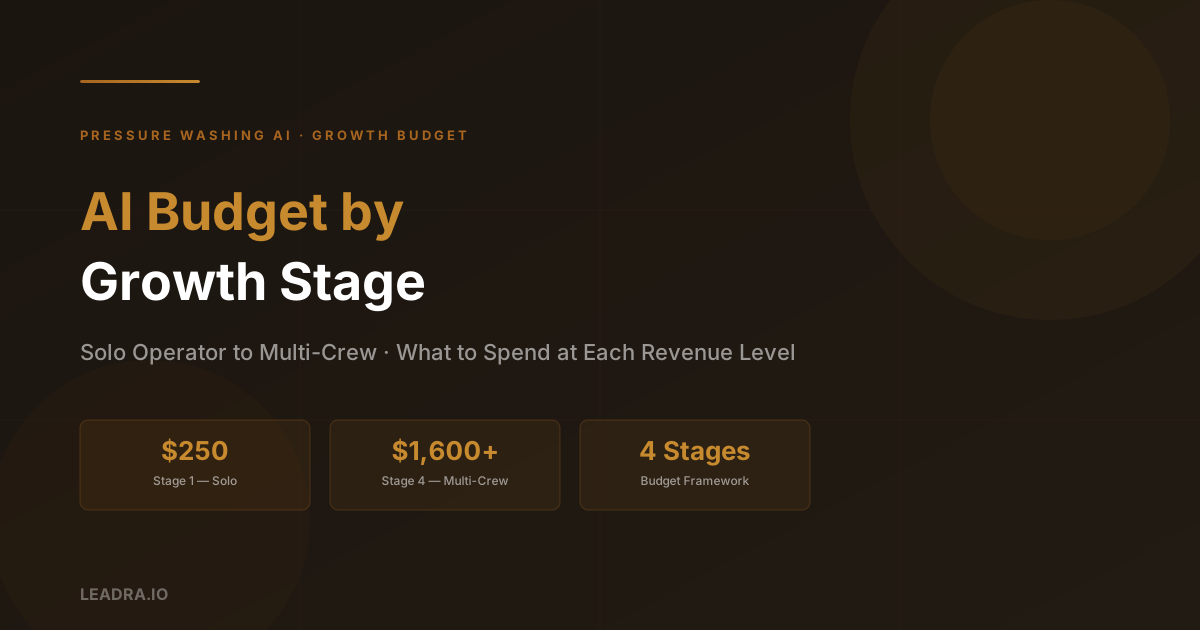
The question is not whether a pressure washing business can afford AI automation. It is how much to spend right now, at your current size, without overbuying tools you cannot use yet or underbuying the ones that would already be paying for themselves.
Most owners get this wrong in one of two directions. Some hold off entirely, treating AI as something for "later" while missed calls quietly bleed jobs to competitors who answer first. Others jump straight to a full voice-agent-and-dispatch stack built for a five-crew operation when they are still running two trucks and 18 jobs a month — paying for capacity they will not use for a year.
This guide breaks AI automation budget into four growth stages, from solo operator to established multi-crew company, with real dollar ranges and a clear priority order for each. By the end, you will know exactly what to buy now, what to hold off on, and when to upgrade.
Why Budget by Stage Instead of a Flat Percentage
A flat rule like "spend 3% of revenue on AI" sounds clean but breaks down in practice, because automation cost does not scale smoothly with revenue. Some tools are near-fixed cost regardless of job volume — a voice agent configuration is roughly the same whether it handles 40 calls a month or 90. Other costs, like message-based follow-up sequences, scale directly with volume.
The practical effect: budget as a percentage of revenue is highest in the middle stages, when a company is adding automation layers fastest, and it tapers at both ends — low because there is not much to automate yet, and low again at scale because fixed-cost tools stop growing proportionally with revenue. That is why the stage framework below works better than a single percentage target.
AI Automation Budget by Growth Stage
Find your current monthly revenue below. Each stage lists what to prioritize first and what to deliberately skip until you grow into it.
Solo Operator
Priorities
- ✓Missed-call text-back — the single highest-ROI tool at this stage
- ✓Automated quote acknowledgment with ballpark pricing
- ✓Post-job Google review request
Skip for now
Voice agents, dispatch software integration, multi-sequence reactivation campaigns — call volume doesn't justify the cost yet
Two-Crew Operation
Priorities
- ✓Everything in Stage 1
- ✓AI SMS agent for after-hours estimate requests
- ✓Quote-to-booking follow-up sequence
- ✓First seasonal reactivation campaign to the existing customer list
Skip for now
Full voice booking and commercial account outreach — wait until job volume regularly exceeds 40/month
Multi-Crew Company
Priorities
- ✓Everything in Stage 2
- ✓AI voice agent that books directly onto the route calendar
- ✓Jobber or Housecall Pro two-way integration
- ✓Recurring maintenance plan pipeline for repeat commercial accounts
Skip for now
Custom-built internal tooling — off-the-shelf AI stacks still outperform a homegrown system at this size
Established Multi-Crew
Priorities
- ✓Everything in Stage 3
- ✓HOA and property manager commercial outreach automation
- ✓Multi-location or multi-crew dispatch coordination
- ✓Monthly attribution reporting tied to marketing spend by channel
Skip for now
Nothing — at this stage most companies should be running close to the full stack
Three Signals It Is Time to Move Up a Stage
Your team is turning down or delaying calls during active jobs.
If missed-call text-back alone is no longer enough — homeowners want a real conversation about scope, access, or pricing before booking — that is the signal to add an AI voice or SMS agent that can handle those questions live instead of routing everyone to a callback.
Your follow-up sequences are triggering faster than your crew can honor them.
When automation books more estimates than your current crew count can service within a reasonable window, that is not a marketing problem — it is a capacity problem the automation just exposed. It usually means it is time to add a crew, and the automation budget should scale with it.
Manual dispatch and scheduling are eating hours every week.
Once a company runs multiple crews across overlapping routes, coordinating by text and spreadsheet becomes the bottleneck instead of lead flow. That is the point to invest in two-way route software integration so the AI system reads and writes to a live calendar instead of operating in a separate silo.
Two Budgeting Mistakes That Cost Growing Companies the Most
| Mistake | What It Costs You |
|---|---|
| Buying a Stage 3 or 4 stack while still at Stage 1 or 2 volume | Paying $1,200+/mo for a voice agent and dispatch integration that sits mostly idle at 15–20 jobs/month — the fixed cost outweighs the marginal jobs it can actually capture at that volume |
| Staying on a Stage 1 setup after crossing into Stage 3 volume | Missed after-hours calls, unconverted quotes, and no seasonal reactivation compound into a revenue leak that typically runs $3,000–$7,000/mo higher than the cost of upgrading |
What This Looks Like for Pressure Washing Companies in Charlotte, NC
Charlotte's pressure washing market has grown fast alongside the metro's population, and most of the companies moving from Stage 2 to Stage 3 right now are doing it in the same 12 to 18 month window — which means the local competition for "pressure washing near me" is shifting faster than owners expect.
Companies that budget for automation a stage ahead of where they are today, rather than reacting after call volume outgrows their setup, are the ones capturing the growth instead of losing it to a faster-moving competitor down the street. Book a free strategy call or call +1 (302) 495-9984 and Leadra.io will tell you exactly which stage your business is at and what to budget next.
Your Next Steps — What to Do This Week
Find your stage.
Match your current monthly revenue to one of the four stages above. Be honest about your actual job volume, not where you hope to be in six months.
Compare your current spend to the stage range.
If you are spending less than the low end of your stage's range, you are likely leaving jobs on the table. If you are spending more than the high end, you may be paying for capacity you have not grown into yet.
Check the upgrade signals.
Review the three signals above. If two or more apply to your business right now, start budgeting for the next stage this quarter, not next year.
Separate your AI budget from ad spend.
Set AI automation as its own line item so you can track its return independently from paid advertising — the two behave very differently over time.
Frequently Asked Questions
How much of my revenue should I spend on AI automation as a pressure washing business?
Most pressure washing companies should budget 2% to 4% of monthly revenue on AI automation once they pass $15,000/mo. Below that, a flat $250–$400/mo for missed-call text-back and quote follow-up is usually enough. Above $75,000/mo, the percentage can drop closer to 1.5–2% because fixed-cost tools like voice agents and dispatch automation stop scaling linearly with revenue.
When should a pressure washing company add its first AI tool?
The moment missed calls start costing more than the tool itself — usually around 15 to 20 jobs per month. A solo operator running equipment for two to three hours at a stretch cannot answer the phone, and every unanswered call during that window is a lead going to a competitor. Missed-call text-back is the first automation to add because it pays for itself with a single recovered job.
What's the biggest AI budgeting mistake growing pressure washing companies make?
Buying a full voice-agent-and-dispatch stack before the business has enough call volume to justify it. A two-truck company running 18 jobs a month does not need the same system as a five-crew operation running 90. The fix is matching automation depth to current job volume, then upgrading in stages as volume grows — not front-loading spend on features that sit unused.
Should AI budget come out of marketing spend or operations spend?
AI automation for booking, follow-up, and reactivation should be budgeted as a growth-and-retention line item separate from paid ads, because it compounds differently. Ad spend buys clicks that stop the moment you stop paying. AI automation captures and converts leads you are already generating, and reactivation campaigns keep working on your existing customer list indefinitely. Most companies find it fits best under a combined 'customer acquisition and retention' budget line rather than pure marketing.
Find Out What Your Business Should Budget for AI Right Now
Leadra.io builds AI booking automation and revenue growth systems for pressure washing and exterior cleaning businesses. We will map your growth stage and show you exactly what to spend and what to skip — free, no obligation.
Written by the Leadra.io Team. Leadra.io is an AI marketing agency helping pressure washing and home-service businesses grow using AI-powered automation, booking capture, and lead generation systems. Based in Charlotte, NC — serving clients nationwide.