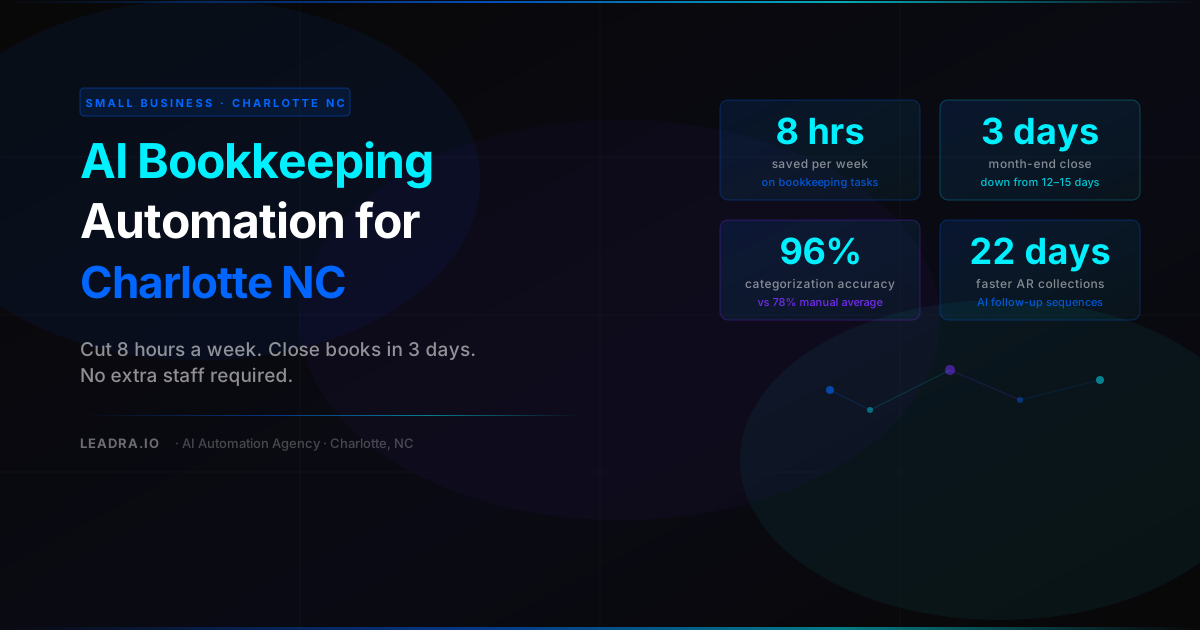
The average Charlotte NC small business owner spends 6-10 hours every week on bookkeeping — categorizing transactions, chasing invoices, hunting for receipts, and waiting on reports that arrive two weeks after the month ended. That's time not spent on clients, sales, or operations. And it's entirely preventable in 2026.
AI bookkeeping automation handles the high-volume, low-judgment work that fills most of those hours: bank feed categorization, daily reconciliation, AR follow-up sequences, and receipt matching. What used to take a part-time bookkeeper 12-15 hours a month now takes under 4 hours of human review — because the AI has already done the rest.
This guide breaks down exactly how the system works, what a Charlotte NoDa service business achieved in 90 days, and what you should budget at different revenue sizes. If you're currently running books manually — or paying someone hourly to do data entry — this is the most direct ROI available to a small business right now.
We're not talking about replacing QuickBooks with something new. We're talking about putting an AI layer on top of what you already use — so the tedious parts run themselves, and your bookkeeper (or you) handles only what actually requires judgment.
Why Charlotte Small Businesses Still Lose 8 Hours a Week to Bookkeeping
According to a 2025 QuickBooks survey, small business owners spend an average of 5 hours per week on accounting and bookkeeping tasks — and 40% say the time drain is their top financial operations complaint. For service businesses, contractors, and retail shops in Charlotte, the number is often higher because of high transaction volumes across multiple revenue streams.
The problem isn't lack of accounting software. Most Charlotte small businesses already use QuickBooks Online or Xero. The problem is that even with good software, the categorization, reconciliation, AR follow-up, and reporting work is still largely manual. The software stores the data. A human still has to process it.
AI automation addresses that gap directly. The AI doesn't replace your accounting software — it plugs into the bank feed, learns your transaction patterns, and handles the processing layer automatically. By the time your bookkeeper opens the file, 95% of the work is already done. They spend their time on the 5% that requires professional judgment.
For Charlotte businesses competing in fast-moving sectors — construction, healthcare services, restaurants, professional services — getting clean monthly financials two weeks faster means making better pricing, hiring, and cash flow decisions in real time. That's a competitive advantage, not just an admin improvement.
Manual Bookkeeping vs. AI Automation: Side-by-Side
| Task | Manual Process | AI Automated |
|---|---|---|
| Transaction categorization | 3-5 hrs/week, 78% accuracy on first pass | 15-min weekly review, 94-97% auto-accuracy |
| Bank reconciliation | 2-4 hrs at month-end, errors surface weeks late | Daily automated — discrepancies flagged same day |
| Month-end close | Day 12-15 of the following month | Day 2-3 of the following month |
| AR invoice follow-up | Manual emails, often skipped — 35-50 day DSO | Automated sequence — 15-28 day DSO average |
| Receipt & expense capture | Month-end scramble, missing receipts, wrong codes | Real-time capture, matched to transactions automatically |
| Financial reporting | Standard QuickBooks export, owner rarely reads it | Plain-English summary with month-over-month context |
| Bookkeeper hours per month | 8-15 hrs/month on data entry and reconciliation | 3-5 hrs/month on review, exceptions, and advisory |
| Owner time on bookkeeping | 6-10 hrs/week on transactions, receipts, follow-up | Under 1 hr/week on exception review and approvals |
The 5-Component AI Bookkeeping Automation System
The full system runs across five layers. Each one eliminates a different category of manual work. Most Charlotte small businesses see the biggest impact from components one, two, and three in the first 30 days — and the cumulative ROI compounds as all five layers run together.
AI transaction categorization — 80% less manual data entry
Most Charlotte small businesses spend 3-5 hours every week manually categorizing bank transactions, matching receipts to expenses, and fixing miscoded entries before their bookkeeper can close the month. The AI rules engine eliminates most of that. It connects directly to your QuickBooks Online or Xero bank feed, learns your vendor patterns — Charlotte Water, Duke Energy, your regular suppliers — and auto-categorizes each transaction against your chart of accounts. After training on 60-90 days of history, accuracy runs 94-97%. The remaining 3-6% that needs a human review gets flagged with a confidence score, so your bookkeeper spends 20 minutes on exceptions instead of 3 hours on everything.
Automated bank reconciliation alerts — month-end in 3 days
Manual bank reconciliation is the reason most small businesses don't have current books. The business owner or bookkeeper logs in once a month, finds 50-200 unmatched transactions, and spends an afternoon sorting out what happened in February. The AI reconciliation layer runs daily. Every morning it checks whether every transaction in your accounting software matches the bank statement. Discrepancies get flagged the same day they appear — not at month-end. When there are no unresolved matches, month-end close takes 2-3 hours instead of 2-3 days. Charlotte businesses using this system are closing books by the 3rd of every month instead of the 12th to 15th, giving owners accurate P&L data while the month is still recent enough to act on.
Automated AR follow-up — collect invoices 22 days faster
Accounts receivable is where most small business cash flow problems live. You do the work, send the invoice, and then wait. A week passes. You send a follow-up. Another week. You're now 21 days past due chasing a payment that should have arrived on day 15. The AI AR system takes over the entire follow-up sequence. When an invoice goes unpaid past your net terms, the AI sends a polite reminder at day 1 past due, a firmer message at day 7, a phone call prompt at day 14, and an escalation alert to you at day 21. Small businesses using automated AR follow-up reduce their average collection time by 15-22 days and cut AR aging by 30-40%. For a Charlotte service business with $60,000 in monthly receivables, that means $30,000-$40,000 more cash available at any given time.
Smart receipt and expense capture — no more month-end scramble
Every Charlotte business owner knows the feeling: it's the last week of the month, your bookkeeper is asking for receipts, and you're digging through email, a pile of paper receipts on your desk, and your credit card statement trying to reconstruct what happened. The AI expense capture system eliminates that scramble entirely. Employees and owners photograph receipts with a mobile app the moment they happen — Hubdoc or Dext. The AI reads the receipt, extracts the vendor, amount, date, and category, and posts it to QuickBooks or Xero automatically. Credit card charges are matched to receipts in real time. By month-end, there's nothing to gather — it's already in the system, coded and reconciled.
AI-generated monthly financial summaries — plain English for owners
Most small business owners don't read their P&L. Not because they don't care — but because the standard QuickBooks report is a wall of numbers that requires 20 minutes and an accounting degree to interpret. The AI financial summary layer generates a plain-English monthly summary: revenue was up $4,200 versus last month driven by the new SouthPark contract, labor costs increased 8% due to the extra weekend shifts in mid-month, and your cash balance heading into next month is $18,400 — 12% lower than the same period last year because of the equipment deposit. Owners read these in 3 minutes, ask better questions of their bookkeeper, and make faster decisions with real data instead of gut feelings.
Real Results: Charlotte NoDa Service Business, 90-Day Snapshot
(Results representative of the type of outcomes Leadra.io clients achieve)
A two-location service business in Charlotte's NoDa neighborhood — 18 employees, $85,000 in monthly revenue across recurring clients and project work — was spending 8-10 hours per week on bookkeeping. The owner was doing most of it personally: categorizing transactions on Sunday evenings, chasing overdue invoices by phone, and waiting until the 14th of every month to get a P&L from their part-time bookkeeper.
After implementing the full 5-component AI bookkeeping automation system through Leadra.io:
- Owner bookkeeping time dropped from 8-10 hrs/week to 45 min/week — just reviewing exception flags and approving AI-drafted AR messages
- Month-end close moved from day 14 to day 3 — the owner had clean financials within 72 hours of month-end for the first time in 4 years
- AR aging improved by 22 days — average collection time went from 38 days to 16 days across recurring client invoices
- Three overdue invoices totaling $14,200 were recovered in the first 60-day reactivation cycle — these had been written off mentally by the owner
- Bookkeeper retainer reduced by $380/month because data-entry hours dropped — the bookkeeper shifted to a monthly review-and-advisory model
- Net ROI in 90 days: $2,800/month in recovered owner time (valued at $35/hr) + $380/month bookkeeper savings + $14,200 recovered AR = 19.2x return on system cost
AI Bookkeeping Automation in Charlotte NC: What Local Businesses Should Know
Charlotte added more than 14,000 new businesses between 2023 and 2025, making it one of the fastest-growing small business markets in the Southeast. Uptown, South End, NoDa, Ballantyne, and SouthPark are all seeing high density of independent restaurants, contractors, healthcare practices, and professional service firms — all of which have the same bookkeeping bottleneck.
Charlotte's growth also means local competition for talent is intense. A bookkeeper who charged $18-22/hour in 2022 is now $28-35/hour or not available at all. AI automation doesn't eliminate your need for a skilled local bookkeeper — but it dramatically reduces the number of hours they need to bill. You get faster, cleaner books at lower total cost.
Three areas where Charlotte businesses specifically benefit from AI bookkeeping automation:
- 1.Multi-location businesses (restaurants, retail, contractors) — AI consolidates bank feeds from multiple accounts and entities into a single categorized view, eliminating the manual merge work that takes 4-6 hours per location per month.
- 2.Project-based businesses (construction, marketing, design) — AI tracks project-level expenses automatically by mapping vendor transactions to job codes, giving owners real project P&L without manual allocation.
- 3.Healthcare and professional services in Charlotte — AI automates insurance payment reconciliation by matching EOBs and ERA files to patient accounts, cutting insurance AR aging by 30-45 days at practices still reconciling manually.
Your 4-Step Action Plan to Start Automating Bookkeeping
Audit where your time goes
Track bookkeeping hours for two weeks — categorizing transactions, chasing invoices, gathering receipts, and waiting on reports. Most owners discover they're spending 8-12 hours monthly on tasks the AI will handle automatically.
Confirm your accounting software compatibility
AI bookkeeping automation integrates natively with QuickBooks Online, Xero, FreshBooks, and Wave. If you're on desktop QuickBooks or a spreadsheet, a one-time migration to QBO takes 1-2 days and unlocks the full automation layer.
Prioritize the highest-ROI component first
If you have unpaid invoices, start with AR automation — it often recovers more cash in 30 days than the system costs for six months. If your books are always late, start with the reconciliation layer. The highest pain point generates the fastest ROI.
Let the AI train on 60 days of history before going live
The AI categorization engine needs historical transactions to learn your vendor patterns. Feed it 60-90 days of data on setup, and accuracy will be 94%+ from the first week instead of the second month. Don't skip the training window.
AI bookkeeping automation is one component of a broader AI operations system that includes lead follow-up, client communication, and content marketing. Charlotte businesses running all three layers typically see 3-5x the impact of any single component alone — because the same AI infrastructure handles admin, sales, and marketing in one integrated stack.
Frequently Asked Questions
What AI bookkeeping automation tools work best for Charlotte NC small businesses?
The most effective AI bookkeeping automation stack for Charlotte NC small businesses combines QuickBooks Online Advanced or Xero with an AI rules engine for transaction categorization, an automated AR follow-up sequence (email and SMS), and a receipt-capture app like Hubdoc or Dext. The AI layer sits on top of your existing accounting software — no migration required. Most Charlotte small businesses are already on QuickBooks or Xero, so setup takes 48-72 hours, not weeks. The combination cuts transaction categorization time by 80%, closes books 8-10 days faster per month, and reduces AR aging by 15-22 days on average.
How much does AI bookkeeping automation cost for a small business in Charlotte NC?
AI bookkeeping automation for a Charlotte NC small business typically costs $700-$2,400 per month depending on transaction volume, number of integrations, and whether you include AR follow-up and payroll automation. A basic setup covering transaction categorization and bank reconciliation alerts runs $700-$900/month. A full stack with AR automation, expense capture, payroll prep, and monthly financial summaries runs $1,500-$2,400/month. Most small businesses recover the entire cost in time savings alone — 8 hours per week at a $40 hourly value is $1,280/month in reclaimed owner time, before counting reduced bookkeeping fees.
Do I still need a local Charlotte bookkeeper if I use AI bookkeeping automation?
Yes — but you need them for far less time. AI handles the data-entry and categorization layer: importing bank transactions, matching receipts, reconciling accounts, and generating standard reports. A local Charlotte bookkeeper then handles the review layer: catching exceptions, making adjusting entries, preparing tax-ready financials, and advising on cash flow. Most businesses using AI automation cut their bookkeeper hours by 50-70%, reducing the bill while getting faster and cleaner books. The AI and the bookkeeper work together — the AI does the volume work, the bookkeeper does the judgment work.
How long does it take to set up AI bookkeeping automation for a Charlotte small business?
Most Charlotte NC small businesses are fully live with AI bookkeeping automation in 5-10 business days. Day one is connecting bank feeds and credit cards to QuickBooks or Xero. Days two and three are training the AI categorization rules on 60-90 days of historical transactions — the system learns your vendor patterns, cost categories, and chart of accounts. Days four and five are setting up AR follow-up sequences and receipt-capture workflows. By day 10, the AI is running categorization at 95%+ accuracy, and month-end close drops from 12-15 days to 2-3 days within the first full cycle.
Ready to cut bookkeeping hours?
Let Leadra.io set up AI bookkeeping automation for your Charlotte business.
Free 30-minute AI operations audit — we map your current bookkeeping workflow, identify the top 2-3 automation opportunities, and give you a written implementation plan. No obligation. You leave the call with the plan whether or not you hire us.
Charlotte NC · serving businesses nationwide · 90-day results guarantee