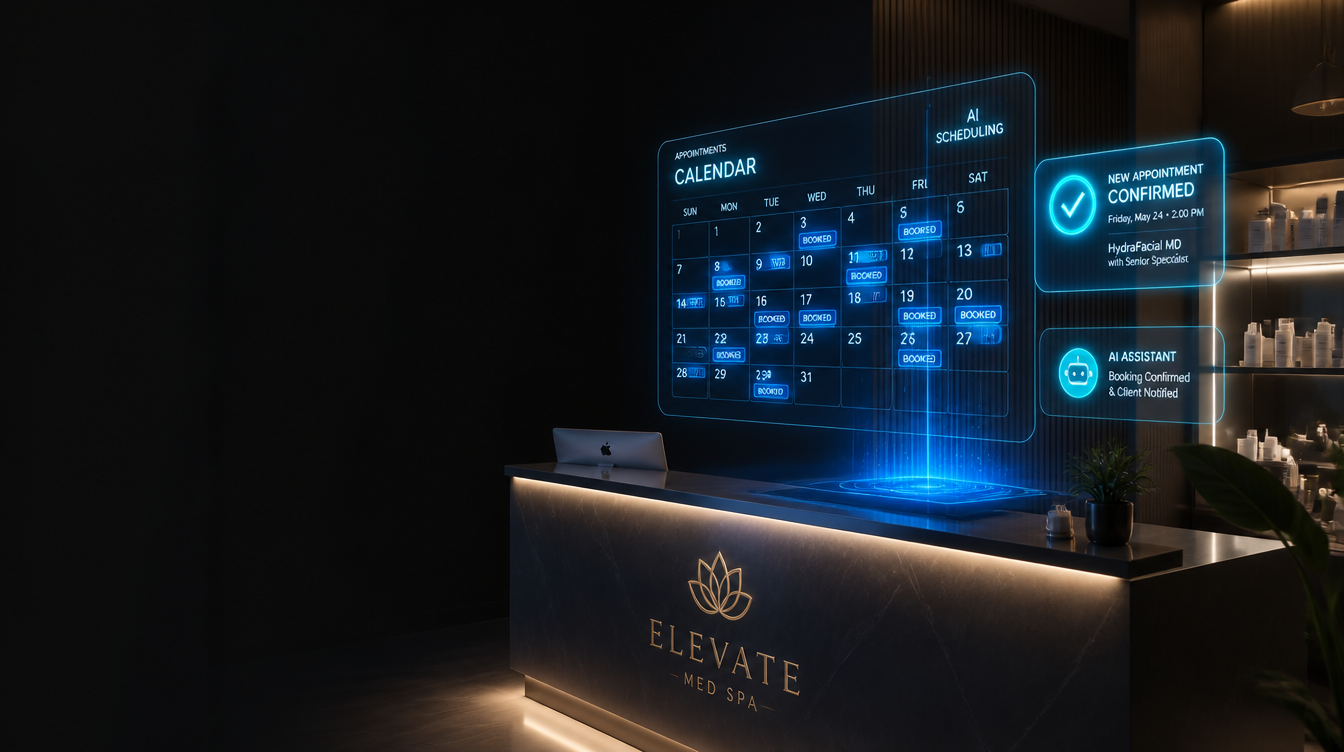
A med spa in the Charlotte metro came to us in early 2026 with a simple problem: they were spending $3,200 per month on Instagram ads for Botox, filler, and PRF services and booking 9 consultations a month. Their cost per booked consultation was $355. That number alone told the story — not a bad ad problem. A conversion problem.
When we audited their inquiry pipeline, we found 67 inquiries over a 60-day window. Nine consultations booked from 67 inquiries is a 13% conversion rate. The industry benchmark for med spas with active follow-up is 35-45%. The gap between 13% and 40% isn't a quality gap — it's a systems gap. Specifically, it was a response speed and after-hours coverage gap.
This is the full case study of what happened when we deployed AI consultation booking for their med spa: what the system did, how it was set up, what broke during testing, and what the numbers looked like at 30, 60, and 90 days. No padded claims. Just the actual data.
Why 67 Inquiries Only Produced 9 Consultations
Before we built anything, we spent three days inside their inquiry data. The findings were not unusual — they show up in almost every med spa audit we run.
36% of inquiries arrived outside business hours and received zero response
24 of their 67 inquiries came in after 6pm or on Saturday and Sunday. None of them received a reply until the next business day. By that point, the average prospective filler client had already contacted two other practices and, in most cases, booked elsewhere. The practice wasn't aware this was happening at scale because no one was monitoring their Instagram DMs after closing.
Average business-hours response time was 4.2 hours
Even during the hours the front desk was staffed, response time was slow. The desk handled phones, check-ins, payments, and scheduling simultaneously. Instagram DMs and website chat fell to the bottom of the priority stack. A 4.2-hour response time in a market where prospects are comparison-shopping 3-5 practices in the same session is a near-automatic loss. The 12 inquiries that got a reply within 30 minutes converted to booked consultations at 58%. The rest converted at 7%.
No qualification system — every lead went through a phone callback attempt
When the front desk did respond to a text or DM, the response was: 'Let me grab your number and give you a call.' Phone callback pickup rate: 44%. That means 56% of the leads they tried to follow up with never picked up, and the practice had no system to re-engage them. They just moved on. Those leads — who had shown enough interest to reach out — were permanently lost.
No post-consultation follow-up for unconverted consultations
About 52% of consultations converted to a treatment on the day. The other 48% walked out with no follow-up sequence. No same-day recap, no 48-hour check-in, no soft prompt at day five. A practice running 9 consultations per month with a 48% non-conversion rate is losing 4-5 potential treatments per month to a gap that's straightforward to close with automation.
The diagnosis was clear. Their ads were working fine. Their conversion infrastructure was losing more than half their leads before anyone ever spoke to them. AI consultation booking was the fix — not better ads, not a new landing page, not a rebrand. A system that answered every inquiry, at any hour, in under 60 seconds.
Setup Timeline: From Audit to First AI-Booked Consultation in 7 Days
This is the actual week-by-week setup for this specific practice. We've averaged this out across dozens of med spa implementations — 7-10 days from contract to live is the norm, not the exception.
Audit of existing inquiry pipeline
We pulled 60 days of inquiry history from the practice's Instagram DMs, website contact form, and SMS line. Out of 67 total inquiries in that window, 24 had received no response at all — all of them arrived after 6pm or on weekends. Another 31 received a response averaging 4.2 hours after the inquiry, too slow to compete in the market. Only 12 inquiries were responded to within 30 minutes, and those 12 had a 58% consultation booking rate. The pattern was clear: speed was everything.
System build and response library configuration
We configured the AI booking system to cover Instagram DM, the website chat widget, and the practice's SMS line. The response library was built around the practice's actual service menu: Botox, lip filler, cheek filler, under-eye filler, PRF microneedling, and medical-grade facials. Pricing context, realistic results timelines, and recovery information for each service were written and approved by the clinic director before anything went live. Calendar integration synced directly with Boulevard.
Test runs and show-rate sequence setup
We ran test inquiries across all three channels and verified booking flow, calendar sync, and that confirmation messages included the injector's name and intake form link. The pre-appointment sequence — booking confirmation, 48-hour prep message, day-before reminder, and same-day check-in — was tested against a blocked test slot on the live calendar. Minor wording adjustments were made to one service's pricing message based on the owner's feedback.
Go-live
The system went live at 8am on a Monday. The first AI-booked consultation came in at 11:23pm the same night — a first-time lip filler inquiry from someone who had found the practice on Instagram. The AI responded in 38 seconds, answered her questions about downtime and cost per syringe, and offered three available time slots. She booked the Wednesday 2pm slot before midnight. Her consultation converted to a $680 treatment two days later.
First 72 Hours Live
In the first 72 hours after go-live, the AI handled 22 inquiries. Of those, 19 engaged with the qualification flow. 14 were offered calendar slots and 11 booked. 3 asked questions the AI couldn't answer confidently (a question about combining PRF with a specific medication the client was taking) and were handed to the front desk with a summary of the conversation. In the first three days, the practice booked more consultations than they typically saw in two weeks — without a single additional ad dollar spent.
90-Day Results: The Actual Numbers
Here are the before-and-after metrics at 90 days. The "before" numbers are the 60-day averages from the audit period. The "after" numbers are the average of months 2 and 3 post-implementation (month 1 is excluded as a ramp period).
| Metric | Before AI | After AI (Month 2–3 Avg) |
|---|---|---|
| Monthly consultations booked | 9 | 31 |
| Inquiry-to-booked rate | 13% | 46% |
| After-hours inquiries captured | 12% | 100% |
| Average response time | 4.2 hours | 41 seconds |
| Consultation show rate | 71% | 90% |
| Same-day treatment conversion | 52% | 69% |
| Monthly treatment revenue | $16,800 | $44,200 |
| ROI on system cost | — | 21x |
Ad spend remained flat at $3,200/month throughout. Revenue increase is attributable entirely to the AI consultation booking system — improved inquiry conversion, after-hours capture, show-rate improvement, and post-consultation follow-up. System cost: $1,400/month.
4 Things This Case Study Revealed About AI Consultation Booking
The revenue numbers are the headline. But the more useful takeaways are in the mechanics — what specifically drove the results and why each component mattered.
After-hours is where the money was
43% of all new consultations booked in the 90-day window arrived as after-hours inquiries. Before the AI, every single one of those would have gone unanswered until morning. At an average treatment ticket of $585, that's $7,553 per month that the practice was previously losing to response timing alone — not bad targeting, not weak creative, not poor treatment quality. Just slow replies.
Qualification by text outperformed phone callbacks
The practice had previously relied on front desk callbacks to qualify leads. Callbacks had a 44% pickup rate — meaning more than half the leads never got qualified at all. The AI's text-based qualification in the initial inquiry response achieved a 91% engagement rate. Leads who engaged with the qualification questions booked at 61%. Leads who received only a callback attempt (when the AI handed off to phone for complex questions) booked at 29%. Text-first qualification is faster and converts higher.
The pre-appointment sequence had a measurable revenue impact
Show rate went from 71% to 90% — an improvement of 19 percentage points. On a practice running 31 consultations per month, that's 6 additional kept appointments per month that would have been no-shows. At the practice's 69% same-day conversion rate and $585 average ticket, those recovered appointments added $2,427 per month in treatment revenue from the show-rate improvement alone.
Post-consultation follow-up closed the leaking pipeline
At 69% same-day conversion, 31% of consultations left without booking a treatment. The AI follow-up sequence — same-day recap, 48-hour check-in, 5-day soft prompt — ran on every unclosed consultation automatically. Of the consultations that didn't convert on the day, 27% booked within 7 days of the follow-up sequence. Before AI, that number was under 6% because no follow-up system existed. Each recovered consultation added $585 in treatment revenue.
The practice owner summarized it well in her month-three check-in: "We're not doing anything different on the front end. The ads are the same. The services are the same. The only thing that changed is that every person who contacts us now actually gets a response — and most of them book before we even talk to them."
This is the consistent finding across every AI consultation booking for med spas case study we run. The ads aren't the bottleneck. The conversion infrastructure is. And fixing infrastructure doesn't require more budget — it requires the right system.
Related Reading
Frequently Asked Questions
How does AI consultation booking work for med spas?
AI consultation booking for med spas works by automatically responding to every inquiry — website chat, Instagram DM, SMS, Google Business — in under 60 seconds, qualifying the lead based on treatment interest and intent, then booking a consultation slot directly into the practice's calendar software (Boulevard, Mindbody, Jane App, Vagaro). The system runs 24/7 with no staff involvement. Most med spas see consultation volume increase 2-3x within 90 days, primarily by capturing after-hours inquiries that previously went unanswered.
What results can a med spa expect from AI consultation booking in 90 days?
Based on Leadra.io client data, med spas implementing AI consultation booking typically see: inquiry-to-booked rate increase from 15-20% to 38-48%, monthly consultation volume up 2-3x, consultation show rate improve from 70-74% to 88-93%, and total monthly treatment revenue increase 60-120% within 90 days. Results vary by market, service menu, and existing inquiry volume, but the primary driver is consistent: capturing after-hours leads that previously went unanswered until morning.
How much does AI consultation booking cost for a med spa?
AI consultation booking for med spas typically costs $800-$2,500 per month depending on inquiry volume, number of channels covered, and whether AI voice is included. At a $400-$700 average consultation-to-treatment ticket, the system pays for itself with 2-4 additional bookings per month. Most practices generate 10-20 incremental consultations per month from previously missed after-hours inquiries alone, producing ROI of 8-20x by month three.
What med spa software does AI consultation booking integrate with?
Leadra.io's AI consultation booking integrates with Boulevard, Mindbody, Jane App, Vagaro, AestheticsPro, and PatientNow. When the AI books a consultation, the appointment writes directly to your existing calendar software. No duplicate data entry, no separate system. Your front desk sees AI-booked appointments exactly like manually scheduled ones.
The Consultations Are Already There. The System Is the Only Missing Piece.
The med spa in this case study went from $16,800 to $44,200 per month in treatment revenue. They didn't hire more staff. They didn't increase their ad budget. They didn't change their service menu or their pricing. They installed a system that answered every inquiry in under 60 seconds and followed every lead to completion.
Most med spas are in the same position they were in — not because their market is saturated or their ads are bad, but because their conversion infrastructure has gaps that compound quietly: slow responses, no after-hours coverage, callbacks that don't get picked up, consultations that don't get followed up. AI consultation booking closes every one of those gaps.
Leadra.io builds and manages AI consultation booking systems for med spas, aesthetic clinics, and beauty practices nationwide. We integrate with your existing scheduling software, build a response library specific to your treatment menu, and back the system with a results guarantee: if consultation volume doesn't increase measurably in the first 30 days, you don't pay for month two.
Free Inquiry Pipeline Audit
See Exactly How Many Consultations You're Losing Every Month
We analyze your inquiry volume, after-hours coverage gap, response time, and current conversion rate — then show you the revenue sitting in your existing inquiry pipeline before you commit to anything.
Leadra.io
AI marketing agency — Charlotte, NC · Published June 30, 2026