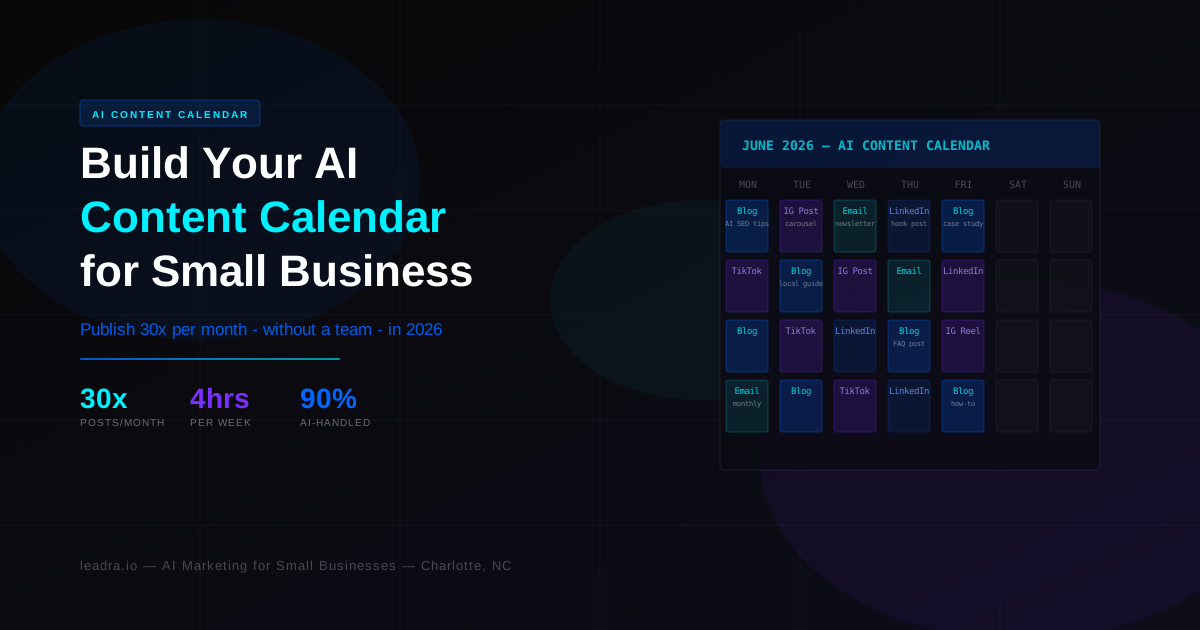
The number one reason content marketing fails for small businesses is not the quality of the content. It's the absence of a system. You publish two blog posts in January, go quiet for six weeks, blast five Instagram posts in March, and wonder why nothing is ranking or converting. That's not content marketing. That's improvisation.
A properly built AI content calendar fixes this. It maps out every blog post, social caption, email newsletter, and video script for the next 90 days — and then AI generates the content automatically against that schedule. You go from publishing 3-4 times per month to 30-50 times per month, without adding a single hire.
At Leadra.io, we've built AI content calendars for service businesses across Charlotte, NC and the US. This guide walks you through exactly how to build one — and what it produces.
Why Sporadic Posting Destroys Your SEO
Google treats publishing frequency as a trust signal. A site that publishes consistently tells Google's crawlers that the site is active, maintained, and authoritative. A site that publishes erratically signals the opposite — and Google deprioritizes indexing it.
According to HubSpot's 2025 State of Marketing Report, companies that blog 8-12 times per month get 4.5x more traffic than companies that blog 0-4 times per month. That gap compounds over time: 12 months of consistent publishing builds a topical authority moat that late entrants cannot close quickly.
Google crawl frequency drops with inconsistency.
Googlebot adjusts how often it crawls a site based on how often that site publishes. A site that publishes once a week gets crawled several times a week. A site that publishes once a month gets crawled once a month. That means new content takes longer to rank — just because you went quiet.
Social algorithms punish gaps.
Instagram, Facebook, and LinkedIn all use posting recency as an engagement signal. A business that posts daily gets distributed to more followers than one that posts weekly. Drop below three posts per week on Instagram and your organic reach collapses by as much as 60%.
Irregular email kills deliverability.
Email service providers track sender consistency. Lists that receive emails at unpredictable intervals have higher spam complaint rates because subscribers forget they opted in. A consistent weekly or bi-weekly cadence builds inbox trust and keeps open rates above 25%.
The only way to publish at the frequency Google and social algorithms reward — without burning 20 hours per week — is an AI content calendar. Manual execution at that volume is not possible for a one- or two-person business.
What an AI Content Calendar Actually Looks Like
An AI content calendar is not just a spreadsheet with post titles. It's a structured publishing system where every piece of content is planned in advance, keyed to a specific keyword or business goal, and then generated by AI against that plan.
Here is what a typical monthly AI content calendar looks like for a Leadra.io client in a local service industry:
Monthly Content Output — AI Calendar System
Blog posts
10-12Google rankings + AI Overview citations
1,800-2,500 words each, keyword-targeted, FAQ schema
Social media posts
40-50Brand awareness + inbound DMs
Mix of carousels, short captions, Reels scripts
Email newsletters
4Repeat visits + reactivation
Weekly send, segmented by customer type
Short-form video scripts
4-8TikTok + Reels reach
30-90 second scripts repurposed from blog posts
Total owner time required: 3-5 hours per week. All drafts generated by AI; owner reviews and schedules. No content agency required.
How to Build Your AI Content Calendar in 4 Steps
This is the exact process Leadra.io uses when onboarding a new client. You can run it yourself in about 4 hours for the initial setup. After that, the system runs on autopilot.
Step 1. Build Your 90-Day Keyword Map
Before scheduling a single post, identify the exact search terms your ideal customers use when they are ready to buy. Not vanity terms like "best dentist" — specific terms like "cosmetic dentist Charlotte NC same-day consult." Use Google autocomplete, the "People Also Ask" boxes, and tools like Google Keyword Planner to pull 40-60 target keywords.
Group those keywords into topic clusters — a main pillar keyword with 4-6 supporting long-tail variants. Each cluster becomes a month of blog content. Three clusters cover your first 90 days. This structure signals to Google that your site has depth on a topic, which is what earns page-1 rankings over scattered, unrelated posts.
Step 2. Map Content to a Publishing Grid
Take your keyword map and assign each piece of content to a specific day of the week. A reliable weekly rhythm for a service business: two to three blog posts, ten to twelve social posts (two per platform per day), one email, and one short-form video script.
Each blog post should map to one keyword from your cluster. Each social post should repurpose a key insight from that week's blog content. Each email should highlight that week's most valuable post. This repurposing model means you write the blog post once and it generates 8-12 additional content pieces automatically — just by running it through AI with different format prompts.
Step 3. Set Up Your AI Generation Workflow
The generation workflow is where the calendar becomes a machine. For blog posts: give AI the target keyword, your brand voice brief, the top two competitor URLs ranking for that keyword, and the FAQ questions from Google's People Also Ask box. AI generates a full draft in 3-5 minutes. Your job is a 30-minute edit: check facts, add a client story, and confirm the CTA.
For social posts: paste the blog draft into AI with a prompt like "Generate 10 social posts from this article — two LinkedIn hooks, three Instagram carousels, two Facebook posts, two TikTok scripts, one Twitter/X thread." You get 10 pieces of content from a 5-minute prompt. The total time investment per blog post, including all repurposed content: 45-60 minutes.
Step 4. Schedule, Publish, and Track
Use a scheduling tool — Buffer, Later, or Hootsuite — to queue all social content for the week in one session. Blog posts publish directly to your website or CMS on their scheduled date. Email newsletters get queued in your email platform (Klaviyo, Mailchimp, or ActiveCampaign) and go out automatically.
Every 30 days, review Google Search Console to see which posts are getting impressions and clicks. Double down on the clusters that are moving. Pull back on clusters where competition is too high. The AI content calendar is not set-and-forget — it is guided by data, and the data compounds week over week.
Case Study: How a Charlotte Roofing Company Went from 0 to 22 Organic Leads Per Month in 90 Days
Client Story
A Charlotte-area roofing company was spending $4,500 per month on Google Ads and getting 8-12 leads per month. Organic traffic was essentially zero — their site had four pages and no blog. They came to Leadra.io to cut ad dependence and build a traffic source they owned.
We built a 90-day AI content calendar targeting three keyword clusters: emergency roof repair Charlotte NC, residential roofing company Charlotte, and roof inspection cost Charlotte. Month one: 10 blog posts, 45 social posts, 4 email newsletters. Month two: repeat. Month three: repeat with updated seasonal angles.
At day 90, we ran a full performance review. The results were clear — and they justified cutting the Google Ads budget in half going into month four.
Organic traffic/month
38
490
Organic leads/month
0
22
Google AI Overviews
0
9
Cost per lead
$375
$64
Investment: $1,500/month for a fully managed AI content calendar. Google Ads spend reduced from $4,500 to $2,200/month by month four — net positive ROI from day one of the content program.
Building an AI Content Calendar for a Charlotte, NC Business
Charlotte's search landscape has a specific dynamic that makes AI content calendars especially powerful. The city is growing fast — nearly 100 new residents per day, according to US Census estimates — which creates constant demand for local service businesses. But that growth also brings new competition: more businesses entering the market, all competing for the same local keywords.
A Charlotte business with a 90-day AI content calendar publishing consistently can dominate local search terms within 4-6 months. Most competitors in Charlotte's local market — dentists, contractors, financial advisors, med spas — are not publishing more than 2-4 blog posts per year. That bar is beatable.
For Charlotte specifically, content should reference local neighborhoods where your clients live and work: SouthPark, Ballantyne, NoDa, Uptown, Dilworth, Myers Park. A post titled "Roof Inspection in Ballantyne: What Charlotte Homeowners Need to Know in 2026" will outrank a generic post every time. Local content signals match local search intent.
The Right Tools for Your AI Content Calendar
You do not need an expensive tech stack to run an AI content calendar. Here are the three tool categories you need and what to use for each:
| Category | Tool Options | Monthly Cost |
|---|---|---|
| AI content generation | Claude, ChatGPT, Jasper | $20-$100 |
| Keyword research | Google Keyword Planner, Ahrefs, Semrush | $0-$120 |
| Social scheduling | Buffer, Later, Hootsuite | $15-$50 |
| Email marketing | Mailchimp, Klaviyo, ActiveCampaign | $20-$80 |
| Analytics tracking | Google Search Console, GA4 | $0 |
| Calendar management | Notion, Airtable, Google Sheets | $0-$15 |
Total self-managed cost: $55-$365 per month in tools. Add 3-5 hours per week of your own time for review and scheduling. That is the budget version.
The fully managed version — where Leadra.io handles the keyword research, calendar planning, AI content generation, SEO optimization, and publishing — runs $1,200-2,500 per month. For business owners whose time is worth more than $50 per hour, the math on managed services is straightforward: you recoup the cost of the service in the first month.
Frequently Asked Questions
What should a small business include in an AI content calendar?
A small business AI content calendar should include blog posts (8-12 per month), social media posts (30-50 per month across Instagram, Facebook, LinkedIn, and TikTok), email newsletters (2-4 per month), and short-form video scripts (4-8 per month). Each piece of content should be mapped to a keyword cluster and tied to a specific business goal — lead generation, brand awareness, or customer retention. AI handles the drafting; you handle the strategy and scheduling.
How long does it take to build an AI content calendar for a small business?
Building the initial AI content calendar — keyword research, topic clusters, and a 90-day publishing schedule — takes 3-4 hours the first time. With the right AI tools and templates, maintaining and executing the calendar going forward takes 3-5 hours per week total. Compare that to 15-20 hours per week for a traditional manual content process.
How many times should a small business post per month to rank on Google?
To rank on Google for local and mid-competition keywords, small businesses should publish at minimum 4-8 blog posts per month. Google rewards publishing frequency and topical depth. Sites that publish 8-12 posts per month consistently outrank sites that publish 1-2 posts per month by a factor of 4.5x in organic traffic, according to HubSpot's 2025 State of Marketing Report. AI makes 8-12 monthly posts achievable without a dedicated content team.
Can AI create an entire month of content for a small business?
Yes — AI can generate a full month of blog drafts, social media captions, email newsletters, and video scripts in a single working session. The limiting factor is not the AI; it is the human review and brand-voice calibration step. Plan for 30-60 minutes of human editing per blog post and 10-15 minutes of editing per batch of 5-10 social posts. Agencies like Leadra.io manage this entire process end-to-end so business owners never touch a draft.
The Calendar Is the Competitive Moat
Content marketing is a compounding game. The business that starts publishing in January and maintains a consistent AI content calendar through December ends the year with 100+ indexed pages, dozens of keyword rankings, and a lead flow that does not depend on paid ads. The business that publishes when it "gets around to it" ends the year in the same position it started.
The gap between those two businesses gets harder to close every month. In most local markets, the first-mover advantage in AI content marketing is still available — but it won't stay open much longer. The businesses that move now are building a search authority position that will generate leads at near-zero cost for years.
Leadra.io builds and manages AI content calendars for small businesses across Charlotte, NC and the US. We handle everything: keyword strategy, calendar planning, content generation, SEO optimization, and publishing. Your job is to review and approve. Ours is to keep the machine running.
Free 90-Day Content Calendar Audit
See What a 90-Day AI Content Calendar Looks Like for Your Business
We'll build out your keyword clusters, show you a full 90-day publishing schedule, and project the traffic it produces. Free. Takes 30 minutes.
Leadra.io
AI marketing agency — Charlotte, NC · Published May 29, 2026