AI Cost for Carpet Cleaning Business: Pricing Breakdown, ROI Math, and What's Actually Worth Buying
Most carpet cleaning owners ask what AI costs. That is the wrong starting question. The right question is what the absence of it is already costing — because for the average residential and light-commercial carpet cleaning company, that number runs between $2,800 and $7,500 per month, and it never shows up on any report.
Here is the math. A company running 60 jobs per month at a $220 average loses roughly 30% of its inbound booking requests to gaps in phone coverage — that is 5 to 6 potential jobs per month that never get captured because the technician was mid-clean with a truck-mounted extraction unit running when the call came in. Add a 50% quote follow-up failure rate, a customer list nobody re-engages before spring cleaning season or the pre-holiday rush, and zero systematic review generation on a platform where one star of difference in Google rating swings inbound calls by double digits — and the monthly revenue leak is clear. AI does not eliminate all of it, but it closes the majority, and it does it for a fraction of what the loss costs.
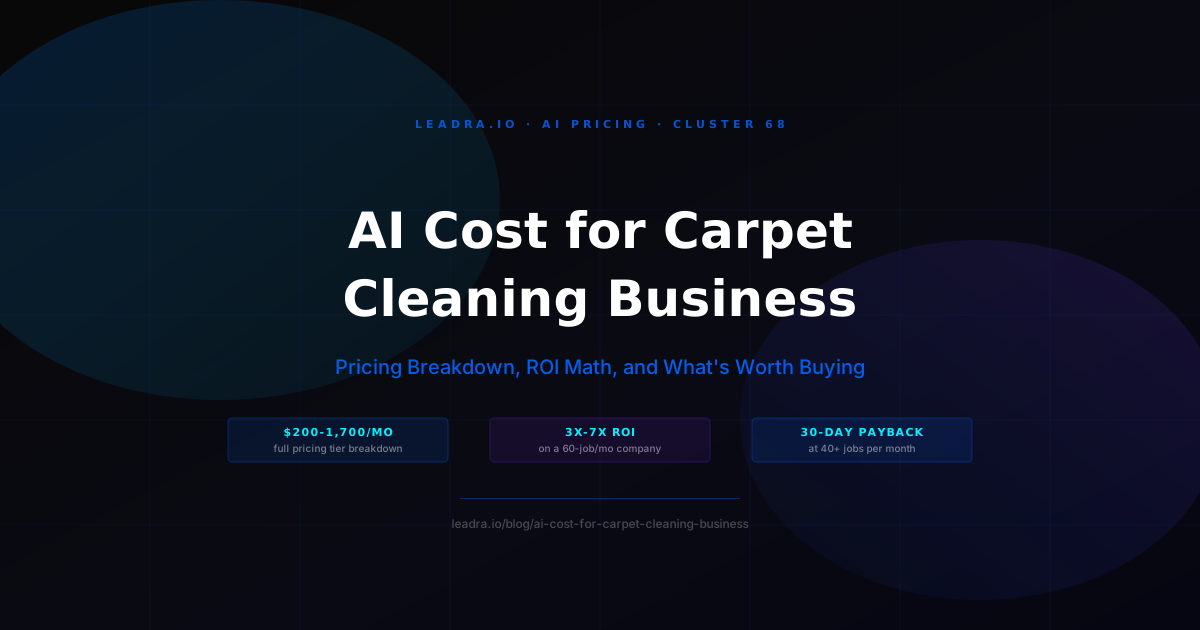
AI for carpet cleaning businesses costs between $200 and $1,700 per month depending on job volume, automation depth, and whether you need voice booking or just SMS follow-up. This guide covers exactly what each pricing tier includes, what the ROI math looks like by company size, what setup fees to expect, and what questions to ask any vendor before committing. By the end, you will know whether AI makes sense for your business and what a fair price looks like.
What Drives AI Cost for a Carpet Cleaning Business
Carpet cleaning AI pricing varies because the scope of automation varies. Vendors price based on four variables:
- 01.Monthly job and inquiry volume. A company handling 20 booking requests per month sends far fewer automated messages than one handling 100. Vendors priced per message can double the headline rate at real volumes. Always get a quote based on your actual monthly job count and inquiry load, not a plan that looks cheap on paper and scales into expensive territory by month three.
- 02.Voice vs. SMS capability. AI voice agents that answer inbound calls and book jobs directly cost more than SMS-only systems. For carpet cleaning, voice matters most in two scenarios: homeowners calling for a same-day whole-house or pet-stain quote who want to talk price by room count before committing, and commercial or property-management accounts that need a scheduling conversation. A technician who cannot hear the phone over a running extraction unit is routing every one of those calls to whoever answers first — often a competitor with an automated booking link already texted back.
- 03.Booking and route software integration depth. Sending a text confirmation after a job is not AI automation — it is an auto-responder. Real integration reads your live technician calendar, writes notes into Jobber, Housecall Pro, or ZenMaid, and triggers follow-up sequences based on what a customer actually requested. That two-way data sync is what makes quote-to-booking conversion, reminders, and re-clean reactivation campaigns work with specificity instead of generic blasts. It costs more to build and maintain, and vendors who skip it will give you a demo that impresses and a product that underdelivers.
- 04.Automation breadth across the customer lifecycle. Quote acknowledgment texts are cheap and widely available. Adding a follow-up sequence, a seasonal reactivation campaign, a review request system, a recurring-plan pipeline, and a commercial account outreach series each layers cost — but each layer also compounds returns. A company running five automations is recovering revenue across five categories simultaneously instead of patching one leak at a time.
Why Carpet Cleaning Companies Have Unique AI Economics
The carpet cleaning business model differs from other service businesses in three ways that make AI both high-impact and specific in how it has to be deployed:
Technicians physically cannot answer the phone while running extraction equipment.
A truck-mounted hot-water extraction unit runs loud for the full duration of a job, often one to two hours per home. Every call that comes in during that window goes to voicemail, and most homeowners requesting a carpet cleaning quote will call the next company on the list rather than wait for a callback. Industry data shows that 78% of customers choose the first business that responds to their inquiry. For a $220 job, an AI agent that texts back within seconds and books an appointment on the spot is the difference between a booked job and a lost lead to a competitor who answered first.
Carpet cleaning is one of the most repeat-friendly service categories, and most companies leave that on the table.
Carpets are recommended for professional cleaning every 6 to 12 months, which means every past customer is a near-guaranteed future booking if someone reminds them at the right time. Add spring cleaning season, the pre-holiday rush when homeowners want carpets done before guests arrive, and post-holiday pet and traffic-stain cleanups, and there are three to four predictable demand windows per year. Most companies do nothing to re-engage their existing customer base before these windows open. An automated re-clean reminder sent 30 days before the typical 6-to-12-month mark — with a specific reference to the rooms cleaned last time — consistently recovers 8–14% of past customers. For a company with 350 past customers and an average re-clean ticket of $200, that is $5,600 to $9,800 in revenue from one campaign that runs automatically every cycle.
Google reviews and trust signals are the primary new-customer acquisition channel.
Carpet cleaning is a high-trust category — homeowners are letting a stranger into their home to work around furniture, pets, and children, and they lean almost entirely on ratings and recent reviews to decide who gets that access. A Google Business Profile with 150+ reviews and a 4.8-star rating receives significantly more organic profile views than a competitor with 30 reviews and a 4.3-star rating. Most companies generate reviews inconsistently — a satisfied customer occasionally leaves one on their own, and that is the entire review strategy. An AI review request sequence sent via SMS the evening a job is completed generates 6–12 new reviews per month on autopilot. Within 60 to 90 days, the ranking lift drives measurable increases in inbound call volume, which compounds every other AI automation the company has in place.
AI Pricing Tiers for Carpet Cleaning Businesses
Here is how the market breaks down across three tiers. Most companies running over 25 jobs per month move to Tier 2 within the first 60 days once they see how much Tier 1 leaves unconverted.
Basic Booking Automation
- ✓Instant missed-call text-back so no booking request goes unanswered
- ✓Automated quote acknowledgment reply with ballpark pricing by room count (same-day, automated)
- ✓Post-job Google review request (sent the evening a job is completed)
- ✓Basic appointment reminder texts to cut no-shows
Best for
Solo operators or one-van crews running under 25 jobs/month
ROI timeline
20–30 days from missed-call recovery and review volume
Standard AI Stack
- ✓Everything in Tier 1
- ✓24/7 AI SMS or voice agent that quotes and books appointments after hours
- ✓Quote-to-booking follow-up sequence (3-touch, triggered on unanswered quotes)
- ✓Annual and biannual re-clean reminder campaign (spring refresh, pre-holiday, post-holiday)
- ✓Lapsed-customer re-engagement for buyers who have not booked in 12 months
- ✓Jobber, Housecall Pro, or ZenMaid integration
Best for
Crews running 25–60 jobs/month, $10k–$30k/mo revenue
ROI timeline
15–25 days — after-hours capture and quote conversion pay fast
Full Revenue Engine
- ✓Everything in Tier 2
- ✓AI voice agent — answers inbound calls and books jobs directly onto the technician calendar
- ✓Property manager and Airbnb host commercial account outreach automation
- ✓Recurring maintenance-plan pipeline (quarterly and biannual carpet and upholstery contracts)
- ✓Custom CRM tagging (repeat residential, commercial, referral source)
- ✓Monthly reporting: job source attribution, conversion rates, review velocity
Best for
Multi-van operations or companies doing $30k+/mo
ROI timeline
10–20 days — multiple revenue channels activate simultaneously
Setup Fees and Onboarding Costs
Every real AI system requires upfront configuration work. Budget for these costs beyond the monthly subscription:
| Component | Typical Cost | What It Covers |
|---|---|---|
| Jobber / Housecall Pro / ZenMaid integration | $200 – $650 | Connecting your route and booking software to the AI system so automations trigger on real job data |
| AI voice agent configuration | $250 – $800 | Training the voice agent on your services, room-count pricing ranges, service area, and common customer questions |
| Sequence copywriting and setup | $150 – $400 | Writing and loading the follow-up, reactivation, and review request message sequences |
| CRM or contact import | $100 – $300 | Migrating your existing customer list from spreadsheets, route software exports, or a prior platform |
| Total typical setup range | $700 – $2,150 | One-time — legitimate vendors do not charge recurring setup fees after month one |
ROI Breakdown: What AI Recovers for a 60-Job Carpet Cleaning Company
The following projections are based on a company running 60 jobs per month at a $210–$230 average ticket. Adjust the numbers proportionally for your actual volume.
These are realistic ranges based on observed AI automation performance across home-service businesses. Individual results vary by market, service area size, and execution quality.
| Revenue Category | Assumption | Monthly Recovery |
|---|---|---|
| After-hours booking capture | 30% of booking requests come after 6 PM or during active jobs — AI captures 5–6 extra jobs/mo at $220 avg | $900 – $1,900 |
| Quote-to-booking conversion improvement | 50% of quotes get no follow-up — AI converts 15–20% more at $220 avg job | $1,200 – $2,400 |
| Annual and biannual re-clean reactivation | 350 past customers, 10% rebook at $200 avg re-clean | $700 – $1,500 |
| No-show and reschedule reduction | 60-job company, 12% reschedule rate drops to 5% — saves 3–4 jobs/mo at $215 | $400 – $900 |
| Google review automation → ranking lift | 10 new reviews/month → top-3 local pack position → 15% more inbound calls | $400 – $1,200 |
| Total estimated recovery | Full Tier 2–3 stack deployed | $3,600 – $7,900/mo |
Against a Tier 2 or Tier 3 system cost of $550–$1,100/mo including setup amortization, the net monthly return is $2,500 to $6,800. That is a 3x to 7x return in a category where paid ads typically deliver 2x to 3x at best — and unlike ad spend, every automation above compounds month over month as the customer database grows.
Five Questions to Ask Any AI Vendor Before Signing
The AI automation market for small businesses is full of vendors selling template SMS sequences with an AI label on the box. These questions separate real systems from expensive auto-responders:
1.Does your system read live data from my route software, or does it just send templates?
A real AI system triggers sequences based on what a customer actually requested, when the job is scheduled, and what their service history looks like. If the answer is templates with a name field, it is an auto-responder — not AI.
2.Can I hear a demo call of your voice agent handling a booking request?
Any vendor selling AI voice should be able to play you a real call, not a scripted demo. Listen for how it handles a question the agent was not specifically trained on — that is where the quality gap shows.
3.How does billing scale as my job volume grows?
Per-message pricing models that look affordable at 20 jobs per month become expensive at 80. Get a quote based on your projected six-month volume, not the base plan.
4.What happens to my data if I cancel?
Your customer contact list, job history, and review data belong to you. A legitimate vendor gives you a full export on cancellation. One that does not is holding your data hostage.
5.Do you have carpet cleaning or home-service clients I can speak with?
Carpet cleaning AI has specific requirements around room-count pricing, pet and stain upsells, and recurring service reminders. A vendor with no home-service references is learning on your budget.
AI for Carpet Cleaning in Charlotte, NC — What the Local Market Looks Like
Charlotte added over 40,000 residents between 2023 and 2025. Homeowner demand for carpet, rug, and upholstery cleaning across South Charlotte, Ballantyne, Huntersville, and Matthews is growing fast — and the Google Maps competition for "carpet cleaning near me" and "carpet cleaners Charlotte" is intensifying every season.
Charlotte carpet cleaning companies operating without review automation are falling behind competitors who are collecting 8 to 12 new Google reviews per month on autopilot. In a category where homeowners are letting a stranger into their home and choose almost entirely based on rating, a 40-review gap translates directly into fewer inbound calls.
The fastest-growing Charlotte carpet cleaning companies in 2025 and 2026 are those that combined consistent Google review velocity with after-hours booking capture. The pattern repeats: a company goes from page 2 to the local 3-pack in 60 to 90 days by collecting reviews systematically, and then their AI agent captures the surge of new inquiries that the ranking lift drives in. The two systems feed each other. That is the flywheel most carpet cleaning businesses are missing.
Leadra.io works with carpet cleaning and residential cleaning companies in Charlotte and across the country to build this exact system. Book a free strategy call or call +1 (864) 721-8384 to see what the numbers look like for your job volume.
Your Next Steps — What to Do This Week
Audit your missed-call and after-hours loss.
Pull the last 30 days of calls from your phone log. Count how many went to voicemail during a job or after hours. That number multiplied by your average job value is your monthly missed-opportunity leak.
Count your unanswered quotes.
How many customers asked for a price in the last month and never booked? If you did not follow up with a second touchpoint within 48 hours, most of those are gone. That conversion gap is where mid-tier AI pays for itself fastest.
Check your Google review count vs. your top local competitor.
Google your category and city. If a competitor has more than 40 more reviews than you, they are winning organic traffic you are not seeing. Review automation closes this gap in 60 to 90 days.
Request quotes from two or three vendors — with your real job volume.
Use the five questions above. Get pricing at your actual monthly job count, not the entry-level plan. A legitimate vendor will give you a quote that scales honestly.
Frequently Asked Questions
How much does AI cost for a carpet cleaning business?
AI for a carpet cleaning business typically costs $200 to $1,700 per month. A basic setup covering missed-call text-back, automated quote follow-up, and review requests runs $200–$450/mo. A mid-tier system adding an AI voice or SMS agent for after-hours booking requests, a quote-to-booking conversion sequence, and annual re-clean reminders runs $550–$1,100/mo. A full AI stack with 24/7 voice booking, technician dispatch coordination, recurring maintenance-plan automation, and monthly reporting runs $1,100–$1,700/mo. Carpet cleaning companies running 40 or more jobs per month typically see positive ROI within 30 days from quote conversion improvement alone.
What is the ROI of AI automation for a carpet cleaning company?
For a carpet cleaning company running 60 jobs per month at an average ticket of $220, a full AI stack typically recovers $3,600 to $7,900 per month. The main categories are: after-hours booking capture ($900–$1,900/mo), quote-to-booking conversion improvement ($1,200–$2,400/mo), annual and biannual re-clean reactivation ($700–$1,500/mo), no-show and reschedule reduction ($400–$900/mo), and Google review automation that drives local ranking ($400–$1,200/mo). Against a system cost of $550–$1,100/mo, that is a 3x to 7x monthly return.
What does a carpet cleaning AI system actually include?
A carpet cleaning AI system typically includes: instant missed-call text-back so no booking request goes unanswered, an AI voice or SMS agent that quotes ballpark pricing by room count or square footage and books appointments around the clock, a quote-to-booking follow-up sequence triggered when a homeowner asks for a price but does not schedule, an annual and biannual re-clean reminder campaign for past customers, an automated Google review request sent after a completed job, and CRM tagging for recurring commercial accounts like property managers and Airbnb hosts. Integration with Jobber, Housecall Pro, or ZenMaid is standard in mid and full-tier plans.
Is AI worth it for a small or solo-operator carpet cleaning business?
Yes — even a one-van operation running 20 jobs per month is losing revenue to missed calls while running a truck-mounted extraction unit that makes the phone impossible to hear. A basic AI text-back and follow-up system at $200–$350/mo that converts 2 extra jobs per month at $220 each pays for itself immediately. Solo operators should start with missed-call text-back and quote follow-up, then add a full voice agent once monthly job volume exceeds 25 and phone coverage becomes the bottleneck.
See What the Numbers Look Like for Your Carpet Cleaning Business
Leadra.io builds AI booking automation and revenue growth systems for carpet cleaning and residential cleaning businesses. We will show you the exact ROI math for your job volume — free, no obligation.
Written by the Leadra.io Team. Leadra.io is an AI marketing agency helping carpet cleaning and home-service businesses grow using AI-powered automation, booking capture, and lead generation systems. Based in Charlotte, NC — serving clients nationwide.