AI Cost for Handyman Service Businesses: Pricing Breakdown, ROI Math, and What's Actually Worth Buying
Most handyman owners ask what AI costs. That is the wrong starting question. The right question is what the absence of it is already costing — because for the average two-tech handyman crew, that number runs between $2,500 and $6,500 per month, and it never shows up on any report.
Here is the math. A crew booking 55 jobs per month at a $275 average loses roughly 25% of its inbound calls to voicemail because every tech is on a ladder or under a sink when the phone rings — that is 5 to 6 potential jobs per month that never get captured, and the caller moves to the next name on the search results page instead of waiting for a callback. Add a 50% quote follow-up failure rate, a customer list that nobody re-engages for seasonal maintenance, and inconsistent review generation in a category where trust and licensing concerns drive every booking decision — and the monthly revenue leak is clear. AI does not eliminate all of it, but it closes the majority, and it does it for a fraction of what the loss costs.
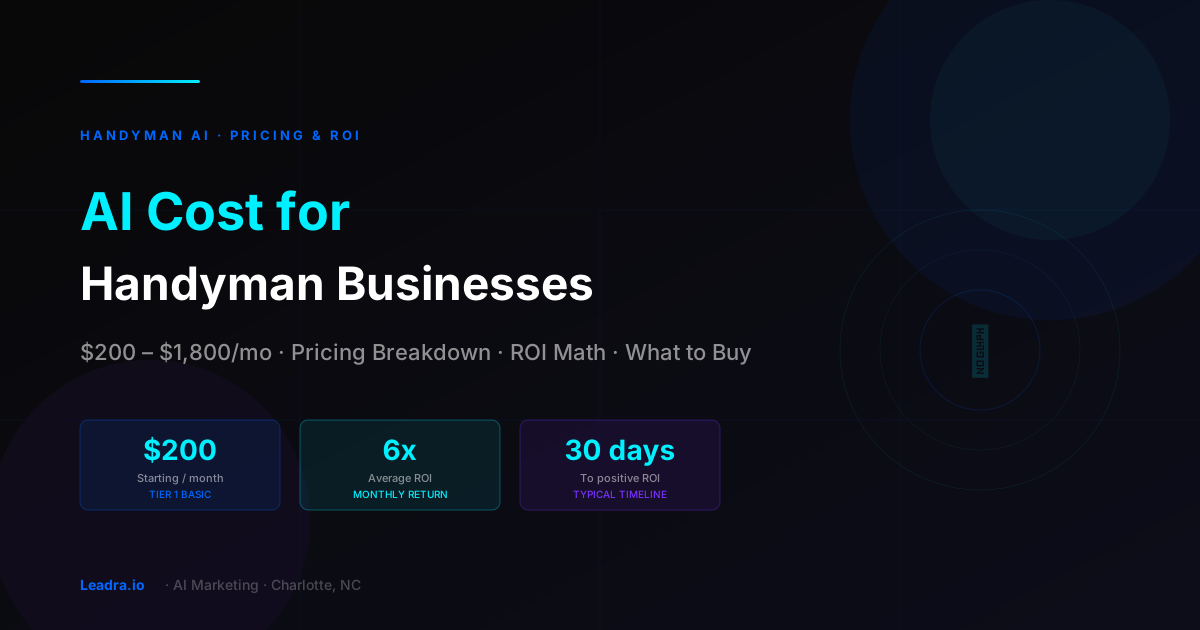
AI for handyman service businesses costs between $200 and $1,800 per month depending on call volume, automation depth, and whether you need a full voice agent or just call-back and SMS follow-up. This guide covers exactly what each pricing tier includes, what the ROI math looks like by crew size, what setup fees to expect, and what questions to ask any vendor before committing. By the end, you will know whether AI makes sense for your business and what a fair price looks like.
What Drives AI Cost for a Handyman Service Business
Handyman AI pricing varies because the scope of automation varies. Vendors price based on four variables:
- 01.Monthly call and job volume. A solo handyman fielding 15 calls per month sends far fewer automated messages than a four-tech crew fielding 120. Vendors priced per message or per call can double the headline rate at real volumes. Always get a quote based on your actual monthly call count and job load, not a plan that looks cheap on paper and scales into expensive territory by month three.
- 02.Voice vs. SMS capability. AI voice agents that answer inbound calls live cost more than SMS-only systems. For handyman businesses, voice matters most in two scenarios: a customer calling about an active leak or electrical issue who wants to talk to someone right now, and a first-time caller comparing three handymen at once who books whoever picks up. A crew that lets calls roll to voicemail during job hours is routing every one of those callers to a competitor with a live answer already on the line.
- 03.Dispatch and calendar integration depth. Sending a text confirmation after a booking is not AI automation — it is an auto-responder. Real integration reads your live tech schedule, checks job-site distance, writes notes into your dispatch tool, and books an estimate window that actually works for your crew. That two-way data sync is what makes quote-to-booking conversion, arrival-window reminders, and multi-tech routing work with accuracy instead of double-booked chaos. It costs more to build and maintain, and vendors who skip it will give you a demo that impresses and a scheduling mess that follows.
- 04.Automation breadth across the customer lifecycle. Missed-call text-back is cheap and widely available. Adding a quote follow-up sequence, a seasonal maintenance reminder campaign, a review request system, a lapsed-customer re-engagement series, and multi-tech dispatch routing each layers cost — but each layer also compounds returns. A crew running five automations is recovering revenue across five categories simultaneously instead of patching one leak at a time.
Why Handyman Businesses Have Unique AI Economics
The handyman business model differs from other service businesses in three ways that make AI both high-impact and specific in how it has to be deployed:
Every caller is comparing you against two or three competitors in real time.
A homeowner with a broken cabinet hinge or a leaking faucet rarely calls one handyman and waits. They call three, and they book whoever answers first with a real appointment window — not whoever calls back four hours later. A crew without live call coverage or instant text-back loses that job before the tech even finishes the current one. Industry data shows that 78% of customers choose the first business that responds to their inquiry. For a $275 average job, a 2-minute AI response versus a 4-hour callback is the difference between booking and losing the job to the next name on the list.
Recurring maintenance work is the highest-margin revenue and the easiest to automate.
Gutter cleaning, seasonal punch lists, filter changes, and small repairs that pile up over six months are predictable, low-acquisition-cost revenue — the customer already knows and trusts you. Most handyman businesses never systematically ask past customers to rebook. An automated seasonal outreach campaign sent to customers from the prior job — timed to spring and fall maintenance windows — consistently rebooks 8–12% of the past-customer list. For a crew with 150 past customers and an average seasonal job of $250, that is $3,000 to $4,500 in revenue from one campaign that runs automatically every season.
Trust and reviews decide who gets the call before price ever comes up.
Handyman work happens inside someone's home, which makes trust the single biggest factor in the booking decision — ahead of price in most cases. A Google Business Profile with 150+ reviews and a 4.8-star rating receives significantly more calls than a competitor with 30 reviews and a 4.3-star rating, even at a higher price point. Most handyman businesses generate reviews inconsistently — a happy customer occasionally leaves one unprompted, and that is the entire strategy. An AI review request sent via SMS the same day a job wraps generates 6–12 new reviews per month on autopilot. Within 60 to 90 days, the ranking lift drives a measurable increase in inbound call volume that compounds every other automation in place.
AI Pricing Tiers for Handyman Businesses
Here is how the market breaks down across three tiers. Most crews doing over 25 jobs per month move to Tier 2 within the first 60 days once they see how many calls Tier 1 alone was leaving on the table.
Basic Call Automation
- ✓Instant missed-call text-back for every unanswered call
- ✓Automated appointment confirmation and reminder SMS
- ✓Post-job Google review request (sent same day the job wraps)
- ✓Basic quote request acknowledgment reply (same-day, automated)
Best for
Solo handymen or crews doing under 25 jobs/month
ROI timeline
20–30 days from missed-call and review recovery
Standard AI Stack
- ✓Everything in Tier 1
- ✓24/7 AI voice agent that answers calls, qualifies the job, and books an estimate window
- ✓Quote-to-booking follow-up sequence (3-touch, triggered on unanswered estimates)
- ✓Repeat-customer maintenance reminder campaign (gutters, seasonal punch lists, filters)
- ✓Lapsed-customer re-engagement for buyers who have not booked in 90+ days
- ✓Calendar or dispatch tool integration (Jobber, Housecall Pro, or Google Calendar)
Best for
Two to four-tech crews doing 25–60 jobs/month, $12k–$40k/mo revenue
ROI timeline
15–25 days — missed-call capture and quote conversion pay fast
Full Revenue Engine
- ✓Everything in Tier 2
- ✓AI voice agent handles emergency and after-hours requests with priority routing
- ✓Multi-tech dispatch coordination — routes jobs by tech location and skill
- ✓Referral and repeat-customer pipeline with automated outreach after every job
- ✓Custom CRM tagging (VIP customers, recurring maintenance clients, property managers)
- ✓Monthly reporting: call source attribution, booking rate, review velocity
Best for
Established handyman companies with 3+ techs doing $40k+/mo
ROI timeline
10–20 days — multiple revenue channels activate simultaneously
Setup Fees and Onboarding Costs
Every real AI system requires upfront configuration work. Budget for these costs beyond the monthly subscription:
| Component | Typical Cost | What It Covers |
|---|---|---|
| Dispatch / calendar integration | $200 – $700 | Connecting Jobber, Housecall Pro, or a shared calendar to the AI system so bookings trigger on real tech availability |
| AI voice agent configuration | $300 – $800 | Training the voice agent on your service list, pricing ranges, service area, and common job-qualifying questions |
| Sequence copywriting and setup | $150 – $450 | Writing and loading the follow-up, reactivation, and review request message sequences |
| CRM or contact import | $100 – $300 | Migrating your existing customer list from spreadsheets, a prior platform, or paper job tickets |
| Total typical setup range | $700 – $2,200 | One-time — legitimate vendors do not charge recurring setup fees after month one |
ROI Breakdown: What AI Recovers for a 55-Job-Per-Month Crew
The following projections are based on a two-tech handyman crew booking 55 jobs per month at a $250–$300 average job value. Adjust the numbers proportionally for your actual volume.
These are realistic ranges based on observed AI automation performance across home-service businesses. Individual results vary by market, ad spend, and execution quality.
| Revenue Category | Assumption | Monthly Recovery |
|---|---|---|
| Missed-call and after-hours capture | 25% of calls go unanswered during job hours — AI books 5 extra jobs/mo at $275 avg | $1,000 – $2,100 |
| Quote-to-booking conversion improvement | 50% of estimate requests get no follow-up — AI converts 15–20% more at $275 avg job | $900 – $1,900 |
| Repeat-customer and seasonal maintenance outreach | 150 past customers, 10% rebook at $250 avg seasonal job | $700 – $1,500 |
| No-show reduction from confirmation sequences | 55-job crew, 10% no-show rate drops to 4% — saves 3 jobs/mo at $250 | $500 – $1,100 |
| Google review automation → ranking lift | 10 new reviews/month → top-3 local pack position → 20% more inbound calls | $700 – $1,000 |
| Total estimated recovery | Full Tier 2–3 stack deployed | $3,800 – $7,600/mo |
Against a Tier 2 or Tier 3 system cost of $700–$1,400/mo including setup amortization, the net monthly return is $2,400 to $6,200. That is a 3x to 6x return in a category where paid ads typically deliver 2x at best — and unlike ad spend, every automation above compounds month over month as the customer database grows.
Five Questions to Ask Any AI Vendor Before Signing
The AI automation market for small businesses is full of vendors selling template SMS sequences with an AI label on the box. These questions separate real systems from expensive auto-responders:
1.Does your system read live data from my dispatch tool or calendar, or does it just send templates?
A real AI system books estimate windows based on what your techs actually have open, not a generic slot that gets double-booked by 2 PM. If the answer is templates with a name field, it is an auto-responder — not AI.
2.Can I hear a demo call of your voice agent handling a job inquiry?
Any vendor selling AI voice should be able to play you a real call, not a scripted demo. Listen for how it handles a question the agent was not specifically trained on — that is where the quality gap shows.
3.How does billing scale as my call volume grows?
Per-call or per-message pricing models that look affordable at 20 jobs per month become expensive at 80. Get a quote based on your projected six-month volume, not the base plan.
4.What happens to my data if I cancel?
Your customer contact list, job history, and review data belong to you. A legitimate vendor gives you a full export on cancellation. One that does not is holding your data hostage.
5.Do you have home-service or handyman clients I can speak with?
Handyman AI has specific requirements around job qualification, service-area boundaries, and dispatch timing. A vendor with no home-service references is learning on your budget.
AI for Handyman Businesses in Charlotte, NC — What the Local Market Looks Like
Charlotte added over 40,000 residents between 2023 and 2025. New homeowners in South End, NoDa, Ballantyne, and Matthews are searching "handyman near me" and "home repair Charlotte" every day — and the Google Maps competition for those terms is getting tighter every month.
Charlotte handyman businesses operating without missed-call coverage are losing jobs to competitors who answer on the second ring — even if that answer comes from an AI agent instead of a person. In a category where 78% of homeowners book the first business that responds, a slow callback is a lost job, not a delayed one.
The fastest-growing Charlotte handyman crews in 2025 and 2026 are those that combined instant call coverage with consistent Google review velocity. The pattern repeats: a crew goes from page 2 to the local 3-pack in 60 to 90 days by collecting reviews systematically, and then their AI agent captures the surge of new calls that the ranking lift drives in. The two systems feed each other. That is the flywheel most handyman businesses are missing.
Leadra.io works with local handyman and home repair businesses in Charlotte and across the country to build this exact system. Book a free strategy call or call +1 (864) 721-8384 to see what the numbers look like for your call volume.
Your Next Steps — What to Do This Week
Audit your missed-call loss.
Pull the last 30 days of call logs. Count how many rang through to voicemail without a same-day callback. That number multiplied by your average job value is your monthly missed-call revenue leak.
Count your unanswered quotes.
How many customers asked for pricing in the last month and never booked? If you did not follow up with a second touchpoint within 48 hours, most of those are gone. That conversion gap is where mid-tier AI pays for itself fastest.
Check your Google review count vs. your top local competitor.
Google your category and city. If a competitor has more than 50 more reviews than you, they are winning calls you are not seeing. Review automation closes this gap in 60 to 90 days.
Request quotes from two or three vendors — with your real call volume.
Use the five questions above. Get pricing at your actual monthly job count, not the entry-level plan. A legitimate vendor will give you a quote that scales honestly.
Frequently Asked Questions
How much does AI cost for a handyman service business?
AI for a handyman service business typically costs $200 to $1,800 per month. A basic setup covering missed-call text-back, appointment confirmation, and simple follow-up sequences runs $200–$500/mo. A mid-tier system adding an AI voice agent for after-hours emergency requests, a quote-to-booking conversion sequence, and a repeat-customer reminder campaign runs $600–$1,200/mo. A full AI stack with 24/7 call answering, job dispatch integration, seasonal maintenance outreach, and monthly reporting runs $1,200–$1,800/mo. Handyman businesses running two or more techs typically see positive ROI within 30 days from missed-call recovery alone.
What is the ROI of AI automation for a handyman business?
For a two-tech handyman business booking 55 jobs per month at an average of $275 per job, a full AI stack typically recovers $3,800 to $7,600 per month. The main categories are: missed-call and after-hours capture ($1,000–$2,100/mo), quote-to-booking conversion improvement ($900–$1,900/mo), repeat-customer and seasonal maintenance reminders ($700–$1,500/mo), reduced no-shows through confirmation and reminder sequences ($500–$1,100/mo), and Google review automation that drives ranking and inbound calls ($700–$1,000/mo). Against a system cost of $700–$1,400/mo, that is a 3x to 6x monthly return.
What does a handyman AI system actually include?
A handyman AI system typically includes: instant missed-call text-back so no inquiry goes unanswered, an AI voice or SMS agent that answers inbound calls, asks the right qualifying questions about the job, and books an estimate or dispatch window, a quote-to-booking follow-up series for customers who requested pricing but did not commit, an automated appointment confirmation and reminder sequence that cuts no-shows, a seasonal maintenance outreach campaign for past customers, and an automated Google review request sent after job completion. Integration with a dispatch or field-service tool like Jobber, Housecall Pro, or a shared calendar is standard in mid and full-tier plans.
Is AI worth it for a solo or small handyman operation?
Yes — even a solo handyman doing 20 jobs per month is losing work to calls that go unanswered while on a job site. A basic AI text-back and follow-up system at $200–$350/mo that converts two extra jobs per month at $250 each pays for itself immediately. Solo operators and small crews should start with a Tier 1 missed-call and review automation setup, then add a full voice agent once monthly call volume exceeds 40.
See What the Numbers Look Like for Your Handyman Business
Leadra.io builds AI call answering, dispatch automation, and revenue growth systems for handyman and home repair businesses. We will show you the exact ROI math for your call volume — free, no obligation.
Written by the Leadra.io Team. Leadra.io is an AI marketing agency helping handyman and home repair businesses grow using AI-powered call answering, dispatch automation, and lead generation systems. Based in Charlotte, NC — serving clients nationwide.