AI Cost for Martial Arts School Businesses: What You'll Pay, What You'll Recover, and Is It Worth It
Most martial arts school owners ask what AI costs. The better question is what the absence of AI is already costing — because that number is almost always larger, and it never shows up on any report.
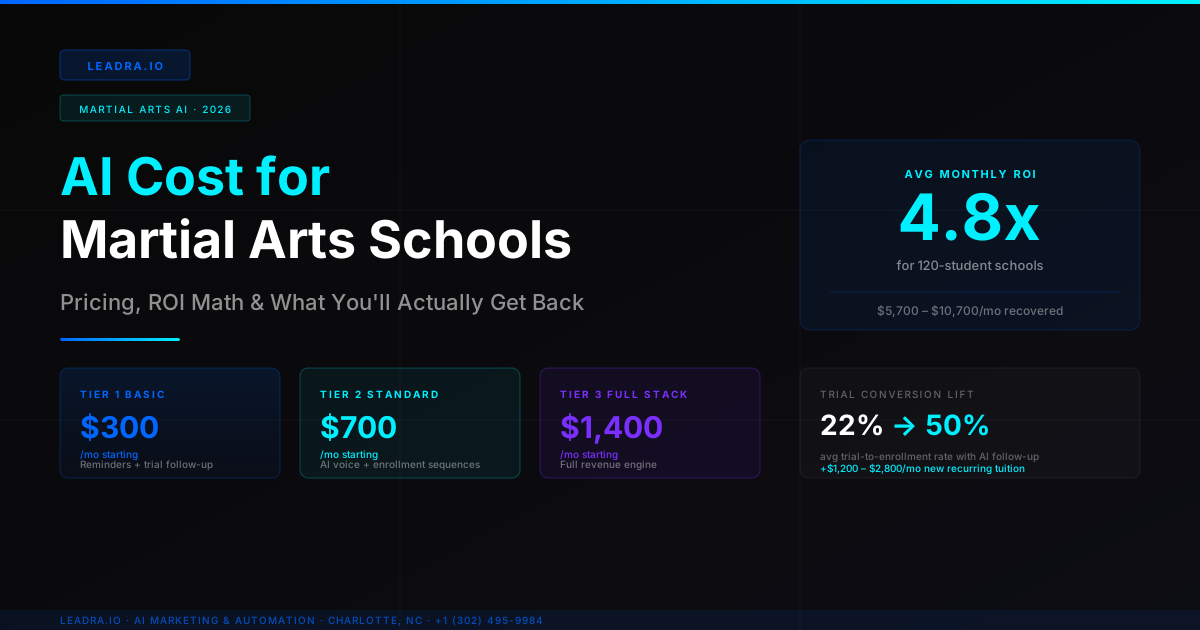
A 120-student school running 18 classes per week with a 22% trial-to-enrollment conversion rate is converting 5 or 6 new students per month from trials. A school with a properly built AI follow-up sequence — same-day post-trial text, 48-hour check-in, 7-day offer, 14-day last-chance — converts 12 to 13 students from the same volume of trials. That gap is $1,225 to $2,100 in new monthly recurring tuition revenue from students who already showed up. No additional ad spend. No extra staff. The only difference is whether the follow-up happened at all.
AI for martial arts schools costs between $300 and $2,200 per month depending on what you automate and how many active students you serve. This guide covers exactly what each pricing tier includes, what the ROI math looks like for schools of different sizes, what setup fees to expect, and which questions to ask any vendor before you sign anything. By the end, you will know whether AI makes financial sense for your school and what fair pricing looks like.
What Drives AI Cost for a Martial Arts School
AI pricing for martial arts schools varies because the automation requirements vary. Vendors price based on four variables:
- 01.Active student count and message volume. A school with 100 active students sending 5 automated touchpoints per month per student sends 500 messages per month. A school with 300 students sends 1,500. Vendors priced per message can triple the headline rate at real volumes. Always request a quote based on your actual student count, not a base plan price that looks cheap until your school grows.
- 02.Voice vs. SMS capability. AI voice agents that answer inbound calls and make outbound calls cost more than SMS-only systems. For martial arts schools, voice coverage is where after-hours enrollment inquiries are captured. A parent searching for kids karate classes at 8 PM who calls and gets voicemail will move on to the next school that picks up. At average tuition of $150–$200 per month per student, missing one family per week costs $600–$800 in monthly recurring revenue — every week, compounding.
- 03.CRM and scheduling software integration depth. Sending a booking link via text is not AI automation — it is an auto-responder with a URL. Real integration reads your live class schedule, confirms open spots, and writes the booking directly into Zen Planner, MINDBODY, or Jackrabbit Martial Arts. That two-way sync is what makes after-hours trial booking, makeup class scheduling, and waitlist fill actually work. Vendors who cut corners on integration quality will show you a demo that works perfectly on a clean test account and a live product that does not.
- 04.Automation stack breadth. Trial class reminder SMS is cheap and widely available. Adding enrollment conversion sequences, belt promotion retention outreach, makeup class automation, dormant reactivation, and tournament registration each adds layers — but each layer also compounds returns. A school running five automations recovers revenue across five categories simultaneously instead of one.
Why Martial Arts Schools Have Unique AI Economics
The martial arts school business model is different from other fitness businesses in three ways that make AI both more impactful and more specific to configure:
Trial classes are the entire enrollment funnel.
Most martial arts schools run their acquisition entirely through trial classes or intro week offers. A new student or family pays $20–$40 for a first class or week, then converts to a monthly tuition agreement. That conversion moment is where most schools lose money without realizing it. The average trial-to-enrollment rate without any automated follow-up is 20–28%. With a properly sequenced AI follow-up — same-day post-trial text, 48-hour check-in, 7-day offer with a deadline, 14-day last-chance — it climbs to 48–60%. On 25 monthly trials, that gap is worth $1,750 to $2,800 in new monthly recurring tuition revenue from students who already walked in the door.
Belt progression creates predictable attrition windows.
Martial arts students quit at specific moments: after their first belt test, when progress slows between ranks, and when they hit the intermediate plateau around blue or purple belt. These are predictable windows. An AI system that tracks student rank and automatically sends milestone check-in messages — celebrating recent promotions, sharing what comes next, and offering a personal-sounding reach-out when a student has missed three or more consecutive classes — reduces attrition at these windows by 30–45% in schools that run it consistently. At $175/mo tuition, retaining 3 extra students per quarter is worth $525/mo in protected recurring revenue per quarter from a single automation.
After-hours inquiries are the biggest unconverted revenue pool.
According to a 2025 survey of martial arts school owners, 38–45% of new family inquiries come between 5 PM and 9 PM — exactly when most school owners and front desk staff have gone home. A parent who calls at 7:30 PM to ask about kids karate classes and reaches voicemail will usually call the next school on Google before calling back. An AI voice agent that answers after hours, walks the parent through program options and class times, and schedules the trial class on the spot captures that lead before it leaves. For schools in competitive markets with 3 to 8 other programs nearby, this is the single highest-impact automation in the stack.
AI Pricing Tiers for Martial Arts Schools
Here is how the market breaks down across three tiers. Most schools doing more than 12 classes per week move to Tier 2 within the first 60 days once they see how much Tier 1 leaves unconverted.
Basic Automation
- ✓Automated trial class reminder sequences (48h / 24h / morning-of)
- ✓No-show and late-cancel prevention SMS series
- ✓Post-trial follow-up text with enrollment link (1-touch)
- ✓Basic Google review request after belt tests
Best for
Schools under 70 active students running fewer than 12 classes/week
ROI timeline
30–45 days from no-show reduction and trial follow-up
Standard AI Stack
- ✓Everything in Tier 1
- ✓24/7 AI voice booking agent for after-hours enrollment inquiries
- ✓SMS booking agent for text-based class questions and trial scheduling
- ✓Trial-to-enrollment conversion sequence (3–5 touch over 7 days post-trial)
- ✓Makeup class booking automation for absences
- ✓Belt promotion milestone outreach for at-risk students
- ✓CRM integration (Zen Planner, MINDBODY, Jackrabbit Martial Arts)
Best for
Schools doing 12–25 classes/week with 70–200 active students
ROI timeline
20–35 days — trial conversion and after-hours capture pay fast
Full Revenue Engine
- ✓Everything in Tier 2
- ✓Dormant student reactivation campaigns (30/60/90-day segments)
- ✓Tournament and testing registration automation
- ✓Family enrollment upsell sequences (sibling discounts, family plans)
- ✓Monthly retention reporting and churn prediction
- ✓Custom CRM segmentation, tagging, and quarterly optimization reviews
Best for
Multi-program schools, flagship locations, or schools doing $25k+/mo tuition revenue
ROI timeline
15–25 days — multiple revenue streams fire simultaneously
Setup Fees and Onboarding Costs
Every real AI system requires upfront configuration. Here is what to budget for beyond the monthly subscription:
| Tier | Setup fee range | What it covers |
|---|---|---|
| Basic | $0 – $350 | Template configuration, student list import, reminder and trial follow-up sequence setup |
| Standard | $500 – $1,200 | CRM integration, AI voice setup, trial conversion script build, belt milestone logic, staff training |
| Full Stack | $1,000 – $2,500 | Full CRM workflow build, multi-sequence configuration, family enrollment upsell setup, custom segmentation, monthly reporting |
Annual contracts regularly waive or deeply discount setup fees. Month-to-month contracts are more flexible but typically run 15–25% higher per month. If a vendor quotes zero setup on a standard or full-stack plan without explanation, push back — the configuration work is real and gets paid for somewhere, usually in a longer required contract or a lower-quality initial build that produces poor early results and a slow start to ROI.
ROI Breakdown for a 120-Student Martial Arts School
This is what a 120-student school running 18 classes per week at $175 average monthly tuition typically recovers with a full AI stack. These numbers are conservative — most schools report higher returns in the first 60 days, particularly on trial conversion and after-hours capture.
| Revenue category | Assumption | Monthly recovery |
|---|---|---|
| Trial-to-enrollment conversion | 25 trials/mo at 22% conversion → 50% | avg tuition $175/mo | $2,200 – $3,800 |
| After-hours inquiry capture | 40% of inquiries come after 6 PM, AI captures 9 extra trials/mo | $1,400 – $2,600 |
| No-show prevention and makeup booking | 18 classes/wk, 20-student cap, 18% no-show → 6% | $30 drop-in | $800 – $1,600 |
| Dormant student reactivation | 180 lapsed students, 11% reactivate at $175/mo tuition | $700 – $1,500 |
| Retention through belt progression | 120 students, quit risk drops from 6% to 2.5% at promotion points | $600 – $1,200 |
| Total monthly recovery | Conservative blended estimate | $5,700 – $10,700 |
A full-stack plan at $1,600/mo against $5,700–$10,700/mo in recovered revenue is a 3.5x to 6.7x return. Even the conservative low end produces a 256% monthly ROI. The trial conversion category alone — moving from 22% to 50% on 25 monthly trials at $175/mo tuition — adds $2,200–$2,800/mo in new recurring revenue from prospects who already showed up at your door.
The most underestimated category is dormant student reactivation. Schools with a database of 300 or more past students are sitting on a revenue asset they almost never use. A properly segmented reactivation campaign sent to students who stopped attending 45–90 days ago — with a personal-sounding message acknowledging the gap and offering a simple path back in — typically reactivates 10–15% of the contacted list within 30 days. At $175/mo per reactivated student, 180 reachable lapsed students represents a potential $3,150/mo in recurring revenue from a single campaign that runs automatically.
The Martial Arts School Revenue Leaks That AI Closes
Martial arts schools have specific revenue leak patterns that most general automation tools miss. AI built for the martial arts model closes all of them:
The unconverted trial class.
The industry average trial-to-enrollment conversion rate without automated follow-up is 20–28%. With a proper post-trial sequence — same-day text, 48-hour check-in, 7-day offer with a soft deadline, and a 14-day last-chance with a different angle — it climbs to 48–60%. If your school does 25 trials per month and converts 6 of them at $175/mo, you are earning $1,050/mo in new recurring revenue from trials. With AI follow-up converting 13 of those same 25 trials, you earn $2,275/mo. That is $1,225 more per month from the exact same lead volume and zero extra ad spend.
The parent who called after hours and got voicemail.
A parent searching for kids martial arts classes at 7 PM calls your school, reaches voicemail, and moves to the next result on Google. That family was worth $175/mo in tuition — and likely $350/mo if they enroll two kids. At one family lost per week, that is $700–$1,400/mo in missed recurring revenue. An AI voice agent that answers after hours, walks the parent through your programs and class times, answers common questions, and schedules the trial class on the spot captures every one of those calls before they leave your funnel.
The student who quit after their first belt test.
Belt test nerves and post-promotion letdowns are the two most common attrition triggers in martial arts schools. A student who passes their first test and then has no clear picture of what comes next — and no instructor or system checking in — drops to every-other-week attendance and then stops showing up. A belt milestone sequence that congratulates the student immediately after testing, outlines the next belt requirements, and sends a personal-sounding check-in when attendance slips reduces first-belt attrition by 30–40% in schools that implement it consistently.
The lapsed student with no reactivation sequence.
Most martial arts school owners know they have a database of past students who could come back. Almost none of them have a system that actually reaches those students. A dormant reactivation sequence that texts a former student with a personalized message — referencing their previous rank, offering a low-barrier re-entry path like a free week or discounted restart month — reactivates 10–15% of lapsed students within 30 days. At $175/mo, 20 reactivated students from a single campaign is $3,500/mo in recovered recurring revenue that was sitting unused in your contact list.
What to Watch Out For When Comparing AI Vendors
The martial arts software and automation market has grown fast, and not every vendor delivers what the demo promises. These are the red flags to screen for:
Booking link vs. real CRM integration.
If the vendor cannot read your live class roster and write the booking directly into Zen Planner, MINDBODY, or Jackrabbit Martial Arts — it is not AI automation. It is a text blast with a URL. After-hours trial booking and makeup class automation only work when the system can see open slots in real time and lock them immediately. Ask for a live technical walkthrough of the two-way sync. If they cannot demo it live with your actual platform, it does not work.
SMS-only vs. voice plus SMS.
An AI that only sends text messages misses every inbound phone inquiry. For martial arts schools where 38–45% of new family inquiries come in after hours by phone, voice capability is not an add-on — it is the core product. Confirm both inbound answering and outbound trial confirmation calling are supported before signing. A system that only texts is leaving the highest-value inquiries unanswered.
Generic fitness automation vs. martial arts-specific logic.
Belt progression, rank milestone tracking, family enrollment logic, and tournament registration are specific to martial arts schools. A general gym automation tool built for month-to-month fitness memberships does not understand these workflows and will not build them for you at no extra charge. Ask specifically how the vendor handles belt milestone outreach and whether their sequences are configurable for your belt system before you commit.
No performance guarantee or exit clause.
Any vendor who will not commit to measurable results within 60–90 days is not confident in their product. Before signing, ask for a 90-day performance benchmark with defined metrics — minimum trial conversion rate improvement, no-show reduction percentage, and after-hours inquiry capture rate — and a pro-rated exit clause if those numbers are not hit. A well-built AI system produces measurable results fast enough that no vendor with a real product should refuse this.
Which Tier Is Right for Your School?
A straightforward decision guide based on active student count and monthly tuition revenue:
If: Under 70 active students, under 12 classes/week, under $12k/mo tuition revenue
→ Start with Tier 1. Fix no-shows and automate trial follow-up first. The trial conversion gap will be visible within 45 days. Upgrade to voice booking when you see the after-hours inquiry volume — typically clear within the first month.
If: 70–200 active students, 12–25 classes/week, $12k–$35k/mo tuition revenue
→ Tier 2 is the right entry point. After-hours voice booking and belt milestone retention pay for the system within the first 30–45 days. Most schools in this range report $3,500–$7,000/mo in incremental recovery within 60 days of launch.
If: 200+ active students, multiple programs or instructors, over $35k/mo tuition revenue
→ Tier 3. At this volume, the gap between 3% and 7% monthly churn represents $15,000–$35,000 per year in tuition revenue. Family enrollment upsell, tournament automation, and dormant reactivation compound on top of voice and SMS — the return scales with the student base.
How Leadra.io Builds AI Systems for Martial Arts Schools
Leadra.io builds AI enrollment and retention systems for martial arts schools, fitness studios, and local service businesses. Our pricing is based on what actually drives revenue for your tuition model — not a generic SaaS subscription that charges for features your school never uses.
Every engagement starts with a 30-minute audit where we calculate the actual dollar amount your school is losing each month to unconverted trials, after-hours missed inquiries, belt-progression attrition, and lapsed student revenue. If the math does not show a clear path to ROI-positive within 60 days, we say that before you spend anything.
We integrate directly with Zen Planner, MINDBODY, and Jackrabbit Martial Arts — not link-in-text workarounds. We build outbound voice capability, not just inbound answering. Our belt milestone sequences are configured for your actual rank structure. And we do not lock schools into 12-month contracts with no exit clause when the numbers do not move.
For martial arts schools in markets like Charlotte, Atlanta, Dallas, or any city with active competition from national franchise chains, the window to gain a competitive edge through AI is still open. According to a 2025 survey of independent martial arts school owners, fewer than 12% currently use AI-assisted trial conversion or after-hours inquiry automation — meaning most of your local competition is losing the same unconverted trials and missed evening calls you are. Read more about AI marketing for martial arts schools, see our AI receptionist system for martial arts schools, or explore the best AI tools for martial arts schools in 2026.
Frequently Asked Questions
How much does AI cost for a martial arts school business?
AI for a martial arts school typically costs $300 to $2,200 per month. Basic SMS automation covering trial reminders and no-show prevention runs $300–$600/mo. A mid-tier system adding a 24/7 AI voice booking agent, trial-to-enrollment conversion sequences, and review generation runs $700–$1,400/mo. A full AI stack with voice and SMS booking, CRM integration, belt milestone retention, dormant student reactivation, and family enrollment upsell runs $1,400–$2,200/mo. Schools with 80 or more active students typically see positive ROI within 30–45 days from trial conversion improvement alone.
What is the ROI of AI automation for a martial arts school?
For a 120-student school running 18 classes per week at $175 average monthly tuition, a full AI stack typically recovers $5,700–$10,700 per month across five categories: trial-to-enrollment conversion improvement, after-hours inquiry capture, no-show prevention, dormant student reactivation, and belt-progression retention. Against a system cost of $1,200–$1,800/mo, that is a 3.5x to 6.7x monthly return. Most schools reach payback within the first 30–45 days.
What does a martial arts school AI system actually include?
A martial arts school AI system typically includes automated trial class reminder sequences (48h, 24h, same-morning), an AI voice and SMS agent that answers after-hours enrollment inquiries and books trials, a trial-to-enrollment conversion sequence triggered after the first class (3–5 touches over 7 days), belt promotion milestone outreach that reduces attrition at rank progression windows, makeup class booking automation for absences, dormant student reactivation for students who stopped attending in the last 30–90 days, and automated Google review requests after belt tests or tournaments. CRM integration with Zen Planner, MINDBODY, or Jackrabbit Martial Arts is standard in mid and full-tier plans.
Is AI worth it for a small martial arts school with under 60 students?
Yes — a school with 55 active students at $165/mo tuition losing 3 students per month to attrition is losing $495/mo in recurring revenue with no retention automation. A basic AI system at $350–$500/mo that reduces monthly attrition from 5.5% to 2.5% retains 1–2 extra students per month, easily covering the cost. Add a trial conversion sequence that improves conversion from 22% to 48% on 10 monthly trials at $165/mo and the net new MRR from trials alone adds $430/mo in month one. ROI is positive from the first invoice for most schools in this range.
See the exact ROI number for your school
We run a free 30-minute audit and calculate exactly how much your martial arts school is losing monthly to unconverted trials, after-hours missed calls, attrition at belt progression, and lapsed student revenue — before you spend a dollar.