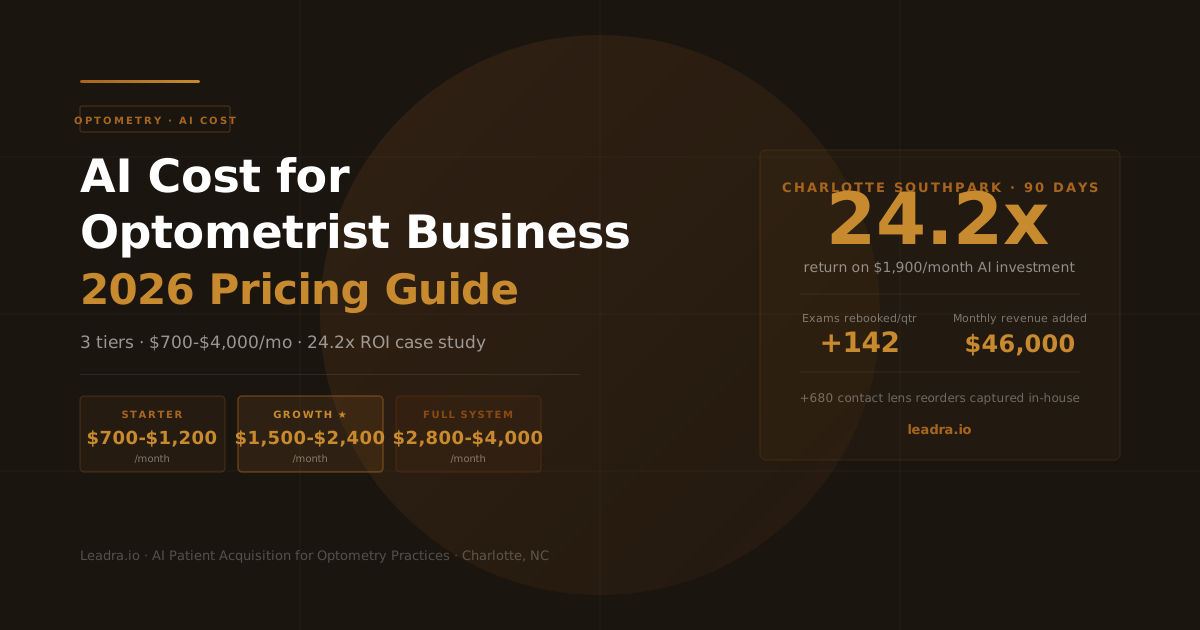
Every optometrist Googling “how much does AI cost” gets the same vague answer: “pricing varies.” It does. But not in the way that makes it impossible to budget. In 2026, AI for optometry practices follows a predictable cost structure tied to three tiers of capability — and the ROI math at each tier is straightforward once you know the inputs.
An optometry practice rebooking 15-20 lapsed annual exam patients per month has already covered most AI subscription costs. Rebook 40 and you're running a double-digit return before you count contact lens reorder revenue or insurance pre-verification time saved. This guide breaks down exact pricing, what each dollar buys, and the real-world numbers from a Charlotte optometry practice that deployed AI in Q2 2026.
No fluff. Just numbers.
Why AI Costs What It Does for Optometry — and What Drives the Price
AI for optometry practices sits in the middle of the medical AI cost spectrum. It's more complex than a general retail booking bot because it has to handle vision insurance verification (VSP, EyeMed, Davis Vision, medical insurance for eye disease), annual exam recall timing tied to each patient's last visit date, and contact lens reorder cycles that vary by prescription and wear schedule. It's less complex than surgical specialties because there's no multi-stage case progression or referral network to manage.
That positioning matters for pricing. Optometry-specific AI costs more than a generic scheduling bot but less than surgical or specialty medical AI — and the premium over generic tools pays for itself quickly because:
The recall list is the biggest untapped revenue source in the practice
Most optometry practices have hundreds of patients overdue for their annual exam sitting in the EHR untouched. AI that automatically identifies and re-engages this list at the 11-month, 13-month, and 15-month marks recovers revenue that front desk staff almost never has time to chase manually.
Insurance verification eats 10-15 hours of staff time per week
Vision insurance (VSP, EyeMed) and medical insurance for eye disease visits use different billing pathways, and mixing them up creates claim denials and patient billing surprises. AI that verifies benefits before the appointment and flags which pathway applies removes a major source of front desk time and billing errors.
Contact lens reorders are recurring revenue if someone remembers to ask
A single contact lens patient reordering four times a year at $180 per order is worth more over 3 years than most single eyewear purchases. Automated reorder reminders timed to each patient's wear schedule keep that revenue in-house instead of losing it to online retailers.
The 3 AI Cost Tiers for Optometry Practices
Most optometry practices fall into one of three tiers based on patient volume, whether they run an in-house optical dispensary, and how large their recall list has grown. Here's what each tier includes and what it costs.
Best for solo-doctor practices doing under 500 exams per month who want to stop losing after-hours calls without hiring additional front desk staff.
AI Voice Employee — answers all inbound calls 24/7, handles exam scheduling and eyewear pickup questions, books directly into your practice management software. Covers after-hours and overflow when front desk is with a patient.
Insurance Pre-Verification — checks VSP, EyeMed, and Davis Vision benefits before the appointment and flags which billing pathway applies. Cuts front desk verification time by 60-70%.
Google Review Automation — post-visit review request sequences sent at the optimal time. Moves practices from 3.8 to 4.6+ star average within 90 days.
Best for multi-doctor practices and those with an in-house optical dispensary doing 500-1,200 exams per month. This is the most common entry point because recall automation alone typically covers the monthly cost within the first two weeks.
Everything in Starter, plus:
Annual Exam Recall Automation — AI scans the patient database for anyone overdue for their annual exam and runs a multi-touch SMS and email sequence at the 11, 13, and 15-month marks. Rebooks 15-30 lapsed patients per month for most practices.
Contact Lens Reorder Automation — timed reminders based on each patient's wear schedule and prescription expiration, sent before the patient runs out and starts shopping online instead.
No-Show Reduction Sequences — automated confirmation and reminder texts at 48 hours and 3 hours before the appointment, with easy one-tap rescheduling. Reduces no-show rates by 30-45%.
Best for high-volume practices (1,200+ exams/month), multi-location groups, or those building toward an aggressive new-patient growth target. Includes everything in Growth plus search visibility and content systems.
Everything in Growth, plus:
AI SEO Content Engine — monthly optometry-focused blog content targeting “eye doctor near me,” contact lens and eyewear keywords, and AI Overview citations in Google. Drives direct new-patient acquisition without relying entirely on recall volume.
Dormant Patient Reactivation — multi-touch sequences targeting patients who haven't visited in 2+ years, with a specific offer to re-establish care.
Performance Analytics Dashboard — monthly reporting on cost per booked exam, recall recovery rate, reorder revenue, and AI system revenue attribution.
AI Cost vs. Hiring: The Numbers Side by Side
The most common budget question optometry practice owners ask is whether AI is cheaper than hiring another front desk employee to handle what AI would cover. Here's the honest comparison.
| Factor | AI (Growth Tier) | Full-Time Front Desk Hire |
|---|---|---|
| Monthly cost | $1,500-$2,400 | $3,700-$5,200 |
| Hours of coverage | 24/7 (8,760 hrs/yr) | 40 hrs/wk (2,080 hrs/yr) |
| Simultaneous calls | Unlimited | 1 at a time |
| Recall list follow-up | Automatic, ongoing | Rarely gets done |
| Training time | 3-7 days setup | 3-6 weeks |
| Turnover risk | None | High (retail/medical front desk avg. 30%+) |
| Contact lens reorder tracking | Included | Manual / inconsistent |
| Performance reporting | Automated monthly | Not available |
The cost comparison alone favors AI — but the real argument is the recall list. A front desk employee juggling phones, checkout, and insurance rarely has spare hours to work through hundreds of overdue patients one by one. AI works that list every single day without it ever falling to the bottom of the priority stack.
Case Study: Charlotte SouthPark Optometry Practice, 90 Days at Growth Tier ($1,900/month)
A two-doctor optometry practice near Charlotte's SouthPark neighborhood deployed Leadra.io's Growth tier system in April 2026. Their core problem: an EHR recall list of over 600 patients overdue for their annual exam that no one had time to work, plus a front desk team of two spending an estimated 12 hours a week on insurance verification calls alone. Contact lens reorders were handled reactively — patients called when they ran out, and a meaningful share simply reordered online instead.
90-Day Results at $1,900/month:
+142 exams
Lapsed patients rebooked from recall automation by day 90
$46,000
Additional monthly revenue (avg. $325/exam-and-eyewear ticket)
24.2x
ROI on $1,900/month AI investment
+680 orders
Contact lens reorders captured in-house by month 3
The biggest driver was not the AI Voice Employee — it was the recall automation. Of the 600 overdue patients in the database, the AI sequence rebooked 142 within the first 90 days, a recovery rate the practice's front desk had never come close to when working the list manually a few names at a time between other tasks.
Contact lens reorder automation added a second, quieter revenue stream: 680 reorders were captured through automated reminders that previously would have been split between phone-tag reminders and lost sales to online retailers. At an average reorder value of $165, that's over $112,000 in annual recurring revenue the practice was leaving on the table before AI took over the reminder cadence.
Build Your Own ROI Estimate in 3 Steps
Before choosing a tier, run this math against your own numbers. It takes less than 2 minutes.
Step 1 — Pull your recall list size
Run a report in your practice management software for patients overdue for their annual exam by more than 60 days. Most independent optometry practices carry 300-800 names on this list at any given time, most of whom have never received a systematic follow-up.
Step 2 — Calculate your average exam-and-eyewear ticket
Take your last 90 days of revenue divided by completed exams that included an eyewear or contact lens purchase. Most practices land between $250-$450. Practices with a strong in-house dispensary trend toward the higher end of that range.
Step 3 — Apply the conservative recall recovery rate
Assume AI recall automation rebooks 20-25% of your overdue list within 90 days, which is the low end of what most practices see. Multiply recovered patients by your average ticket. Compare against the monthly AI cost for your tier. If the number is 3x or higher, the investment pays — and recall alone usually clears that bar before counting reorder or new-patient revenue.
Frequently Asked Questions
How much does AI cost for an optometry practice?
AI for optometry practices runs $700-$4,000 per month depending on scope. A Starter setup costs $700-$1,200/month and covers AI voice, insurance pre-verification, and review automation. A Growth setup runs $1,500-$2,400/month and adds annual exam recall automation and contact lens reorder sequences. A Full system covering all five components costs $2,800-$4,000/month. Most practices start at the Growth tier because recovering a handful of lapsed exam patients covers the monthly cost within the first two weeks.
Is AI worth the cost for an optometrist?
Yes — the annual exam recall list is usually the single largest untapped revenue source in an optometry practice, and it's exactly what AI recall automation targets. Recovering just 20 lapsed patients per month at an average exam-and-eyewear ticket of $300-$400 produces $6,000-$8,000 in recovered revenue against a $1,500-$2,400 monthly investment. Most practices see 8x-24x ROI within 90 days.
What does AI cost compared to hiring a front desk employee for an optometry practice?
A full-time front desk or optical staff member costs $44,000-$62,000 per year fully loaded. AI costs $8,400-$48,000 per year (Starter to Full tier) and provides 24/7 call coverage, automatic recall list follow-up, and contact lens reorder tracking — tasks that rarely get done consistently when left to a busy front desk team. AI doesn't replace the need for staff, but it removes the recall and reorder workload that almost never gets worked otherwise.
What is the cheapest way for an optometrist to start using AI?
The cheapest high-ROI entry point is annual exam recall automation, starting at $500-$900/month as an add-on to a Starter voice package. This single component typically rebooks 15-30 lapsed patients per month who were never called back. At a $325 average exam-and-eyewear ticket, recovering just 10 of those patients produces $3,250 in new revenue against a $700 monthly investment — a 4.6x return before adding any other AI capability.
Want the exact AI cost for your optometry practice?
Leadra.io builds AI systems for optometry practices with transparent pricing and a 90-patient guarantee. Schedule a 20-minute call and we'll run the ROI estimate against your actual recall list and exam volume.