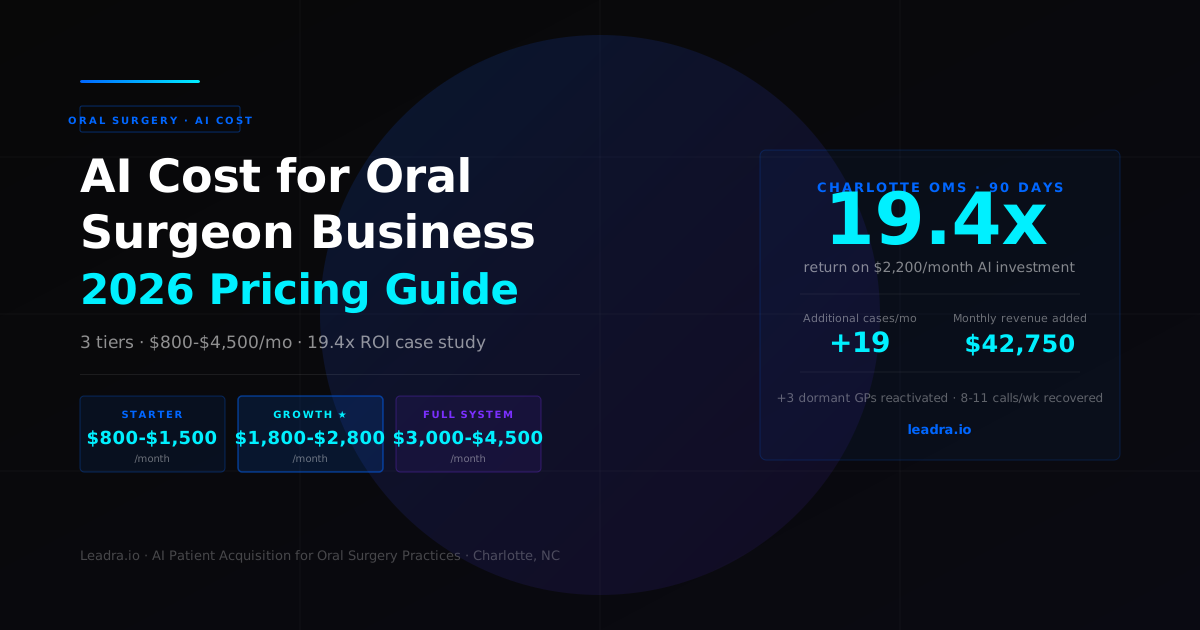
Every oral surgeon Googling “how much does AI cost” gets the same vague answer: “pricing varies.” It does. But not in the way that makes it impossible to budget. In 2026, AI for oral surgery practices follows a predictable cost structure tied to three tiers of capability — and the ROI math at each tier is straightforward once you know the inputs.
An OMS practice recovering one additional implant case per month has already covered most AI subscription costs. Recover three and you're running a 5x return before you count referral management value or post-op staff savings. This guide breaks down exact pricing, what each dollar buys, and the real-world numbers from a Charlotte oral surgery practice that deployed AI in Q1 2026.
No fluff. Just numbers.
Why AI Costs More Per Month for OMS — and Why That's Fine
AI for oral surgery practices costs more than AI for general dentistry or service businesses. The systems are more complex: they handle referral relationship tracking, multi-stage case progression across 6-12 months, OMS-specific post-op protocols (wisdom teeth vs. implant vs. bone graft), insurance pre-authorization workflows, and surgical scheduling that requires clinical understanding of procedure types and surgical blocks.
General-purpose AI tools don't handle this well. OMS-specific AI does — and the complexity premium is $300-$800/month over generic systems. That premium pays for itself quickly because:
Average OMS case value is $1,800-$4,800
Compared to $150-$350 for general dentistry. Each recovered missed call represents 10-20x the revenue of a GP missed call. AI that costs $500/month more but recovers one extra implant consultation per month returns the premium 7x over.
Post-op call volume is 3-5x higher than GP practices
Oral surgery patients call back constantly — swelling questions, dry socket concerns, implant discomfort. AI that handles the routine 80% of these calls without staff involvement saves 15-25 hours of front desk time per week. That's the equivalent of a part-time employee.
Referral pipeline management is a profit center
Most OMS practices run 40-60% of case volume through GP and periodontist referrals. Consistent referral relationship automation — case acknowledgments, quarterly touchpoints, referral analytics — strengthens those pipelines without any manual work. A single additional referring GP sending 3 cases per month adds $5,400-$14,400 in monthly revenue.
The 3 AI Cost Tiers for Oral Surgery Practices
Most OMS practices fall into one of three tiers based on practice size, case volume, and whether they run a referral-heavy model. Here's what each tier includes and what it costs.
Best for solo OMS practices doing under 40 surgical cases per month who want to stop losing after-hours leads without hiring additional staff.
AI Voice Employee — answers all inbound calls 24/7, handles wisdom tooth and implant inquiries, books directly into scheduling software. Covers after-hours and overflow when front desk is with a patient.
Consultation Follow-Up Sequences — automated 5-touch SMS and email sequences for leads who inquired but didn't book. Recovers 25-35% of unbooked consultation leads over 7 days.
Google Review Automation — post-visit review request sequences sent at the optimal time. Moves practices from 3.9 to 4.6+ star average within 90 days.
Best for multi-surgeon practices and referral-heavy OMS businesses doing 40-90 surgical cases per month. This is the most common entry point because the ROI typically exceeds 10x within 90 days.
Everything in Starter, plus:
Referral Relationship Automation — automated case acknowledgment letters to referring GPs and periodontists after every treatment, quarterly touchpoint sequences for dormant referral sources, and referral analytics showing which sources generate the highest case value.
Implant Case Progression Tracking — AI monitors multi-stage implant cases and triggers next-step prompts at each phase (post-extraction healing, osseointegration check, abutment placement, final crown). Reduces implant case drop-off by 40-55%.
Post-Operative AI Follow-Up — automated check-ins at 24 hours, 72 hours, and 7 days with procedure-specific content. Routes clinical escalations to your team; handles routine questions automatically.
Best for high-volume OMS practices (90+ cases/month), practices with aggressive growth targets, or those building toward a multi-location model. Includes everything in Growth plus search visibility and content systems.
Everything in Growth, plus:
AI SEO Content Engine — monthly OMS-focused blog content targeting “oral surgeon near me,” implant and wisdom tooth keywords, and AI Overview citations in Google. Drives direct patient acquisition without relying entirely on referral volume.
Dormant Patient Reactivation — multi-touch sequences targeting patients who completed wisdom tooth extractions 12-24 months ago for implant consultation, and patients who had consultations but never booked surgery.
Performance Analytics Dashboard — monthly reporting on cost per consultation, case conversion rate, referral source ROI, and AI system revenue attribution.
AI Cost vs. Hiring: The Numbers Side by Side
The most common budget question OMS practice managers ask is whether AI is cheaper than hiring a front desk employee to handle what AI would cover. Here's the honest comparison.
| Factor | AI (Growth Tier) | Full-Time Receptionist |
|---|---|---|
| Monthly cost | $1,800-$2,800 | $4,300-$6,000 |
| Hours of coverage | 24/7 (8,760 hrs/yr) | 40 hrs/wk (2,080 hrs/yr) |
| Simultaneous calls | Unlimited | 1 at a time |
| After-hours coverage | Included | Not covered |
| Training time | 3-7 days setup | 4-8 weeks |
| Turnover risk | None | High (dental avg. 27%) |
| Referral automation | Included | Manual / inconsistent |
| Performance reporting | Automated monthly | Not available |
The cost comparison alone favors AI — but the real argument is the after-hours gap. A receptionist who works 8 AM-5 PM captures zero calls from patients researching implants at 8 PM after watching a YouTube video. AI captures every one. For OMS practices, a meaningful share of high-value consultations are initiated outside business hours.
Case Study: Charlotte OMS Practice, 90 Days at Growth Tier ($2,200/month)
A two-surgeon oral surgery practice in Charlotte's South End deployed Leadra.io's Growth tier system in January 2026. Their core problem: they were losing an estimated 12 consultation calls per week to voicemail, and their referral relationships with 8 active GPs had no consistent follow-up cadence. Their front desk team of two handled roughly 80 calls per day — leaving overflow calls either unanswered or routed to a generic voicemail that recovered fewer than 10% of callbacks.
90-Day Results at $2,200/month:
+19 cases
Additional surgical cases per month by day 90
$42,750
Additional monthly revenue (avg. $2,250/case)
19.4x
ROI on $2,200/month AI investment
+3 GPs
Reactivated dormant referring doctors by month 2
The biggest driver was not the AI Voice Employee — it was the referral relationship automation. Three GPs who had sent occasional referrals in 2024 but gone quiet in 2025 began sending consistent monthly cases again after receiving automated case acknowledgments and quarterly practice updates. Each reactivated GP added 2-3 cases per month at an average value of $2,800, contributing $16,800 in monthly revenue from the referral component alone.
The AI Voice Employee recovered 8-11 consultation calls per week that had previously gone to voicemail, converting 34% to booked consultations — in line with the industry average for inbound OMS inquiries when reached within 5 minutes of the initial call.
Build Your Own ROI Estimate in 3 Steps
Before choosing a tier, run this math against your own numbers. It takes less than 2 minutes.
Step 1 — Estimate your missed calls
Pull your phone system report for the last 30 days. Count unanswered calls and after-hours missed calls. Most OMS practices with 2 front desk staff miss 35-60 calls per month. Even capturing 30% of those as booked consultations changes the economics significantly.
Step 2 — Calculate your average case value
Take your last 90 days of revenue divided by surgical cases completed. If you're implant-heavy, this number is likely $2,500-$3,800. If you do primarily wisdom teeth and extractions, it may be $800-$1,400. Either number runs favorable AI ROI math, but implant-heavy practices see the most dramatic returns.
Step 3 — Apply the conservative recovery rate
Assume AI recovers 25% of your missed calls as booked consultations, and 65% of those convert to surgical cases (industry average for OMS consult-to-case conversion). Multiply recovered cases by your average case value. Compare against the monthly AI cost for your tier. If the number is 3x or higher, the investment pays.
Frequently Asked Questions
How much does AI cost for an oral surgery practice?
AI for oral surgery practices runs $800-$4,500 per month depending on scope. A Starter setup costs $800-$1,500/month and covers AI voice, follow-up sequences, and review automation. A Growth setup runs $1,800-$2,800/month and adds referral automation and implant case progression. A Full system covering all five components costs $3,000-$4,500/month. Most OMS practices start at the Growth tier because each recovered implant case ($3,500+ average) more than covers the monthly cost in the first week.
Is AI worth the cost for an oral surgeon?
Yes — oral surgery has one of the strongest AI ROI profiles of any medical specialty because the average case value ($1,800-$4,800) is so high relative to monthly AI cost ($800-$4,500). Recovering 3 additional implant consultations per month that would otherwise be missed calls produces $10,500+ in recovered revenue against a $2,000-$3,000 monthly investment. Most OMS practices see 8x-19x ROI within 90 days.
What does AI cost compared to hiring a full-time receptionist for an oral surgery practice?
A full-time front desk employee costs $52,000-$72,000 per year fully loaded. AI costs $9,600-$54,000 per year (Starter to Full tier) and provides 24/7 coverage, unlimited simultaneous call handling, and built-in performance analytics — none of which a receptionist provides. The practical comparison: AI handles after-hours calls that a receptionist would never answer, recovering revenue that simply doesn't exist in a human-only model.
What is the cheapest way for an oral surgeon to start using AI?
The cheapest high-ROI entry point is an AI voice employee for after-hours and overflow call handling, starting at $700-$1,200/month. This single component typically recovers 6-12 missed consultation calls per month. At a $2,200 average OMS case value, recovering 3 cases per month produces $6,600 in new revenue against a $900 monthly investment — a 7.3x return before adding any other AI capabilities.
Want the exact AI cost for your OMS practice?
Leadra.io builds AI systems for oral surgery practices with transparent pricing and a 90-patient guarantee. Schedule a 20-minute call and we'll run the ROI estimate against your actual call volume and case mix.