AI Cost for Well Water Service Businesses: Pricing Breakdown, ROI Math, and What's Actually Worth Buying
Most well water service owners ask what AI costs. That is the wrong starting question. The right question is what the absence of it is already costing — because for the average two-crew company, that number runs between $3,000 and $6,000 per month in lost jobs, and it never shows up on any invoice.
Here is the math. A well water service company fielding 40 calls a month at a $650 average ticket loses roughly 30% of no-water and pump-failure calls to after-hours gaps — that is a real emergency job most weeks that never gets captured because the homeowner's call went to voicemail at 9 PM. Add a 40% quote-follow-up failure rate on non-emergency inspection requests, a testing customer list nobody re-engages a year later, and inconsistent review generation in a category where homeowners search “well water service near me” when the tank runs dry — and the monthly leak is clear. AI does not eliminate all of it, but it closes the majority, and it does it for a fraction of what the loss costs.
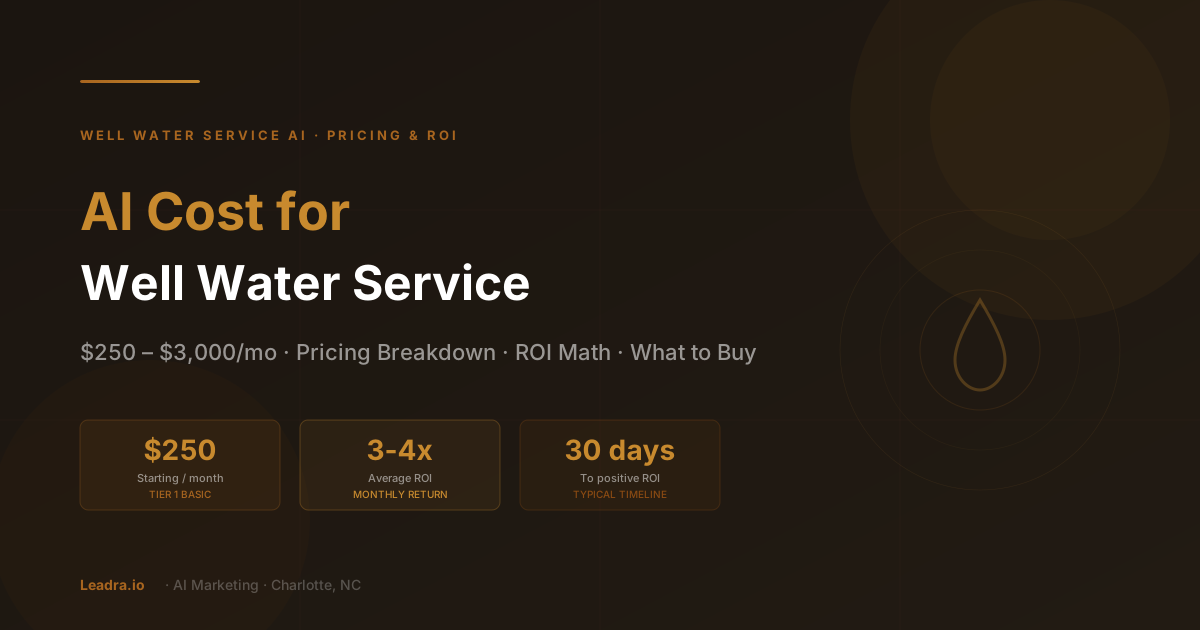
AI for well water service businesses costs between $250 and $3,000 per month depending on call volume, automation depth, and whether you need voice coverage or just SMS and email follow-up. This guide covers exactly what each pricing tier includes, what the ROI math looks like by job volume, what setup fees to expect, and what questions to ask any vendor before committing. By the end, you will know whether AI makes sense for your company and what a fair price looks like.
What Drives AI Cost for a Well Water Service Business
Well water service AI pricing varies because the scope of automation varies. Vendors price based on four variables:
- 01.Monthly call volume. A company fielding 15 calls a month sends far fewer automated touches than one fielding 60 during a summer drought or after a storm knocks out power to a cluster of wells. Vendors priced per message or per call can quietly double the headline rate once real volume hits. Always get a quote based on your actual monthly call count, not a plan that looks cheap on paper and scales into expensive territory the moment a storm rolls through.
- 02.Voice vs. SMS capability. AI voice agents that answer inbound calls after hours cost more than SMS-only systems. For well water service, voice matters most for true emergencies — a homeowner with no water at all is calling, not texting, and wants confirmation someone is coming, not a text they might not see for an hour. A company that stops answering calls at 5 PM is routing every evening emergency to voicemail, and that homeowner is calling the next name on the list within minutes.
- 03.Field service integration depth. Sending a generic “we got your message” text is not AI automation — it is an auto-responder. Real integration reads your live technician schedule, writes notes into your field service software (ServiceTitan, Housecall Pro, or Jobber), and triages symptoms — no water at all, pump not kicking on, pressure tank failure, storm-related outage — before a human ever touches the call. That two-way data sync is what makes emergency dispatch, testing reminders, and contract renewal work with specificity instead of generic blasts. It costs more to build and maintain, and vendors who skip it will give you a demo that impresses and a product that underdelivers on the first real emergency.
- 04.Automation breadth across the customer lifecycle. Missed-call text-back is cheap and widely available. Adding annual testing reminders, a maintenance contract renewal sequence, a dormant-customer reactivation campaign, seasonal storm-outage outreach, and review automation each layers cost — but each layer also compounds returns. A company running five automations is recovering revenue across five categories simultaneously instead of patching one leak at a time.
Why Well Water Service Has Unique AI Economics
The well water service business model differs from most home service trades in three ways that make AI both high-impact and specific in how it has to be deployed:
A no-water emergency has zero tolerance for delay, and the sales cycle rewards whoever answers first.
A well pump replacement or emergency repair can run $800 to $3,000 or more — one job can equal several routine service calls in revenue. But a homeowner with no water does not wait for a callback; they call the next company on the list within two minutes of getting voicemail. That response window is the shortest and most competitive moment in the entire relationship, and speed to answer is the single strongest predictor of who wins the job. A company without an after-hours AI agent to triage and confirm that call loses it to whichever competitor picks up first — every time.
Storms and drought create predictable, brutal call spikes.
Power outages after a storm knock out well pumps across an entire service area at once, and extended dry spells push well levels low enough to trigger a wave of low-pressure and no-water calls in the same week. Companies relying on a shared cell phone or a single dispatcher cannot keep up manually during these spikes and miss a large share of the calls entirely. An AI system that instantly triages every call during a surge — flagging true no-water emergencies for immediate dispatch while booking routine requests as next-available — captures demand that would otherwise sit unanswered for hours while the office is buried.
Recurring testing and maintenance revenue is easy to build and easy to lose without a system.
Annual water testing and pump maintenance contracts are the closest thing well water service has to predictable recurring revenue, but most companies test a well once and never build a system to remind that customer a year later. An AI reminder tied to each customer's actual service date turns a one-time test into an annual relationship — and the same logic applies to maintenance contract renewals, which lapse quietly when nobody is tracking expiration dates rather than customers actively choosing to leave.
AI Pricing Tiers for Well Water Service Companies
Here is how the market breaks down across three tiers. Most companies fielding over 20 service calls per month move to Tier 2 within the first 60 days once they see how many after-hours calls Tier 1 still leaves unconverted.
Basic Call & Review Automation
- ✓Missed-call text-back so no after-hours no-water call goes to voicemail unanswered
- ✓Automated quote request confirmation with next-available inspection slot
- ✓Post-job Google review request sequence
- ✓Basic customer tagging by service type and date
Best for
Single-crew companies handling under 20 service calls/month
ROI timeline
30–45 days from review volume and missed-call recovery
Standard AI Stack
- ✓Everything in Tier 1
- ✓24/7 AI SMS agent for after-hours symptom triage (no water, pump failure, low pressure)
- ✓Annual water testing reminder sequence tied to each customer's last service date
- ✓45-day maintenance contract renewal campaign (email, text, call fallback)
- ✓Dormant-customer reactivation campaign for lapsed well owners
- ✓Field service integration (ServiceTitan, Housecall Pro, or Jobber)
Best for
Companies fielding 20–60 service calls/month, $250k–$800k/yr revenue
ROI timeline
20–35 days — after-hours capture and quote follow-up pay fast
Full Emergency-Dispatch Engine
- ✓Everything in Tier 2
- ✓AI voice agent — answers inbound calls, runs symptom triage, and dispatches the on-call technician directly
- ✓Multi-crew routing logic based on job urgency and technician location
- ✓Custom CRM tagging (testing, pump repair, filtration, new well installation)
- ✓Automated seasonal campaigns (storm-season power-outage outreach, spring runoff contamination alerts)
- ✓Monthly reporting: call source attribution, emergency job conversion rate, average ticket trend
Best for
Multi-crew well water service companies doing $800k+/yr
ROI timeline
15–25 days — multiple recovery channels activate simultaneously
Setup Fees and Onboarding Costs
Every real AI system requires upfront configuration work. Budget for these costs beyond the monthly subscription:
| Component | Typical Cost | What It Covers |
|---|---|---|
| Field service integration (ServiceTitan, Housecall Pro, Jobber) | $300 – $900 | Connecting your dispatch software to the AI system so triage and scheduling trigger on real technician availability |
| AI voice agent configuration | $400 – $1,000 | Training the voice agent on emergency symptom checklists, service area, pricing ranges, and technician on-call rotation |
| Sequence copywriting and setup | $200 – $600 | Writing and loading the testing reminder, contract renewal, and reactivation message sequences |
| Contact and service history import | $100 – $300 | Migrating your existing customer list from spreadsheets, field service exports, or paper job tickets |
| Total typical setup range | $1,000 – $2,800 | One-time — legitimate vendors do not charge recurring setup fees after month one |
ROI Breakdown: What AI Recovers for a 40-Call-a-Month Company
The following projections are based on a two-crew well water service company fielding 40 service calls per month at a $650 average ticket. Adjust the numbers proportionally for your actual volume.
These are realistic ranges based on observed AI automation performance across home service and trade businesses. Individual results vary by market, service area size, and execution quality.
| Revenue Category | Assumption | Monthly Recovery |
|---|---|---|
| After-hours emergency call capture | 30% of no-water calls arrive after 6 PM — AI triages instantly, adding 3–5 recovered jobs/month at $650 avg | $1,800 – $3,200 |
| Instant quote request follow-up | 40% of quote requests stall without same-day follow-up — AI converts 15–20% more at $650 avg ticket | $900 – $1,600 |
| Annual testing rebooking | 400 past testing customers, automated 11-month reminder lifts rebooking rate by 3x | $500 – $900 |
| Maintenance contract renewal recovery | 45-day renewal sequence recovers 15–20 points of contract renewal rate previously lost to forgetting | $400 – $800 |
| Google review automation → ranking lift | 6–8 new reviews/month → stronger local pack position → more inbound emergency calls | $200 – $400 |
| Total estimated recovery | Full Tier 2–3 stack deployed | $3,800 – $6,900/mo |
Against a Tier 2 or Tier 3 system cost of $1,200–$2,200/mo including setup amortization, the net monthly return is $1,600 to $4,700. That is a 3x to 4x return in a category where paid ads alone typically deliver 1.5x to 2x — and unlike ad spend, every automation above compounds month over month as your customer database and review count grow.
Five Questions to Ask Any AI Vendor Before Signing
The AI automation market for small businesses is full of vendors selling template SMS sequences with an AI label on the box. These questions separate real systems from expensive auto-responders:
1.Does your system triage emergencies, or does it just send templates?
A real AI system asks the right symptom questions — no water at all, pump not kicking on, pressure tank failure — and dispatches accordingly. If the answer is a generic template with a name field, it is an auto-responder, not AI.
2.Can I hear a demo call of your voice agent handling a no-water emergency?
Any vendor selling AI voice should be able to play you a real call, not a scripted demo. Listen for how it handles a symptom the agent was not specifically trained on — that is where the quality gap shows.
3.How does billing scale during storm or drought call spikes?
Per-message or per-call pricing models that look affordable at 20 calls a month become expensive when a storm triples volume in a single week. Get a quote based on your projected peak-demand volume, not the base plan.
4.What happens to my customer data if I cancel?
Your customer list, service history, and testing dates belong to you. A legitimate vendor gives you a full export on cancellation. One that does not is holding your data hostage.
5.Do you have well water or home service trade clients I can speak with?
Well water service AI has specific requirements around emergency triage, seasonal timing, and technician dispatch. A vendor with no trade-industry references is learning on your budget.
AI for Well Water Service Companies in Charlotte, NC — What the Local Market Looks Like
Charlotte added over 40,000 residents between 2023 and 2025, and rural and exurban growth around Union, Cabarrus, and Lincoln counties keeps expanding the well-dependent household base right along with it. The Google Maps and directory competition for "well water service Charlotte NC" and "well pump repair near me" is getting more crowded every season.
Charlotte-area companies operating without after-hours call automation are falling behind competitors who answer every no-water emergency instantly, day or night. In a category where the homeowner calling first typically books whoever answers first, a response-time gap translates directly into fewer emergency jobs and a smaller share of the highest-ticket repairs.
The fastest-growing Charlotte-area well water service companies in 2025 and 2026 combined consistent review velocity with instant, always-on call answering. The pattern repeats: a company moves from missing calls during storms to landing consistently on the first page in 60 to 90 days by collecting reviews systematically, and then their AI agent captures the surge of emergency calls that the visibility lift drives in. The two systems feed each other — see how the full well water service marketing automation stack fits together, or check the AI receptionist guide for well water service to see the call-answering piece in detail.
Leadra.io works with well water service companies in Charlotte and across the country to build this exact system, alongside the broader AI lead generation approach we use for local service businesses. Book a free strategy call or call +1 (864) 721-8384 to see what the numbers look like for your call volume.
Your Next Steps — What to Do This Week
Audit your after-hours call loss.
Pull the last 30 days of calls from your office line and voicemail log. Count how many came in after 6 PM or on weekends. That number multiplied by your average ticket is your monthly after-hours job leak.
Count your unconverted quote requests.
How many website and Google Business Profile quote requests came in last month with no same-day follow-up? If a human did not reach out within a few hours, most of those are gone. That conversion gap is where mid-tier AI pays for itself fastest.
Check your review count vs. your top local competitor.
Search your category and city on Google. If a competitor has significantly more reviews than you, they are winning emergency call volume you are not seeing. Review automation closes this gap in 60 to 90 days.
Request quotes from two or three vendors — with your real call volume.
Use the five questions above. Get pricing at your actual monthly and peak-demand call count, not the entry-level plan. A legitimate vendor will give you a quote that scales honestly.
Frequently Asked Questions
How much does AI cost for a well water service business?
AI for a well water service business typically costs $250 to $3,000 per month. A basic setup covering missed-call text-back, automated quote confirmation, and post-job review requests runs $250–$600/mo. A mid-tier system adding a 24/7 AI SMS agent for after-hours symptom triage, an annual testing reminder campaign, and a maintenance contract renewal sequence runs $700–$1,500/mo. A full emergency-dispatch engine with a 24/7 AI voice agent, field service integration, dormant-customer reactivation, and monthly reporting runs $1,500–$3,000/mo. Companies fielding 15 or more emergency calls per month typically see positive ROI within 30 days from recovered after-hours jobs alone.
What is the ROI of AI automation for a well water service company?
For a two-crew well water service company handling 40 service calls a month at an average ticket of $650, a full AI stack typically recovers $3,800 to $6,900 per month in equivalent job value. The main categories are: after-hours emergency call capture ($1,800–$3,200/mo), instant quote follow-up ($900–$1,600/mo), annual testing rebooking ($500–$900/mo), maintenance contract renewal recovery ($400–$800/mo), and Google review automation that drives ranking and new inbound calls ($200–$400/mo). Against a system cost of $1,200–$2,200/mo, that is a 3x to 4x monthly return.
What does a well water service AI system actually include?
A well water service AI system typically includes: 24/7 automated call answering with symptom-based emergency triage (no water, pump failure, low pressure, storm-related outage), instant text and email confirmation for website and Google Business Profile quote requests, an annual water testing reminder sequence tied to each customer's last service date, a 45-day maintenance contract renewal campaign, an automated Google review request sent after every completed job, and CRM tagging by service type and last-service date. Integration with ServiceTitan, Housecall Pro, or Jobber is standard in mid and full-tier plans.
Is AI worth it for a small or single-crew well water service company?
Yes — even a single-crew well water service company is losing high-value emergency calls to after-hours response gaps and unfollowed quote requests. A basic AI system at $250–$450/mo that captures even two extra emergency jobs a month at a $650+ average ticket pays for itself several times over. Small and single-crew companies should start with a Tier 1 call-back and review automation setup, then add 24/7 voice coverage and a full reminder sequence once call volume exceeds 20 per month.
See What the Numbers Look Like for Your Company
Leadra.io builds AI call automation and emergency-dispatch growth systems for well water service companies. We will show you the exact ROI math for your call volume — free, no obligation.
Written by the Leadra.io Team. Leadra.io is an AI marketing agency helping well water service companies and small businesses grow using AI-powered automation, call handling, and lead generation systems. Based in Charlotte, NC — serving clients nationwide.