AI Lead Generation for Insurance Agencies: 30+ Qualified Prospects Per Month (2026 Guide)
Most insurance agencies are fighting over the same shared leads from EverQuote, QuoteWizard, and Datalot — paying $30-$150 per lead and competing against 4-7 other agents on the same prospect. AI for insurance agencies' lead generation fixes that by building a pipeline you own.
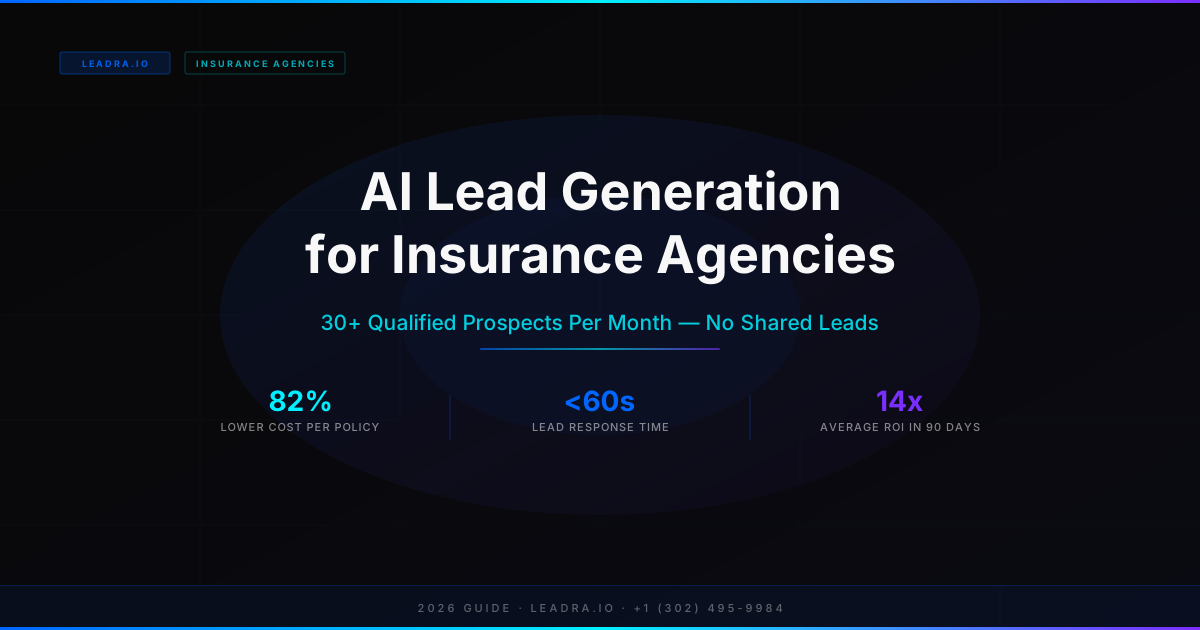
An independent insurance agency in south Charlotte was spending $4,200 per month on shared leads. Average cost per lead: $68. Leads sold to 5-6 other agents simultaneously. Close rate on those leads: 11%. Cost per new policy: $618. It was profitable, barely — but every month felt like running faster to stay in the same place.
They deployed a 5-component AI lead generation system. Ninety days later: 34 new policies written from AI-generated leads, no shared-lead budget, and a cost per acquired policy under $110. This guide breaks down exactly how that system works and how to build one for your agency.
The insurance market in 2026 is shifting fast. Prospects search for coverage online, compare quotes after hours, and make decisions faster than ever. Agencies that respond in minutes win. Agencies that respond the next business day lose. AI bridges that gap — 24/7, at scale, without adding headcount.
Why Insurance Lead Generation Fails Without AI
Insurance lead generation has three structural problems that manual systems can't solve:
AI for insurance agencies' lead generation solves all three. It responds in under 60 seconds, builds a first-party pipeline the agency owns outright, and maintains follow-up cadence for every prospect automatically. See how AI lead generation works for other local service businesses.
The 5-Component AI Lead Generation System for Insurance Agencies
A complete AI lead generation system for insurance agencies isn't one tool — it's five integrated components working together. Here's what each one does and why all five are required for a self-sustaining pipeline:
Most insurance prospects start with a Google search: 'best homeowners insurance Charlotte NC,' 'auto insurance quotes south Charlotte,' 'commercial liability insurance small business Charlotte.' An AI content engine publishes 4-8 hyperlocal blog posts per month targeting these long-tail keywords — covering coverage questions, local rate factors, claim scenarios, and policy comparisons. Over 90-120 days, the agency begins ranking for dozens of high-intent searches and capturing organic leads that cost nothing per click. This is the foundation that makes every other component more efficient.
Every prospect who calls after hours, submits a contact form, or texts the agency number gets an immediate AI response — within 60 seconds. The AI conducts a structured intake: coverage type needed, current carrier, approximate premium, timeline, and whether they're the decision-maker. Qualified prospects get booked directly into the agent's calendar. Prospects who aren't ready yet go into a 90-day nurture sequence. This captures the large segment of insurance shoppers who search and reach out between 5 PM and 10 PM on weekdays and on weekends — the window where most agencies have zero coverage.
When a prospect doesn't commit on the first contact, they don't disappear — they go into a structured follow-up sequence. Day 1: same-day callback from the AI. Day 3: educational SMS about the specific coverage type they inquired about. Day 7: email with a local rate comparison. Day 14: AI voice call checking in. Day 30: monthly check-in offer. Day 60: re-qualification call. Day 90: final reactivation attempt with a rate update. Most policies are written from leads that were 'not ready' on first contact. This sequence is what captures them when the timing changes.
Referrals are the highest-closing, lowest-cost leads in insurance — they close at 3-5x the rate of cold leads and arrive pre-trusting the agency. The problem is most agencies ask for referrals inconsistently, awkwardly, and at the wrong moment. AI referral automation sends a structured referral request to every new client 7 days after policy binding — the peak satisfaction window. It sends a second request 30 days later. It resurfaces a referral ask during the annual renewal review. Agencies with systematic referral automation generate 30-50% of new leads from their existing book, at effectively zero acquisition cost.
Insurance prospects research agencies on Google before calling. A profile with 4.8 stars and 80 reviews gets 3-4x more calls than a profile with 3.9 stars and 12 reviews — even when the inferior agency ranks higher in the local pack. AI review generation sends an SMS review request to every client 2-3 days after a positive service interaction: policy binding, claim resolution, successful rate review, or renewal with savings. Agencies that automate this process typically accumulate 40-80 five-star reviews in the first 90 days, permanently improving their local search click-through rate and trust signals.
Each component generates leads on its own. Together, they compound — the SEO engine drives inbound prospects, the AI agent captures and qualifies them instantly, follow-up sequences close the ones who need time, referral automation grows the book from within, and reviews improve the organic conversion rate on every new prospect who finds the agency.
Manual vs AI Lead Generation for Insurance Agencies
Here's how the two approaches compare across the metrics that determine whether an insurance agency grows or stagnates:
| Factor | Manual / Aggregator Leads | AI Lead Generation |
|---|---|---|
| Speed to first contact | 15 min – next day (business hours only) | Under 60 seconds, 24/7/365 |
| Lead exclusivity | Shared with 4-8 competing agents | 100% exclusive — you own the pipeline |
| Cost per lead | $30 – $150 (aggregator price) | $8 – $35 (fully loaded AI system cost) |
| After-hours coverage | None — voicemail or missed call | Full coverage — every lead captured |
| Follow-up consistency | 1-2 attempts, then dropped | 90-day automated multi-touch sequence |
| Referral generation | Ad hoc — when agents remember | Systematic — every client at peak moment |
| Close rate on leads | 8 – 15% (shared, cold leads) | 22 – 38% (exclusive, qualified, fast response) |
| Scalability | More volume = more staff cost | Handles 5x volume with no headcount change |
The close rate difference is the compounding variable. An agency writing 30 new policies per month from AI-generated leads at a 30% close rate needs 100 qualified conversations. At a 10% close rate on shared leads, they need 300 — and pay 3x more per conversation while competing against 5 other agents on each one.
Case Study: Charlotte Independent Agency Cuts Acquisition Cost by 82% in 90 Days
A 4-agent independent P&C agency in south Charlotte — personal lines (auto, home, umbrella) plus small commercial accounts — came to Leadra.io with a lead cost problem. They were spending $5,100/month on shared leads from two aggregators, writing an average of 18 new policies per month, and watching close rates erode as more agencies entered the Charlotte market and the lead pools got more competitive.
Before AI — Month 0
- —$5,100/month in aggregator lead spend
- —75 leads/month (shared with 4-6 competitors per lead)
- —18 new policies written (24% close rate on a good month)
- —$283/month in new premium per policy (auto + home bundle)
- —Cost per new policy: $283 (lead cost alone)
- —0 systematic referral process — ad hoc only
- —Google profile: 3.7 stars, 14 reviews
We deployed all five system components over 12 business days. The AI content engine started publishing 6 hyperlocal articles per month targeting Charlotte-area auto, home, and commercial insurance keywords. The 24/7 AI voice agent went live on their main number and website chat. The follow-up sequences were built out for their three primary product lines. The referral automation went to their existing 340-policy book. The review generation system launched to new clients immediately after binding.
Month one results were modest — the SEO component takes 60-90 days to mature. But the AI voice agent immediately recovered the after-hours and weekend leads that were previously going to voicemail. In the first month, it handled 31 after-hours contacts that would have been missed. Of those, 14 booked appointments and 9 became new policies.
By month three, the full system was producing. The Google profile had accumulated 61 five-star reviews (from 14 prior). Organic leads from the content engine started arriving: 22 inbound contacts in month three directly from blog content. The referral automation had generated 11 referral leads from the existing book — at zero additional acquisition cost. The shared lead budget was cut to $1,000/month as a supplement.
New policies/month
Cost per new policy
Monthly lead spend
Google reviews
34 new policies per month at an average of $1,420 in first-year premium: $48,280 in new premium volume per month, up from $27,900 (18 policies at $1,550 average — the mix had shifted toward higher-value commercial accounts the AI captured from organic search). The AI system cost $2,100/month. Total acquisition cost including the remaining aggregator budget and AI system: $3,100/month. Cost per new policy: $91. ROI: 14.2x by month three.
The agency principal's comment: "We spent 5 years chasing leads we were sharing with half the agencies in Charlotte. Now prospects call us specifically — they read an article we published, or a client referred them, or they saw our reviews. The quality of every conversation is completely different when someone chose you before they picked up the phone."
What AI Lead Generation Costs for Insurance Agencies in 2026
Pricing depends on agency size, monthly lead volume targets, and how many components you need to deploy. Here are the three standard configurations:
- —24/7 AI voice agent on your main number (nights, weekends, holidays)
- —Website chat and SMS lead capture with immediate AI response
- —Structured intake: coverage type, current carrier, timeline, decision-maker
- —Qualified leads auto-booked into agents' calendars
- —60-day automated follow-up sequences for not-yet-ready prospects
- —Appointment confirmation and reminder texts
- —CRM sync (Applied Epic, AMS360, HubSpot, or custom)
Best for: Agencies with 1-3 agents that want to capture what they're currently losing to voicemail and slow response time
- —Everything in Foundation tier
- —AI local SEO content engine — 6-8 articles/month targeting local insurance keywords
- —Google Business Profile review generation automation
- —Referral request automation for existing book (at binding, 30 days, renewal)
- —90-day nurture sequences by product line (auto, home, commercial)
- —Monthly lead source attribution report
- —Handles 75-150 lead intakes/month
Best for: Independent agencies with 3-8 agents ready to replace or significantly reduce aggregator spend with a first-party pipeline
- —Everything in Growth tier
- —Commercial lines outreach automation — small business owner targeting
- —Medicare/AEP seasonal campaign capability
- —Dormant prospect reactivation — AI re-engagement of leads from prior 6-12 months
- —Agency referral partner network automation (mortgage brokers, realtors, CPAs)
- —Competitive displacement campaigns targeting policyholders at renewal
- —Unlimited lead intakes and follow-up sequences
Best for: Agencies with 8+ agents pursuing aggressive growth across personal and commercial lines, or agencies targeting commercial account acquisition specifically
At an average first-year premium of $1,200-$2,400 per personal lines policy and $3,000-$8,000 for small commercial accounts, most agencies recover the full system cost from 3-5 additional policies written per month. The compounding effect of referrals and organic leads means the cost per new policy drops month over month as the system matures.
See the full AI implementation cost breakdown for service businesses if you want to understand how this fits into a broader technology investment for your agency.
How to Set Up AI Lead Generation for Your Insurance Agency
Implementation takes 10-14 business days from start to live system. Here's the standard setup sequence:
1. Audit your current lead sources and close rates.
Before building anything, map where your current leads come from (aggregators, referrals, organic, Google Ads, walk-in) and what you close on each source. Most agencies discover that referral and organic leads close at 3-5x their aggregator close rate but represent under 20% of their total volume. The audit determines which system components will generate the highest immediate ROI and in what order to deploy them. This takes one working session with your lead agent.
2. Configure the AI voice agent for your product lines.
The AI intake conversation needs to be calibrated to the specific questions that determine quote readiness for your product mix. For auto: current carrier, vehicles, drivers, major violations in last 3 years, homeowner status (bundle discount). For home: property age, construction type, current carrier, coverage lapse history. For commercial: business type, revenue range, number of employees, current coverage, renewal date. This calibration takes 3-4 hours and determines whether your AI captures qualified leads or just contact information.
3. Connect to your AMS and calendar.
The AI writes structured lead records to your agency management system (Applied Epic, AMS360, EZLynx, or HubSpot) and books directly into agents' calendars by product specialization or capacity. If you have multiple agents handling different lines, routing rules determine which agent's calendar receives which lead type. Setup includes buffer rules (minimum response time, maximum daily appointments per agent) and overflow handling (what happens if all agents are at capacity). Integration takes 3-5 business days.
4. Build follow-up sequences by product line and buyer stage.
Different insurance prospects need different nurture tracks. A homeowner who just bought a house needs immediate follow-up on home insurance with a same-day callback. A prospect who's mid-term with their current carrier needs a 90-day nurture until their renewal window opens. A small business owner researching commercial coverage needs educational content about liability, workers comp, and commercial auto. Build distinct sequences for each major product line and each stage: immediate, 30-day, 60-day, and renewal-window reactivation.
5. Launch referral automation and review generation simultaneously.
On the same day the inbound system goes live, activate the referral request automation for your existing book. The first batch goes to clients who received positive service in the past 90 days — policy changes, claims that resolved well, renewals with savings. Configure the review generation to trigger automatically 48 hours after every new policy binding. Within 30 days you should see both new referral leads arriving and your Google star rating beginning to climb. Most agencies see their first referral from the automated system within 2 weeks of launch.
The system goes live in two phases: the AI voice agent and follow-up sequences deploy in week one (immediate ROI from captured leads). The SEO content engine, referral automation, and review generation deploy in week two (builds over 60-120 days into compounding organic growth). You don't need to change your quoting process, your carriers, or your current workflows — the AI sits between the prospect and your agent, handling the capture and qualification layer. See the broader AI lead generation playbook for service businesses.
Frequently Asked Questions
How does AI help insurance agencies generate more leads?
AI helps insurance agencies generate more leads through five integrated systems: an AI local SEO content engine that puts the agency in front of prospects searching for coverage; a 24/7 AI voice and SMS agent that captures and qualifies every inbound inquiry immediately; automated multi-touch follow-up sequences that pursue warm leads for 60-90 days without agent time; referral request automation that systematically generates introductions from the existing book; and Google Business Profile review generation that improves local search ranking and trust. Together, these systems generate 25-50 qualified appointments per month without buying shared leads from aggregators.
What is the ROI of AI lead generation for insurance agencies?
The ROI of AI lead generation for insurance agencies is typically 8x-18x within 90 days. A mid-size agency adding 12-20 new policies per month from AI-generated leads, at an average of $1,800 in first-year premium, captures $21,600-$36,000 in new monthly premium volume. The AI system costs $800-$3,500/month. Most agencies reach positive ROI in the first 30-45 days from new policies written. The compounding effect of retained policyholders — renewals, cross-sells, and referrals — makes the lifetime ROI significantly higher than the first-year calculation.
How fast does AI respond to insurance leads compared to a human agent?
AI responds to insurance leads in under 60 seconds, regardless of time of day or how many leads arrive simultaneously. Human agents typically respond in 15 minutes to 4 hours during business hours, and not at all on nights and weekends. Research consistently shows that contacting a lead within 5 minutes increases conversion probability by 21x compared to waiting 30 minutes. For insurance specifically, a large portion of prospects shop and submit quote requests after work hours — the window where most agencies have zero coverage. AI captures every one of those leads before a competitor does.
What types of insurance agencies benefit most from AI lead generation?
Independent insurance agencies with 2-15 licensed agents benefit most from AI lead generation. This includes independent P&C agencies (auto, home, umbrella), life and health agencies targeting individuals and families, commercial lines agencies serving small and mid-size businesses, and Medicare/AEP-focused agencies that need to scale outreach seasonally. The one profile that benefits least is a brand-new solo agent with no existing book — they need both the system and a budget for inbound lead generation to feed it. Established agencies with an existing book of 100+ policies benefit fastest because the referral and review components activate an asset they already have.
The insurance agencies winning in 2026 aren't buying more leads — they're building pipelines they own. AI for insurance agencies' lead generation replaces the shared-lead treadmill with a compounding system: organic search brings in first-party prospects, AI captures them in under 60 seconds, follow-up sequences close the ones who need time, referral automation grows the book from within, and reviews compound the trust signals that make every future lead convert better.
At Leadra.io, we build AI lead generation systems for independent insurance agencies across Charlotte and the Carolinas. Setup is 10-14 business days. The system works on your existing phone number, website, and agency management software. Most agencies see their first AI-captured lead in the first week of going live.
Built for Insurance Agencies
Stop Competing on Shared Leads
We'll build your AI lead generation system in 10-14 days. Every inbound lead captured in under 60 seconds. Every prospect followed up for 90 days. Your existing book generating referrals automatically. First-party leads that close at 3x the rate of anything you're buying from an aggregator.