The average tutoring business is leaking revenue from three places at once: inquiry calls that go unanswered after hours, no-shows that leave paid slots empty, and students who drift away between academic seasons and never come back.
According to data from the tutoring industry, 40-60% of new student inquiries happen outside business hours. Parents searching for a SAT prep tutor at 10 PM don't wait until Monday morning for a callback — they book with whoever responds first. At the same time, no-show rates at tutoring centers average 18-25% without automated reminders. And student churn between academic milestones — after finals, after a test, during summer — accounts for 50-70% of a tutoring business's annual revenue loss.
AI automation fixes all three failures simultaneously. An AI lead capture system answers every inquiry within 60 seconds, qualifies the student, and books a trial session before a parent can call a competitor. An AI scheduling system sends reminders that drop no-shows from 25% to under 8%. And an AI retention system keeps students booked through academic transitions instead of letting them drift out.
This guide covers exactly how AI works for tutoring businesses in 2026, what a five-component system looks like, and the results a Charlotte tutoring center produced in their first 90 days running it.
Why Tutoring Businesses Lose Students — and Revenue — to Preventable Problems
Tutoring businesses face a unique growth problem: demand is consistent, but operations are fragile. A single no-show, an unanswered inquiry, or a student who forgets to rebook after spring break can represent $240-$480 in lost revenue from one interaction. Multiply that across 50-100 students per month and the leaks add up fast.
Inquiry calls missed after hours
Most tutoring centers operate 9 AM to 7 PM. Parents research tutoring options in the evening, after dinner, while their student is doing homework and the frustration is fresh. A parent who can't reach anyone after 7 PM doesn't leave a voicemail and wait — they move to the next option in their search results. The tutoring business never even knows the inquiry happened.
No-shows treated as a cost of doing business
A 20% no-show rate sounds abstract until you do the math: at $100/session and 60 sessions per week, that's 12 empty slots per week — $1,200 in lost revenue every seven days. Manual reminder calls take staff time, reach voicemail more than half the time, and have no systematic follow-up. Most tutoring owners accept no-shows as inevitable when they're actually highly preventable with a structured reminder sequence.
Student churn between academic cycles
Students disappear at predictable moments: after finals, after the SAT, when summer starts, at the new school year. These aren't organic dropoffs — they're gaps where the tutoring relationship has no momentum carrying it forward. A student who finishes AP prep in May and doesn't hear from the tutoring center until August has already enrolled somewhere else or decided they don't need help. Proactive outreach timed to the academic calendar recovers a significant portion of this seasonal churn.
AI automation addresses each failure at the source. It doesn't require hiring another admin, building a manual follow-up process, or hoping tutors remember to send reminder texts. The system runs every check, reminder, and outreach automatically — every day, including nights and weekends.
The 5-Component AI System for Tutoring Businesses
Here's the full AI system Leadra.io deploys for tutoring centers and independent tutors. Each component targets a specific revenue leak — together they cover the full student lifecycle from first inquiry to long-term retention.
24/7 AI lead capture and inquiry qualification
When a parent calls or texts at 9 PM about SAT prep for their 10th grader, most tutoring businesses send them to voicemail. An AI lead capture agent answers immediately, asks qualifying questions — subject, grade level, schedule preference, urgency — and books a trial session or schedules a 10-minute consultation call before the parent has time to Google a competitor. Response time is the single biggest factor in converting education inquiries. Parents researching tutors contact 3-4 providers simultaneously. The first to respond with a clear answer and a booking confirmation wins the student.
Automated session reminders and no-show prevention
No-shows cost the average tutoring business $800-$2,400 per month in lost revenue — sessions that were paid for or could have been filled by a waitlisted student. An AI no-show prevention system sends a personalized reminder 48 hours before the session via SMS, another 24 hours out with a one-tap confirm link, and a same-day check-in 2 hours before. Students or parents who don't confirm trigger an automatic follow-up. Waitlisted students get notified the moment a cancellation opens up. Most tutoring centers see no-show rates drop from 20-30% to under 8% within the first 30 days.
Post-session rebooking and retention sequences
The highest-churn moment in a tutoring relationship is the gap between completed sessions. When a student finishes a session and doesn't rebook within 48 hours, the probability they book again drops by 40% each additional day. An AI retention sequence sends a personalized post-session message within 2 hours, references what was covered, and includes a direct rebooking link. For recurring students, it also sends a weekly progress check-in that keeps parents engaged between sessions — reducing the 'we just stopped because life got busy' churn that accounts for 60% of tutoring cancellations.
Lapsed student reactivation campaigns
Most tutoring businesses have a graveyard of students who completed a course, stopped coming after a test, or drifted away during a school break — and never returned. An AI reactivation system identifies students who haven't booked in 30, 60, or 90+ days, segments them by subject and grade level, and sends personalized outreach tied to upcoming academic milestones: midterms, standardized tests, new school year prep, college application season. Timing outreach to academic urgency windows produces 3-4x better reactivation rates than generic 'we miss you' campaigns.
Review generation and local SEO content engine
Parents choosing a tutoring business search Google first. The difference between a tutoring center with 12 reviews and one with 140 is not reputation — it's whether they have a system that asks for reviews at the right moment. An AI review generation system sends a review request via SMS 24 hours after a positive session outcome, includes a direct Google review link, and follows up once for non-responders. Combined with an AI-managed local SEO content engine publishing keyword-targeted blog posts on Charlotte tutoring topics, this produces a consistent flow of organic search visibility that compounds over time.
System Design Note
Components 1 and 2 (lead capture and no-show prevention) typically produce ROI within the first 30 days because they recover revenue that was already being lost. Components 3-5 (retention, reactivation, and SEO) compound over time — the longer they run, the higher the recurring student base and the lower the cost per new student acquisition.
Manual Operations vs. AI: What the Numbers Look Like
Here's a direct comparison of what a tutoring business running manual operations produces versus one with an AI automation system:
| Factor | Manual Operations | AI System |
|---|---|---|
| After-hours inquiry response | Voicemail, next-day callback | Instant AI response, books trial session |
| Lead response time | 2-24 hours average | Under 60 seconds, 24/7 |
| No-show rate | 20-30% of sessions | Under 8% with AI reminders |
| Post-session rebooking | Staff follow-up, often forgotten | Auto within 2 hours of session end |
| Lapsed student outreach | Occasional email, generic content | Timed to academic milestones, personalized |
| Google review collection | Manual ask, low follow-through | Automated after positive sessions |
| Admin hours per week | 10-20 hours (scheduling, reminders, follow-up) | Under 2 hours (oversight only) |
| Monthly system cost | $0 (but $2,400+ in lost revenue) | $600-$3,500 |
The hidden cost in the left column isn't the $0 line item — it's the $2,400+ in lost revenue per month from no-shows, missed inquiries, and lapsed students. For a tutoring center billing $100/session with 60 weekly sessions, that gap often represents 15-20% of total revenue sitting on the table with no system to capture it.
Case Study: Charlotte Tutoring Center Goes From 67% to 91% Schedule Utilization in 90 Days
Client Story — Charlotte, NC
A tutoring center in Charlotte's Ballantyne area came to Leadra.io in early 2026 with eight tutors, 74 active students, and a no-show rate of 22%. The owner was spending 12-15 hours per week on administrative work — scheduling, reminder calls, parent follow-ups, and chasing lapsed students before exam season. Revenue had plateaued at $28,400/month despite consistent inquiry volume.
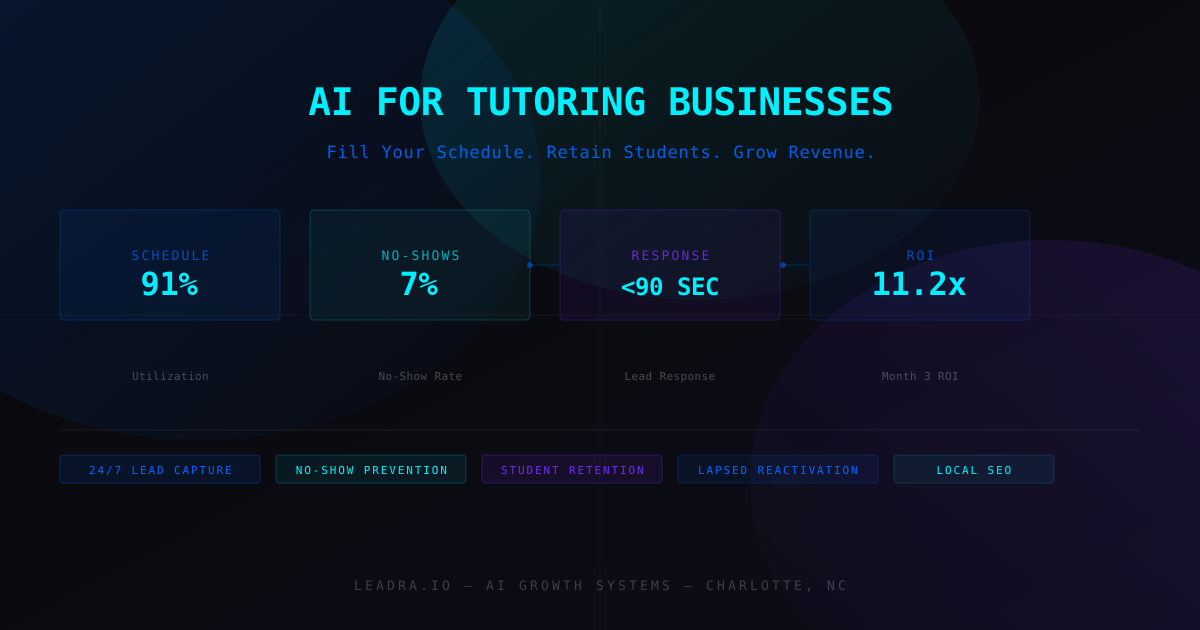
We deployed all five AI components over a 5-day setup period. The 24/7 AI lead capture agent was live within 48 hours and immediately started handling after-hours inquiries — capturing 11 new student bookings in the first week that the owner confirmed would have previously gone to voicemail. The no-show prevention sequence dropped the miss rate from 22% to 7% within the first 30 days. The lapsed student reactivation campaign ran against 41 students who hadn't booked in 45+ days, timed to upcoming AP exams — 18 of them rebooked within two weeks.
Schedule utilization
67%
91%
Monthly no-show rate
22%
7%
Lapsed students recovered
18 of 41
Monthly revenue
$28,400
$44,100
System cost: $1,400/month · Revenue increase: +$15,700/month · Month 3 ROI: 11.2x. Owner reduced admin time from 12-15 hours/week to under 2 hours. Lead response time went from 14 hours average to under 90 seconds.
The most significant behavioral change was in how the owner spent her time. Before the AI system, she was functioning as a full-time administrator who also happened to run a tutoring business. After the system was live, she spent those 12-15 weekly hours on tutor training, curriculum development, and selling higher-ticket packages — the work that actually scales a tutoring business instead of just maintaining it.
The local SEO content engine published six blog posts targeting Charlotte-specific tutoring keywords in the first 90 days. By day 87, three posts appeared in Google AI Overviews for queries like "SAT prep tutoring Ballantyne" and "AP Chemistry tutor Charlotte NC" — generating organic inquiries that previously required paid ad spend.
How to Implement AI at Your Tutoring Business: 3 Steps
The implementation process is straightforward — most tutoring businesses are running their first automated campaigns within a week. Here's the path Leadra.io uses:
Audit your current revenue leaks
Before deploying any automation, calculate the actual dollar value of your three main leaks. Pull last month's inquiry log: how many came after 7 PM? How many went unanswered? Pull your session data: what was your no-show rate and what's the per-session dollar value of each empty slot? Pull your student list: how many haven't booked in 30+ days? For most tutoring centers, this audit reveals $3,000-$8,000 per month in recoverable revenue — which gives you a clear ROI baseline before you spend anything on a system.
Connect your scheduling platform and go live on components 1 and 2
Leadra.io integrates with Acuity, Calendly, TutorBird, WhenIWork, and most scheduling systems via API. The AI lead capture agent is configured with your subject offerings, tutor availability, session pricing, and FAQ answers about your curriculum and approach. Setup takes 48-72 hours. The no-show prevention sequences are configured with your preferred reminder timing and confirmation method. Most tutoring businesses see the first measurable results — a no-show prevented, an after-hours inquiry booked — within the first 72 hours of going live.
Layer in retention, reactivation, and SEO in weeks 2-4
After the immediate revenue recovery components are running, we deploy the post-session rebooking sequences, lapsed student reactivation campaigns (timed to your next academic milestone — an upcoming SAT date, midterms, or the start of a new semester), and the review generation system. The local SEO content engine starts publishing tutoring-focused keyword content in week 3. Each component builds on the others — a student retained by the post-session sequence is a student who generates a review, who becomes an SEO signal, who brings in a referral through the organic search content.
For tutoring businesses with specific scheduling or CRM setups, see also: AI lead generation for local businesses and AI implementation costs for Charlotte small businesses for related context on budgeting and ROI expectations.
The Revenue Math: Why AI Pays for Itself in the First Month
A tutoring business billing $100/session with 60 active weekly sessions has a theoretical weekly revenue ceiling of $6,000. At a 22% no-show rate, that's 13 empty slots per week — $1,300 in lost revenue every seven days. Over a month, that's $5,200 gone before the business even reaches its actual capacity.
An AI no-show prevention system at $800/month that drops the miss rate from 22% to 8% recovers 8-9 sessions per week — $800-$900 in weekly revenue, or $3,200-$3,600 per month. That single component alone produces a 4-4.5x return on the full system cost. Add the revenue from after-hours leads captured (3-5 new students per month is typical), lapsed student reactivations, and reduced admin time — and the full ROI picture for a mid-size tutoring center is typically 8-14x within 90 days.
The compounding factor is the SEO content engine. Paid ads for tutoring keywords in competitive markets like Charlotte run $8-$20 per click, with conversion rates of 3-7% — meaning $200-$500 per acquired student from paid traffic. An organic search ranking on "SAT tutor Ballantyne NC" or "math tutoring Charlotte" produces the same inquiry at a fraction of the cost and keeps generating leads without additional ad spend every month.
Frequently Asked Questions
How does AI help tutoring businesses get more students?
AI helps tutoring businesses acquire more students by answering inquiry calls and texts 24/7, qualifying leads based on subject, grade level, and scheduling availability, and booking a first session before a parent has time to call a competitor. Traditional tutoring centers miss 40-60% of after-hours inquiries because no one is available to respond within the critical first 5 minutes. An AI lead capture system responds instantly, answers parent questions about curriculum and tutor backgrounds, and routes the inquiry to a booking confirmation — cutting time-to-booking from days to minutes.
Can AI handle scheduling and booking for a tutoring center?
Yes. AI scheduling systems for tutoring businesses integrate with scheduling platforms like Acuity, Calendly, TutorBird, or custom systems via API or webhook. The AI handles inbound booking requests, sends automated session reminders 48 and 24 hours before each appointment, fills last-minute cancellation slots by texting the waitlist, and triggers a rebooking nudge after each completed session. For tutoring centers with 10 or more active students, this eliminates 80-90% of manual scheduling coordination.
How much does an AI system for a tutoring business cost?
AI systems for tutoring businesses typically cost between $600 and $3,500 per month depending on student volume, the number of automation components deployed, and whether AI voice outreach is included. Entry-level systems covering lead capture and scheduling automation start around $600/month. Full systems with student retention campaigns, lapsed student reactivation, and review generation run $1,500-$3,500/month. For a tutoring center billing $80-$120/session, recovering 10-15 lost sessions per month more than covers the system cost in the first cycle.
Does AI for tutoring businesses work for independent tutors or just large learning centers?
AI automation works for both independent tutors and multi-tutor learning centers, though the highest-ROI use cases scale with volume. An independent tutor managing 15-25 students benefits most from lead capture automation and no-show prevention — recovering 2-4 missed sessions per month at $80-$120 each pays for basic automation immediately. Tutoring centers with 50+ active students benefit from the full system: lead qualification, scheduling automation, student retention sequences, lapsed student reactivation, and review generation. Leadra.io configures systems scaled to your student count and session volume.
Your Schedule Has More Capacity Than You Think — AI Fills It
Most tutoring businesses aren't short on demand. They're short on systems to capture that demand when it shows up at 9 PM, to keep students booked through the academic calendar, and to win back the ones who drifted away last semester.
AI automation removes the manual bottlenecks that cause those failures. Inquiries get answered instantly. Reminders go out automatically. Lapsed students hear from you when exam pressure is highest. Reviews get collected without anyone on staff having to ask. And while all of that runs in the background, your tutors focus on teaching — not admin work — and you focus on growing the business instead of maintaining it.
Leadra.io builds and manages AI growth systems for tutoring businesses, learning centers, and education service providers. We back every engagement with a results guarantee — if the system doesn't produce measurable improvements in schedule utilization and student retention, you don't pay.
Free Revenue Audit
See Exactly How Much Revenue Your Tutoring Business Is Losing — and How to Recover It
30-minute audit. We'll analyze your inquiry capture rate, no-show rate, and lapsed student count — and show you the exact dollar value of an AI system before you commit to anything.
Leadra.io
AI marketing agency — Charlotte, NC · Published June 3, 2026