Most local service businesses are not losing leads because their service is bad. They're losing leads because no one answered the phone at 7 PM on a Tuesday, or because a competitor texted back in 4 minutes while they got around to it the next morning.
Research from Harvard Business Review found that leads contacted within 5 minutes of inquiry are 21 times more likely to convert than leads contacted after 30 minutes. For a plumber, HVAC technician, or dental practice fielding 30-80 inquiries per month, that gap in response time is the difference between a full calendar and an empty one.
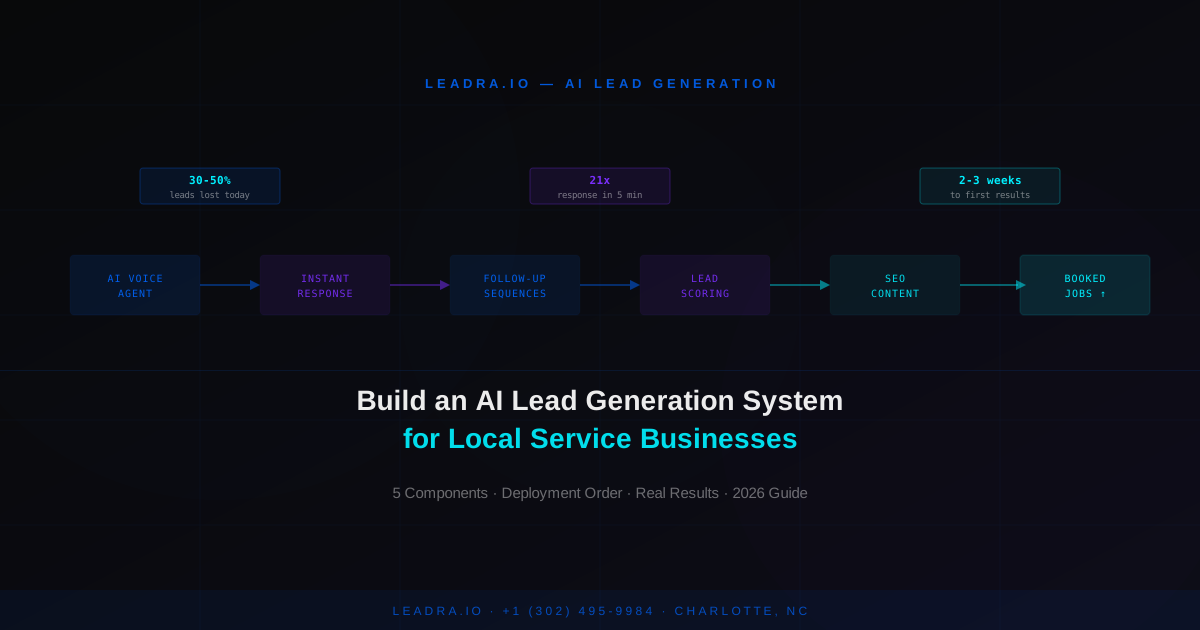
This guide breaks down exactly how to build an AI lead generation system for local service businesses— the five components it needs, how to deploy them in the right order, and what results look like at 30, 60, and 90 days. At Leadra.io, we've built this system for plumbers in Charlotte, dentists in Denver, and HVAC companies from Philadelphia to Portland. The fundamentals are the same everywhere.
Why Local Service Businesses Lose 30-50% of Their Leads Before the Sale Even Starts
Local service businesses have a structural disadvantage that most owners don't quantify until they see the data. Here's what's happening:
Calls outside business hours go unanswered.
According to CallRail data, over 40% of calls to local service businesses arrive outside 9-to-5 hours. Of callers who reach voicemail, fewer than 1 in 5 leave a message. The rest hang up and call the next result on Google.
Web form leads go cold within minutes.
The average local service business responds to a web inquiry in 3-5 hours. By then, the prospect has already had a conversation with someone else. Speed-to-response is the single biggest variable in local lead conversion — more than price, reputation, or reviews.
Manual follow-up is inconsistent.
When a busy technician or office manager handles follow-up between jobs, it happens once — maybe twice. The industry average is 1.3 follow-up attempts per lead. The research shows it typically takes 5-8 touches to convert a qualified local service lead. The gap between 1.3 and 7 is where the revenue is.
There is no system — only habits.
Most local service businesses run their lead process on memory, sticky notes, and text history. When the owner is on a job, leads wait. When the office manager is sick, leads fall through entirely. There is no consistent pipeline — just individual heroics that don't scale.
The good news: every one of these problems is solved by the same system. You don't need a bigger team or a bigger ad budget. You need a machine that runs the lead process consistently whether you're on a job, asleep, or on vacation.
The 5 Components of a High-Performance AI Lead Generation System
A complete AI lead generation system for local service businessesis not one tool. It's five layers that work together — each one solving a specific leak in your current pipeline.
AI Voice Agent
An AI voice agent answers every call — including after-hours, weekend, and holiday calls — in under 2 rings. It greets callers with your business name, asks qualifying questions (what service do you need, what's your zip code, is this an emergency), collects contact information, and either books an appointment directly or routes the call to your team if available.
This layer alone captures 30-50% more leads than a business running voicemail. Setup uses your existing phone number — callers don't know they're talking to AI unless you want them to. Most implementations go live in 72 hours.
Instant SMS + Email Response
For web form submissions, Facebook lead ads, and any lead source that isn't a phone call — the AI system sends a personalized SMS within 90 seconds and a detailed email within 3 minutes. Not a generic autoresponder. A response that references the specific service they inquired about, offers two or three appointment time slots, and includes a direct link to book.
Speed matters more than the message here. Getting to a local prospect in 90 seconds versus 3 hours changes your close rate more than any copy optimization.
Multi-Step Follow-Up Sequences
Most leads don't book on the first touch. Your AI system needs a sequence that follows up automatically over 10-14 days — mixing SMS, email, and (for high-ticket services) voicemail drops. A standard sequence includes 7 touchpoints: day 0 (immediate), day 1, day 3, day 5, day 7, day 10, day 14.
Each message varies in channel and content — a mix of service reminders, social proof (a recent 5-star review), and a direct booking link. The sequence stops automatically the moment a lead books. No manual management required.
AI Lead Scoring and CRM Routing
Not all leads are equal. An AI lead scoring layer tags each incoming lead based on service type, location match, response behavior, and urgency signals. Hot leads (emergency service requests, high-ticket service types, leads that responded to the first message) get flagged for immediate owner or team outreach. Warm leads continue through the automated sequence.
This layer integrates with your existing CRM — GoHighLevel, HubSpot, Jobber, ServiceTitan — and auto-tags leads so your team knows exactly where to spend their human attention.
SEO Content Engine
The first four layers capture leads that are already looking for you. Layer 5 makes sure more people find you in the first place. An AI-assisted SEO content engine publishes 4-8 blog posts per month targeting high-intent local search terms — the kind of searches your ideal clients run right before they call: "emergency plumber [city]", "best HVAC company near me", "how to find a good roofer in [city]".
SEO content takes 60-90 days to rank but becomes your lowest cost-per-lead source by month 6. Unlike ads, it compounds — each post adds to a growing content library that generates leads every day without additional spend.
How to Implement It: The Right Deployment Order
The order matters. Businesses that skip to content or ads before fixing their lead capture layer waste money driving traffic to a broken funnel. Here's the sequence that works:
Map where leads currently enter and where they drop off.
Before building anything, document your lead journey. Where do your inquiries come from (Google Ads, organic search, referrals, directory listings, direct calls)? Where do they fall through? Most local service businesses find 60-70% of their leakage at two points: unanswered calls and leads that didn't get followed up after the first contact.
Deploy the AI voice layer first.
This produces the fastest ROI and creates immediate business impact. Connect your phone number to the AI voice system, script the qualification flow, and test it. This layer typically goes live within 72 hours and generates its first recovered leads in the first week.
Build the SMS and email follow-up sequences.
Write 7-touchpoint sequences for your 2-3 most common lead types (for example: emergency service, routine service, estimate request). Set up the triggers so sequences start automatically when a lead enters your CRM. Test each sequence with a real phone number before going live.
Configure lead scoring and CRM integration.
Define what a 'hot' lead looks like for your business. Map the scoring rules and connect them to CRM tags or pipeline stages. Set up notifications so your team gets a real-time alert when a high-priority lead enters the system.
Launch the SEO content engine.
Once your lead capture and nurture layers are running, start publishing. Identify 10-15 high-intent local keywords your ideal clients search before they call. Publish 4-8 well-structured posts per month targeting those keywords. Expect page 1 results for long-tail keywords within 60-90 days.
Case Study: Charlotte NC Plumbing Company Goes from 12 to 24 Booked Jobs per Month
Client Story
A family-owned plumbing company in the Charlotte metro was spending $1,400/month on Google Ads and booking around 12 jobs per month from a mix of paid and organic leads. Their biggest problem: nearly half of their inbound calls came in after 5 PM or on weekends, and every one of them was going to voicemail. They estimated they were losing 5-8 jobs per month to competitors who answered faster.
Leadra.io deployed a 5-component AI lead generation system. Within 72 hours, the AI voice agent was answering after-hours calls, qualifying leads (service type, zip code, urgency), and sending booking links via SMS. The first week produced 3 after-hours bookings that would have been voicemail hang-ups the week before.
By month 3, the SMS follow-up sequence was converting 4-6 leads per month that had initially gone cold. By month 5, two SEO posts ranked on page 1 for "emergency plumber Charlotte NC" and "water heater replacement Charlotte" — generating 6-8 organic inbound calls per month from zero ad spend.
Booked jobs/month
After-hours bookings
Cost per booked job
Organic leads/month
The system paid for itself in month 1. By month 6, the plumbing company was running the same $1,400/month in Google Ads — but with 12 additional booked jobs coming from organic search and the AI voice layer. Total revenue increase: approximately $14,400/month at a $1,200 average job value. See the broader breakdown of AI lead generation for local businesses.
Why This System Matters More in 2026 Than It Did Two Years Ago
Two changes in the local search landscape have made AI lead generation non-optional for local service businesses.
First, Google AI Overviews now answer local service questions directly in search results — before the user ever sees your website. A question like "who is the best HVAC company near me" now gets answered by Google's AI with a summary pulled from your content, reviews, and Business Profile. Businesses that publish structured, high-quality content get cited. Businesses that don't are invisible.
Second, competition from national lead aggregators — Angi, Thumbtack, HomeAdvisor — has trained local consumers to expect instant response. When a prospect submits a request through one of these platforms, they get called within 90 seconds by 3-5 competing contractors. If your direct business doesn't respond that fast, you lose to businesses paying aggregator fees for leads you could have generated organically.
In fast-growing markets like Charlotte, NC — where the metro population has grown 18% since 2020 and new neighborhoods in areas like Ballantyne, Steele Creek, and University City are adding thousands of new homeowners every year — the local service market is large and intensifying. Businesses with automated lead generation systems are capturing market share that manual-process competitors are surrendering. See the full Charlotte NC digital marketing guide for local businesses.
Frequently Asked Questions
What is an AI lead generation system for local service businesses?
An AI lead generation system for local service businesses is a stack of automated tools — AI voice agent, instant SMS/email response, multi-step follow-up sequences, and SEO content — that captures every inbound inquiry, qualifies it automatically, and moves it toward a booked appointment without manual intervention. It runs 24/7 and replaces the inconsistent manual process most local service businesses rely on.
How many leads do local service businesses lose from missed calls?
Industry data suggests local service businesses miss 30-50% of inbound calls — most during evenings, weekends, and peak busy periods. Fewer than 20% of callers leave a voicemail. The rest call a competitor. For a service business with a $500-$2,000 average job value, recovering even 3-4 missed calls per month typically covers a full AI system retainer.
How long does it take to set up an AI lead generation system?
A core AI lead generation system — voice agent plus SMS/email follow-up — can be live in 2-3 weeks. The SEO content layer takes 60-90 days to build ranking momentum. Most Leadra.io clients see their first recovered leads from the voice layer within the first 7 days of going live.
What types of local service businesses benefit most from AI lead generation?
AI lead generation delivers the highest ROI for businesses where each lost lead has a clear dollar cost: HVAC, plumbing, roofing, electrical, dental practices, personal injury law, medical aesthetics, and real estate. Any local service business where clients search on mobile, call to inquire, and book within 24 hours of first contact is an ideal candidate.
The Bottom Line
Your business is probably generating more inquiry traffic than you think. The problem is not the top of the funnel — it's the middle, where calls go unanswered and follow-up happens once before giving up. A properly built AI lead generation system closes that gap without adding headcount.
The five-layer system outlined here — AI voice agent, instant response, automated follow-up, lead scoring, and SEO content — addresses every leak in the standard local service business lead pipeline. Each layer builds on the one before it. The voice layer pays for the system. The content layer makes the whole machine compound over time.
At Leadra.io, we build and manage this system for local service businesses across the US. Most clients are live within 2-3 weeks and see their first measurable result — a recovered after-hours booking — within the first 7 days.
Ready to Stop Losing Leads?
Build Your AI Lead Generation System in 2-3 Weeks
Tell us your industry, average job value, and how leads currently come in. We'll show you exactly where you're losing leads and what an AI system would recover. First conversation is free.
Last updated: May 29, 2026 | Leadra.io — AI Lead Generation for Local Service Businesses