Every business owner asking about AI marketing automation eventually asks the same question: "What return am I actually going to see?" The honest answer is: it depends heavily on your industry.
A dental practice and a law firm both benefit from AI marketing automation — but the ROI mechanics are completely different. The dental practice has high-frequency recurring visits, a short lead-to-appointment cycle, and massive value leakage from missed after-hours calls. The law firm has longer sales cycles, higher average deal values, and ROI that comes primarily from follow-up sequences and reputation signals rather than call volume.
At Leadra.io, we've deployed AI marketing automation across dozens of small businesses in Charlotte, NC and nationwide. The industry-specific benchmarks below come from that real deployment data — not projections. Here is what AI marketing automation ROI actually looks like by vertical in 2026, with cost breakdowns, payback timelines, and the specific levers that drive each number.
What Drives AI Marketing Automation ROI (Across Every Industry)
Before breaking down industry-specific benchmarks, it helps to understand the four revenue levers that AI automation activates. Every industry benefits from some combination of these — but the weight of each varies significantly by vertical.
Lead capture rate improvement.
Most service businesses lose 30-50% of inbound leads because the phone rings after hours, no one follows up fast enough, or the inquiry gets buried in a generic inbox. AI voice employees and automated SMS follow-up sequences capture those leads in real time. For high-volume businesses like dental practices and HVAC companies, even a 20% improvement in lead capture rate generates significant revenue.
Speed-to-response advantage.
MIT research shows that responding to a new lead within 5 minutes makes conversion 21x more likely than responding within 30 minutes. Most small businesses respond in hours or days. AI automation closes this gap by sending an immediate, personalized response — text, email, or voice — the moment a lead comes in. This alone typically lifts close rates by 15-30% across all industries.
Customer reactivation revenue.
The average small service business has 3-5 years of customer history sitting in a CRM or booking system — customers who bought once and were never contacted again. AI-powered reactivation sequences (personalized SMS or email outreach) convert 8-15% of dormant customers into repeat buyers. For most businesses, this is the fastest path to new revenue without new ad spend.
Review volume and local SEO lift.
Google reviews directly affect local search ranking. Businesses that automate post-service review requests generate 4-8x more reviews than businesses that ask manually. More reviews improve Google Maps ranking, which drives organic call and walk-in traffic without paid media cost. This creates a compounding SEO return that builds over 6-18 months.
Dental Practices: AI Marketing Automation ROI Breakdown
Dental practices are the highest-ROI vertical for AI marketing automation. The math is simple: a new patient is worth $1,200-$2,800 in lifetime value, appointment slots are limited and perishable, and the average practice misses 20-35% of inbound calls during business hours — and nearly all calls after hours.
Dental Practice — ROI Model
The primary driver is after-hours call recovery. A typical dental practice receives 15-25% of appointment requests outside of office hours. Without an AI voice employee, those calls hit voicemail — and 70% of patients who reach voicemail call the next practice instead. An AI voice employee answers, collects the appointment request, and books directly into the scheduling system. That single capability alone generates 4-8 new patients per month for most practices.
Review automation amplifies this further. Practices that automate post-visit review requests see Google Maps ranking improvements within 90 days. A Charlotte dental practice Leadra.io worked with moved from a 3.9 to a 4.7 rating in 4 months through automated review sequences — and saw a 31% increase in organic call volume from Google Maps alone. See how AI voice employees work for dental practices.
HVAC & Home Services: AI Marketing Automation ROI Breakdown
HVAC and home services businesses have a unique ROI profile: high average job values ($800-$5,000), strong seasonality that creates predictable demand spikes, and customers who make urgent decisions. An AC that breaks in July is not a comparison-shopping situation — the first company that reaches that homeowner wins the job.
HVAC Business — ROI Model
Speed-to-response is the dominant ROI driver for HVAC. AI automation sends an immediate text acknowledgment and estimated arrival window the moment a lead comes in — significantly outpacing competitors who respond manually. This alone converts 20-35% more leads into booked jobs without any additional ad spend.
Seasonal campaign automation adds a second layer. AI systems can launch targeted SMS and email campaigns to the existing customer base 3-4 weeks before peak season — pre-booking AC tune-ups before the summer rush, or heating system checks before the first cold snap. HVAC companies running these pre-season campaigns fill 60-75% of available capacity before peak season begins, reducing dependence on expensive emergency-search ad spend.
Professional Services: AI Marketing Automation ROI Breakdown
Law firms, accounting practices, financial advisors, and consulting businesses operate differently from service trades. Average client values are higher ($3,000-$25,000+), sales cycles are longer (2-8 weeks), and the buying decision involves more trust-building. AI marketing automation still delivers strong ROI here — but through different mechanisms.
Professional Services — ROI Model
The highest-impact tool for professional services is automated nurture sequencing. Most professional service firms speak with a prospect once, then lose track of them. AI-powered follow-up sequences keep the firm top of mind through a 4-8 week decision window — sending relevant case studies, educational content, and direct outreach at the right intervals. Firms running these sequences close 2-3x more of the leads they already generate, without changing their ad spend at all.
AI Marketing Automation ROI by Industry: Side-by-Side Comparison
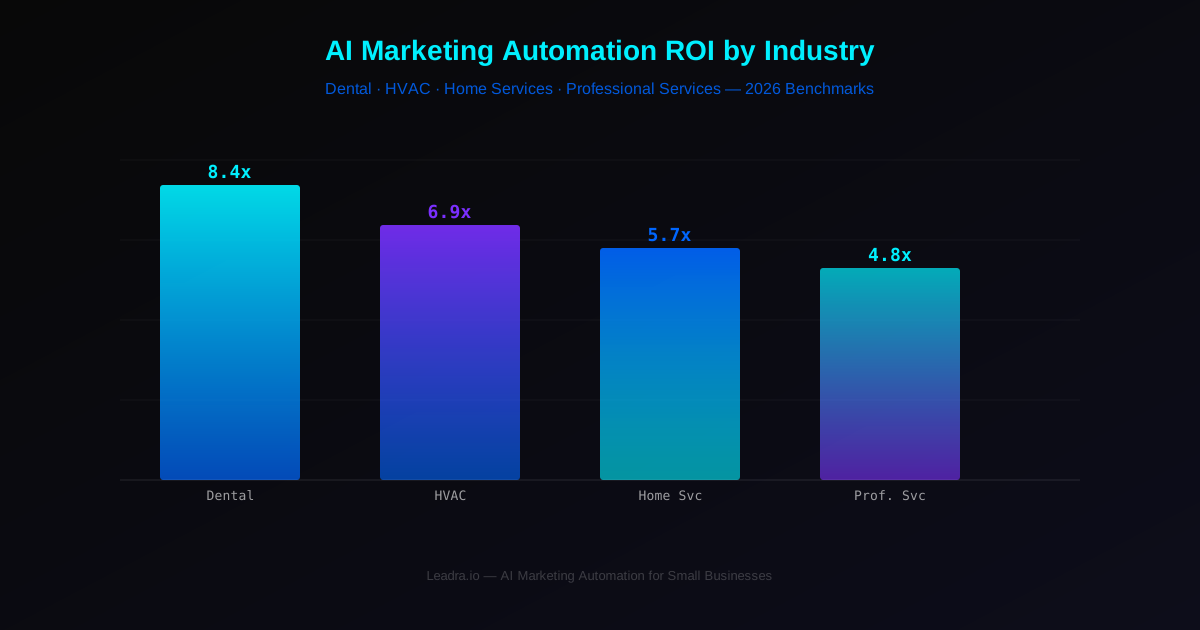
| Industry | Monthly Cost | ROI Range | Payback Period | Primary Driver |
|---|---|---|---|---|
| Dental Practices | $800-$1,200 | 7x-14x | 45-60 days | After-hours call recovery |
| HVAC / Home Services | $900-$1,500 | 5x-11x | 50-75 days | Speed-to-response + seasonal campaigns |
| Med Spas / Aesthetics | $800-$1,400 | 6x-12x | 45-70 days | Reactivation sequences + reviews |
| Professional Services | $1,000-$1,800 | 5x-10x | 60-90 days | Nurture sequences + lead follow-up |
| Restaurants / Food Svc | $600-$1,000 | 3x-7x | 60-90 days | Review automation + loyalty campaigns |
| Real Estate | $1,200-$2,000 | 6x-15x | 90-120 days | Lead nurturing + follow-up sequences |
Case Study: Charlotte NC HVAC Company Adds $14,400/Month in 90 Days
Client Story — Charlotte, NC
A residential HVAC company in Charlotte's NoDa district came to Leadra.io frustrated with their ad spend. They were running $2,200/month in Google Ads, generating roughly 30 inbound calls per month — but only converting 11 of those into booked jobs. The remaining 19 leads were lost to slow follow-up or after-hours voicemail. Their cost per booked job was $200.
Leadra.io deployed three automation layers: an AI voice employee for after-hours calls, an instant SMS follow-up sequence for all web form inquiries, and a pre-season campaign targeting their 340-person customer database with heating system check offers. Total automation cost: $1,100/month.
By month 3, their call-to-booking conversion rate moved from 37% to 61%. The pre-season campaign generated 18 booked tune-ups in the first two weeks. Monthly booked revenue increased from $17,600 to $32,000 — an additional $14,400/month against $1,100 in monthly automation cost. Their cost per booked job dropped from $200 to $81.
Call-to-booking rate
Monthly booked revenue
Cost per booked job
Monthly automation ROI
The HVAC result reflects a pattern Leadra.io sees repeatedly: businesses with existing lead flow but poor follow-up infrastructure see the fastest ROI. The automation did not generate new leads — it captured revenue from leads the business was already paying to generate and then losing. That's why payback timelines are measured in weeks, not months. See the full AI lead generation guide for local businesses.
How to Calculate Your Expected AI Marketing Automation ROI
You don't need to guess your ROI. Walk through these four inputs and you'll have a reliable estimate within 15 minutes.
Calculate your current lead leakage.
Count your total inbound leads per month (calls + web forms + DMs). Then count how many resulted in a booked appointment or quote. The difference is your lead leakage. Most businesses find 30-50% of leads are lost. Multiply lost leads by your average job value — that's the revenue ceiling AI automation is targeting.
Estimate your reactivation pool.
How many past customers have you not contacted in the last 12 months? Export that list from your CRM, booking system, or invoicing software. A 10% reactivation rate is conservative — apply that to your pool and multiply by average job value. This is typically the largest single revenue driver in the first 60 days.
Model your review volume impact.
Check your current Google review count and rating. Businesses below 50 reviews or under 4.3 stars lose significant call volume to competitors. Every 10-point improvement in rating (3.8 to 4.8) correlates to roughly a 12% increase in organic call volume according to BrightLocal's 2025 consumer survey. Estimate what 10% more organic calls would be worth at your current conversion rate.
Add the three numbers and compare to automation cost.
Sum (lead leakage recovery) + (reactivation revenue) + (SEO lift revenue). Divide by 12 for a monthly figure. Compare to the monthly automation investment ($800-$1,500 for most small businesses). Most businesses land at 5x-12x ROI in this exercise — which is why the payback period is consistently under 90 days.
Frequently Asked Questions
What ROI does AI marketing automation deliver for dental practices?
Dental practices typically see 7x-14x ROI from AI marketing automation within the first 12 months. The biggest driver is after-hours call recovery — AI voice employees capture appointment requests that would otherwise be lost. A practice converting just 6 additional new patients per month at a $1,400 average lifetime value generates $100,800 in additional annual revenue against a $1,000/month automation investment.
How long does it take for AI marketing automation to pay for itself?
Most small businesses see payback on AI marketing automation within 60-90 days. Dental and HVAC businesses hit breakeven fastest because their average transaction values are high ($800-$2,500 per job) and the primary revenue driver — capturing leads that were already being generated but lost — delivers immediate results. Professional services firms with longer sales cycles typically reach breakeven in 90-120 days.
Which industry gets the highest ROI from AI marketing automation?
Dental practices consistently show the highest AI marketing automation ROI — averaging 7x-14x in the first year — because they combine high lifetime patient value ($1,400+), a recurring service model, and significant lead leakage from missed calls. HVAC businesses rank second, driven by high per-job revenue and seasonal campaign automation that captures high-intent searches in real time before competitors respond.
What AI marketing automation tools deliver the best ROI for local service businesses?
The highest-ROI tools for local service businesses are AI voice employees (after-hours lead capture), automated review generation sequences (Google ranking improvement), and customer reactivation workflows (revenue from dormant clients). Businesses that deploy all three see 5x-14x ROI versus 2x-4x from using any single tool in isolation, because each component reinforces the others across the full customer lifecycle.
The Bottom Line
AI marketing automation ROI is not uniform across industries — but it is consistently strong across all of them. Dental practices lead with 7x-14x returns driven by call recovery and appointment volume. HVAC and home services companies hit 5x-11x through speed-to-response and seasonal campaigns. Professional services firms see 5x-10x returns once nurture sequences close the leads already coming in.
The common thread: most small businesses are already generating enough lead volume to justify the investment. The problem is not lead generation — it's lead conversion. AI automation captures the revenue that's already in the pipeline and being lost to slow follow-up, after-hours gaps, and dormant customer lists. That's why payback timelines are measured in weeks, not quarters.
At Leadra.io, we build industry-specific AI marketing automation systems for small businesses across the US. Our guarantee: 90 new clients in 90 days for qualifying practices — or you don't pay. See the full AI marketing automation ROI breakdown.
See What ROI Your Business Can Expect
Get a Free AI Automation ROI Estimate
We'll walk through your current lead volume, conversion rate, and reactivation pool — and give you a realistic revenue projection for your specific industry. 15-minute call, no commitment.
Last updated: May 29, 2026 | Leadra.io — AI Marketing Automation ROI for Small Businesses