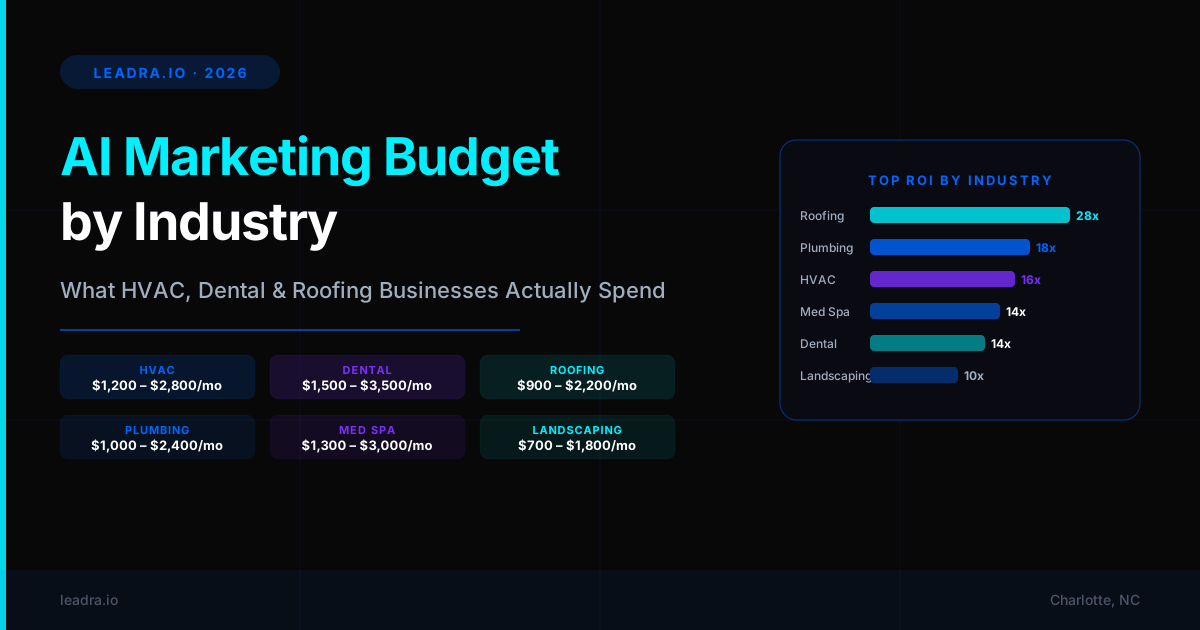
AI Marketing Budget by Industry: What HVAC, Dental, and Roofing Businesses Actually Spend in 2026
By Leadra.io Team · July 3, 2026 · 9 min read
A one-size-fits-all AI marketing budget does not exist. An HVAC company missing $4,000 emergency calls every weekend has a completely different problem than a dental practice losing consultation requests to voicemail. The budget that fixes one won't fix the other — and funding the wrong tools first is the fastest way to conclude “AI doesn't work” before you've actually tested it. Here is what service businesses across eight industries are actually spending in 2026, what that money goes toward, and what they're getting back.
Why Your Industry Determines Your AI Budget — Not Just Your Revenue
Most generic AI budget guides tell you to spend 5-8% of revenue on marketing. That number is not wrong, but it does not tell you where to put the money first or why the same $1,500/month produces a 4x ROI in one industry and a 22x ROI in another.
Three factors drive industry-specific AI budget decisions:
- Average job value. A roofing contractor's average ticket is $9,000-$18,000. A house cleaner's is $180-$350. One recovered lead after hours justifies months of AI spend for the roofer. The cleaner needs volume — which means the budget goes toward SEO and booking automation, not voice agents.
- Lead leakage rate. Industries with high after-hours demand (HVAC, plumbing, dental emergencies) lose the most revenue to missed calls. Industries with scheduled demand (landscaping, pet grooming, yoga studios) lose revenue to slow follow-up and no-show gaps instead.
- Sales cycle length. Roofing and home improvement businesses often wait 5-14 days between first contact and signed contract. AI follow-up automation closes that gap. Barbershops and salons book same-day — so AI value sits in booking automation and review generation.
Once you know which factor dominates your industry, the budget decisions get simple. The table below shows what the highest-ROI businesses in each category are spending and where they're putting it.
See also: how to allocate your AI marketing budget across phases for the sequencing framework that pairs with these industry numbers.
Industry-Specific AI Marketing Budget Benchmarks (2026)
| Industry | Monthly AI Budget Range | Highest-ROI First Tool | Typical 90-Day ROI | Payback Period |
|---|---|---|---|---|
| HVAC | $1,200 – $2,800 | AI voice agent (after-hours) | 8x – 16x | 30–55 days |
| Dental Practices | $1,500 – $3,500 | AI receptionist + new patient follow-up | 6x – 14x | 30–60 days |
| Roofing Contractors | $900 – $2,200 | AI estimate follow-up automation | 12x – 28x | 14–30 days |
| Plumbing | $1,000 – $2,400 | AI voice agent (emergency calls) | 9x – 18x | 25–50 days |
| Landscaping / Lawn Care | $700 – $1,800 | Seasonal reminder + quote follow-up | 5x – 10x | 45–75 days |
| Med Spa | $1,300 – $3,000 | AI consultation booking + reactivation | 7x – 16x | 30–60 days |
| Auto Repair | $600 – $1,600 | AI appointment booking + review automation | 5x – 11x | 45–70 days |
| Moving Companies | $800 – $1,900 | AI quote follow-up + after-hours capture | 7x – 14x | 30–50 days |
Deep Dive: The Top Three Industries by AI Budget Efficiency
1. Roofing Contractors — Highest ROI, Smallest Budget Needed
Roofing is the most capital-efficient industry for AI marketing, and the reason is simple: average job value. At $9,000-$18,000 per roof replacement, a single recovered lead covers 8-16 months of AI spend. Roofing contractors are not trying to generate volume — they're trying to close the leads they already receive faster.
The biggest revenue leak in roofing is estimate follow-up. Most contractors send a quote and wait. According to industry data from Contractor Nation, 67% of roofing leads that do not get a follow-up within 24 hours choose a competitor. AI follow-up sequences that trigger automatically after an estimate is sent — with text, voicemail drop, and email at 2 hours, 24 hours, and 72 hours — consistently move close rates from 18-25% to 38-50%.
A roofing contractor running $1.2M in annual revenue can start with a $900-$1,400/month AI budget (estimate follow-up automation + after-hours voice agent for storm inquiries) and see payback in 14-30 days. See how AI estimate follow-up works for roofing companies for the full sequence breakdown.
2. HVAC Companies — After-Hours Is Where the Money Lives
HVAC has a unique demand pattern. Equipment failures do not happen on business hours. The highest-value HVAC leads — customers with a failed system who need service today — call at 10pm, 6am, and on weekends. An HVAC company without after-hours coverage sends those leads to whoever answers.
The math is blunt. An HVAC company missing 15 after-hours calls per week at an average of $420 per service call is walking away from $6,300 in weekly revenue — $327,600 per year — before counting the customers who become recurring maintenance clients. An AI voice agent that captures and qualifies those calls costs $400-$900/month. The payback is typically one emergency call.
HVAC companies spending $1,200-$2,800/month are generally running three tools in sequence: AI voice agent for after-hours capture, automated estimate follow-up for system replacements, and a monthly AI SEO content engine targeting local search terms like “AC repair [city]” and “furnace replacement near me.” The content engine compounds — posts written in month 1 still pull traffic in month 18.
3. Dental Practices — Highest Absolute Budget, Fastest Volume Scale
Dental practices invest more per month in AI marketing than most other service industries, and they justify it with a different metric: lifetime patient value. A new patient is worth $1,200-$3,000 in year one and $600-$1,800 per year ongoing. Acquiring 10 additional new patients per month via AI adds $144,000-$360,000 in lifetime practice value on the conservative end.
The highest-ROI tools for dental practices are a 24/7 AI receptionist (capturing new patient calls that come in during lunch, after 5pm, and on weekends) and automated follow-up for consultation requests that go unconfirmed. Practices lose an estimated 30-40% of new patient appointments to no-show or drop-off between the initial inquiry and the first appointment. AI reminder and confirmation sequences cut that number in half.
Practices spending $1,500-$3,500/month are typically combining a voice agent, appointment confirmation automation, dormant patient reactivation (targeting patients who have not been in for 18+ months), and an AI content engine targeting local dental search terms. The dental AI marketing ROI case study covers what that looks like at a 3-doctor practice in month 90.
What Drives Budget Differences — The Three Variables That Matter
After-Hours Call Volume
If your business gets calls after 5pm or on weekends that you cannot answer, an AI voice agent should be your first dollar. Industries with the highest after-hours call volume: HVAC, plumbing, electrical, dental (emergencies), and moving companies (people call evenings to plan upcoming moves). For these businesses, the voice agent is not optional — it is the foundation everything else is built on.
Average Ticket Size
Higher ticket size = faster payback = higher budget ceiling makes sense. A med spa doing $400 injectables per client can justify a $2,500/month AI budget if it closes 8 additional bookings per month. A mobile car wash at $60 per wash needs to close 40+ bookings to justify the same spend. Match your budget ceiling to the math, not to a percentage guideline.
Lead Response Gap
Research from Lead Response Management shows that leads contacted within 5 minutes are 21x more likely to enter the sales process than leads contacted after 30 minutes. Most service businesses respond to web leads in 2-48 hours. AI follow-up automation closes that gap and is the most universally effective tool regardless of industry.
Case Study: Charlotte, NC Plumbing Company — $1,100/Month Becomes $31,000 in Added Revenue
This example represents the type of results Leadra.io clients achieve.
A residential plumbing company in the Charlotte, NC metro area was generating around $72,000 in monthly revenue with a two-person office team handling calls during business hours. Evenings and weekends were covered by a voicemail box that nobody checked until Monday morning.
In month one, Leadra.io installed an AI voice agent to handle after-hours calls and a follow-up sequence for estimates that had not been accepted within 48 hours. Total monthly spend: $1,100.
Results by end of month three:
- After-hours booked jobs: 0/week to 11/week
- Estimate close rate: 22% to 49%
- Monthly revenue: $72,000 to $103,000
- Added revenue attributable to AI: $31,000/month
- ROI: 28.2x on a $1,100/month investment
The owner's comment three months in: “I had no idea how much money we were leaving on the table every weekend. The AI just answers like a real dispatcher and gets them booked. We never even hear about it until the job shows up on the schedule.”
Charlotte, NC: Why Local Budget Benchmarks Run Slightly Higher
Charlotte's rapid growth — over 100,000 new residents added since 2020 — means service businesses here compete in one of the most active markets in the Southeast. Neighborhoods like Ballantyne, South End, Mooresville, and Huntersville are adding new homeowners faster than local service providers can keep up. That is a significant market opportunity for businesses that can answer faster than competitors.
Charlotte-area service businesses running AI marketing typically invest at the middle-to-upper end of their industry range, because the cost per acquired customer is higher here but so is the average job value. An HVAC installation in Charlotte averages $4,800-$8,200 — well above the national median. That makes the $1,800-$2,800/month AI budget easy to justify.
Leadra.io works exclusively with Charlotte-area and national service businesses. If you want to know exactly what budget makes sense for your specific trade and revenue level, the fastest path is a 20-minute call.
How to Build Your Industry-Specific AI Budget in 3 Steps
Step 1: Find your biggest revenue leak.
Check your call logs for the past 30 days. How many calls came in after 5pm or on weekends? How many estimates did not close within 7 days? How many consultation requests did not confirm an appointment? The largest gap is where your first AI dollar goes.
Step 2: Match one tool to one problem.
After-hours missed calls → AI voice agent. Estimate drop-off → AI follow-up automation. Lapsed customers → reactivation sequences. Weak local search visibility → AI content engine. Fund one tool completely before adding the next. Spreading a $1,000/month budget across four tools produces four mediocre results.
Step 3: Calculate break-even before you start.
If your average job is worth $800 and your AI budget is $1,200/month, you need 1.5 additional jobs per month to break even. Most voice agents capture that in the first week. If the math does not close within 45 days, the tool is wrong — not the strategy. Adjust and reallocate.
For a full breakdown of how these tools work and what each one costs, see our AI cost breakdown for small businesses.
Frequently Asked Questions
How much should an HVAC company spend on AI marketing per month?
An HVAC company doing $500k-$2M in annual revenue should budget $1,200-$2,800/month for AI marketing. The foundation is an AI voice agent ($400-$900/mo) to capture after-hours emergency calls plus automated follow-up for estimates ($300-$600/mo). Add AI SEO content once the lead recovery layer is cash-flow positive, typically by month 2-3.
What is the AI marketing budget for a dental practice?
Dental practices typically invest $1,500-$3,500/month in AI marketing. The highest-ROI allocation is AI-powered new patient follow-up (capturing consultation requests that go cold) and a 24/7 AI receptionist for after-hours calls. Practices that add a monthly AI content engine targeting local searches see consistent new patient flow within 60-90 days.
Is a $500/month AI marketing budget enough for a service business?
At $500/month, focus entirely on one tool: an AI voice agent or follow-up automation system — not both. Choose whichever problem costs you more. If you miss 20+ calls per week after hours, start with the voice agent. If you get leads but lose them before booking, start with follow-up automation. Spread $500 across multiple tools and none will perform.
What AI marketing ROI should service businesses expect by industry?
ROI varies significantly by industry and average job value. Roofing contractors see the fastest payback (14-30 days) because a single recovered lead worth $8,000-$15,000 covers months of AI spend. Dental practices average 6x-14x ROI on their AI investment within 90 days. HVAC companies typically achieve 8x-16x ROI. Landscaping and cleaning businesses with lower job values see 5x-10x ROI over a longer 60-90 day window.
Final Thoughts
The businesses winning with AI marketing in 2026 are not spending the most — they are spending on the right problem first. A roofing company that funds follow-up automation before buying a voice agent will see 3x the return of one that does it in reverse. Industry context changes everything.
Match your budget to your industry, your biggest revenue leak, and your average job value. The math will tell you what to buy and in what order. The only mistake is spending money on tools before you run the numbers.
Ready to build an AI marketing budget that fits your specific trade?
Call Leadra.io directly at +1 (864) 721-8384 or schedule a free strategy call. We will tell you exactly which tool pays back fastest for your industry and revenue level — no guesswork, no generic advice.
Written by the Leadra.io Team. Leadra.io is an AI marketing agency helping service businesses and dental practices grow using AI-powered automation, lead generation systems, and content engines. Based in Charlotte, NC — serving clients nationwide.