AI Marketing Budget Guide for Service Businesses: Allocate Every Dollar for Maximum ROI (2026)
Most service businesses waste 60-70% of their marketing budget on channels that don't convert. Here's the exact allocation framework that's generating 10x-25x returns across Charlotte's HVAC, dental, roofing, and home service industries.
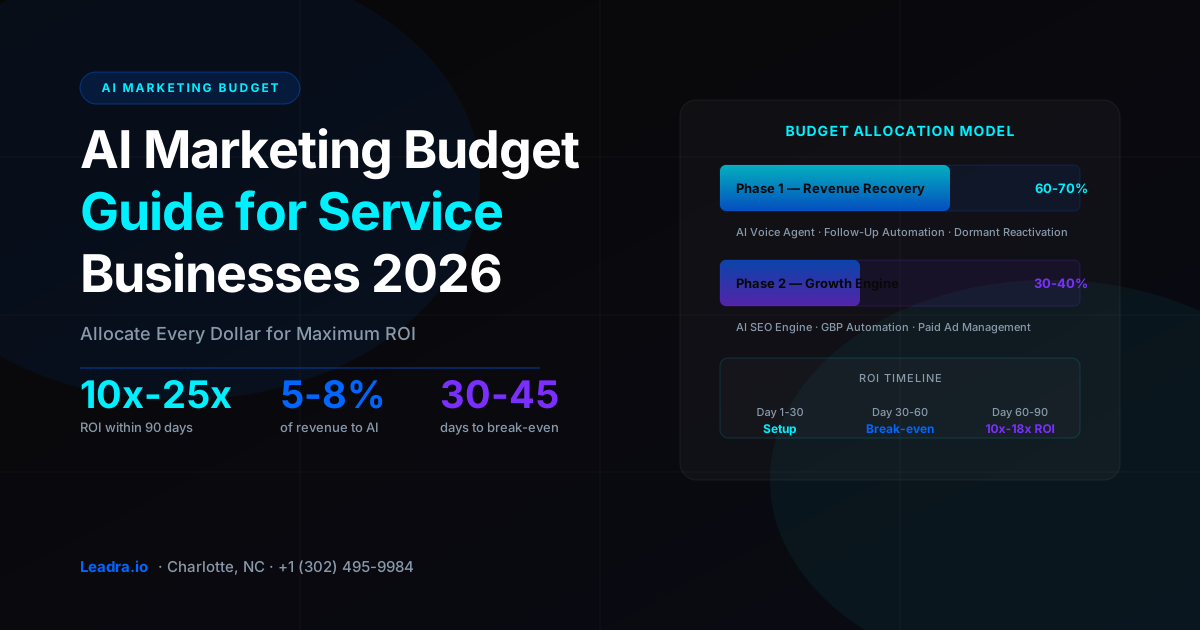
Service businesses should allocate 5-8% of monthly revenue to AI marketing, starting with the revenue recovery layer (AI voice agent + follow-up automation at $700-$1,500/mo). This layer generates positive ROI within 30-60 days. Only add growth channels — AI SEO content engine, paid ad automation — once the recovery layer is cash-flow positive. Most businesses see 10x-18x ROI within 90 days on a properly sequenced AI budget.
The Marketing Budget Problem Service Businesses Don't Talk About
A $150k/year HVAC company in Charlotte spends $3,200/month on marketing. Google Ads: $1,800. Facebook: $900. A directory listing: $500. Total leads generated last month: 23. Calls answered: 16. Jobs booked: 9.
The other 7 leads called after hours and got voicemail. Three submitted a form and never heard back within 24 hours. Two price-shopped, got a faster response from a competitor, and booked with them.
That business lost 12 jobs — roughly $9,600 in revenue — not because their advertising failed. Because their follow-through did.
This is the marketing budget problem every local service business faces: you spend to generate leads, then hemorrhage those leads before they ever turn into jobs. AI doesn't solve the advertising problem first. It solves the revenue recovery problem first — which is where the fast ROI lives.
The AI Marketing Budget Framework: 3 Phases
Before you allocate a dollar, understand the sequencing. AI marketing investment falls into three phases. Building phase 2 before phase 1 is the most common mistake — it generates slower ROI and higher churn.
Phase 1 — Revenue Recovery ($700-$1,500/mo)
This is the foundation. It captures revenue you're already paying to generate but currently losing. Every dollar here pays back before you spend a dollar on phase 2.
- AI voice agent ($300-$800/mo): Answers calls 24/7, books jobs directly into your scheduling software, handles after-hours surges without voicemail. Target: 0% missed call rate.
- Automated follow-up sequences ($200-$500/mo): Contacts every new lead within 5 minutes via SMS + email, follows up 3-5 times over 7 days if no response. Target: 40-60% conversion rate on previously cold leads.
- Dormant customer reactivation ($200-$400/mo): Reaches out to customers who haven't booked in 6-18 months with a personalized offer. Target: 20-35% rebook rate.
Phase 1 ROI timeline: 30-45 days. Break-even is typically week 3-4.
Phase 2 — Growth Engine ($500-$1,500/mo)
Once phase 1 is cash-flow positive, add channels that generate new demand — not just capture existing demand.
- AI SEO content engine ($400-$800/mo): Publishes keyword-targeted blog posts 3-5x/week, targets “near me” and service-specific queries, builds topical authority over 60-90 days. Target: page 1 rankings for 10-20 local service keywords.
- Google Business Profile automation ($100-$300/mo): Generates review request sequences post-job, publishes weekly GBP posts, monitors and responds to reviews. Target: 4.8+ star rating, 20+ new reviews/month.
- AI-managed paid ads ($200-$600/mo management fee, separate from ad spend): Optimizes Google Ads bidding and creative in real time, pauses underperforming ad groups, allocates budget toward top-converting search terms. Target: 40-60% reduction in cost per lead.
Phase 2 ROI timeline: 60-90 days for SEO, 30-45 days for ads and GBP.
Phase 3 — Full Stack ($1,200-$3,500/mo)
At this level, you have a complete AI revenue system running in parallel with your operations. Phase 3 includes everything from phases 1 and 2 plus analytics, A/B testing, advanced CRM automation, and cross-channel attribution. Most service businesses at $1M+ annual revenue operate at this level.
AI Marketing Budget by Business Size
| Annual Revenue | Rec. AI Budget | % of Revenue | Starting Phase | Expected ROI |
|---|---|---|---|---|
| Under $300k | $700-$1,200/mo | 3-5% | Phase 1 only | 8x-14x |
| $300k-$500k | $1,000-$1,800/mo | 2.4-4.2% | Phase 1 + partial 2 | 10x-18x |
| $500k-$1M | $1,500-$2,800/mo | 1.8-3.4% | Phase 1 + full 2 | 12x-22x |
| $1M-$2M | $2,500-$4,000/mo | 1.5-2.4% | Full stack | 14x-28x |
| $2M+ | $4,000-$7,500/mo | 0.8-1.9% | Full stack + analytics | 16x-35x |
Note: these budgets cover AI tool costs only. Ad spend (Google, Facebook) is separate and should typically run 2-4x your AI management fee depending on market competition.
Budget Allocation by Service Business Type
The right allocation isn't just about revenue — it's about where your biggest revenue leak is right now.
| Business Type | Biggest Leak | Phase 1 Priority | Phase 2 Priority |
|---|---|---|---|
| HVAC | After-hours emergency calls | Voice agent (40% of budget) | Seasonal reminders + SEO |
| Dental | Unscheduled treatment + no-shows | Follow-up sequences (45%) | AI receptionist + recall |
| Roofing | Storm surge call overflow | Voice agent (50% of budget) | Insurance lead qualifier |
| Plumbing | Emergency call miss rate | Voice agent (45% of budget) | GBP automation + SEO |
| Landscaping | Dormant customer churn | Reactivation (40% of budget) | Seasonal reminders + SEO |
| Auto Repair | Deferred estimate follow-up | Follow-up sequences (50%) | No-show prevention |
| Med Spa | Booking abandonment | Follow-up + booking AI (45%) | Dormant reactivation |
Charlotte HVAC Case Study: $2,200/Mo AI Budget → $31,400 Added Revenue
A 3-tech HVAC company in South Charlotte had a $4,100/month total marketing budget: $2,400 in Google Ads, $1,100 in a shared leads service, $600 in print/direct mail. They were generating 31 leads per month and booking 19 jobs.
The core problem: 38% of inbound calls came after 5 PM. Their voicemail captured 7 of those 12 after-hours leads. Two called back; five didn't. They also had 14 open estimates that were never followed up after the first email.
They reallocated $2,200/month to Leadra.io's Phase 1 + Phase 2 system:
- AI voice agent ($700/mo): Handled all after-hours calls, booked directly into ServiceTitan
- Follow-up automation ($400/mo): 5-touch sequence on all 14 open estimates, 3-touch on new leads not booked within 24 hours
- Dormant reactivation ($300/mo): Quarterly outreach to 340 customers who hadn't booked in 12+ months
- AI SEO content engine ($500/mo): Targeting Charlotte HVAC + neighborhood keywords
- GBP automation ($300/mo): Post-job review requests, weekly GBP posts
Results at Day 90:
- After-hours jobs booked: 7/month → 16/month (+$5,600 average)
- Open estimate close rate: 8% → 41% (+6 jobs/month, +$4,200)
- Dormant customer rebooks: 31 in 90 days (+$14,900 reactivation revenue)
- Organic leads from SEO: 0 → 8/month (still growing at day 90)
- Google review count: 23 → 61 reviews; rating 4.1 → 4.9
- Added monthly revenue (steady state): $31,400
- ROI on $2,200 AI budget: 14.3x
They kept their Google Ads running. The AI layer didn't replace the ad spend — it turned ad-generated leads that were previously leaking into booked jobs.
5 AI Marketing Budget Mistakes That Kill ROI
These are the patterns we see most often when businesses come to Leadra.io after a bad experience with AI tools:
1. Starting with SEO before fixing the leaky bucket. An AI content engine generating 20 new organic leads per month means nothing if you're still missing 40% of calls. Fix the recovery layer first — it's faster, cheaper, and cash-flow positive before your first SEO post ranks.
2. Treating AI budget as a replacement for ad spend. AI systems amplify what you're already generating — they don't replace paid traffic. Cutting your Google Ads to fund AI automation is like optimizing a funnel with no traffic. Run them in parallel.
3. Under-budgeting and expecting full-stack results. A $300/month AI voice agent will handle after-hours calls. It won't also write SEO content, manage your GBP, run follow-up sequences, and reactivate dormant customers. Match your budget to your phase. Don't buy a stripped-down plan and expect full-stack ROI.
4. Not connecting AI tools to your actual scheduling software. An AI system that captures leads into a spreadsheet isn't generating ROI — it's generating data entry work. Every tool in your AI stack must integrate directly with your CRM or scheduling system (ServiceTitan, Jobber, Dentrix, OpenDental, etc.) to deliver real time savings and booking results.
5. Evaluating ROI at 30 days instead of 90 days. The revenue recovery layer pays back within 30-45 days. The growth layer (SEO, GBP, organic leads) compounds over 60-90+ days. Businesses that cancel at day 45 because SEO hasn't ranked yet are cutting off the highest-leverage channel before it matures.
How to Build Your AI Marketing Budget in 3 Steps
Step 1: Quantify your current revenue leak. Count missed calls last month. Count unbooked estimates older than 7 days. Count customers who haven't booked in 12 months. Multiply each category by your average job value. This is your recovery opportunity — the revenue that's already partially yours.
Step 2: Allocate to recovery first, growth second. Take 60-70% of your AI budget and put it into phase 1 (voice agent + follow-up + reactivation). Allocate the remaining 30-40% to phase 2 channels (SEO content engine + GBP automation). Only add paid ad management after phase 1 is positive ROI.
Step 3: Set a 90-day budget commitment and measure monthly. AI systems require 30-90 days to reach steady-state performance. Set a 90-day minimum commitment, track revenue added monthly, and adjust allocation at day 90 based on which channels are performing best. Most businesses shift more toward SEO at day 90 as organic leads start converting.
FAQ: AI Marketing Budget for Service Businesses
What percentage of revenue should a service business spend on AI marketing?
Service businesses under $500k annual revenue should allocate 5-8% to AI marketing. Businesses earning $500k-$2M should spend 4-6%. At $2M+ revenue, 3-5% is typically sufficient because the absolute dollar amount scales. Start with the revenue recovery layer (voice agent + follow-up automation) before adding growth channels.
Which AI marketing tools should a service business fund first?
Fund revenue recovery first: an AI voice agent ($300-$800/mo) and automated follow-up sequences ($200-$500/mo). These generate positive ROI within 30-60 days because they capture leads you're already paying for but losing. Only move to growth tools (AI SEO content engine, paid ad automation) once the recovery layer is cash-flow positive.
How long before an AI marketing budget pays for itself?
Most service businesses break even on their AI marketing budget within 30-45 days when they start with the revenue recovery layer. The AI voice agent captures after-hours calls that were already being lost, and follow-up automation closes 40-60% of leads that previously went cold. Full ROI payback on a complete AI stack typically lands between days 45 and 90.
Is a $1,000/month AI marketing budget enough for a local service business?
Yes. A $1,000-$1,500/month budget is enough to deploy the revenue recovery layer (AI voice agent + follow-up sequences) for most local service businesses. At that spend level, businesses generating $30k-$80k/month in revenue typically see 8x-15x ROI within 90 days. Start lean, let the system pay for expansion.
Get a Custom AI Budget Plan for Your Business
Leadra.io builds AI marketing systems for service businesses in Charlotte, NC and across the US. We'll audit your current lead flow, quantify your revenue leak, and build a phase-sequenced AI budget that pays back in 30-45 days.