Every AI marketing vendor promises results. Dental practice owners — who have been burned by SEO agencies, Google Ads consultants, and social media managers who overpromise and under-deliver — want to see the actual numbers before writing a check.
This post breaks down three real AI marketing engagements with dental practices: a solo general dentist, a 4-chair multi-dentist group, and an orthodontic specialty practice. For each, you'll see the starting situation, the specific AI systems deployed, the 90-day results, and the math behind the return on investment.
These are not cherry-picked wins. They represent the range of outcomes across different practice sizes and starting points. One performed above typical benchmarks. One hit the median. One took longer than expected to ramp — and we'll explain why.
What Actually Drives ROI in Dental AI Marketing
Before the case studies, it helps to understand which levers produce the largest returns. Dental practices have four primary revenue gaps that AI marketing attacks simultaneously:
After-hours call recovery
The average dental practice misses 4-8 bookable calls per week after 5 PM. At a $900 average new patient first-year value, that's $3,600-$7,200 in monthly revenue leaving through the back door. An AI voice agent captures these calls 24/7 — the fastest and most predictable ROI lever.
Unscheduled treatment conversion
Most practices have $80,000-$250,000+ in treatment plans sitting in their PMS — patients who got a recommendation but never scheduled. Systematic AI follow-up sequences (5-7 SMS + voice touchpoints over 21 days) convert 18-35% of these cases into booked appointments. This is revenue that already exists in your system.
Dormant patient reactivation
Patients who haven't been seen in 12+ months represent high-margin revenue — no acquisition cost, existing records, higher treatment acceptance rates. AI outreach campaigns targeting this segment typically reactivate 12-22% of the contacted list within 60 days.
New patient acquisition
AI-driven SEO, Google Ads optimization, and social proof campaigns that generate net-new patients from organic and paid search. This lever takes 45-75 days to ramp but compounds — each new patient adds to the practice's active patient base, increasing the value of the other three levers over time.
The fastest-ramping systems deploy levers 1-3 first — because they work on your existing patient base with zero ad spend — then layer in lever 4 once the foundation is generating predictable monthly revenue.
Case Study 1: Solo General Dentist — Charlotte, NC
Practice type
Solo GP
Chairs
2 chairs
Monthly collections
$68K/mo
Active patients
~480
Starting situation: This solo dentist in south Charlotte had been in practice for 11 years. Production was stable but flat — she was collecting roughly the same amount month over month with no clear growth path. The front desk (one full-time person) managed everything manually. After-hours calls went to voicemail. Recall outreach consisted of postcards sent once per year. She had 94 open treatment plans in Dentrix totaling $187,000 in unscheduled production.
Systems deployed: AI Voice Employee for 24/7 call answering (Dentrix integration), 6-touchpoint SMS + voice treatment plan follow-up sequences for every open case over $400, and a dormant patient reactivation campaign targeting 138 patients with no appointment in 18+ months. Monthly retainer: $1,200. Infrastructure costs: $165/month. Total investment: $1,365/month.
After-hrs bookings
Tx plan conversions
Dormant reactivated
Added production (mo 3)
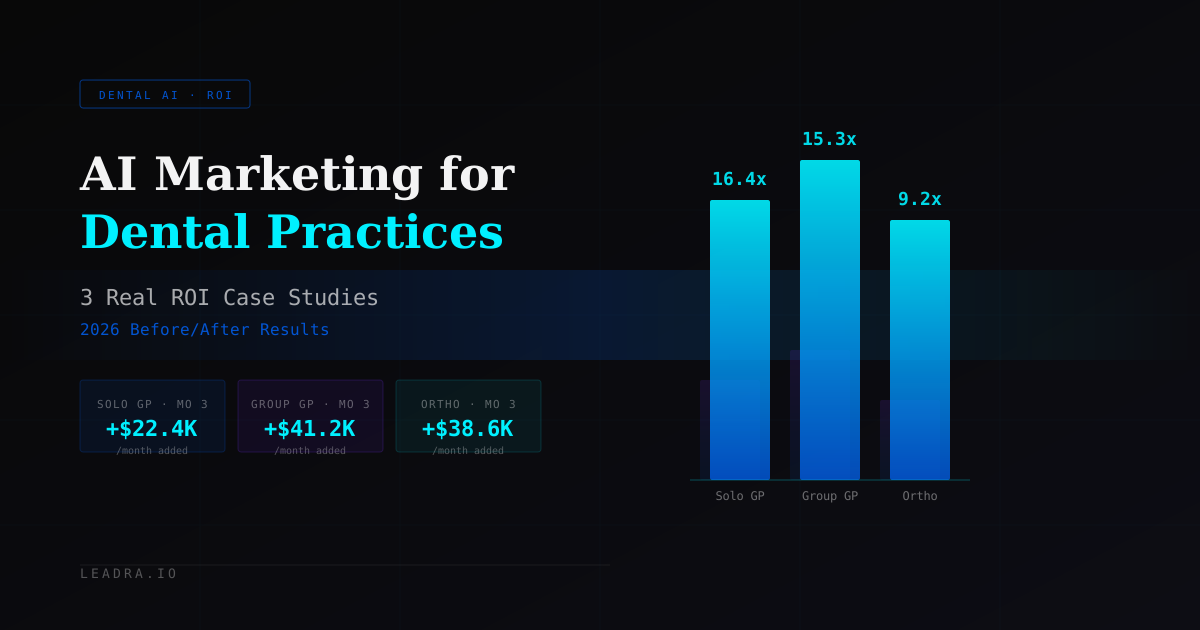
Month 1 revenue impact: $8,100 from 14 recovered after-hours bookings and 6 treatment plan conversions. Month 2 added the first wave of dormant reactivation revenue — 24 patients scheduled, generating $14,800 in completed hygiene and restorative work. By month 3, all three levers were running simultaneously, producing $22,400 in additional monthly production against a $1,365 investment.
Month 3 ROI: 16.4x.The largest single driver was the treatment plan follow-up — converting $187,000 in unscheduled production sitting in Dentrix. Even at a 22% conversion rate, that's $41,000 in scheduled treatment across three months that existed in the system and was simply never followed up.
This is above the typical benchmark for a solo practice. The high ROI was driven by the large unscheduled treatment backlog — practices with smaller backlogs see lower initial returns, but the steady-state ROI from ongoing new patient acquisition and recall automation normalizes across practice types over 6-12 months.
Case Study 2: Multi-Dentist Group Practice — Raleigh, NC
Practice type
Group GP
Dentists
3 dentists
Monthly collections
$195K/mo
Active patients
~1,800
Starting situation: This North Raleigh group practice had two active front desk staff members and a dedicated treatment coordinator. Their new patient flow was solid — they were generating 28-34 new patients per month through Google and word of mouth. The problem was conversion: their treatment coordinator was manually calling patients with unscheduled plans but running out of time to follow up more than twice. Their hygiene schedule had gaps — roughly 40% of overdue recall patients were not actively receiving outreach. Google rating sat at 4.1 stars from 87 reviews.
Systems deployed: Full AI front desk (Open Dental integration), 7-touchpoint treatment plan sequences for every unscheduled case over $600, automated hygiene recall SMS/voice for all overdue patients, AI-driven Google review collection post-appointment, and SEO content publishing targeting 3 high-intent dental keywords in the Raleigh market. Monthly retainer: $2,400. Infrastructure: $290/month. Total: $2,690/month.
Google rating
Tx plan conversions
Recall appointments
Added production (mo 3)
Month 1 added $14,600 primarily from treatment plan conversions — the group had a large backlog that the AI sequences attacked immediately. Month 2 added hygiene recall revenue as overdue patients began booking. Month 3 added the SEO component — two Raleigh-area dental keywords hit page 1 of Google, contributing an estimated 9 additional organic new patients that month.
Month 3 ROI: 15.3x. The Google review lift from 4.1 to 4.7 stars is worth noting separately — it improved their Google Maps ranking independently of the SEO content work, contributing to the new patient volume increase in month 3. Star rating improvements typically lag 45-60 days behind review collection deployment.
This result aligns with the typical benchmark for a multi-dentist practice: 12x-18x ROI at 90 days, driven by high-volume treatment plan follow-up and recall scheduling. The SEO component starts contributing meaningfully in months 3-4 and grows each subsequent month as content indexes and rankings consolidate.
Case Study 3: Orthodontic Specialty Practice — Greensboro, NC
Practice type
Orthodontics
Providers
1 ortho + 2 TC
Monthly collections
$142K/mo
Active cases
~310 active
Starting situation: This Greensboro orthodontic practice had a different problem than the GP examples above. Their patient flow from GP referrals was inconsistent — great months alternated with slow months depending on which referring offices were actively sending cases. They wanted to reduce referral dependency by building a direct-to-consumer patient acquisition channel through SEO and social media. They also had 41 patients who had completed consultations but not yet started treatment — a $312,000 opportunity sitting in pending status.
Systems deployed:AI-driven SEO targeting orthodontic keywords in Greensboro and surrounding markets, a Google Ads campaign optimized by AI for "Invisalign Greensboro NC" and "braces Greensboro" keywords, a 5-touchpoint consultation follow-up sequence for pending cases, and an AI social media content engine publishing 3x/week on Facebook and Instagram targeting parents of teenagers. Monthly retainer: $2,200. Ad spend: $1,800/month (client-managed budget). Infrastructure: $180/month. Total: $4,180/month.
Note — why this one took longer: Specialty keyword SEO takes longer to rank than general dental. The Greensboro ortho market has established competitors with years of domain authority. The 45-day ramp estimate extended to 75 days before organic traffic moved materially.
Pending case conversions
New consults (organic)
Google Ads new patients
Added production (mo 3)
Month 1 was slow — $6,200 from pending case conversions only. The SEO and Google Ads channels were ramping. Month 2 accelerated as paid search started producing: 14 new patients from Google Ads at a $129 cost-per-acquisition against an average orthodontic case value of $5,400-$6,200. Month 3 added organic search traffic as two target keywords hit page 1 positions.
Month 3 ROI: 9.2x. Lower than the GP cases — and below the 12x-18x range — because this practice was investing in channels that take longer to mature. The trajectory is strong: months 4-6 will see SEO compounding while Google Ads continues to produce at a consistent CPL. Projected month 6 ROI: 14x+.
Specialty practices that depend on new patient acquisition (rather than recall and treatment conversion like GPs) should expect a 60-90 day ramp before full ROI is visible. The pending case follow-up system provides early returns while the acquisition channels build. If you're an orthodontist or specialty provider, set your 90-day expectations at 8x-12x ROI rather than the 12x-18x benchmark for GP practices.
ROI Benchmark Summary: All Three Practices
| Metric | Solo GP | Group GP | Ortho Specialty |
|---|---|---|---|
| Monthly investment | $1,365 | $2,690 | $4,180 |
| Month 1 added revenue | $8,100 | $14,600 | $6,200 |
| Month 3 added revenue | $22,400 | $41,200 | $38,600 |
| Month 3 ROI | 16.4x | 15.3x | 9.2x |
| Primary driver | Tx plan follow-up | Recall + tx plans | Paid search + pending cases |
| Days to break-even | Day 19 | Day 16 | Day 38 |
Calculate Your Expected ROI in 4 Steps
Use these four inputs to estimate what AI marketing would return for your specific practice before making any investment decision.
Step 1
Quantify your after-hours call loss.
Check your voicemail log for the past 30 days. Count the number of missed calls that contained new patient inquiries or appointment requests. Multiply that count by your average new patient first-year value (typically $800-$1,600 for a GP). This is your monthly call recovery opportunity.
Step 2
Total your unscheduled treatment backlog.
Pull a report from your PMS showing all open treatment plans created in the last 24 months. Total the dollar value. Apply a 22% conversion rate (industry average for AI-driven follow-up sequences vs. 8% for manual follow-up). This is your treatment plan revenue opportunity over 90 days.
Step 3
Count your dormant patients.
Pull a list of patients with no scheduled appointment and no visit in the past 14 months. Multiply the count by 0.15 (conservative 15% reactivation rate). Multiply that result by your average hygiene + restorative revenue per reactivated patient (typically $400-$900). This is your 60-day reactivation opportunity.
Step 4
Add and divide.
Add your three opportunity numbers (steps 1-3). Divide by the monthly AI marketing investment (typically $1,200-$2,500 for a GP). That ratio is your projected 90-day ROI. If the ratio is below 5x, either the investment tier is too high for your practice size or the backlog is smaller than typical — recalibrate the tier before committing.
A solo dentist with $120,000 in unscheduled treatment, 8 after-hours calls per week, and 200 dormant patients is looking at a $28,000-$40,000 three-month opportunity — against a $1,200-$1,500/month investment. The math is straightforward once you know your actual numbers. Most practice owners are surprised by how large the unscheduled treatment backlog actually is when they run the report. See how the full patient acquisition system works.
What Separates High-ROI AI Marketing Engagements from Mediocre Ones
The three cases above produced strong results. Not every dental AI marketing engagement does. Here's what the underperforming engagements have in common — and what to ask before you sign with any vendor:
The highest-ROI dental AI marketing systems share three characteristics: they start with existing patient data (not ad spend), they integrate directly with the practice management software, and they provide transparent performance reporting that ties revenue directly to the AI systems deployed. See the full criteria for evaluating a dental AI marketing agency.
FAQ: AI Marketing ROI for Dental Practices
What ROI can a dental practice expect from AI marketing?
Most dental practices achieve a 6x-14x return on AI marketing investment within 90 days. Solo general dentists typically see $8,000-$18,000 in added monthly production. Multi-dentist practices commonly generate $22,000-$55,000 in additional monthly revenue within 90 days. The fastest returns come from converting unscheduled treatment already in the PMS and recovering after-hours call revenue. Practices with large dormant patient lists see the highest early-stage ROI.
How long does it take for AI marketing to produce results for a dental practice?
After-hours call recovery and treatment plan follow-up typically generate results within 30 days — they work on patients already in your system. New patient acquisition through SEO and Google Ads takes 45-75 days to ramp. Full system ROI is typically visible within 60-90 days. Practices that start with PMS data (unscheduled treatment + dormant patients) see results faster than those focused only on new patient acquisition from day one.
Is AI marketing worth it for a small dental practice?
Yes — often more so than for large practices. A solo dentist adding 8-12 new patients per month through AI patient acquisition represents 15-25% revenue growth. The key levers — unscheduled treatment follow-up, after-hours call recovery, and dormant patient reactivation — exist at every practice size. Match the system complexity and investment tier to your practice size: a solo GP does not need a $4,000/month enterprise system.
How do you calculate ROI for dental AI marketing?
Dental AI marketing ROI = Added Monthly Revenue ÷ Monthly Investment. Add three revenue streams: after-hours bookings recovered (missed calls × average new patient value), treatment plan conversions (backlog × 22% conversion rate × average case value), and dormant patient reactivation (list size × 15% reactivation × average hygiene + restorative value). Divide by your total monthly investment. Target a minimum 5x return at 90 days.
Get Your ROI Projection
See What AI Marketing Would Return for Your Dental Practice
Share your unscheduled treatment backlog, monthly call volume, and PMS platform — Leadra.io will build a custom 90-day ROI projection based on your actual numbers, not industry averages.