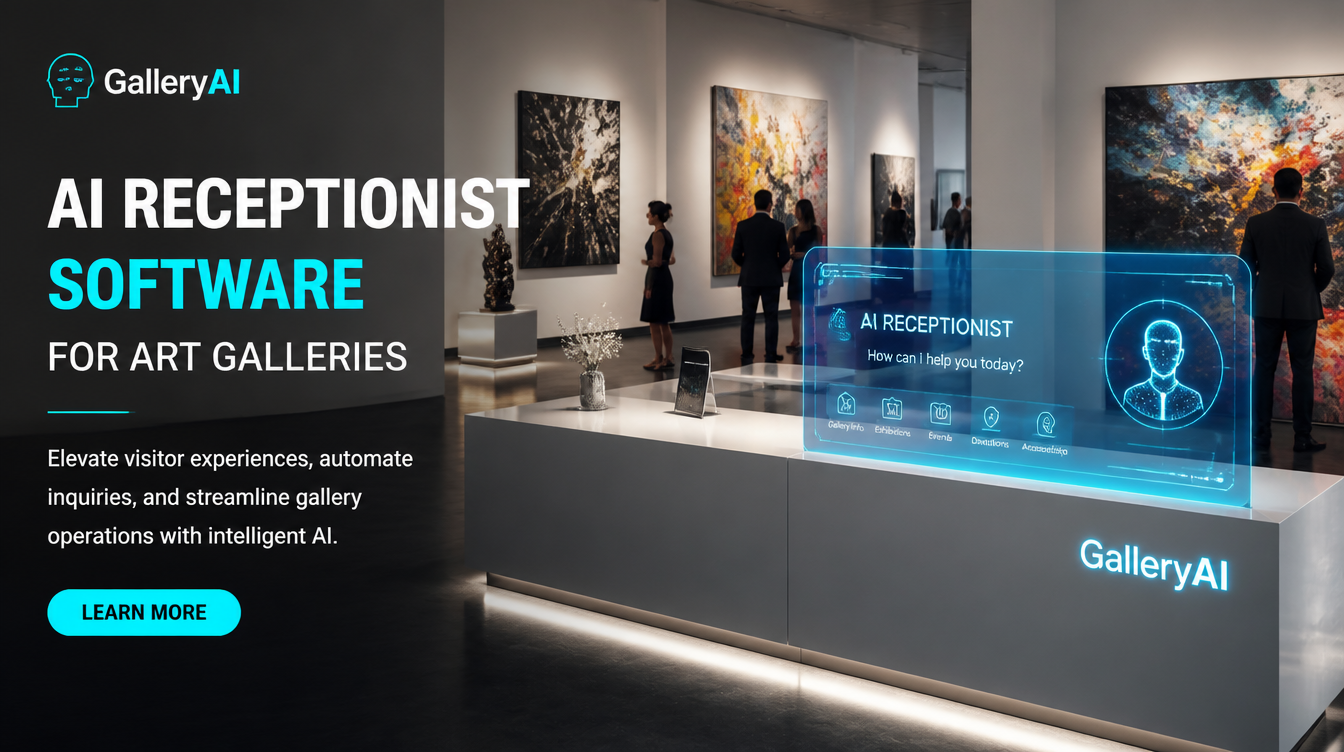
AI Receptionist for Art Galleries: Never Miss a Visitor Inquiry or Sale Again
By Leadra.io Team · June 21, 2026 · 8 min read
An AI receptionist for an art gallery is a 24/7 automated voice and chat system that answers inquiries about artwork, prices, and hours, qualifies serious collectors, schedules private viewings, and follows up with leads — all without a human picking up the phone. Most galleries see a measurable increase in booked appointments within the first 30 days.
A serious collector calls your gallery at 7:30 PM on a Tuesday. She wants to know about a specific piece she saw on Instagram. Nobody answers. She emails — your inbox pings, but you are at dinner. By Thursday morning when you respond, she has already purchased from a competitor who had a live chat widget on their site.
That is not a hypothetical. It is the daily reality for most art galleries operating without an AI receptionist. Every unanswered inquiry is a potential five-figure sale that walks out the digital door.
This guide breaks down exactly how an AI receptionist for art galleries works, what it costs, which tasks it handles best, and how to set one up without disrupting your existing operation.
Why Art Galleries Bleed Revenue Through the Phone and Inbox
Gallery hours are typically 10 AM to 6 PM, five or six days a week. But collector curiosity does not respect business hours. According to a 2025 Artsy market report, 61% of online art inquiries happen outside gallery business hours — evenings, weekends, and lunch breaks. That is the majority of your inbound interest going unanswered.
On top of that, the average gallery spends 40% of front-desk staff time on repetitive questions: gallery hours, parking, whether a piece is available, upcoming exhibition dates, and commission pricing. These are not conversations that require an art degree. They are conversations that an AI receptionist handles in under 10 seconds, 24 hours a day.
The cost of missed follow-up is staggering. A gallery selling pieces in the $2,000–$50,000 range needs to close only a handful of additional sales per month to cover a year of AI tools. Most galleries are missing those sales right now because they lack a system to capture and respond to interest the moment it happens.
Internal link: See how Leadra.io's client acquisition system solves this for service businesses and galleries alike.
What an AI Receptionist for an Art Gallery Actually Does
The term "AI receptionist" covers a range of tools from basic chatbots to fully conversational voice agents. For art galleries, the most effective systems handle all of the following:
1. Answering Inbound Calls and Web Chats 24/7
When a visitor calls after hours, the AI picks up immediately. It greets them in the gallery's voice, answers questions about current exhibitions, available pieces, and pricing tiers, and offers to schedule a private viewing or callback from a gallery advisor. No voicemail. No "leave a message and we'll get back to you." Real-time engagement that keeps the collector warm.
2. Qualifying Serious Buyers vs. Casual Inquiries
Not every caller is a collector. Your staff time is valuable. An AI receptionist can be trained to ask qualifying questions that separate serious buyers from people just browsing: Are you looking for a specific medium? Do you have a budget range? Is this for a personal collection or a corporate space? Serious leads get flagged immediately and routed to your team with full context.
3. Booking Private Viewings and Appointment Follow-Ups
Once a potential collector is qualified, the AI books a private viewing directly into your calendar — no back-and-forth emails. It sends a confirmation, a reminder 24 hours before, and a follow-up message after the appointment asking for feedback. This alone eliminates 3–5 hours of scheduling admin per week for most galleries.
4. Answering Artwork-Specific Questions
You can train an AI receptionist on your entire catalog: artist bios, medium, dimensions, edition sizes, provenance, and price. When a collector asks "Is that Reyes piece still available?" the AI checks your inventory data and gives an accurate answer in real time. No more "I'll have to check and call you back" responses that kill sales momentum.
5. Following Up With Exhibition Visitors
Visitors who sign your guest book or scan a QR code at an opening can automatically receive a follow-up text or email the next day — a personalized note mentioning the pieces they showed interest in, with a direct link to schedule a private viewing or inquiry call. This kind of structured follow-up converts casual visitors into buyers at a much higher rate than waiting and hoping they return.
| Task | Without AI Receptionist | With AI Receptionist |
|---|---|---|
| After-hours inquiry | Voicemail, responded next day (if at all) | Answered instantly, appointment offered |
| Artwork availability check | Staff callback, 1–24 hr delay | Real-time answer from inventory data |
| Viewing booking | 3–5 emails back and forth | Booked in 60 seconds during the call |
| Exhibition follow-up | Rarely done, no system | Automated next-day personalized message |
| Lead qualification | Staff time on every inquiry | AI pre-qualifies, routes only hot leads |
Real-World Example: A Boutique Gallery Adding $18,000 in Sales in 60 Days
(This example represents the type of results our clients achieve.)
A boutique gallery in the Southeast was selling primarily through weekend foot traffic and word of mouth. They had a website with a contact form but no one responding to web inquiries consistently. Their front-desk coordinator handled calls during the week, but anything that came in after 5 PM or on Sunday went unanswered until Monday.
After implementing an AI receptionist, they saw three immediate changes:
- Weekend and evening inquiries were now answered instantly. In the first month, 14 of those became qualified leads.
- Their coordinator stopped spending 2 hours a day on scheduling and basic FAQ calls, and redirected that time to relationship-building with existing collectors.
- Two collectors who had previously emailed with no response returned after receiving an automated follow-up through the new system. One purchased a $9,200 piece. The other scheduled a corporate art consultation worth $8,800.
Total additional revenue in 60 days: approximately $18,000. Monthly AI receptionist cost: under $400.
The system did not replace the gallery's relationship with collectors. It made sure those relationships had a chance to start in the first place.
How to Set Up an AI Receptionist for Your Art Gallery
Most galleries can go live in under two weeks. Here is the actual process:
Step 1: Map your most common inquiries. Write down the 20 questions your staff answer most often. Gallery hours, parking, exhibition dates, piece availability, pricing structure, commission policy, artist bios. This becomes the AI's knowledge base.
Step 2: Upload your inventory or connect your CRM. If you track available pieces in a spreadsheet, Airtable, or gallery management software, the AI can pull from that data in real time. This enables accurate availability answers without staff involvement.
Step 3: Configure call and chat routing. Decide which inquiries the AI handles end-to-end (basic FAQs, booking viewings) versus which it routes to a human (high-value collector calls, press inquiries, corporate commissions). Set the thresholds based on your team's bandwidth.
Step 4: Integrate with your calendar. Connect Google Calendar or Calendly so the AI can book viewings directly without creating double-bookings. Set available time slots per advisor.
Step 5: Build your follow-up sequences. Set up automated texts or emails for post-exhibition follow-up, abandoned inquiry recovery (people who filled out a form but never responded), and appointment reminders. These sequences run forever once set up.
Step 6: Train the AI on your brand voice. A gallery has a specific aesthetic and tone. The AI should match it — refined, knowledgeable, warm. Not robotic. Not generic. This takes about 30 minutes of configuration and sample conversation review.
Leadra.io handles all six of these steps as part of our AI implementation service. Most gallery clients are fully operational within 10 business days.
What It Costs — And What the ROI Looks Like
AI receptionist systems for galleries typically run $200–$600 per month depending on call volume, the number of integrations, and whether you want a voice agent, chat agent, or both. Enterprise-level solutions with full CRM integration and custom voice training run higher.
The math is straightforward: if your average piece sells for $3,500 and your AI receptionist captures just one additional sale per month that would have otherwise been a missed inquiry, you are at 5x–10x ROI before accounting for staff time saved.
Most galleries see payback in the first 30–45 days. The ones that see the fastest returns are those with active social media presence driving inquiry volume — because that is exactly where the gap is widest between interest generated and interest captured.
Frequently Asked Questions
What is an AI receptionist for an art gallery?
An AI receptionist for an art gallery is a 24/7 automated system — voice, chat, or both — that answers visitor and collector inquiries, provides information about artwork and exhibitions, qualifies leads, and books private viewings without requiring gallery staff to be available. It is trained on your specific gallery inventory, policies, and brand voice.
Will an AI receptionist sound robotic to serious collectors?
Modern AI voice agents are indistinguishable from human receptionists in most conversations. They speak naturally, handle interruptions, and can be given a specific name and persona that matches your gallery's brand. Collectors interacting via chat often do not realize they are speaking with AI at all. The key is custom training — generic out-of-the-box bots feel cheap. A properly configured system does not.
How long does it take to see results from an AI receptionist?
Most galleries see measurable results within 30 days. The first metric to move is response rate on after-hours inquiries — that improves immediately on day one. Booked viewings typically increase within two to three weeks as the follow-up sequences activate. Revenue impact is usually visible in 30–60 days, depending on your gallery's sales cycle.
Can the AI handle high-value collector calls without offending them?
Yes — when configured correctly. The AI qualifies the conversation, gathers context, and then transfers the collector to a human advisor with a full summary of what was discussed. Serious collectors do not object to AI if the handoff is seamless and they reach a knowledgeable person quickly. What offends collectors is being ignored or waiting 48 hours for a response. The AI eliminates that entirely.
- 61% of art gallery inquiries happen outside business hours — an AI receptionist captures all of them instead of sending callers to voicemail.
- The AI qualifies buyers, answers inventory questions in real time, and books viewings directly into your calendar with no staff involvement.
- Most galleries recoup the cost of the system in the first 30–45 days from sales that would otherwise have been missed inquiries.
- Setup takes under two weeks when working with a specialist — no technical knowledge required from the gallery owner or staff.
What to Do Next
If your gallery has any social media presence, runs exhibitions, or fields more than 10 inquiries per week, an AI receptionist will pay for itself. The question is not whether it makes sense — it does. The question is how fast you want to stop losing sales to unanswered calls.
Start by auditing your missed inquiry rate for the last 30 days. Check your voicemail volume, your unread contact form submissions, and your email response times. That number is the baseline. An AI receptionist closes that gap on day one.
At Leadra.io, we build and manage AI receptionist systems for galleries, studios, and creative businesses. Call us at +1 (864) 721-8384 or visit our contact page to schedule a free 30-minute strategy call.
Ready to stop missing sales?
Let Leadra.io build your AI receptionist system.
Free 30-minute strategy call — we audit your current inquiry process and show you exactly what you are missing. No obligation. You leave with a written plan whether or not you hire us.
Charlotte NC · serving galleries and creative businesses nationwide
Written by the Leadra.io Team. Leadra.io is an AI marketing and automation agency helping galleries, dental practices, and small businesses grow with AI-powered systems. Based in Charlotte, NC — serving clients nationwide.