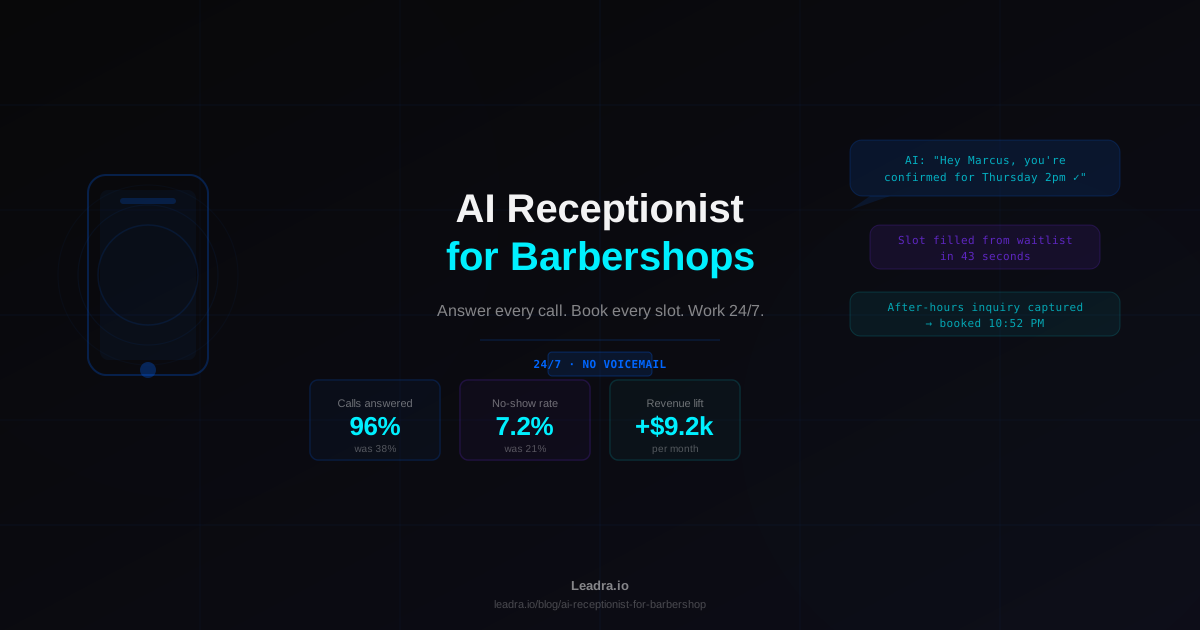
Every barber knows the problem. You're mid-fade, clippers in hand, and your phone rings. You let it go to voicemail. By the time you finish the cut, clean up, and check your messages, the caller booked somewhere else. That's $40 to $80 gone — and it happens three or four times a day.
Hiring a receptionist costs $2,800 to $4,200 per month for full-time coverage in Charlotte. Part-time help solves evenings and weekends but leaves you exposed during busy morning hours when you can't pick up. Neither option handles the 11pm text from a potential new client asking if you have anything open Saturday.
An AI receptionist for a barbershop solves all of this at a fraction of the cost. This guide covers what a barbershop AI receptionist actually does (it's a lot more than a booking app), how much it costs, and what real results look like for shops using it in Charlotte.
AI Receptionist vs. Booking App: What's the Difference?
Most barbershops already have a booking app — Square Appointments, Booksy, Vagaro, or StyleSeat. Those tools do one thing: they sit there and wait for clients to find them, navigate to the booking page, and schedule themselves. That's passive.
An AI receptionist is active. When someone calls, texts, DMs on Instagram, or messages through your Google Business Profile, the AI picks up and handles it. It doesn't require the client to find your booking link. It meets them wherever they already are — phone, text, social — and completes the booking in that conversation.
Booking apps wait. AI receptionists respond.
A booking app is a destination. An AI receptionist is a front desk. The difference in conversion rates is significant: passive booking apps convert 5-15% of people who hear about your shop into booked appointments. AI receptionists that respond instantly to inbound contact typically convert 40-65% of inquiries into confirmed bookings.
Booking apps require clients to self-serve. AI handles objections.
When a client texts asking 'do you do skin fades?' or 'how long is the wait on Saturdays?', a booking app can't answer. Those questions go unanswered, or you stop cutting to reply. An AI receptionist answers service questions, explains pricing, checks wait times, and books the appointment in the same conversation.
Booking apps don't prevent no-shows or recover cancellations.
Booking apps send one generic reminder email before the appointment. AI receptionists run three-step confirmation sequences, auto-fill cancellations from a waitlist before the slot empties, and send recovery messages after missed appointments to reschedule rather than just losing the revenue.
5 Things an AI Receptionist Does for Your Barbershop Every Day
A well-configured AI receptionist for a barbershop handles the full front-desk function. Here's what that looks like in practice:
Inbound Call and Message Handling
When a client calls your shop number, the AI answers in your shop's name with a natural voice. It asks what they need, checks your real-time calendar for the barber they prefer, offers specific available times, and confirms the booking by voice — or texts them a link to complete it if they prefer. The call ends with the appointment booked and a confirmation text sent automatically.
The same system handles inbound SMS and Google Business Profile messages. A client who texts "do you have anything open for Marcus tomorrow around noon?" gets an instant reply with available slots and books in under two minutes. No one had to stop cutting to handle it.
No-Show Prevention Sequence
For every confirmed appointment, the AI runs a three-step sequence: a personalized text 48 hours out asking the client to confirm or reschedule, a reminder 24 hours before, and a final check-in 2 hours before the chair time. Each message uses the client's name and their barber's name — not a generic reminder blast.
If the client doesn't confirm by the 24-hour mark, the system automatically offers the slot to the next person on the waitlist for that barber. The seat fills before you even know there was a risk. Shops running this system consistently drop their no-show rate from 18-25% down to 6-9%, which for a three-barber shop typically recovers $800-$1,400 per week in previously lost revenue.
After-Hours Inquiry Capture
Most barbershop booking requests don't happen during business hours. Clients remember they need a cut at 10pm on a Tuesday, or they see a social post on Sunday morning and want to book before they forget. Without an AI receptionist, those inquiries go unanswered until morning — and the client has moved on.
An AI receptionist captures every after-hours contact with an immediate, helpful response. It books appointments, answers service questions, and handles rescheduling requests at any hour. Barbershops that add after-hours coverage typically see 20-30% of their weekly bookings originate from contact made outside of business hours.
Post-Visit Rebooking and Review Request
Twenty minutes after every completed appointment, the AI sends two things: a rebooking nudge ("Looking good, Marcus. Want to lock in your next cut before DeShawn's calendar fills up?" with a direct booking link) and a review request ("If you're happy with the cut, a Google review takes 30 seconds and helps us out a lot").
The rebooking message keeps your repeat clients on a consistent cadence instead of waiting for them to remember to book again. The review request generates 15-30 new Google reviews per month consistently — more than most barbershops get in a year without automation. A higher review count and rating directly improves where your shop appears in Google searches.
Dormant Client Reactivation
Every barbershop has a graveyard of clients who came in once or twice and then disappeared. For a busy shop, that's typically 150-400 people in your booking system who haven't returned in 60 days or more. They already liked your work. They just drifted — and no one followed up.
The AI receptionist identifies dormant clients automatically and sends a personalized re-engagement message: "It's been a while, Marcus — your last cut with DeShawn was 9 weeks ago. We've got some open slots this week if you want to get back on the schedule." These sequences typically reactivate 20-30% of dormant clients, recovering $600-$2,000 per month from clients you already acquired and then lost to silence.
No Receptionist vs. Human Receptionist vs. AI Receptionist: Real Numbers
| Area | No Receptionist | Human Receptionist | AI Receptionist |
|---|---|---|---|
| Monthly cost | Free | $2,800–$4,200/mo | $300–$2,500/mo |
| Hours of coverage | You, during cuts | 8–10 hrs/day, 5 days | 24/7/365 |
| Calls answered | 30–40% (rest go to voicemail) | 85–95% during business hours | 95–100% any time |
| After-hours bookings | 0 | 0 | 20–30% of weekly total |
| No-show rate | 18–25% | 12–18% with manual reminders | 6–9% with 3-step automation |
| Google reviews/mo | 0–2 (only volunteers) | 2–5 if they ask | 15–30 automated post-visit |
| Dormant reactivation | None | Manual, inconsistent | Automated, 20–30% reactivation |
| Sick days / turnover | N/A | Regular disruption | None |
Case Study: South End Barbershop Adds $9,200/Month Without Hiring Anyone
A two-barber shop in Charlotte's South End neighborhood was losing revenue three ways: calls going to voicemail during busy hours, no-shows running at 21%, and roughly 180 past clients who hadn't booked in over 60 days. The owner had looked at hiring a part-time receptionist but couldn't justify $1,400/month for 20 hours of coverage when the problem was really about 24-hour availability.
Calls answered
38%
96%
No-show rate
21%
7.2%
Google reviews
29
118
Monthly revenue
$14,800
$24,000
Leadra.io deployed an AI receptionist for the barbershop covering inbound calls and texts, a three-step no-show confirmation sequence, after-hours booking, and a dormant client reactivation campaign targeting the 180 lapsed clients in the system.
In the first two weeks, the no-show sequence alone recovered an average of 11 previously empty slots per week — roughly $440 to $660 in weekly revenue that had been evaporating. The after-hours AI captured 31 booking requests in the first 30 days that would have gone to voicemail. Of those, 24 became confirmed appointments.
The dormant reactivation campaign ran at day 21 and brought back 41 clients over the following six weeks. By day 90, monthly revenue had grown from $14,800 to $24,000. The AI receptionist cost $850/month. The net gain was roughly $9,200 per month — with no new staff.
What an AI Receptionist Costs for a Barbershop in 2026
Pricing for AI receptionist systems depends on the number of barbers, call volume, and which features you need. Here's how the tiers break down:
Basic
$300–$600/mo
- →SMS booking and confirmation
- →2-step no-show reminder sequence
- →Waitlist fill on cancellations
- →Post-visit review request
- →Best for: solo or 2-barber shops with existing booking app
Standard
$600–$1,200/mo
- →Everything in Basic
- →3-step no-show confirmation sequence with voice AI backup
- →After-hours SMS and DM handling
- →Dormant client reactivation campaigns
- →Monthly performance reporting
- →Best for: 2–4 barber shops looking to replace or avoid hiring a receptionist
Full AI Receptionist
$1,200–$2,500/mo
- →Everything in Standard
- →Inbound voice AI (calls answered by AI, booked by voice)
- →Multi-channel: phone, SMS, Instagram DM, Google Business Profile chat
- →Local SEO content and GBP updates
- →Proactive lead outreach for slow days
- →Best for: 3+ barber shops replacing a full human receptionist
How to Evaluate an AI Receptionist System for Your Barbershop
Not all AI receptionist systems are built for barbershops. Most are generic business phone tools that weren't designed around appointment-based scheduling with specific barber preferences, service menus, and the real-time availability that clients expect. Here's what to look for:
Real-time calendar integration — not delayed sync
The AI needs to see your actual availability when a client asks. Systems that sync every 15-30 minutes will double-book or offer slots that are already taken. Demand direct API integration with your booking software (Booksy, Vagaro, StyleSeat, Square Appointments) that reads live availability.
Barber-specific booking, not just shop-level availability
Clients book barbers, not time slots. If a client wants Marcus and Marcus is full Saturday but another barber has openings, the system needs to handle that — offer alternatives, suggest the next available Marcus slot, or present both options. Generic systems don't understand this.
Multi-channel coverage from day one
Phone calls, SMS, Instagram DMs, and Google Business Profile messages all need to go through the same system so there's no gap. A solution that only handles one channel leaves revenue on the table everywhere else.
Measurable no-show and recovery reporting
Ask any vendor for month-one results from barbershop clients: no-show rate before and after, slots recovered from waitlist fill, and dormant client reactivation numbers. If they can't provide that data, they aren't measuring what matters.
Frequently Asked Questions
What does an AI receptionist for a barbershop actually do?
An AI receptionist for a barbershop answers incoming calls, responds to text and DM inquiries, books and confirms appointments in real time, handles rescheduling, sends no-show prevention reminders, fills cancellation slots from a waitlist, and reactivates dormant clients — all automatically, 24 hours a day. It handles the full front-desk function that a human receptionist would handle, except it never calls in sick, never misses an after-hours inquiry, and never costs $3,500/month.
How much does an AI receptionist cost for a barbershop?
AI receptionist systems for barbershops typically run $300 to $2,500 per month depending on the number of barbers, call volume, and features. A basic SMS booking and confirmation system starts around $300-$600/month. A full system with voice AI, multi-channel messaging, and dormant client reactivation runs $1,200-$2,500/month. Most shops with two or more chairs recover the cost within 30 days from no-show prevention alone.
Will clients know they're talking to an AI?
AI receptionist systems for barbershops communicate in your shop's voice and don't announce themselves as AI unless asked. Clients see your shop name and number, receive messages with their name and barber's name, and complete bookings without friction. If a client directly asks whether they're talking to a person, the system is configured to be transparent. The goal is efficient service, not deception.
Can an AI receptionist handle phone calls, not just texts?
Yes. Advanced systems include a voice AI that answers incoming calls, asks what the caller needs, checks your real-time calendar, and books or reschedules appointments by voice. The voice AI can also capture missed calls after hours, text the caller a booking link, and log the inquiry. Barbershops using voice AI alongside SMS automation typically capture 70-85% of calls that would otherwise go to voicemail.
Related Reading
Ready to Stop Losing Calls Between Cuts?
Leadra.io builds and manages AI receptionist systems for barbershops. We handle the setup, integration with your booking software, and ongoing optimization. Most shops see positive ROI within 30 days.