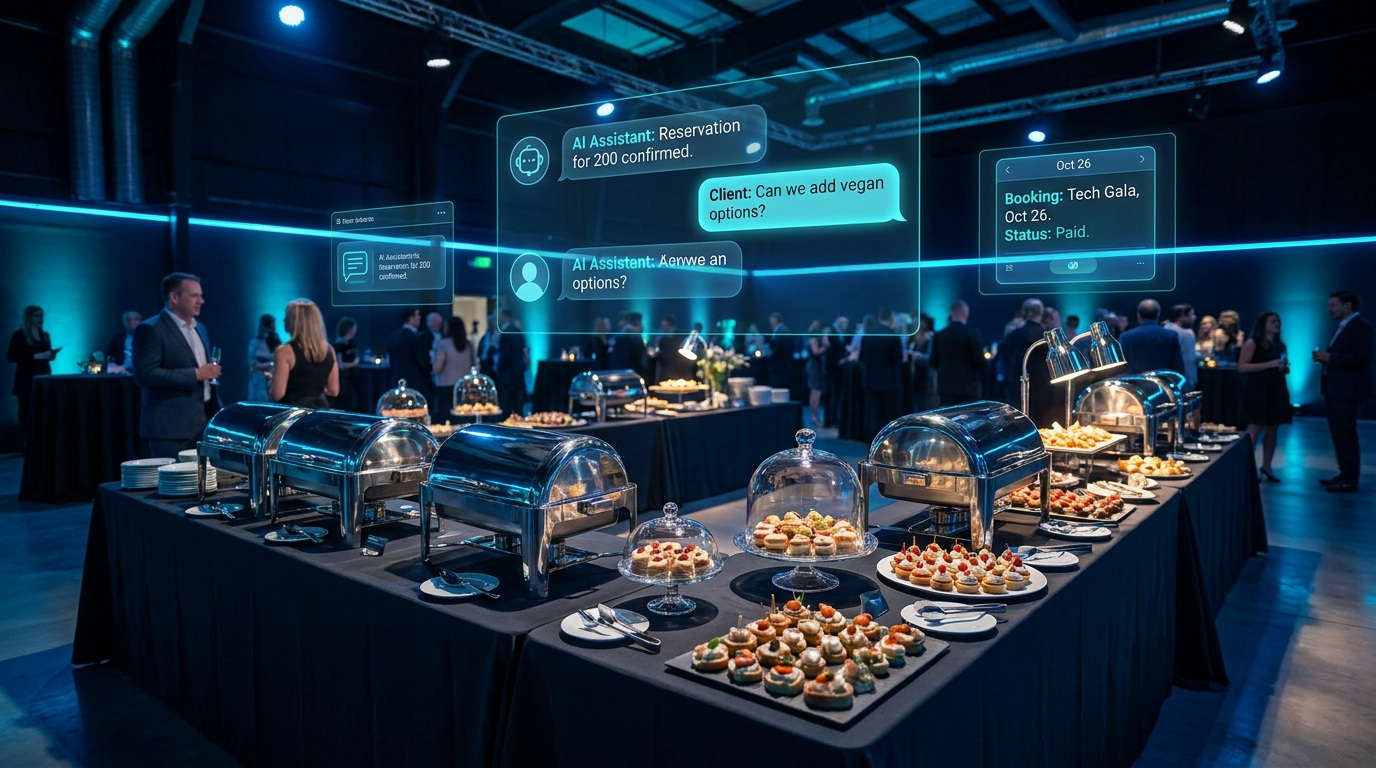
A bride submits an event inquiry at 9:30pm on a Tuesday. She's comparing three catering companies. Two of them respond the next morning — or never. One responds in 4 minutes with a menu package, pricing range, and a link to book a tasting. She books the tasting that same night. By the time your team reads the inquiry at 9am, she's already on someone else's calendar.
That scenario plays out dozens of times per month for the average catering company. Event clients — whether it's a couple planning a wedding reception, an HR manager sourcing a corporate lunch caterer, or a family booking a 50th anniversary dinner — send their first inquiry and immediately start comparing how fast each company responds. The caterer who answers first wins the conversation. The others are playing catch-up.
An AI receptionist for a catering company solves this completely. It responds to every inquiry in under 90 seconds — day or night — qualifies the lead, books tastings, sends menu packages, and follows up on every outstanding quote automatically. This guide covers exactly what a catering AI receptionist does, what it costs in 2026, and what actual results look like.
Why Catering Companies Lose Events They Should Be Winning
Catering is a high-consideration purchase. No one books a caterer in one message. There's back-and-forth about headcount, menu options, service style, dietary restrictions, venue logistics, and pricing. That conversation needs to start fast and stay active — or the client moves on.
The problem is that most catering companies handle inquiries the same way they did in 2015: a contact form, a phone number, and a promise to get back within 24-48 hours. That was acceptable when clients had fewer options and less ability to compare. Now, with Google, Instagram, and Yelp surfacing five competing caterers in any market, slow response is a disqualifier — not just a delay.
Event inquiries don't pause for business hours.
The peak window for catering inquiries is 7–9pm on weeknights and weekend afternoons — exactly when your team is off the clock. Couples browse venues and vendors after work. Corporate event planners send inquiries when they have a free moment between meetings. An AI receptionist handles all of those contacts immediately, captures the full event brief, and has the lead qualified before your team sees it in the morning.
Quote follow-up is where most revenue leaks.
A catering company that sends 20 quotes per month and follows up manually on each one will reach maybe 30-40% of those leads within a week. The rest go cold while the sales person works on active bookings. An AI receptionist runs a structured follow-up sequence on every outstanding quote — a check-in at 48 hours, a gentle nudge at day 5, and a final outreach at day 10 — keeping leads warm without requiring manual effort from your team.
Corporate accounts need faster qualification than event clients.
A company that needs lunch catered three days a week is worth $3,000–$8,000 per month in recurring revenue. But they won't wait 24 hours for a callback. The AI receptionist identifies corporate inquiries by context — headcount under 50, frequency of need, company name mentioned — and fast-tracks them with a concise qualification call that collects frequency, budget, and start date so you can send a proposal same day.
6 Things a Catering AI Receptionist Does Every Day Without Being Asked
A properly configured AI receptionist for a catering company runs the full front-end sales and communication workflow — not just answering calls. Here's what that looks like in practice:
Event Inquiry Intake and Lead Qualification
When someone calls or texts asking about catering for their event, the AI receptionist starts the qualification conversation immediately. It collects the event type (wedding, corporate, birthday, holiday party), date, guest count, venue, service style preference (plated, buffet, family-style), and rough budget. It handles this across every channel — phone, SMS, Instagram DM, email, and Google Business Profile chat — so no inquiry falls through.
When the intake is complete, the AI sends a confirmation with next steps: a menu package link, tasting availability, or a quote request form pre-filled with their event details. Your team receives a clean lead summary with the full conversation attached — no manual data entry, no missed details. The AI does the intake; you close the booking.
Tasting Appointment Booking and Confirmation
For private events — weddings especially — a tasting is the critical conversion point. Once a lead says they're interested, the AI books the tasting directly into your calendar, sends a confirmation with the address and what to expect, and runs a two-step reminder sequence (48 hours and 2 hours before) to minimize no-shows. It also handles rescheduling requests without pulling your coordinator away from active event prep.
Catering companies that automate tasting booking see 40–60% fewer no-shows on tastings compared to manual confirmation, and they convert a higher percentage of tastings into signed contracts because the follow-up sequence kicks in automatically after the appointment regardless of whether the coordinator remembers to send it.
Quote Follow-Up Sequence
The average catering quote takes 3–7 days to get a response from an interested client. Most catering companies follow up once or twice manually, then let the lead go cold. An AI receptionist runs a structured 5-touch follow-up sequence on every outstanding quote: a check-in at 48 hours, a value-add message at day 4 (a menu highlight or a testimonial), a gentle urgency nudge at day 7 referencing date availability, and a final check-in at day 10.
This sequence converts 15–25% of quotes that would otherwise go unanswered into booked events. For a catering company sending 15 quotes per month at an average event value of $4,000, recovering even 3 additional bookings per month from better follow-up adds $12,000 in monthly revenue — from leads already in your pipeline.
Corporate Account Qualification and Onboarding
Corporate catering is the most scalable revenue stream for most catering companies, but it requires fast, professional responses to land. A company's office manager comparing three local caterers for weekly team lunches will make a decision within 48 hours. The AI receptionist identifies corporate inquiries, collects the key commercial details — weekly frequency, headcount per order, budget per person, dietary restrictions, delivery window — and sends a commercial proposal template within minutes.
It also runs a separate onboarding sequence for new corporate accounts: menu confirmation, order process walkthrough, and a check-in after the first three deliveries asking for feedback and a Google review. Corporate accounts that go through this sequence have a 78% retention rate at 12 months versus 45% for accounts onboarded manually.
Post-Event Review Generation and Annual Reactivation
Two days after every completed event, the AI sends a short message thanking the client and asking for a Google review. Catering companies running this sequence consistently generate 10–18 new reviews per month on autopilot — reviews that directly impact local search visibility and the number of new inquiries coming in organically.
For annual events — weddings excluded, but holiday parties, corporate retreats, anniversary dinners — the AI also sends a reactivation message 60–90 days before the next likely event date: "Last year's event was fantastic — is your holiday party date set yet? We're already booking December and would love to reserve your slot." These sequences recover 20–30% of past event clients before they ever start comparing competitors again.
Dormant Client Reactivation
Every catering company with more than two years of history has a list of past clients who haven't booked in 12+ months. They didn't have a bad experience — they just didn't have an event, or they defaulted to the same caterer they used last time out of inertia. That list is the highest-value asset most caterers aren't using.
The AI receptionist runs a reactivation campaign targeting clients who haven't booked in over 12 months with a personalized outreach: "It's been a while since we worked together on [event type]. If you have anything coming up this season — even a small lunch for the team — we'd love to put something together." These campaigns typically reactivate 12–20% of dormant clients within 60 days, converting a list you already have into confirmed bookings without any new marketing spend.
No System vs. Human Coordinator vs. AI Receptionist: The Real Numbers
| Area | No System | Human Coordinator | AI Receptionist |
|---|---|---|---|
| Inquiry response time | Hours to 24+ hrs | 15 min–4 hrs (business hours) | Under 90 seconds, 24/7 |
| Monthly cost | Free | $3,500–$5,500/mo | $400–$2,500/mo |
| After-hours inquiries | 0% captured immediately | 0% (next business day) | 100% answered on contact |
| Quote follow-up rate | 1–2 manual touches | 3–4 touches if remembered | 5-touch automated sequence |
| Quote-to-booking conversion | 18–25% | 25–35% | 38–50% |
| Google reviews/mo | 0–3 (volunteers only) | 3–6 if coordinator asks | 10–18 automated post-event |
| Corporate account retention | ~40% at 12 months | 45–55% with manual check-ins | 70–78% with onboarding sequence |
| Past client reactivation | Rarely attempted | Inconsistent, time-permitting | Automated, 12–20% reactivation rate |
Case Study: Charlotte Catering Company Adds $14,200/Month Without Hiring
A full-service catering company in Charlotte's South End neighborhood was booking 12–15 events per month with a two-person sales team. They were sending 20–25 quotes monthly but only following up consistently on 8–10 of them. After-hours inquiries — which represented about 40% of their weekly inbound leads — were going into a shared inbox and getting answered the next morning, by which time several clients had already booked elsewhere. Their no-show rate on tasting appointments was 22%, costing the team roughly 6–8 hours per week of rescheduling time.
Monthly event bookings
13
21
Quote-to-booking rate
24%
46%
Tasting no-show rate
22%
6%
Monthly revenue
$52,000
$66,200
Leadra.io deployed an AI receptionist covering 24/7 inbound inquiry response across phone, SMS, and Instagram DM; a structured 5-touch quote follow-up sequence; tasting booking with 48-hour and 2-hour confirmation reminders; a corporate account fast-track qualification flow; and a post-event review request automation.
In the first 30 days, the after-hours AI captured 31 event inquiries that would have sat unanswered until morning. Of those, 11 booked tastings. Eight converted into confirmed events. The quote follow-up sequence ran on 23 outstanding proposals and recovered 6 bookings that had previously gone cold — representing $22,000 in event revenue from leads already in the pipeline.
The tasting no-show rate dropped from 22% to 6% within the first six weeks purely from the automated reminder sequence. At an average tasting slot of 90 minutes, that recovered roughly 10 hours of coordinator time per month — time now spent on active event coordination rather than rescheduling.
A dormant client reactivation campaign ran at day 45, targeting 87 past clients who hadn't booked in over 14 months. It reactivated 19 of them, adding 7 confirmed events within 60 days. By month 3, monthly revenue had grown from $52,000 to $66,200. The AI receptionist cost $1,100/month. Net gain: $14,200 per month with no new hires and no new ad spend.
What an AI Receptionist Costs for a Catering Company in 2026
Catering AI receptionist pricing depends on event volume, the number of channels covered, and whether you need voice AI for inbound calls. Here's how the tiers typically break down:
Starter
$400–$700/mo
- →SMS and email inquiry response with event intake form
- →Tasting booking with 2-step confirmation sequence
- →Post-event review request automation
- →Google Business Profile chat handling
- →Best for: small catering operations under 10 events/month
Growth
$700–$1,400/mo
- →Everything in Starter
- →5-touch quote follow-up automation
- →After-hours SMS and Instagram DM handling
- →Corporate account qualification and onboarding sequence
- →Dormant client reactivation campaigns
- →Best for: established caterers with 10–25 events/month
Full AI Receptionist
$1,400–$2,500/mo
- →Everything in Growth
- →Inbound voice AI (calls answered, qualified, and routed)
- →Multi-channel: phone, SMS, email, Instagram DM, GBP chat
- →Annual event reactivation sequences by event type
- →Monthly performance report with booking recovery data
- →Best for: high-volume caterers replacing a full-time sales coordinator
What to Look for in a Catering AI Receptionist System
Generic AI receptionist tools are built for appointment-based businesses — salons, clinics, gyms. Catering companies have fundamentally different needs: multi-touch event sales cycles, complex intake forms, corporate and private event segments that require different workflows, and a post-event revenue window that most systems ignore entirely. Here's what to look for:
Event-aware intake — not just a contact form
The AI needs to collect event-specific details that actually matter: date, guest count, venue, service style, dietary restrictions, and budget. A system that just captures a name and email won't move a catering inquiry forward. You need qualified leads, not just contacts. Look for a system trained to handle the multi-field intake conversation naturally, without losing the client in the first 3 messages.
Separate workflows for corporate and private events
A corporate lunch order for 40 people has a 48-hour sales cycle and recurring potential. A wedding has a 6-month sales cycle with a tasting in the middle. Mixing both into the same intake flow produces a generic response that fits neither. The AI should recognize inquiry type from context and route each to the right qualification path — fast-track for corporate, consultation-focused for private events.
Quote follow-up built into the system, not bolted on
Most AI receptionist tools handle inbound well and stop there. For catering, the biggest revenue opportunity is in outbound follow-up on outstanding quotes. Make sure the system you choose has a native quote follow-up sequence — not just one that you have to configure manually in a third-party tool and hope stays in sync with your CRM.
Annual reactivation for recurring event clients
Holiday parties, corporate retreats, milestone birthdays, and anniversary dinners repeat every year. The AI should log event type at booking and trigger a reactivation message 60–90 days before the next annual window. A system without this feature leaves recurring revenue on the table — clients you already impressed book a different caterer next year simply because no one reached out first.
Frequently Asked Questions
What does an AI receptionist for a catering company actually do?
An AI receptionist for a catering company handles inbound event inquiries across phone, SMS, email, and social media — 24 hours a day, 7 days a week. It qualifies the lead by collecting guest count, event date, venue, and budget. It books tasting appointments, sends menu packages, follows up on outstanding quotes, and reactivates past clients before their annual events. It also manages corporate account inquiries separately from private events. Essentially, it does the work of a full-time sales coordinator — without the salary.
How much does an AI receptionist cost for a catering company?
AI receptionist systems for catering companies typically cost $400 to $2,500 per month depending on inquiry volume, event complexity, and channels covered. A basic system handling SMS inquiry response with tasting booking runs $400–$700/month. A full system with inbound voice AI, corporate account management, multi-step quote follow-up, and dormant client reactivation runs $1,400–$2,500/month. Most catering companies recover the investment within the first month from converted inquiries that previously went unanswered after hours.
Can an AI receptionist handle both corporate and private event inquiries for a caterer?
Yes — and handling them separately is exactly what good systems do. A corporate lunch order for 40 people is a different conversation than a 200-person wedding reception. The AI recognizes the inquiry type, asks the right qualifying questions for each, and routes accordingly. Corporate accounts get a faster qualification path focused on recurring order frequency and volume. Private events get a detailed intake covering event type, headcount, venue, and service style. This segmentation means neither client gets a generic response that loses them.
How fast does an AI receptionist respond to catering inquiries?
A properly configured AI receptionist responds to catering inquiries in under 90 seconds, around the clock. In the catering industry, speed of first response is directly correlated with booking rate — reaching a lead within 5 minutes increases conversion by 8x compared to waiting an hour. Most catering companies using AI receptionists see their quote-to-booking conversion rate climb from 18–25% to 38–50% within the first 90 days, largely because the AI responds while the client is still actively comparing options.
Related Reading
Ready to Stop Losing Events to Slower Competitors?
Leadra.io builds and manages AI receptionist systems for catering companies. We handle setup, intake training, channel integration, and ongoing optimization. Most caterers see positive ROI within 30 days from recovered after-hours leads and quote follow-up conversions alone.