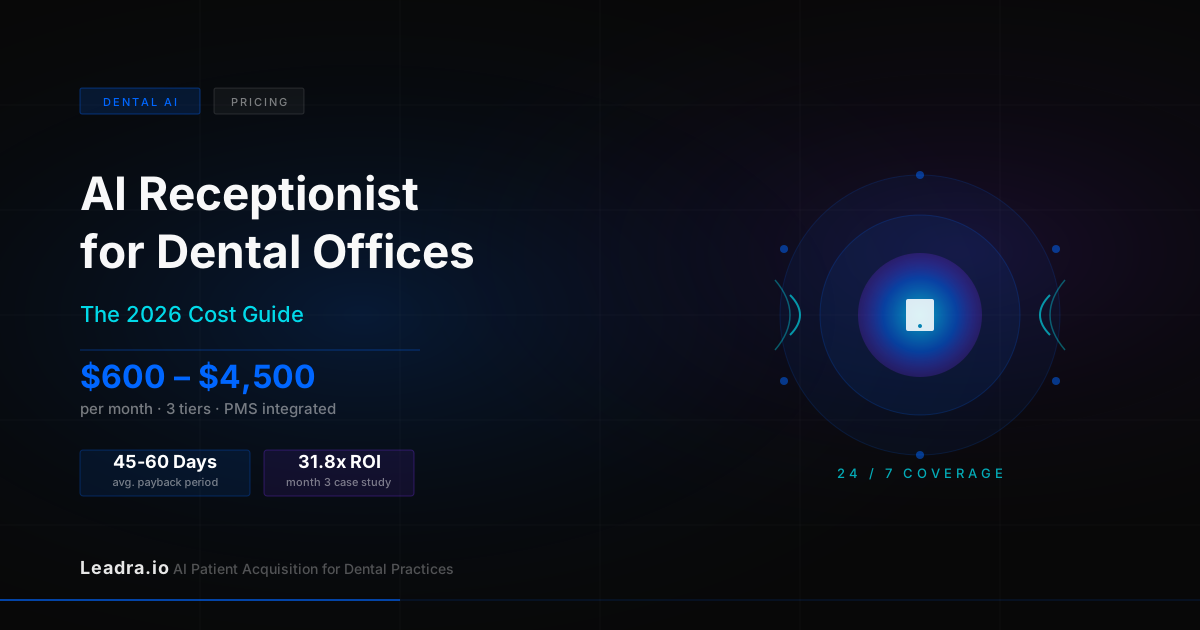
Your front desk staff leaves at 5 PM. Your patients call at 6:30 PM asking about a crown appointment, whether you take their insurance, and what the new patient process looks like. Those calls hit voicemail. Some patients leave a message. Most don't — they call the next practice on their Google search results list.
An AI receptionist for dental offices solves that problem by answering every call, 24 hours a day, 7 days a week — with no hold time, no scripts read robotically, and no missed booking opportunities. The question most dental practice owners ask next: what does it actually cost?
This guide breaks down the real pricing — three tiers, what's included at each level, what drives costs higher, and how the numbers compare to putting a second body behind your front desk. No fluff. Just what you need to make an informed decision.
What a Dental AI Receptionist Actually Does
Before getting into cost, it helps to understand the scope. A dental AI receptionist is not a voicemail upgrade. It's a live-response AI voice agent trained on your practice's specific services, hours, insurance plans, and appointment types. When a patient calls, the AI picks up immediately and handles the interaction end-to-end. Key functions:
The scope you activate determines the tier — and therefore the cost. A practice that only wants after-hours call coverage pays less than one deploying a full front-desk automation system with PMS integration and treatment plan follow-up sequences.
AI Receptionist Pricing for Dental Offices: 3 Tiers
Here's how the cost breaks down based on what you actually need.
The baseline solution: an AI voice agent answers calls when your front desk isn't available — evenings, weekends, and during peak call times when every line is occupied. The AI collects patient name, reason for calling, preferred appointment time, and contact info, then sends your front desk a structured lead summary by SMS and email each morning.
Setup time: 1-2 weeks. No changes to your phone number. Calls route to the AI layer only when your lines are busy or unanswered — your staff takes priority during business hours. Basic insurance plan FAQ responses (accepted plans, in-network status) are included.
Best for: Solo practices and small group practices (1-3 chairs) where after-hours call recovery is the primary gap. Average dental practice loses 4-9 bookable calls per week after hours — recovering 3-4 per month covers this tier entirely.
Everything in Tier 1 plus direct PMS integration (appointments write to Dentrix, Eaglesoft, or Open Dental), treatment plan follow-up sequences (5-7 automated SMS/voice touchpoints over 21 days for patients with unscheduled treatment), automated hygiene recall outreach (contacts overdue patients at the 3-, 6-, and 12-month marks), and post-appointment review collection. The AI also handles online form submissions and website chat inquiries with the same response logic.
Setup time: 3-4 weeks for PMS integration and workflow configuration. Most practices see the highest ROI from treatment plan follow-up — accepted treatment that was sitting idle is revenue that already exists in your system, waiting to be scheduled.
Best for: Established practices with 4+ chairs, $800K+ in collections, and significant unscheduled treatment in their PMS. Practices running hygiene programs with large recall lists see the fastest payback at this tier.
Custom-built AI receptionist systems for DSOs, multi-location group practices, and specialty offices (orthodontics, oral surgery, periodontics) that require complex routing logic, separate scheduling flows per location or provider, specialty-specific insurance handling (medical billing crossover, pre-authorization workflows), and dedicated analytics dashboards tracking call volume, booking conversion rate, and recall reactivation by location.
Implementation for enterprise-tier systems runs 5-8 weeks and requires your team to map existing call flows, document insurance handling rules, and test edge cases across appointment types before going live.
Best for: DSOs with 3+ locations, specialty practices, and group practices generating $3M+ in annual collections where call volume and scheduling complexity justify the build-out.
What's Not Included — And What That Costs
The monthly retainer covers the AI system, ongoing management, and performance monitoring. These items are separate — billed directly to you at their standard rates:
| Item | Who Pays | Typical Cost |
|---|---|---|
| AI voice call minutes (VAPI / Twilio) | Client | $40 – $180/mo |
| SMS credits for follow-up sequences | Client | $25 – $100/mo |
| PMS integration middleware (if required) | Client | $0 – $150/mo |
| New phone number (if dedicated line needed) | Client | $5 – $15/mo |
| HIPAA-compliant messaging platform | Client | $30 – $80/mo |
| Review platform (Birdeye, Podium, etc.) | Client | $0 – $300/mo |
For a Tier 1 implementation, plan on $80-$200/month in infrastructure costs on top of the retainer. For Tier 2 with PMS integration and follow-up sequences, budget $150-$350/month in additional infrastructure. The all-in number for most dental practices is $750-$2,850/month depending on tier and call volume.
One note on HIPAA: any AI system handling patient appointment information, insurance data, or health-related inquiries operates in a HIPAA-adjacent environment. A reputable vendor will use BAA-compliant infrastructure — confirm this before you sign. It shouldn't cost extra; it should be the standard.
AI Receptionist vs. Hiring: The Real Cost Comparison
Most dental practice owners frame this as a choice between hiring staff and deploying AI. Here's the real comparison for a Charlotte NC dental practice considering both options:
| Factor | Second Front Desk Hire | AI Receptionist (Tier 2) |
|---|---|---|
| Monthly cost (all-in) | $3,500 – $4,800 salary + benefits | $1,350 – $2,850 retainer + infra |
| After-hours coverage | None | 24/7 — evenings, weekends, holidays |
| Response time | Next available — often minutes to hours | Under 2 rings, every time |
| Treatment plan follow-up | Inconsistent — depends on staff workload | Automated 5-7 touch sequence, always runs |
| Hygiene recall outreach | Manual calls — 20-30 min/day when remembered | Automated SMS/voice at 3, 6, 12 months |
| Training time | 4-8 weeks to full productivity | 2-4 weeks for full deployment |
| Turnover risk | High — dental front desk avg tenure: 18 months | None |
| Peak call overflow | Calls queue or go to voicemail | Every call answered simultaneously |
A second front desk hire in Charlotte costs $42,000-$58,000 per year in salary plus $8,000-$12,000 in payroll taxes, benefits, and PTO. That's $50,000-$70,000 per year for coverage that stops at 5 PM on weekdays and doesn't exist on weekends.
A Tier 2 AI receptionist runs $16,200-$34,200 per year — covering the gaps a human receptionist physically cannot fill. The right model for most practices isn't AI vs. hiring — it's AI handling everything a human can't (after-hours, overflow, automated follow-up) while your in-office team focuses on what patients actually need face-to-face. See how Leadra.io's AI Voice Employee works for dental practices.
Dental-Specific Factors That Affect Your Price
Not every dental practice pays the same rate within a tier. These factors move the price up or down:
PMS platform and integration complexity.
Dentrix and Eaglesoft have mature API integrations that deploy faster. Older versions, highly customized setups, or niche platforms (Curve, Carestream, Dolphin) may require a middleware layer that adds setup time and monthly cost. Always ask your vendor for a PMS compatibility assessment before signing.
Specialty vs. general dentistry.
Orthodontic, oral surgery, and periodontal offices have more complex scheduling logic — appointment types vary significantly by treatment phase, insurance authorization requirements differ, and consultation workflows need custom scripting. Specialty practices typically land at the higher end of each tier.
Size of unscheduled treatment backlog.
Practices with large treatment plan backlogs (common in offices that haven't run systematic follow-up) see immediate ROI from Tier 2 systems. The bigger your existing backlog, the faster the AI pays for itself — which means practices with large backlogs should actually invest in a higher tier, not a lower one.
Number of providers and locations.
Each additional provider requires separate scheduling logic — availability rules, appointment types, and patient assignment routing. Multi-location practices need location-specific call routing and reporting. Add $150-$400/month per additional location to the base tier cost.
Call volume.
AI voice minute pricing scales with call volume. A practice fielding 300 calls per month pays more in infrastructure than one handling 80 calls per month. Most vendors offer tiered minute packages — your vendor should give you a usage estimate based on your current call volume before you commit.
Case Study: Charlotte NC Dental Practice, $1,400/Month, 31 Extra Appointments per Month
Client Story
A 3-dentist general practice in south Charlotte came to Leadra.io with two problems: they were losing an estimated 6-8 bookable calls per week after 5 PM, and they had over $240,000 in unscheduled treatment plans sitting in their PMS — patients who had received treatment recommendations but never booked. Their front desk of two handled everything in-house, and follow-up on unscheduled treatment happened sporadically when workload allowed.
We deployed a Tier 2 AI front desk system: 24/7 voice answering (Dentrix integration for direct appointment booking), a 7-touchpoint SMS + voice sequence for every patient with unscheduled treatment over $500, and automated hygiene recall outreach targeting patients 6+ months past their last cleaning. Total retainer: $1,400/month. Infrastructure costs (voice minutes + SMS + Dentrix middleware): $210/month.
In the first 45 days, the after-hours system recovered 19 appointment bookings that would have gone to voicemail. By day 60, the treatment plan sequences had converted 12 previously idle cases into scheduled appointments — generating $28,400 in booked production from patients already in the practice's database. Month 3 hygiene recall outreach reactivated 41 overdue patients, adding 22 completed hygiene appointments to the schedule.
After-hrs bookings
Unscheduled tx converted
Hygiene recalls/mo
Added production (mo 3)
Total all-in cost in month 3: $1,610 (retainer + infrastructure). Added production directly attributable to the AI system: $51,200 in booked procedures. That's a 31.8x return on the monthly investment — driven mostly by treatment that was already in the system but had never been followed up properly.
The after-hours recovery and unscheduled treatment conversion are the fastest paths to ROI. Hygiene recall compounds over months 3-6 as the AI works through the full overdue list and begins the ongoing cadence of keeping active patients scheduled. See the full patient acquisition framework Leadra.io uses for dental practices.
FAQ: AI Receptionist Cost for Dental Offices
How much does an AI receptionist for a dental office cost?
An AI receptionist for a dental office costs $600-$1,200/month for after-hours voice coverage, or $1,200-$2,500/month for a full AI front desk with PMS integration, treatment plan follow-up, and hygiene recall. Multi-location and specialty practices run $2,500-$4,500/month. Most practices recover the investment within 45-60 days from bookings previously lost to unanswered after-hours calls.
Can an AI receptionist handle dental insurance questions?
Yes. A properly configured AI dental receptionist answers common insurance questions — accepted plans, in-network status, general coverage tiers for preventive, basic, and major services — based on your practice's insurance contracts. It cannot verify real-time eligibility (that requires a live payer call), but it collects patient insurance info and flags the case for your billing team before the appointment.
Does an AI dental receptionist integrate with my practice management software?
Most AI dental receptionist systems integrate with Dentrix, Eaglesoft, Open Dental, Curve Dental, and Carestream. Integration depth varies: some write appointments directly to your schedule, others send a booking request for front desk confirmation. Direct schedule-write integration adds $200-$400/month and takes 2-4 weeks to configure. Older or niche PMS platforms may need a middleware layer.
Is an AI receptionist better than hiring a front desk staff member for a dental practice?
For after-hours coverage, treatment plan follow-up, and recall outreach, AI is more reliable and costs 40-60% less than a full-time hire. A dental receptionist in Charlotte NC costs $42,000-$58,000/year in salary plus benefits. An AI receptionist runs $7,200-$30,000/year and works 24/7. The best model for most practices: AI covers after-hours and automated follow-up while in-office staff handles complex, face-to-face patient interactions.
Get a Custom Quote
See What an AI Receptionist Would Cost for Your Dental Practice
Tell us your PMS, call volume, and biggest scheduling gap — Leadra.io will give you a tier recommendation and realistic ROI projection based on your actual numbers.