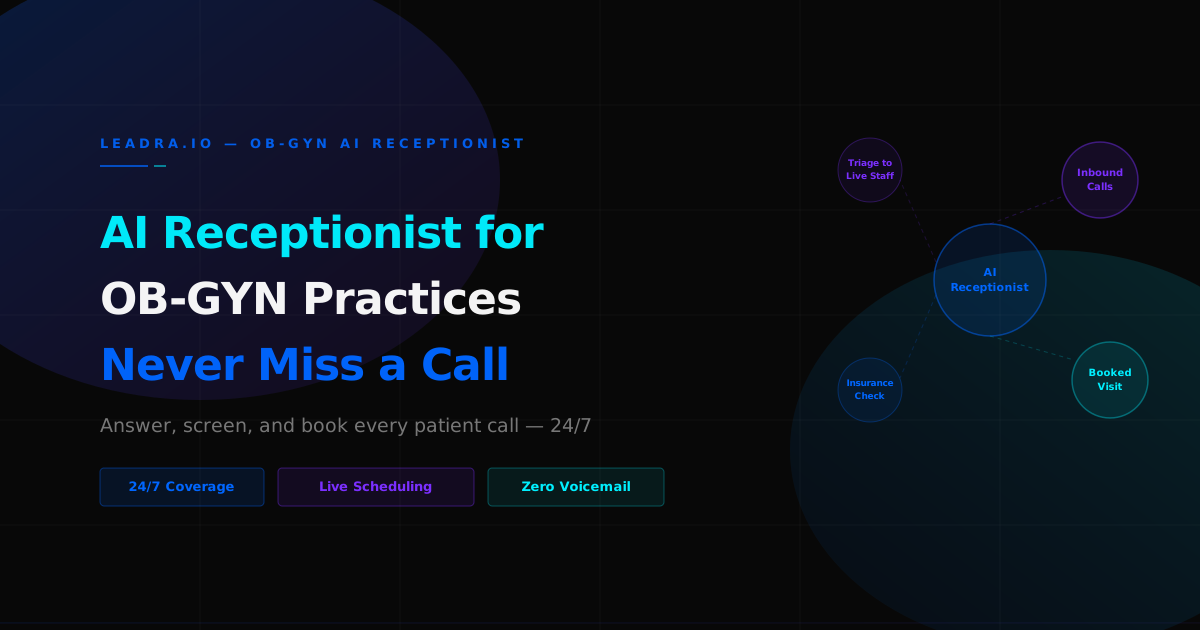
The front desk at most OB-GYN practices is doing three jobs at once: checking in the patient standing in front of them, verifying insurance for the next appointment, and trying to answer a ringing phone. The phone usually loses. That missed call might be a new patient trying to establish prenatal care, an existing patient booking her annual exam, or someone with a time-sensitive gynecologic question — and if it goes to voicemail, most callers simply hang up and try the next practice on their list.
An AI receptionist fixes this without adding headcount. It answers every call immediately, sorts routine scheduling from urgent concerns, books directly into the practice's calendar, and hands anything clinical straight to a live staff member. This guide covers exactly how it works for an OB-GYN practice, what it costs, and how it compares to a human front desk or a traditional answering service.
If you want the broader lead generation picture beyond just call handling, see how AI helps OB-GYN practices get more leads.
Why OB-GYN Practices Need Something Better Than Voicemail
OB-GYN scheduling is more time-sensitive than most specialties. A prospective patient comparing providers for prenatal care often calls two or three practices back to back and books with whichever one answers first. An existing patient calling about a pregnancy-related question wants reassurance that someone is listening, not a voicemail greeting. Three patterns show up again and again:
How an AI Receptionist Handles a Real OB-GYN Call
The AI receptionist is not a phone tree or a chatbot reading a script. It carries a natural conversation, understands context, and takes real action inside the practice's existing systems.
Step 1 — Answer and Greet
Every call is answered on the first ring, any time of day, with a greeting that matches the practice's name and tone. The caller never hears a phone tree or hold music — the conversation starts immediately.
Step 2 — Screen the Reason for the Call
The AI asks a few natural questions to understand whether the caller is a new patient seeking prenatal care, an existing patient booking an annual exam, someone requesting a prescription refill, or a caller with a concern that needs clinical attention. This determines what happens next.
Step 3 — Book, Answer, or Escalate
Routine scheduling requests get booked directly against the live calendar, common questions about hours, location, and accepted insurance get answered on the spot, and anything involving symptoms, urgent concerns, or emergency language is transferred immediately to a nurse or on-call provider rather than handled by the AI.
Step 4 — Confirm and Follow Up
Once an appointment is booked, the patient gets an automated text or email confirmation, and the practice's team sees the new booking in their scheduling system without having to lift a finger. No message slips get lost on someone's desk.
AI Receptionist vs. Human Front Desk vs. Answering Service
An AI receptionist is not meant to replace a practice's front desk team — most practices run it alongside their existing staff to cover overflow, lunch hours, and after-hours calls. Here is how the three options actually compare:
AI Receptionist
Answers 100% of calls instantly, 24/7, including nights, weekends, and lunch hours. Books directly into the live schedule and never gets sick, takes a break, or quits. Cannot handle a highly unusual conversation the way a trained human can, so complex or sensitive calls still route to staff.
Human Front Desk Staff
Best for in-person check-in, complex scheduling exceptions, and calls that need genuine empathy or judgment. Limited by hours worked and by how many things one person can do simultaneously — which is exactly where calls get missed.
Traditional Answering Service
Covers after-hours calls but typically can only take a message, since it has no access to the practice's live scheduling system. The patient still waits for a callback, which defeats the purpose of picking up in the first place.
The practices seeing the best results run all three together: human staff for in-person care and complex situations, the AI receptionist for volume and after-hours coverage, and a clear escalation path between them so no call — clinical or administrative — falls through the cracks.
Is It Safe for a Medical Practice?
A properly built AI receptionist for a medical practice runs on HIPAA-compliant infrastructure and is scoped narrowly to scheduling and front-desk communication. It does not attempt to diagnose, give clinical advice, or answer medical questions — those calls are recognized and transferred to a nurse or on-call provider automatically.
Before deploying any AI receptionist, confirm in writing that the vendor signs a Business Associate Agreement (BAA) and that call data is encrypted and stored compliantly. This is a standard requirement for any tool that touches patient information, and any legitimate healthcare AI vendor will have it ready.
AI Receptionist Pricing for OB-GYN Practices
Tier 1 — After-Hours and Overflow Coverage
$500 – $900/mo
AI receptionist handles calls only when the practice is closed or the front desk is already on another line, so existing staff keep primary call duty during business hours. Setup time: 1 week.
Tier 2 — Full-Time AI Receptionist
$900 – $1,500/mo
AI receptionist answers every call around the clock, with human staff handling escalations and in-person check-in only. Best for practices with high call volume or a lean front desk team. Setup time: 1-2 weeks.
Tier 3 — Multi-Location Practice Group
$1,500 – $3,000/mo
Custom routing across multiple locations, with per-location scheduling rules, providers, and escalation contacts. Setup time: 2-3 weeks.
Compare that to $35,000-$45,000 per year in salary and benefits for one full-time front desk hire, and an AI receptionist typically pays for itself through recovered appointments alone within the first month or two. See the full AI implementation cost guide for small businesses for how this compares across other tools and industries.
Rolling Out an AI Receptionist — Your First Two Weeks
An AI receptionist is one piece of a bigger patient acquisition system. For the full picture on choosing the right AI tools for a practice in 2026, see the best AI for OB-GYN practices in 2026, and for a Charlotte-specific playbook, see AI marketing for OB-GYN practices in Charlotte, NC.
FAQ: AI Receptionist for OB-GYN Practices
What does an AI receptionist actually do for an OB-GYN practice?
It answers every inbound call, sorts a new obstetric inquiry from an annual exam request, refill request, or urgent concern, books directly into the live schedule, and answers common questions about hours, location, and insurance. Anything clinical or urgent routes straight to a live staff member instead of being handled by the AI.
Is an AI receptionist safe for a medical practice to use?
Yes, when it is built for healthcare use. A properly configured AI receptionist runs on HIPAA-compliant infrastructure, never gives clinical advice, and escalates any symptom description or emergency language directly to a nurse or on-call provider rather than attempting to answer it.
How much does an AI receptionist cost compared to hiring front desk staff?
An AI receptionist typically runs $500-$1,500 per month depending on call volume, compared to $35,000-$45,000 per year in salary and benefits for one full-time front desk employee. Most practices keep their human staff and use the AI receptionist for overflow, after-hours, and lunch-hour calls.
How long does it take to set up an AI receptionist for an OB-GYN practice?
A single-location practice can typically go live within 1-2 weeks. Setup includes connecting the practice's scheduling system, writing call scripts for common scenarios, and testing escalation rules so urgent calls reach a live person immediately.
Built for OB-GYN Practices
Ready to Stop Missing Calls?
Leadra.io builds HIPAA-compliant AI receptionists for OB-GYN practices. Tell us your current call volume and scheduling system — we will give you a setup timeline and cost estimate.