Your 7am flow class sells out in 20 minutes. Your 6pm vinyasa runs at half capacity every Tuesday. Somewhere between those two realities is a studio that could fill more mats, keep more members, and stop losing trial students who came once and disappeared.
The problem is almost never the teaching. It's the communication gap between a potential student's first question and their first recurring membership charge. Someone texts at 9pm asking about your intro offer. No one answers. They check another studio. A trial student attends Tuesday's class, loves it, and waits for someone to follow up. No one does. They buy a ClassPass instead.
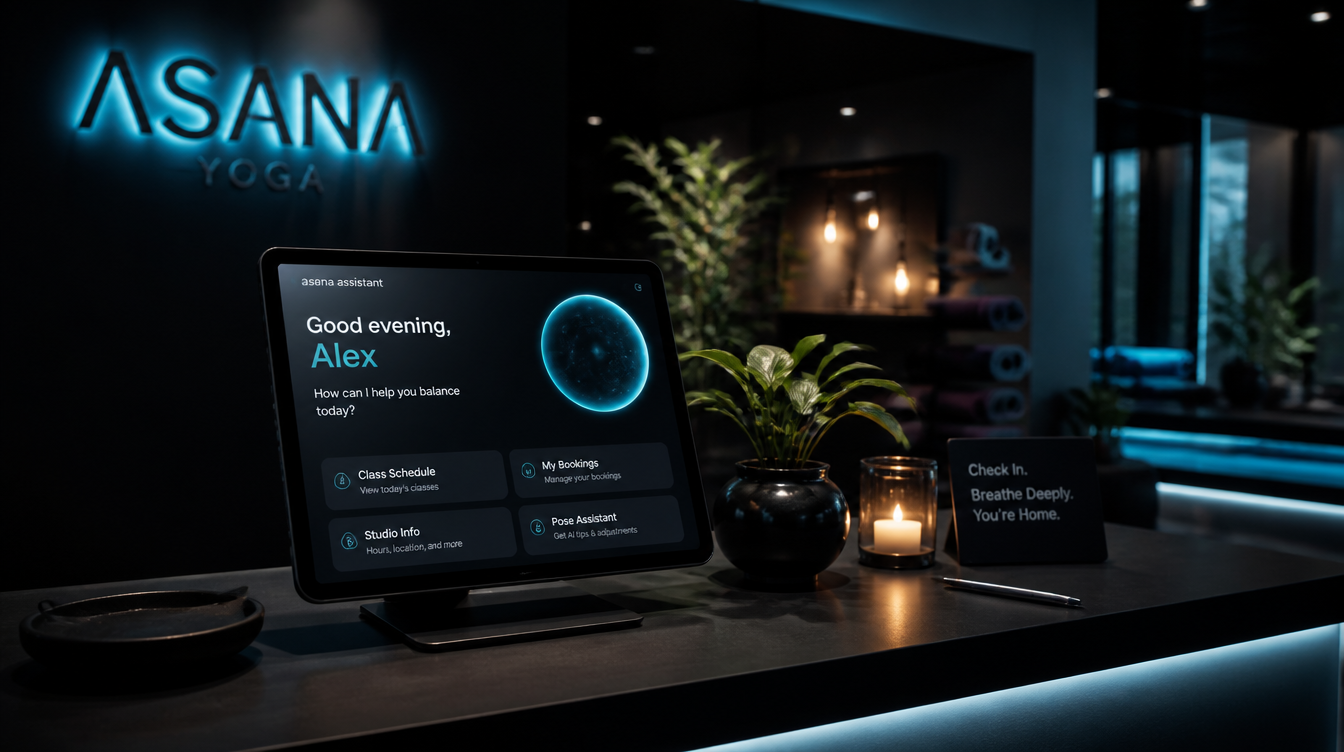
An AI receptionist for a yoga studio closes that gap. This guide covers what it actually does, what it costs, and what real studios in Charlotte are seeing after 90 days of using one.
Why Yoga Studios Lose Revenue at the Front Desk (Without Realizing It)
A yoga studio's revenue model is different from most service businesses. You're not selling one-off appointments — you're selling recurring memberships built on a trial class funnel. Every step in that funnel depends on fast, personal communication at the right time.
According to a 2025 Mindbody fitness industry report, the average studio converts only 18-22% of trial students into paying members. The studios hitting 40-55% conversion share one trait: they follow up within 24 hours of the first class with a personal, specific message. Most studios don't have the staff or systems to do that consistently.
Unanswered inquiries cost more than you think.
A studio with 20 classes per week and a 14-mat average capacity has roughly 280 potential class bookings available every week. If your front desk misses 15-20% of inbound inquiries — calls, texts, and DMs that come in after hours or during class — that's 42-56 missed booking opportunities per week. At $20 per drop-in, that's $840-$1,120 walking out the door every seven days from communication gaps alone.
Trial-to-member conversion is where the real money is.
Getting a student to their first class costs real marketing dollars — typically $25-$80 in acquisition cost depending on your channels. If you convert them at 20%, you spent $125-$400 in acquisition costs for each member. If you convert at 45%, that same marketing budget produces more than twice the members. The difference between 20% and 45% conversion is almost entirely about what happens in the 7 days after the trial class.
No-shows and late cancellations are a class-based business's biggest waste.
Studios that charge late cancellation fees manually — someone checks the list, sends the charge notice, handles the dispute — often don't enforce them consistently. The result: students learn they can cancel freely. No-show rates of 18-28% are common for popular evening classes. An AI receptionist enforces the policy automatically and impersonally, which removes the awkward manual follow-up and keeps your mat utilization honest.
5 Things a Yoga Studio AI Receptionist Does Every Day
A well-built AI receptionist for a yoga studio isn't a chatbot that answers FAQ. It's a full front-desk system that handles the most revenue-critical communication your studio sends and receives. Here's what that looks like in practice:
24/7 Class Booking and Schedule Inquiries
When someone calls, texts, or DMs asking about your schedule, the AI responds immediately with current class availability, teacher names, format descriptions (flow vs. restorative vs. hot), and pricing. It books the student into the class they want via direct Mindbody or Glofox integration, sends a confirmation, and adds them to the waitlist if the class is full — all in one conversation.
The system handles inbound from phone calls, SMS, Google Business Profile chat, and Instagram DMs through a single backend. A student who texts "do you have anything Sunday morning under an hour?" gets an instant, accurate reply with the specific class, teacher, and a booking link. No one has to stop teaching to handle it.
Trial-to-Member Conversion Sequence
The 7 days after a student's first class are the highest-leverage window in your entire business. The AI runs a three-touch sequence during that window: a personalized message the day after the trial asking how the class went and which teacher or format they preferred; a follow-up on day 3 with membership pricing broken down by cost-per-class at each tier; and a day-7 message with a direct booking link and a specific class recommendation based on what they attended.
Studios using this sequence consistently convert trial students at 38-54%, compared to the 15-22% industry average for studios that rely on manual or no follow-up. For a studio that runs 20 trial classes per month, lifting conversion from 20% to 45% means 5 additional new members per month — roughly $750-$1,500 in new monthly recurring revenue.
No-Show Prevention and Late Cancellation Enforcement
For every class registration, the AI sends a reminder 24 hours before with a one-tap confirm or cancel option. If a student cancels within your late cancellation window, the AI sends the policy reminder, notifies the waitlist, and processes the late fee automatically — no manual review, no awkward chase. Cancellation slots go to the waitlist before the class starts.
Studios enforcing cancellation policy automatically and consistently see no-show rates drop from 20-28% to 7-12% within 60 days. When your 14-mat class runs at 92% capacity instead of 72%, the revenue difference is real: roughly $280-$420 per class week in a mid-size studio, or $14,000-$21,000 per year from that one metric alone.
Waitlist Management and Class Fill Automation
Your most popular classes fill up and generate waitlists. Your least popular ones sit at 40% capacity. The AI manages both ends: when a spot opens in a full class, it messages the first waitlist member immediately with a 30-minute claim window, then moves to the next person if unanswered. For underperforming classes, it sends targeted nudges to students who attended the same class format previously but haven't booked this week.
Studios running AI waitlist automation fill 60-80% of cancellation openings before the class starts, compared to 15-25% with manual waitlist management or standard booking app notifications. For a studio with 5-8 cancellations per week in popular classes, that's 3-5 additional filled seats every week from students already waiting for a spot.
Dormant Student Reactivation
Every yoga studio has a list of members and class-pack holders who haven't attended in 30 days or more. These students liked the studio enough to pay. They just drifted — life got busy, a schedule changed, or they ran out of classes on their pack and never renewed. No one followed up.
The AI identifies dormant students automatically and sends personalized re-engagement messages: "Hey Sarah — it's been a while since you've been to class. We added a 7:30am Wednesday flow with Priya that fits the schedule you used to come in for. Want me to grab you a spot?" These campaigns typically reactivate 22-35% of dormant students, recovering $500-$2,000 per month from students your studio already acquired.
No Front Desk vs. Part-Time Staff vs. AI Receptionist: The Real Numbers
| Area | No Front Desk | Part-Time Staff | AI Receptionist |
|---|---|---|---|
| Monthly cost | Free | $1,400–$2,800/mo | $400–$2,500/mo |
| Hours of coverage | Owner, between classes | 15–25 hrs/week | 24/7/365 |
| Inquiries answered | 40–60% (hours only) | 75–90% during shifts | 95–100% any time |
| Trial conversion rate | 15–22% (manual/none) | 20–30% if they follow up | 38–54% with automation |
| No-show rate | 20–28% | 14–20% with reminders | 7–12% with enforcement |
| Waitlist fill rate | 15–25% | 25–40% with manual texts | 60–80% automated |
| Dormant reactivation | None | Manual, inconsistent | 22–35% automated |
| Late fee enforcement | Rarely enforced | Inconsistent | 100% automated |
Case Study: Charlotte Yoga Studio Grows Monthly Revenue from $11,200 to $22,600 in 90 Days
A yoga studio in Charlotte's Plaza Midwood neighborhood was running 22 classes per week across two instructors. Revenue was plateauing at $11,200/month. The owner was teaching, managing the schedule, answering texts between classes, and manually following up with trial students when she had time — which wasn't often.
Three specific problems were holding revenue flat: trial students attending once at a 19% conversion rate, popular evening classes filling with a waitlist while cancellation spots went unfilled, and roughly 140 dormant members in Mindbody who hadn't attended in over 45 days.
Trial conversion
19%
47%
No-show rate
24%
8.3%
Waitlist fill
22%
71%
Monthly revenue
$11,200
$22,600
Leadra.io deployed an AI receptionist for the studio that integrated directly with her Mindbody account. The system handled inbound texts and calls 24/7, ran the trial-to-member sequence for every first-class attendee, enforced the late cancellation policy automatically, and managed the waitlist for all full classes in real time.
In week one, the waitlist automation recovered 8 seats that would have gone empty from last-minute cancellations. The trial conversion sequence ran for every first-class attendee and brought the rate from 19% to 47% by day 45. The dormant reactivation campaign launched at day 30 and brought 38 lapsed members back within six weeks.
By month 3, monthly revenue had grown from $11,200 to $22,600 — a 102% increase. The AI receptionist cost $950/month. The owner stopped answering texts between classes. She added a third instructor instead.
What an AI Receptionist Costs for a Yoga Studio in 2026
Cost depends on class volume, number of teachers, Mindbody vs. other platforms, and which features you need. Here's how the tiers typically break down:
Basic
$400–$700/mo
- →Class booking via SMS and Google Business Profile
- →24-hour class reminder with confirm/cancel option
- →Waitlist notification and auto-fill on cancellation
- →Post-class review request
- →Best for: small studios (under 15 classes/week) with Mindbody or Glofox
Standard
$700–$1,400/mo
- →Everything in Basic
- →Trial-to-member 7-day conversion sequence
- →Late cancellation fee enforcement and notification
- →After-hours multi-channel coverage (SMS, DM, GBP)
- →Dormant student reactivation campaigns
- →Best for: studios running 15-30 classes/week with active trial class funnel
Full AI Receptionist
$1,400–$2,500/mo
- →Everything in Standard
- →Inbound voice AI (calls answered by AI, class booked by voice)
- →Multi-teacher scheduling and teacher-preference matching
- →Class pack expiry nudges and renewal automation
- →Monthly revenue reporting with attribution by automation
- →Best for: multi-teacher studios replacing a full front desk
What to Look for When Evaluating an AI Receptionist for Your Yoga Studio
Most AI receptionist tools were built for general business use — retail stores, dental offices, law firms. Yoga studios have specific requirements that generic systems don't handle well. Here's what separates a tool that actually works for a studio from one that creates more problems than it solves:
Direct Mindbody or Glofox API integration — not a workaround
The AI needs to read live class availability and write bookings directly into your studio management software. Systems that sync every 15-30 minutes will overbook full classes or fail to confirm real-time waitlist opens. Ask any vendor specifically how they connect to your platform and how often availability data updates.
Class-pack and membership awareness
Your pricing structure is more complex than a simple per-appointment model. The AI needs to understand whether a student is booking with remaining class pack credits, a membership, or a drop-in payment, and handle each correctly. Generic tools that treat every booking the same will confuse students and create billing problems.
Trial conversion sequence included — not an add-on
If the vendor doesn't include trial-to-member conversion automation in their standard offering, they haven't built for studios specifically. This is the highest-ROI automation for any class-based business. It should be set up during onboarding, not quoted as a separate project.
Measurable results from real studio clients
Ask for before-and-after data on trial conversion rate, no-show rate, and revenue from specific studio clients — not a generic customer story. Any vendor who can't provide those numbers after 60 days with studio clients isn't measuring what matters for your business.
Frequently Asked Questions
What does an AI receptionist for a yoga studio actually do?
An AI receptionist for a yoga studio handles inbound calls, texts, and DMs to book students into classes, answer schedule and pricing questions, process waitlist requests, send class reminders, enforce late cancellation policies, follow up with trial students to convert them into members, and reactivate dormant students who haven't been to class in 30 days or more — all automatically, 24 hours a day. It replaces the front desk function without adding payroll.
How much does an AI receptionist cost for a yoga studio?
AI receptionist systems for yoga studios typically cost $400 to $2,500 per month depending on class volume, number of teachers, and features included. A basic system covering class booking automation, reminders, and waitlist fill starts around $400-$700/month. A full system with inbound voice AI, trial-to-member conversion sequences, and dormant student reactivation runs $1,400-$2,500/month. Most studios recover the cost within 30-45 days from no-show and late cancellation revenue alone.
Can an AI receptionist integrate with Mindbody for yoga studio bookings?
Yes. AI receptionist systems for yoga studios can integrate directly with Mindbody, Pike13, Glofox, and other studio management platforms via API. The AI reads live class availability, checks waitlists, books students into open spots, processes cancellations, and updates the system in real time. Students book through a conversation rather than navigating the Mindbody app themselves, which removes friction and increases booking completion rates.
How does an AI receptionist help convert yoga trial students into members?
An AI receptionist for yoga studios runs an automated trial-to-member conversion sequence starting the day after a student completes their first class. The sequence includes a personalized check-in message, a day-3 follow-up with membership pricing broken down by cost-per-class, and a day-7 message with a direct booking link and class recommendation. Studios using these sequences see trial-to-member conversion rates of 38-54%, compared to the 15-22% industry average when conversion depends on manual follow-up.
Related Reading
Ready to Stop Losing Trial Students and Empty Classes?
Leadra.io builds and manages AI receptionist systems for yoga studios. We handle setup, Mindbody integration, conversion sequences, and ongoing optimization. Most studios see positive ROI within 30-45 days.