AI Scheduling Software for Pest Control Companies: Cut Drive Time 30% and Fit More Jobs Per Day (2026)
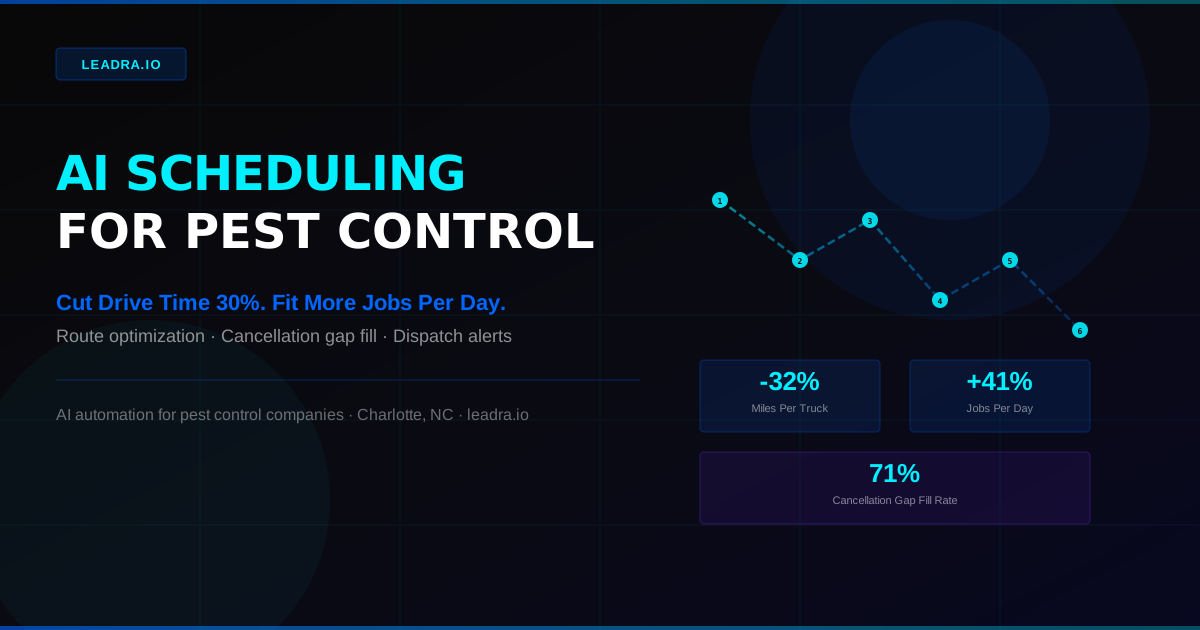
A 4-technician pest control company in north Charlotte runs 28-32 jobs per day across a metro service area spanning 40 square miles. Without a routing system, the owner spends 45-60 minutes every morning building routes manually in a spreadsheet — and still ends up with technicians crossing paths, backtracking, and burning 90-plus miles on routes that could have been completed in 65. That extra 25 miles per truck per day costs $10-$14 in fuel and, more importantly, 45-60 minutes of billable drive time.
Multiply that across 4 trucks and a 250-day work year: 1,000 hours of lost capacity and $10,000+ in unnecessary fuel. That is one full technician's production capacity disappearing into windshield time.
AI scheduling software for pest control companies eliminates that waste. It builds optimized routes in seconds, fills cancellation gaps automatically, dispatches ETA alerts to customers without the office touching a phone, and adjusts live routes when jobs run long or a stop gets cancelled mid-day. This guide covers how AI scheduling works in a real pest control operation, what the numbers look like, and how to evaluate software that actually integrates with the tools you already use.
Why Routing Inefficiency Is a Revenue Problem, Not Just an Operations Problem
Most pest control owners think of routing as a logistics issue. It is actually a revenue ceiling. Every hour a technician spends driving instead of treating is an hour they could have completed a $180-$280 general pest treatment, a $400-$600 termite inspection, or a $150 mosquito service. The math is not complicated:
- →Average pest control job: 45-75 minutes on-site plus 15-25 minutes of drive time in an optimized route. With unoptimized routes, that drive time climbs to 30-45 minutes between stops — cutting daily job capacity by 2-4 stops per technician.
- →Cancellation gap cost: A single cancellation mid-route creates a 60-90 minute gap. Without AI to fill it, the technician either sits idle or drives back to the office early. That gap costs $150-$250 in billable time.
- →Scheduling conflicts: Double-bookings, geographic clustering failures, and poor time-window matching create callbacks and customer complaints that cost time and reputation. AI catches these before dispatch, not after.
According to industry research from the National Pest Management Association, the average pest control technician completes 7-9 jobs per day. Companies using AI-optimized routing consistently hit 10-13 jobs per day with the same technician and the same service-time per stop. That gap — 3-4 additional jobs per day per tech — is pure revenue capacity that routing inefficiency leaves on the table.
How AI Scheduling Software Works for Pest Control Operations
AI scheduling for pest control is not the same as a Google Maps route planner. Generic navigation tools optimize for shortest path. AI scheduling optimizes for maximum revenue per truck-hour, factoring in service time, technician skill sets, customer time-window preferences, job type (general pest, termite, bed bug, rodent), and real-time availability. Here are the six functions that separate AI scheduling from manual route building:
Function 1: Geo-Clustered Route Building
The AI groups jobs by geographic proximity first, then layers in customer time-window preferences and technician skill matching. A termite inspection that requires a licensed applicator gets assigned to the right tech. A general pest maintenance stop gets batched with three nearby stops in the same neighborhood. The AI does this for every technician simultaneously each morning — a task that would take a dispatcher 45-60 minutes takes the AI under 90 seconds.
Function 2: Real-Time Route Adjustment
When a job runs 20 minutes longer than scheduled — a common occurrence when a technician finds secondary infestation during a general pest visit — the AI recalculates the remaining route in real time. It pushes updated ETAs to customers still on the schedule, flags any stops that may need to be rescheduled, and recommends whether to keep the sequence or swap two stops to recover time. This happens automatically, without the dispatcher making ten phone calls.
Function 3: Cancellation Gap Fill
When a customer cancels same-day, the AI immediately identifies the best replacement from a dynamic waitlist — customers who have requested earlier appointments, overdue for a scheduled service, or in a pending follow-up status. It sends an SMS offer for the open slot, waits 15 minutes for a response, and if confirmed, books and inserts the job into the route automatically. Pest control companies using this system fill 60-80% of cancellation gaps versus under 20% with manual callbacks.
Function 4: Customer ETA and Dispatch Alerts
The AI sends automated SMS alerts to customers at three trigger points: the morning of service (confirming the appointment window), when the technician completes the prior job (updated ETA), and when the technician is 15 minutes away. This eliminates the "where is your technician?" call that eats 15-20 minutes of dispatcher time per day across a multi-truck operation. Customer satisfaction scores typically improve 18-25% from ETA automation alone.
Function 5: Technician Skill and Certification Matching
Not all pest control jobs can go to any technician. Termite treatments, fumigations, and commercial accounts require specific licenses and certifications. AI scheduling reads your technician profiles and automatically assigns jobs based on certification level, eliminating the risk of sending an unlicensed tech to a job that requires a commercial applicator license — a compliance violation that can result in fines in most states.
Function 6: Capacity Forecasting and Schedule Loading
During peak season — spring termite swarm windows, summer mosquito programs — inbound booking volume spikes faster than a dispatcher can manually manage slot availability. AI scheduling maintains a live capacity view per technician per day and automatically blocks overbooking before it happens. It also flags under-loaded days 48-72 hours in advance, triggering the outreach system to fill gaps before the schedule goes cold.
Manual Scheduling vs. AI Scheduling: What Changes for a Pest Control Company
| Metric | Manual Scheduling | AI Scheduling |
|---|---|---|
| Time to build daily routes | 45-60 min per dispatcher | 60-90 seconds |
| Average miles driven per truck/day | 85-115 miles | 60-80 miles |
| Jobs completed per technician/day | 7-9 jobs | 10-13 jobs |
| Cancellation gap fill rate | 15-25% | 60-80% |
| ETA calls into dispatch | 8-15 per day | 1-3 per day |
| Scheduling compliance errors (wrong tech) | 2-4 per month | Near zero |
| Fuel cost per truck per month | $680-$1,100 | $480-$780 |
| Dispatcher hours on routing tasks | 2-3 hrs/day | Under 30 min/day |
Case Study: Charlotte Pest Control Company Adds $18,400/Month Without Hiring a Technician
A 4-technician pest control operation serving north Charlotte and Huntersville had reached a capacity wall. They were turning away 8-12 new jobs per week during peak spring season — not because of lead volume, but because the schedule was full and the owner could not figure out how to fit more stops without hiring a fifth technician and a larger vehicle.
The problem was not capacity. It was routing. Their average technician drove 98 miles per day. Routes were built manually by the owner each morning using a combination of a whiteboard and Google Maps. Three technicians shared the northern territory with no geographic clustering — resulting in daily route crossings and 35-45 minutes of backtrack per truck.
They deployed AI scheduling through Leadra.io integrated with their existing PestRoutes account. Setup took 6 days. The AI imported their full customer database, service history, technician profiles with certifications, and historical job duration data to calibrate its time estimates.
Results after 60 days:
- →Average miles per truck per day: 98 to 67 (32% reduction)
- →Average jobs per technician per day: 8.2 to 11.6
- →Total jobs completed per week: 164 to 232
- →Cancellation gap fill rate: 18% to 71%
- →Inbound ETA calls to dispatch: 14 per day to 2 per day
- →Monthly fuel cost across 4 trucks: $3,840 to $2,680 (saved $1,160/mo)
- →Monthly revenue: $61,400 to $79,800
- →No new technician hired — all growth from existing crew
- →Monthly AI scheduling cost: $1,100
- →ROI in month 2: 16.7x
The owner's comment after 60 days: "I used to spend the first hour of every day building routes. Now I get a notification that routes are ready at 6:45 AM and I don't touch them. The techs are finishing earlier, making more stops, and we're not spending anywhere near what we were on gas."
AI Scheduling Integration: What Works with What
AI scheduling for pest control only works if it connects directly to your existing field service software. Manual data entry between systems kills the efficiency gains. Here is how integration works across the most common platforms:
PestRoutes
Direct API integration pulls customer records, service histories, open work orders, and technician schedules. Optimized routes push back into PestRoutes dispatch board automatically. Technicians see the AI-built route in the PestRoutes mobile app with no additional tool. Post-job completion triggers the AI to update route status and fire the review request sequence.
ServiceTitan
ServiceTitan's API allows two-way sync with AI scheduling systems. Job creation, technician assignment, and route sequencing all flow through ServiceTitan. AI adds geographic optimization and real-time adjustment logic on top of ServiceTitan's native scheduling view — the dispatcher still works in ServiceTitan, but the routes they see are AI-optimized.
Jobber
Jobber's open API supports full integration with AI scheduling layers. The AI reads Jobber's calendar, builds optimized routes, and writes confirmed assignments back into Jobber's dispatch view. Client notification workflows in Jobber can be replaced with the AI's more granular ETA alert system for better customer communication.
FieldRoutes
FieldRoutes (ServiceTitan's pest control subsidiary) offers native routing tools, but AI scheduling layers on top of them add real-time adjustment, cancellation gap fill, and dynamic waitlist management that FieldRoutes' built-in tools do not include. The integration is API-based and does not require switching platforms.
5 Things to Check Before Choosing AI Scheduling Software for Your Pest Control Company
1. Does it integrate with your existing field software?
A standalone scheduling tool that does not sync with PestRoutes, ServiceTitan, or Jobber creates a parallel system that requires manual bridging. That manual step negates the efficiency gain. Confirm direct API integration before committing to any platform.
2. Does it account for job duration variability?
Pest control jobs do not all take the same time. A general pest maintenance visit might take 30 minutes. A termite inspection with an exterior barrier application takes 90-120 minutes. AI scheduling needs to be calibrated with your actual job-type duration data — not generic estimates — to build routes that match real-world field performance.
3. Does it handle technician certification matching?
Sending an uncertified technician to a restricted-pesticide or commercial application job is a compliance risk. The AI scheduling layer must read technician license and certification profiles and use that data in assignment logic — not just geographic proximity and availability.
4. Can it fill cancellation gaps automatically?
Dynamic cancellation fill requires a live waitlist of potential replacement customers and automated outreach capability. If the AI can only flag the gap but requires manual callback to fill it, you recover maybe 15-20% of cancellations. Automated SMS-based gap fill pushes that to 60-80%.
5. Does it show route performance data over time?
You need to see average miles per truck, jobs per technician per day, gap fill rate, and fuel cost trend over time. Without data, you cannot verify the system is actually improving efficiency — or identify which technician routes still need tuning. Demand a dashboard before signing a contract.
AI Scheduling Software Pricing for Pest Control Companies (2026)
| Operation Size | Monthly Cost | Includes |
|---|---|---|
| Solo to 2 Techs | $600-$900/mo | AI route optimization, ETA alerts, basic cancellation management. Integration with Jobber or PestRoutes. |
| 3-6 Techs | $900-$1,800/mo | Multi-truck optimization, dynamic cancellation gap fill with automated SMS outreach, certification-based job assignment, performance dashboard. |
| 7+ Techs / Multi-Location | $1,800-$3,500/mo | Full multi-location dispatch, territory management, capacity forecasting, ServiceTitan or FieldRoutes integration, dedicated account manager. |
A 3-5 technician pest control company at the Growth tier ($900-$1,800/month) typically recovers that cost within the first 2-3 weeks from additional jobs completed per day and fuel savings alone. The math: adding 3 jobs per truck per day across 3 trucks at $200 average job value equals $1,800 in daily revenue capacity — which covers the monthly cost in a single week of improved routing.
AI scheduling works best when paired with a system that fills your schedule with the right leads before your technicians ever leave the shop. See how to build a complete inbound lead capture and follow-up system in our guide on AI for pest control companies.
If you want to understand how AI automation costs stack across a full implementation — scheduling, lead capture, follow-up, and SEO — our AI implementation cost guide for small businesses breaks it down tier by tier.
Frequently Asked Questions
What does AI scheduling software do for a pest control company?
AI scheduling software for pest control companies automatically builds optimized daily routes for each technician, groups nearby jobs to minimize drive time, fills cancellation gaps by pulling in standby customers from a waiting list, and sends automated dispatch confirmations and ETA alerts to customers. It also flags overbooking conflicts before they happen and adjusts routes in real time when a job runs long or a cancellation occurs mid-day. The result is 3-5 more completed jobs per truck per week without adding headcount.
How much does AI route optimization save a pest control company?
AI route optimization typically saves a pest control company $800-$2,400 per truck per month in fuel and labor costs. A technician who drives 90-110 miles per day on unoptimized routes often drops to 60-75 miles per day with AI-built routes — saving 20-35 miles, or $8-$14 per day in fuel per truck. The bigger gain is capacity: reducing drive time by 25-35% usually frees up enough time to fit 3-5 additional service stops per truck per week, which at $150-$220 average job value equals $450-$1,100 per week in added revenue per technician.
Does AI scheduling work with PestRoutes and ServiceTitan?
Yes. AI scheduling systems designed for pest control integrate directly with PestRoutes, ServiceTitan, Jobber, and FieldRoutes via API. The integration pulls your existing customer records, service histories, and open appointments into the AI engine, which then builds and pushes optimized routes back into your dispatch board. Technicians see their AI-built routes in the same app they already use — there is no separate interface to learn.
Can AI fill last-minute cancellations automatically in pest control?
Yes. AI scheduling software maintains a dynamic waitlist of customers who want earlier appointments or who have open follow-up service needs. When a cancellation opens a slot in the route, the AI immediately contacts the next best-fit customer on the waitlist by SMS, confirms availability, and books the slot — all within minutes of the original cancellation. Pest control companies using this system fill 60-80% of same-day cancellations compared to under 20% with manual callbacks.
Ready to Run More Jobs With Your Existing Crew?
Leadra.io builds AI scheduling and dispatch systems for pest control companies in 6-8 days. We handle the PestRoutes or ServiceTitan integration, route optimization calibration, and cancellation gap fill setup — so your technicians are hitting 10+ stops per day within the first two weeks. Call us or book a review of your current routing setup.