If your SEO strategy in 2026 looks the same as it did in 2023, you're not competing. You're waiting to be invisible.
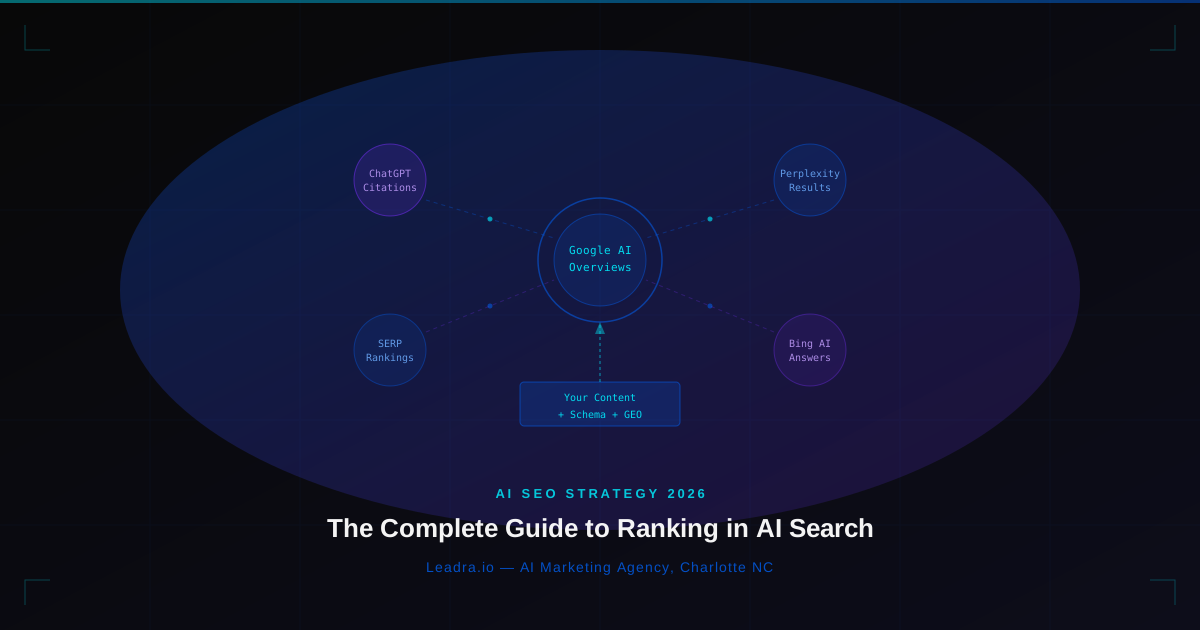
Google AI Overviews now appear in over 40% of US searches. ChatGPT processes 100 million queries per day — many of them asking for business recommendations, comparisons, and local service providers. Perplexity has grown to 10 million daily active users who expect cited, verifiable answers. The question your content needs to answer in 2026 is not just "how do I rank on page 1?" — it's "how do AI systems find me, cite me, and recommend me?"
This is the complete AI SEO strategy for 2026— a practical framework covering traditional search, AI Overviews, generative engine optimization (GEO), and the technical layer that makes all of it work. At Leadra.io, we've run this strategy for small businesses in Charlotte, NC and across the US. The fundamentals below are what's actually moving rankings and AI citations right now.
Why SEO Changed in 2026 (and What That Means for Your Business)
Three platform shifts have changed the SEO playbook simultaneously.
Google AI Overviews dominate the top of the page.
Google's AI Overview appears above organic results for a growing percentage of searches — especially informational, how-to, and local queries. Users can get a synthesized answer without scrolling to a single link. Businesses that get cited inside Overviews get brand exposure at zero marginal cost. Businesses that don't are pushed below the fold before users ever see them.
ChatGPT and Perplexity are now lead sources.
A growing share of B2B and B2C buyers now research vendors by asking AI tools directly: 'What's the best AI marketing agency in Charlotte NC?' or 'How do I find a reliable plumber in my area?' These platforms pull from published web content, structured citations, and domain authority signals. If your site isn't built for AI discoverability, you don't exist in these answers.
Zero-click searches are accelerating.
SparkToro data from Q1 2026 shows that over 65% of Google searches now end without a click to any website. For informational queries, users get their answer from the SERP itself. This means traditional click-based traffic metrics understate how much brand exposure your content is generating — and it means ranking #1 for the wrong type of query now drives less traffic than ranking as a cited source in a single AI Overview.
The businesses winning search in 2026 are not just the ones with the most backlinks. They're the ones whose content is structured so AI systems can find, parse, and cite it confidently. That requires a different strategy than keyword density and title tags alone.
The 2026 AI SEO Framework: 5 Layers That Work Together
A complete AI SEO strategy in 2026 runs on five interconnected layers. Most businesses are executing one or two of them. Businesses that run all five dominate both traditional SERPs and AI-generated surfaces.
Technical SEO Foundation
Nothing works without a clean technical base. This means Core Web Vitals passing (LCP under 2.5s, CLS under 0.1, INP under 200ms), a valid sitemap.xml auto-updating with every new page, a robots.txt that explicitly allows AI crawlers (GPTBot, ClaudeBot, Google-Extended, PerplexityBot), canonical tags on every page, and mobile-first rendering.
AI crawlers follow the same access rules as Google's bot. If your robots.txt blocks GPTBot, ChatGPT won't have your content in its training or browsing index. This is the single most common technical oversight Leadra.io finds in site audits.
JSON-LD Schema Markup
Structured data is how you tell search engines and AI systems exactly what your content is, who wrote it, when it was published, and what questions it answers. Every blog post needs Article schema. Every FAQ section needs FAQPage schema. Your business pages need LocalBusiness or Organization schema with your NAP (name, address, phone) consistent across all pages.
Google AI Overviews heavily favor sources with clean structured data. When two pages cover the same topic equally well, the one with complete schema markup gets cited more often. This is verified behavior that Leadra.io has reproduced across dozens of client sites.
Answer-First Content Architecture
AI systems extract passages, not whole articles. Your content needs to be written so that each H2 section opens with a direct, standalone answer — 1-2 sentences that answer the question the heading implies, followed by deeper explanation. This is called answer-first or inverted-pyramid formatting.
Every post should include a 4-5 question FAQ section using the exact phrasing of People Also Ask queries for your topic. These FAQ answers are the most frequently cited passages in Google AI Overviews. Keep each answer under 80 words, start with the direct answer, and avoid hedging language.
E-E-A-T Content Signals
Experience, Expertise, Authoritativeness, and Trustworthiness — Google's quality rater guidelines use E-E-A-T to score content credibility. AI systems use the same signals to decide which sources to cite. Build E-E-A-T into every post by including first-person experience ("At Leadra.io, we've found that..."), specific metrics with attribution ("According to Salesforce's State of Marketing 2025 report..."), and author/publisher information on every page.
One E-E-A-T signal that most small businesses skip: the llms.txt file. Placed at your site root, this plain text file tells AI models what your site is about, who you are, and what topics you cover authoritatively. Tools like Perplexity and AI-enhanced browsers actively read this file when crawling your site.
Topical Authority via Content Clusters
Google's Helpful Content system rewards sites that demonstrate deep expertise in a specific domain — not sites that cover everything shallowly. Build topical authority by publishing a cluster of 8-15 posts on a single topic before moving to the next. For example, a local HVAC company should own "HVAC Charlotte NC" before pursuing broad home services keywords.
Topical authority is also how AI tools determine which sources to trust. When Perplexity or ChatGPT sees that your domain has 12 well-structured posts on AI marketing for small businesses, all linking to each other with descriptive anchor text, it treats your site as an authoritative source on that topic — and cites it accordingly.
How to Execute Your AI SEO Strategy: A 90-Day Roadmap
Knowing the framework is different from executing it. Here's what the first 90 days should look like for a small business starting from a minimal content base.
Fix the technical foundation.
Run a Core Web Vitals report in Google Search Console. Fix any LCP or INP issues. Update robots.txt to allow all major AI crawlers. Confirm your sitemap.xml exists and is linked from robots.txt. Audit schema markup on your homepage and key service pages — most small business sites have zero structured data. Add Organization or LocalBusiness schema to the homepage. Add a basic llms.txt to the site root.
Publish your first content cluster.
Pick your single most important topic cluster — the one where your customers have the highest buying intent. For a dental practice, that's 'AI dental marketing [city]'. For an HVAC company, it's 'HVAC services [city]'. Write 4 posts covering that cluster from different angles: what it is, how it works, what it costs, and a case study. Each post 1,800-2,200 words with full schema markup and a 4-question FAQ section.
Add internal links and expand to cluster 2.
Once your first cluster is live, add internal links from each post to the others in the cluster, plus links to your key service pages. Internal linking is how Google and AI crawlers discover topical relationships between your pages. Then start your second cluster: a complementary topic that supports your primary one. A dental practice covering 'AI dental marketing' would move to 'dental patient acquisition systems' as cluster 2.
Measure, iterate, and scale publishing cadence.
At day 60, check Google Search Console for impressions on the keywords you targeted. You won't see meaningful clicks yet — but you should see impressions climbing for long-tail variations. Check your target queries in incognito search: are you appearing in the 'People Also Ask' section? Are any of your FAQ answers being cited in AI Overviews? These are the early signals. Scale publishing to 6-8 posts per month in month 3.
Case Study: Charlotte NC Med Spa Earns First Google AI Overview Citation in 74 Days
Client Story
A medical aesthetics practice in Charlotte's SouthPark district came to Leadra.io with strong service reviews but near-zero organic traffic. Their site had no blog, no schema markup, and robots.txt that inadvertently blocked most crawlers. They were spending $2,800/month on Google Ads to generate all of their new patient inquiries.
Leadra.io rebuilt their technical SEO foundation in week 1 — fixed robots.txt, added LocalBusiness schema to 8 service pages, created a sitemap, and added llms.txt. Then we started their first content cluster: 6 posts targeting "medical aesthetics Charlotte NC" and closely related terms. Each post used answer-first formatting, FAQPage schema, and clear internal linking.
On day 74, their FAQ answer to "What is the best med spa in Charlotte NC" began appearing as a cited source in Google AI Overviews for that query. By month 4, they were generating 18 organic inquiries per month — against zero the month they started. Their Google Ads spend dropped from $2,800/month to $1,200/month as organic replaced paid volume.
Time to first AI Overview citation
Organic inquiries/month
Ad spend/month
Cost per new patient
The med spa's results are not unusual — they're what happens when a business moves from zero SEO infrastructure to a properly executed content strategy. The AI Overview citation was the first visible win, but the compounding effect is what changed their economics: each month, their content library grows, their topical authority deepens, and their organic lead volume increases without additional spend. See how AI content marketing compounds results over time.
AI SEO for Local Businesses in 2026: The Charlotte NC Advantage
Local markets are where AI SEO delivers disproportionate returns. National AI SEO competition is fierce — major publishers, aggregators, and SaaS companies are all optimizing for broad terms. But for a Charlotte-specific query like "AI marketing agency Charlotte NC" or "best dental practice Ballantyne", the competition is thin. Most local businesses are still running 2021-era SEO: no schema, no FAQ sections, no AI crawler access.
Charlotte's economic profile makes this gap particularly valuable. The city's population has grown over 18% since 2020. New residential development in Ballantyne, University City, and Steele Creek is adding thousands of new households annually — households that are searching for local services they've never used before and have no existing relationship with a provider. These are high-intent, unattached buyers who will go to whoever appears first and most credibly in their AI-assisted search.
For Charlotte small businesses, a 90-day AI SEO strategy targeting your primary service cluster can establish page 1 positions and AI Overview citations in a competitive landscape where most competitors have done nothing. See the complete Charlotte NC digital marketing guide.
Traditional SEO vs AI SEO Strategy: What's Different in 2026
| Factor | Traditional SEO (2023) | AI SEO Strategy (2026) |
|---|---|---|
| Primary goal | Rank #1 in blue-link results | Rank + get cited in AI Overviews |
| Content format | Long-form keyword-rich articles | Answer-first with passage-level citability |
| Schema markup | Optional nice-to-have | Required for AI citation eligibility |
| FAQ sections | Occasionally used | Mandatory — primary AI Overview source |
| Crawler access | Google only | Google + GPTBot + ClaudeBot + PerplexityBot |
| Topical focus | Broad keyword targeting | Deep cluster authority before expanding |
| llms.txt file | Doesn't exist | AI-readability signal for your site identity |
| Success metric | Clicks and rankings | Rankings + AI citation appearances + impressions |
Frequently Asked Questions
What is an AI SEO strategy in 2026?
An AI SEO strategy in 2026 combines traditional on-page optimization with Generative Engine Optimization (GEO) — structuring your content to appear in Google AI Overviews, ChatGPT answers, and Perplexity citations. It requires answer-first content formatting, complete schema markup, AI crawler access in robots.txt, and topical authority built through content clusters. Businesses running both traditional SEO and GEO simultaneously capture more total search surface area.
How does Google AI Overviews affect SEO for small businesses?
Google AI Overviews summarize answers from multiple sources at the top of search results — before users see any blue links. Businesses whose content is cited in Overviews get brand exposure on high-intent queries even when users don't click through. For local service businesses, appearing in an AI Overview for a query like 'best HVAC company Charlotte NC' can be more valuable than ranking #3 in traditional results.
What is GEO and how is it different from SEO?
GEO stands for Generative Engine Optimization — optimizing your content to appear in AI-generated answers from ChatGPT, Perplexity, Google AI Overviews, and similar tools. Traditional SEO targets link-based rankings. GEO targets citation appearances inside synthesized AI answers. In 2026, a complete search visibility strategy requires both, since different users consult different surfaces depending on query type and intent.
How long does AI SEO take to show results in 2026?
Traditional ranking momentum for competitive keywords still takes 60-120 days. However, AI Overview citations and Perplexity appearances for well-structured content on lower-competition queries can appear in 4-8 weeks. Long-tail and local queries — 'AI marketing agency Charlotte NC', 'emergency plumber Ballantyne' — show AI citation results faster than broad national terms. Consistent publishing at 4-8 posts per month compounds results significantly starting in month 4.
The Bottom Line
SEO in 2026 is not harder — it's more structured. The businesses winning search are not spending more on ads or publishing thinner content faster. They're building content that AI systems can parse, trust, and cite. That takes five layers working together: a clean technical foundation, complete schema markup, answer-first content architecture, E-E-A-T signals, and topical authority through content clusters.
For small businesses in competitive local markets — especially in fast-growing cities like Charlotte, NC — the window to establish AI SEO authority is still open. Most competitors haven't started. That means a 90-day commitment to a properly executed AI SEO strategy can establish market-level authority before the space gets crowded.
At Leadra.io, we build and run this strategy for small businesses across the US. We handle the technical layer, produce the content, manage publishing cadence, and track both ranking and AI citation results month over month.
Ready to Rank in AI Search?
Get a Free AI SEO Audit for Your Business
We'll review your current search visibility, identify the fastest path to your first AI Overview citation, and outline a 90-day content strategy. No commitment required — first conversation is free.
Last updated: May 29, 2026 | Leadra.io — AI SEO Strategy for Small Businesses