AI vs. Hiring an Assistant: Real Cost Comparison for Wedding Planner Businesses (2026)
By Leadra.io Team · August 8, 2026 · 9 min read
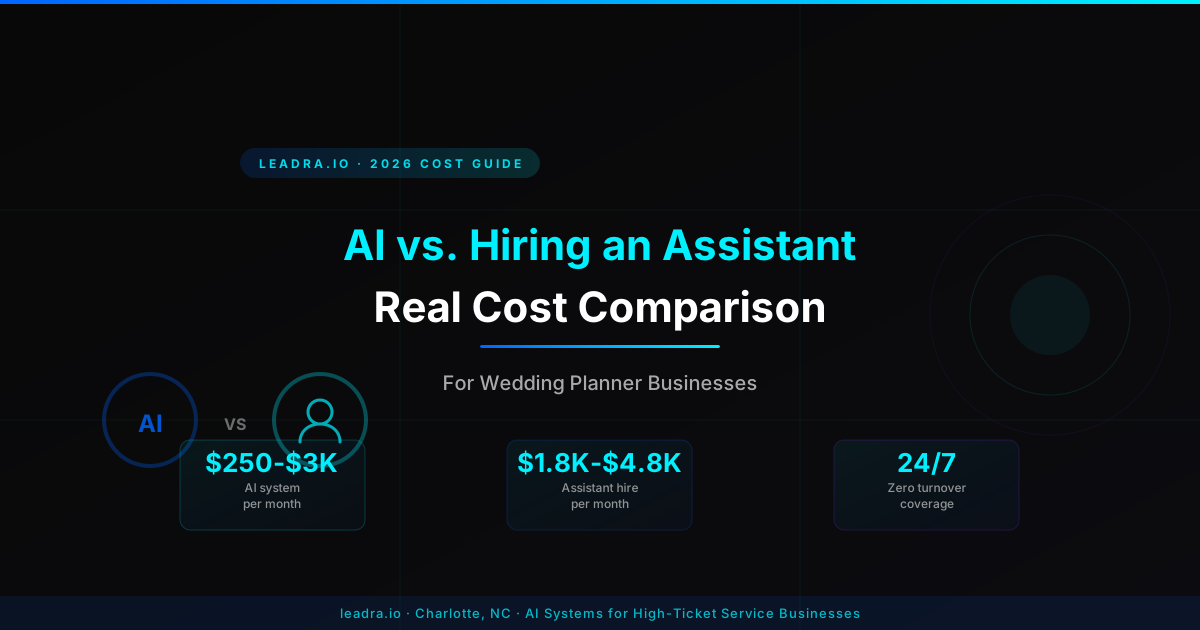
A part-time wedding planning assistant typically costs $1,800-$3,200 a month once you factor in pay, payroll tax, and onboarding time, and that cost resets every time someone quits. An AI automation system that covers the same lead response, follow-up, and admin work typically runs $250-$1,200 a month, works 24/7 with no turnover, but cannot run a venue walkthrough or make a judgment call with an upset bride. Most profitable planners end up running both — AI for volume and always-on response, a human for the high-touch work only a person can do.
Every growing wedding planner business hits the same wall: too many inquiries, proposals, and check-ins to handle solo, not enough revenue yet to justify a full-time hire. The instinct is usually to post a job listing. The better first move is to actually run the numbers on what a hire costs versus what automation costs, because the two options solve different problems at very different price points.
This guide breaks down the real, fully-loaded cost of each path — not just the sticker price — so you can see exactly where your next dollar of capacity should go. For the full pricing breakdown of AI automation tiers and setup fees, see our guide on AI cost for wedding planner businesses. This article focuses specifically on how that cost compares to hiring.
The Real Cost of Hiring a Wedding Planning Assistant
The number in the job posting is never the number you actually pay. A wedding planning assistant or coordinator comes with layered costs most planners underestimate until the first invoice or first quarter of payroll taxes arrives.
- Part-time virtual assistant (10-20 hrs/week): $15-$25/hour, which lands around $650-$2,000/month depending on hours — before you add time spent training them on your process, your voice, and your vendor list.
- Part-time in-person assistant (10-20 hrs/week): $18-$30/hour plus payroll tax (roughly 7-10% on top of wages), landing around $850-$2,900/month.
- Full-time coordinator: salaries in most markets run $40,000-$58,000/year, which adds up to $3,300-$4,800/month once you include payroll tax, and before benefits if you offer them.
- Onboarding and training time: most planners report 3-6 weeks before a new hire can run client communication unsupervised — time you are still paying for at reduced output.
- Turnover: wedding season is seasonal and demanding, and assistant turnover is common. Every departure resets the training clock and creates a coverage gap during your busiest months.
None of this makes hiring a bad decision — a great coordinator is often the difference between a planner who can only run 15 weddings a year and one who can run 30. But it means the real monthly cost of a part-time hire is closer to $1,800-$3,200 once training time and payroll overhead are counted, not the $650 hourly-rate math most planners start with.
What AI Automation Actually Costs
AI automation for a wedding planner business covers a narrower but very specific set of jobs: instant inquiry response, proposal follow-up, appointment booking, review requests, and routine client check-ins. It does not replace judgment, creative direction, or vendor relationships — it replaces the repetitive communication work that eats hours every week.
| Tier | What's included | Monthly cost |
|---|---|---|
| Lead capture only | Instant inquiry reply, SMS alerts | $250-$500 |
| Full follow-up system | Above + proposal nurture, review requests | $500-$1,200 |
| Full-loop system | Above + AI voice line, CRM sync, reporting | $1,200-$3,000 |
A full breakdown of what's inside each tier, plus one-time setup fees, is in our AI cost guide for wedding planner businesses. The key difference from hiring: there is no training ramp, no seasonal turnover, and the system runs identically at 2am on a Sunday as it does at 2pm on a Tuesday.
AI vs. Assistant, Side by Side
| Factor | Human assistant | AI automation |
|---|---|---|
| Fully-loaded monthly cost | $1,800-$4,800 | $250-$3,000 |
| Coverage hours | Scheduled shift only | 24/7, every day of the year |
| Ramp-up time | 3-6 weeks to full output | Days to launch |
| Turnover risk | Common, especially seasonal | None |
| Venue walkthroughs, vendor relationships | Yes | No |
| Handling an upset or emotional client | Yes | No — should escalate to you |
| Instant response to a new inquiry | Only if on shift | Always |
What Each One Is Actually Good At
The comparison above is not really “which one wins.” It's about matching the tool to the job. AI is strongest at repetitive, time-sensitive, high-volume communication: the instant reply the moment an inquiry lands at 11pm, the proposal follow-up sequence that never forgets to send message three, the review request that fires automatically the week after a wedding. A human assistant is strongest at everything that requires context, empathy, or a relationship: reading a bride's tone on a stressful call, negotiating with a vendor who's running late, or making a judgment call on-site that no script could anticipate.
Planners who try to make AI handle emotional or judgment-heavy conversations end up with clients who feel unheard. Planners who make a human handle 50 routine inquiry replies a week end up burning their best hire on work that doesn't need a person. The highest-leverage move is routing each type of work to whichever one actually fits.
The Hybrid Model Most Profitable Planners Use
Very few growing wedding planner businesses pick one or the other exclusively. The most common — and most profitable — setup layers AI automation underneath a smaller, more focused human team. AI handles instant response, proposal follow-up, scheduling, and review requests around the clock. A part-time assistant or coordinator, freed from that volume, spends their hours on vendor coordination, day-of logistics, and the client relationships that actually require a person.
This combination frequently costs less in total than a full-time coordinator alone, because the assistant's hours go entirely toward work that needs a human — not toward retyping the same proposal follow-up email for the fortieth time. It also removes the coverage gap between when your assistant clocks out and when the next inquiry comes in, which is often when planners lose the most leads to a faster-responding competitor.
Real Example: Cutting a Planned Hire in Half
(This example represents the type of results our clients achieve.)
A Charlotte-area wedding planner was about to post a job listing for a full-time coordinator, budgeting roughly $4,200/month once payroll tax was included. Before posting, she implemented an AI system for inquiry response, proposal follow-up, and review requests at $900/month. The system absorbed the volume that was consuming most of a coordinator's week — first replies, proposal nurture, scheduling discovery calls.
She then hired a part-time coordinator at 15 hours/week, focused entirely on vendor coordination and day-of support, for roughly $1,400/month fully loaded. Combined cost: $2,300/month, versus the $4,200/month full-time hire she had originally planned — while covering more hours of lead response than a single employee ever could.
I almost hired for a problem the software could have solved for a third of the cost.
AI Cost vs. Hiring for Charlotte NC Wedding Planners
Charlotte's wedding market runs across a wide range of venue types — Myers Park estates, Lake Norman waterfront properties, Uptown ballrooms, NoDa industrial spaces — and inquiry volume swings hard with engagement season, which peaks late November through Valentine's Day. That seasonality is exactly where the cost gap between hiring and automation shows up most.
A seasonal hire means paying for full coverage during slow months just to have capacity ready for the surge, or scrambling to onboard someone right when volume spikes. An AI system scales with inquiry volume automatically — it costs the same whether you get 10 inquiries a month or 60, and it's already live and trained before your next engagement season opens. For the fuller local marketing picture beyond just the assistant-vs-AI decision, see our AI marketing guide for Charlotte NC wedding planners.
5 Questions to Decide Which One You Need
1. Is the bottleneck volume or judgment? If you're missing inquiries because you can't reply fast enough, that's a volume problem AI solves. If you're missing bookings because discovery calls go poorly, that's a skill problem a person solves.
2. Can you afford 3-6 weeks of reduced output while someone trains? If your busy season starts in 4 weeks, a new hire won't be ready in time. An AI system can be.
3. Does the work require being physically present? Venue walkthroughs and day-of coordination need a person. Inquiry response and follow-up don't.
4. What happens to the cost if a hire leaves mid-season? If that risk would seriously disrupt your business, weight your decision toward the lower fixed cost of automation first.
5. Have you already automated the routine work? If not, do that first — it's the cheaper move, and it often reveals you need less human help than you thought.
What to Do Next
Start by tracking exactly where your hours actually go for two weeks — inquiry replies, proposal follow-up, scheduling, vendor calls, on-site work. Most planners are surprised how much of that time is repetitive communication rather than work that genuinely requires a person. That is the portion AI can absorb immediately, often for less than a single part-time hire's monthly cost.
At Leadra.io, we build the AI automation layer first — inquiry response, follow-up, review requests — so you can see exactly how much capacity it frees up before you commit to a hire. Call +1 (864) 721-8384 or visit our contact page to get a free breakdown of what your specific workload would cost to automate versus hire for.
Frequently Asked Questions
Is AI cheaper than hiring an assistant for a wedding planner business?
For repetitive communication work — inquiry response, proposal follow-up, review requests — yes, typically. AI automation runs $250-$3,000/month depending on scope, versus $1,800-$4,800/month fully loaded for a part-time or full-time hire. AI is not cheaper for work that requires physical presence or emotional judgment, like venue walkthroughs or handling an upset client.
Should I hire an assistant or buy AI automation first?
Automate the repetitive communication work first. It costs less, launches faster, and often reduces how much human help you actually need — so if you do hire afterward, that person's hours go entirely toward work that requires a person, not toward answering the same inquiry email fifty times a month.
Can AI completely replace a wedding planning assistant?
No. AI handles instant response, follow-up sequences, scheduling, and review requests well, but it cannot run a venue walkthrough, negotiate with a vendor, or make an on-site judgment call. Most profitable planners run both — AI for volume and always-on response, a human for everything that requires context or presence.
How is Leadra.io different from a general automation tool?
Leadra.io builds and manages the full AI system for wedding planner businesses — inquiry response, proposal follow-up, review automation, and reporting — rather than handing you a generic template to configure yourself. We back it with a 90-day performance guarantee, and we show you exactly what capacity it frees up before you decide whether to hire on top of it.
- A fully-loaded part-time assistant costs $1,800-$3,200/month; AI automation covering the same follow-up work runs $250-$3,000/month with no training ramp or turnover.
- AI is strongest at volume and always-on response; a human is strongest at judgment, presence, and emotional relationships.
- The most profitable planners run a hybrid model — AI underneath a smaller, more focused human team.
- Automating repetitive work first often reduces how much human help you actually need to hire for.
Not sure if you need a hire or a system?
Get a free workload breakdown from Leadra.io.
30-minute strategy call — we review where your hours actually go and show you exactly what it would cost to automate versus hire for. No obligation. You leave with a written plan.
Charlotte NC · serving wedding planners and small businesses nationwide
Written by the Leadra.io Team. Leadra.io is an AI marketing and automation agency helping wedding planners, dental practices, and small businesses grow with AI-powered systems. Based in Charlotte, NC — serving clients nationwide.