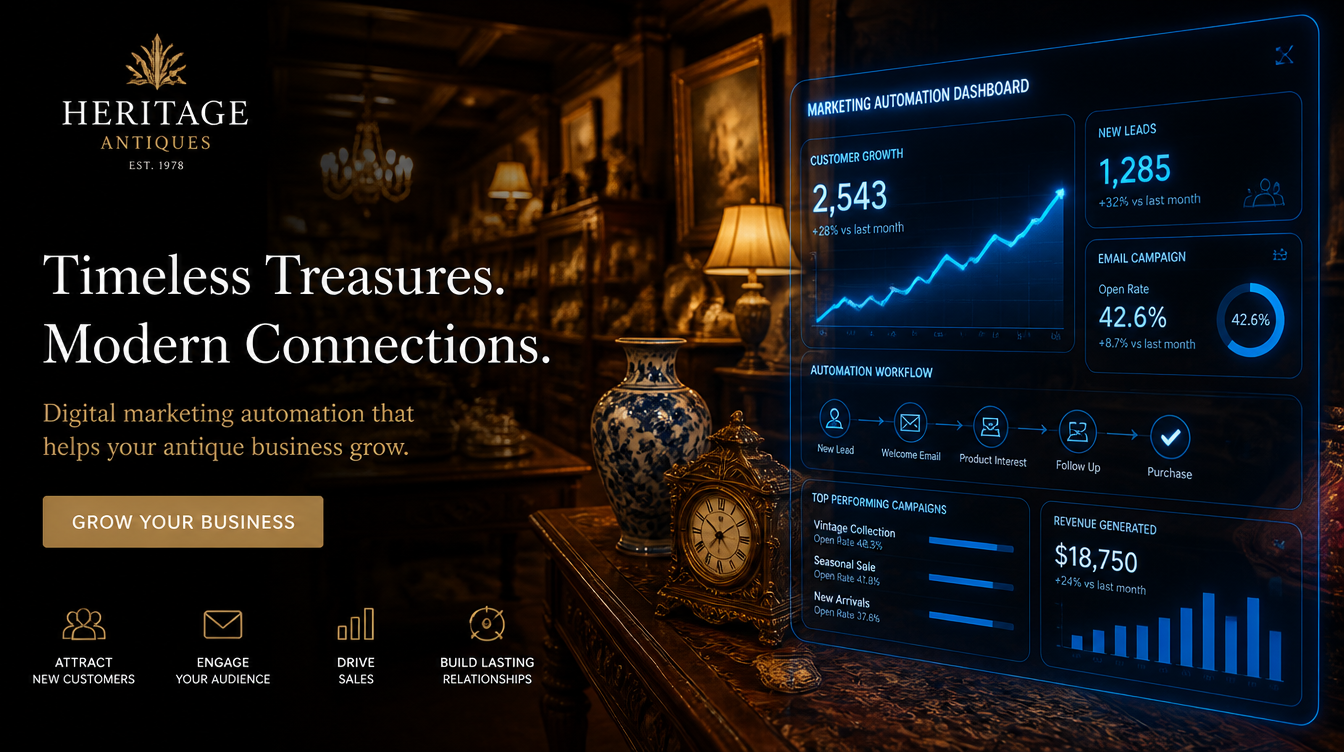
Antique Shop Marketing Automation Guide: Turn Browsers Into Buyers Without Adding Staff in 2026
By Leadra.io Team · June 21, 2026 · 9 min read
Antique shop marketing automation is a set of connected tools that handle your inventory social posts, inquiry follow-ups, email campaigns, and Google review requests automatically. The right stack generates consistent foot traffic and online sales without a dedicated marketing hire — and it pays for itself within the first 60 days for most shops.
Antique shop owners are some of the most underserved business owners in marketing. The inventory changes constantly, the customer base runs on relationships and word of mouth, and there is rarely time to manage a newsletter, post consistently on Instagram, and follow up with every person who asked about a specific piece last month.
The shops that are growing in 2026 have one thing in common: they stopped doing marketing manually. They built systems that handle the repetitive work — posting new arrivals, responding to inquiries instantly, notifying past buyers when matching inventory comes in — and freed the owner to focus on buying, curating, and selling.
This antique shop marketing automation guide walks through exactly which systems work, what each one costs, and how to implement them step by step.
Why Antique Shops Lose Sales to Manual Marketing
Antique shops face a specific marketing challenge that most businesses do not: the inventory is one-of-a-kind and constantly turning over. A customer who saw a Victorian sideboard on Instagram two weeks ago and finally decided to buy it may find it sold when they arrive. A dealer who attended an estate sale last Saturday may have exactly what three customers have been searching for — but none of them know it yet.
Manual marketing cannot keep up with that pace. Here is what it looks like in practice:
- New arrivals sit unphotographed for days because the owner is on the floor with customers or sourcing inventory.
- Someone messages on Facebook asking about a piece. The reply comes 18 hours later. They already bought it somewhere else.
- A customer who bought a mid-century dining set two years ago would love to know about the matching credenza that just came in — but there is no system to tell them.
- Google reviews are sitting at 4.1 stars not because service is poor, but because no one ever asks happy customers to leave one.
These are not effort problems. They are system problems. Marketing automation solves every one of them by replacing manual decisions with automatic triggers.
For antique shops already using an AI receptionist to handle calls and inquiries, see our related guide on AI receptionists for antique shops — that system pairs directly with the automation stack below.
The 6 Core Systems in an Antique Shop Marketing Automation Stack
You do not need a dozen tools. The shops seeing the fastest growth run six interconnected systems. Each one closes a specific gap between a potential buyer and a completed sale.
1. Automated New Arrival Social Media Posting
Consistency on social media is the single most reliable driver of walk-in foot traffic for antique shops. A shop that posts new arrivals three times per week every week — regardless of how busy the floor is — will see measurably more visitors than a shop that posts 20 times during a big estate sale acquisition and then goes quiet for a month.
The workflow that works: photograph new arrivals in a designated 15-minute window each morning using your phone and a simple lightbox or natural light setup. Drop the photos into a scheduling tool like Buffer, Later, or Meta Business Suite. Use a saved caption template that fills in the piece type, era, price range, and a call to action. The week's posts are scheduled and go live automatically — even when you are at a buying trip.
For shops with higher volume, tools like Zapier can trigger automatic posts from a shared Google Sheet or inventory spreadsheet whenever a new row is added. You update your inventory record; the post goes out. No extra step required.
Antique shops that post daily new-arrival content typically see 40–65% more direct messages and profile visits than shops posting once or twice weekly, based on client-reported data from shops running this system.
2. Instant Inquiry Response and Lead Capture
The speed of your first response to an inquiry determines whether you make the sale more than almost any other factor. A 2024 Harvard Business Review study found that businesses responding within 5 minutes are 100 times more likely to convert a lead than those responding within 30 minutes.
For antique shops, inquiries come from multiple channels simultaneously: Instagram DMs, Facebook messages, website contact forms, Google Business Profile messages, and phone calls. Managing all of these manually while running a shop floor is impossible.
Automated inquiry response means every message across every channel triggers an immediate reply: confirming receipt, setting expectations for a human response, and answering the most common questions upfront (Is the piece still available? Do you hold items? What is your layaway policy?). This keeps the lead warm while you finish with the customer in front of you.
For shops that receive 10+ inquiries per day, an AI voice or chat agent handles the full initial conversation, qualifies the buyer, and schedules a callback or visit. See how Leadra.io's client acquisition system handles this end-to-end.
3. New Inventory Notification Emails for Past Buyers
Your past customers are your best buyers. Someone who purchased a set of Depression-era glassware from you is far more likely to buy another piece in the same style or era than a cold visitor who found you on Google. Most antique shops know this — and still have no system to act on it.
Email segmentation changes that. You build a simple list of past buyers with tags noting what they purchased: style period, category (furniture, jewelry, ceramics, clocks), price range. When new inventory comes in that matches a tag, an automated email goes to that segment: “New arrivals you might like — we just got in a collection of [matching era/style].” Include three to five photos with brief descriptions and a call to action to contact you or visit before the weekend.
These targeted notification emails consistently outperform general newsletters by 3x–5x in click-through and conversion rates. The audience is pre-qualified. They already trust you. They are actively interested in exactly what you are selling.
4. Estate Sale and Buying Trip Announcement Sequences
Every major buying trip or estate sale acquisition is a marketing event. Most antique shop owners miss this entirely — they come back with great inventory, set it up over two days, and then mention it once on Facebook.
An automated announcement sequence works differently. Before the trip: “We are heading to [location] estate sale this weekend — tell us what you are looking for.” This pre-generates interest and gives you requests to fulfill. During the trip: one or two “just found” posts showing standout pieces before they even hit the shop floor. The day before arrival: “Big haul arriving tomorrow — [5 photos of highlights] — shop opens at 10 AM.” This creates anticipation and drives first-day traffic from your warmest audience.
This sequence is built once in your email platform and social scheduler. You fill in the trip-specific details and schedule it. The rest runs automatically.
5. Customer Reactivation Campaigns for Lapsed Buyers
Customers who have not visited or purchased in over 12 months are not lost — they just have not had a reason to come back recently. A well-timed reactivation campaign gives them one.
Set up a quarterly automated email to anyone who purchased but has not opened an email or visited in 6+ months: “We have been finding some incredible pieces this quarter. Based on what you bought from us last time, we thought you would want to see what just came in.” Include 3–5 photos of current inventory in their historical style and price range. Offer a private preview or a first-look phone call with the owner.
Response rates on these campaigns consistently run 3x–5x higher than campaigns to cold lists. These customers already have a relationship with your shop and a demonstrated willingness to spend. The campaign just reminds them you exist.
6. Automated Google Review Request Sequences
Google reviews directly affect how many people find your shop when searching “antique shops near me” or “antique furniture [city].” A shop with 87 reviews at 4.8 stars ranks higher than a shop with 12 reviews at 4.9 stars — volume matters as much as rating.
Most shops rely on organic reviews from customers who feel strongly enough to leave them without being asked. That is a slow drip. An automated review request sequence changes the math: two days after a sale, a text message goes to the customer saying “Thank you for coming in — if you enjoyed your visit, we would love a Google review. It helps other antique lovers find us.” Include a direct link to your Google review page.
Shops running this system typically see their review count triple within the first 90 days. Higher review counts directly translate to more discovery searches and more first-time visitors.
| Customer Segment | Automated Sequence | Timing |
|---|---|---|
| Past buyers (tagged by category) | New inventory notifications matching their purchase history | Triggered on new arrivals |
| Warm inquiries (asked, did not buy) | Follow-up when similar pieces arrive, pricing updates | Triggered + monthly |
| Email subscribers (general) | Buying trip announcements, shop news, featured pieces | Bi-weekly |
| Recent buyers (0–7 days) | Thank you message + Google review request | Day 2 post-sale |
| Lapsed (no engagement 6+ mo) | Win-back sequence — “here is what just came in” | Quarterly |
Real Example: A Charlotte Antique Shop Growing Revenue 34% in 90 Days
(This example represents the type of results our clients achieve.)
A multi-dealer antique center in Charlotte, NC had strong foot traffic on weekends but inconsistent weekday sales. Their email list had grown to 800 contacts over 8 years — but they had sent fewer than six newsletters in the last two years. Their Instagram was active during big acquisition weeks and silent for months at a time.
We built a full marketing automation stack over three weeks:
- Segmented their email list by purchase history and style preference (furniture, jewelry, vintage lighting, mid-century)
- Set up automated new-arrival notifications triggered when dealers updated their shared inventory spreadsheet
- Built a 3-email buying-trip announcement sequence deployed before and after each major acquisition run
- Added an automated SMS review request to every customer within 48 hours of a purchase
- Configured instant-response automation across Instagram DMs and their website contact form
Results after 90 days: weekday revenue up 34% on average. Google reviews went from 31 to 94. Email open rates averaged 41% — more than double the industry average of 19%. The owner reported spending 3 hours per week on marketing versus the previous 10+, with better results.
We had the customers. We just were not staying in front of them. The system fixed that.
How to Build Your Antique Shop Automation Stack in 5 Steps
Step 1: Build and clean your email list. Pull every email address you have ever collected — point of sale records, business cards, paper sign-in sheets, past order confirmations. Import them into a single email platform. Start with Klaviyo if you want robust segmentation by purchase category, or Mailchimp if you want the simplest setup. Clean the list for bounces and duplicates first.
Step 2: Tag past buyers by category and style. This is the step most shops skip, and it is what makes inventory notification emails actually convert. Go back through your sales records for the last two years and tag each customer: furniture, jewelry, ceramics, clocks, mid-century, Victorian, industrial, farmhouse, etc. Even rough tagging is enough to start sending more relevant emails than a generic blast to your whole list.
Step 3: Set up your buying trip announcement template. Create a three-email template in your email platform: pre-trip interest survey, day-before arrival preview, and post-trip full arrival announcement. Fill in placeholders for trip location, date, and inventory photos. From now on, deploying this sequence for each buying run takes 20 minutes instead of three hours.
Step 4: Add instant response to every inquiry channel. At minimum, set up an auto-reply on your Facebook page, your website contact form, and your Google Business Profile messages. Each reply should confirm receipt, give a realistic response time, and answer the single most common question upfront. For Instagram DMs, use ManyChat's free tier to set up keyword-triggered responses for common phrases like “available” or “price.”
Step 5: Turn on review requests. Connect your point-of-sale or CRM to an SMS platform like SimpleTexting or Podium. Set up an automated message that goes to every buyer 48 hours after a sale with a direct link to your Google review page. This single step typically triples your monthly review volume within 90 days.
If you want the full stack built and managed for you, Leadra.io handles implementation end to end. Call +1 (864) 721-8384 or visit our contact page to book a free strategy session.
Tools for Antique Shop Marketing Automation
The right tools depend on your shop's size, email list, and how much inventory you move. Here is a practical breakdown by function:
- Email and segmentation: Klaviyo (best for category-based segmentation and triggered sends), Mailchimp (simplest to start, limited automation on free tier), ActiveCampaign (best CRM integration for shops tracking buyer relationships)
- Social scheduling: Buffer or Later (clean interface, affordable), Meta Business Suite (free, covers Instagram and Facebook), Hootsuite (best for shops managing multiple platforms including Pinterest and Google Business Profile)
- Instant inquiry response: ManyChat for Instagram and Facebook DM automation (free tier covers most small shops), Intercom or Drift for website chat, Leadra.io's AI voice agent for phone inquiries
- SMS and review requests: Podium (full review management + text conversations, $300–$400/mo), SimpleTexting (basic SMS automation, $29/mo), Birdeye (review management across multiple platforms)
- CRM and inventory tracking: HubSpot free tier (sufficient for tracking buyer relationships), Airtable (flexible inventory and customer database, ideal for multi-dealer shops), Trello with Zapier integration (for shops that want a visual board with automated triggers)
A complete functional stack for a single-location antique shop runs $150–$350 per month in software. The key is integrating the tools so data flows between them automatically — a sale in your POS triggers the review request, a new inventory row in your spreadsheet triggers the social post and the segmented email notification. Disconnected tools recreate the manual process in digital form.
Frequently Asked Questions
What is antique shop marketing automation?
Antique shop marketing automation is the use of connected software tools to handle repetitive marketing tasks automatically — posting new arrivals on social media, responding instantly to inquiries, emailing past buyers about matching inventory, requesting Google reviews after sales, and running reactivation campaigns for lapsed customers. You configure these systems once, and they run on triggers without requiring manual attention each time.
How much does marketing automation cost for an antique shop?
Software costs for a complete stack run $150–$350 per month for a small to mid-size shop, depending on list size and tools chosen. Professional setup by an agency like Leadra.io typically ranges from $1,200–$2,500 as a one-time investment. Most shops recover that in the first 30–60 days through sales that would otherwise have been lost to slow follow-up or missed inventory notifications.
Do antique shops really need email marketing automation?
Yes — and antique shops benefit more from email automation than most businesses because of the one-of-a-kind, high-intent nature of the inventory. A customer who bought Victorian furniture from you two years ago and sees an email with photos of a matching piece that just came in is already primed to buy. Generic social posts reach everyone; triggered inventory emails reach the exact buyer for each item. That specificity is what drives consistent revenue from your existing customer base.
How long before antique shop marketing automation shows results?
Google review volume increases within the first 30 days once automated review requests are running. Social media engagement and direct inquiry volume typically improve within 4–6 weeks as consistent posting takes effect. Email revenue impact — from segmented inventory notifications and reactivation campaigns — is usually visible within 60–90 days as the list is segmented and the first campaigns deploy. Review gains and social consistency compound over time; month three is materially better than month one.
- The 6 core systems — new arrival social posts, instant inquiry response, segmented inventory emails, buying trip announcements, customer reactivation, and review requests — address every major revenue leak in antique shop marketing.
- Shops posting daily new-arrival content see 40–65% more DMs and profile visits than shops posting once or twice weekly, based on client-reported data.
- Segmented inventory notifications to past buyers outperform general newsletters 3x–5x in click-through and conversion — because the audience already wants exactly what you are selling.
- A full automation stack costs $150–$350 per month in software and requires no marketing hire to maintain after setup.
What to Do Next
The biggest mistake antique shop owners make with marketing automation is assuming it is only for big retailers or tech-savvy businesses. The opposite is true. The segmented, relationship-driven, inventory-triggered model of antique shop marketing is exactly what automation is built for — and small shops benefit disproportionately because every recovered sale has a higher margin impact than in high-volume commodity retail.
Start with Step 3 from the guide above: build your buying-trip announcement template for your next major acquisition run. That single system — pre-trip interest, day-before preview, post-trip arrival email — will show you in concrete terms how much walk-in traffic you have been leaving on the table by not building anticipation before new inventory arrives.
At Leadra.io, we build and manage the full antique shop marketing automation stack. Call +1 (864) 721-8384 or visit our contact page to schedule a free 30-minute strategy call. We audit your current marketing setup, show you the top 3 gaps, and give you a written implementation plan — no obligation.
Ready to automate your antique shop's marketing?
Get a free antique shop marketing audit from Leadra.io.
30-minute strategy call — we review your current marketing process, identify the top 3 revenue leaks, and show you exactly what to automate first. No obligation. You leave with a written plan.
Charlotte NC · serving antique shops and small businesses nationwide
Written by the Leadra.io Team. Leadra.io is an AI marketing and automation agency helping antique shops, dental practices, and small businesses grow with AI-powered systems. Based in Charlotte, NC — serving clients nationwide.