Most appliance repair companies run on the same pattern: answer the phone between jobs, quote a repair when you get a minute, remind customers about their appointment if you remember, and hope satisfied customers leave a review on their own. The problem isn't your repair work. It's that marketing and follow-up happen in whatever gaps are left over after the actual repairs get done.
Marketing automation fixes that gap. Not by replacing the trust your technicians build in someone's kitchen or laundry room, but by running the call capture, follow-up, and customer retention work in the background so every inquiry gets handled the same way, every time, whether or not anyone's free to pick up the phone.
This guide walks through the full six-step appliance repair marketing automation system: what each piece does, how to set it up, what it costs, and what results look like in practice. By the end you'll know exactly which components to build first and what to expect at 30, 60, and 90 days.
Why Most Appliance Repair Marketing Wastes Money
Appliance repair companies that try traditional marketing hit the same wall. They pay for local ads or boost a Google Business Profile listing, get more calls, and then lose a large share of that new demand in the follow-up gap. A homeowner with a broken refrigerator calls three companies back to back, and whoever answers first or replies fastest usually wins the job — regardless of who has the better reviews or lower price.
The problem is rarely a lack of demand. It's conversion. Most appliance repair companies convert 30-40% of inbound inquiries into booked service calls. Companies running automation convert 60-75%. That gap comes almost entirely from response speed and follow-up consistency, not from marketing spend.
Automation doesn't just fix response speed. It closes the three biggest revenue leaks that quietly drain appliance repair company revenue every month: missed inbound calls, slow quote follow-up, and customers who called once and never came back. Here's how to plug all three.
The 6-Step Appliance Repair Marketing Automation System
Build this in order. Each step compounds on the one before it. Most companies see measurable ROI from steps 1-3 within the first two weeks.
24/7 Call and Web Lead Capture
Every call, text, and website form gets answered instantly, even at 9pm on a Sunday, even while a technician is under a dishwasher with both hands full. The AI voice agent gathers the appliance type, brand, and symptom, checks it against your service area, and books the lead — or the appointment directly — in the same conversation. No hold music, no voicemail, no missed opportunity.
Set this up first because it's the highest-leverage change you can make. Companies that go from manual call handling to AI capture typically see a 30-45% increase in booked service calls within the first 30 days — not because more people are calling, but because dramatically more of the calls already coming in convert into jobs.
Instant Quote and Booking Follow-Up
A homeowner with a broken appliance is usually comparing two or three repair companies at once, and whoever confirms a service window first typically gets the job. The automation responds to every new quote request within minutes by text, confirms the appliance issue, and offers real available service windows straight from the conversation.
Speed is usually the single biggest lever for turning more quote requests into booked jobs. Companies running instant follow-up typically see quote-to-booking rates climb from around 30-35% to 50-60% without changing pricing or service quality at all.
Appointment Confirmation and No-Show Prevention
For every booked service call, the system runs a two-touch confirmation sequence: a text the day before asking the customer to confirm their window, and a reminder the morning of with the technician's estimated arrival time. If a customer doesn't confirm, the system flags the slot early enough to offer it to another waiting customer instead of sending a technician on a wasted drive.
For a two-truck company, an unconfirmed appointment that turns into a no-show or a customer who isn't home costs real drive time and a missed slot that could have gone to a paying job. This sequence typically recovers 8-12 wasted truck rolls per month — often $1,200-$2,400 in reclaimed billable time.
Post-Repair Review Automation
Thirty minutes after a technician marks a job complete, the system sends the customer a brief text with the technician's name and a direct link to leave a Google review. No generic request — personalized, immediate, and one tap to the review form while the relief of a working appliance is still fresh.
This alone generates 15-25 new Google reviews per month for a company that was getting 2-4 before. More reviews directly raise your ranking in the Google map pack, which is where the majority of "appliance repair near me" searches convert into calls. A company going from 40 to 120 reviews with a 4.7+ rating typically sees organic inquiry volume increase 35-60% over six months with no added ad spend.
Dormant Customer Reactivation
Every appliance repair company has a list of past customers sitting in its system who haven't called back in a year or more. For a busy company, that's often 200-500 households who already know your work, already trust the name on the invoice, and are statistically likely to have another appliance need eventually — a new symptom, a second unit, or a referral opportunity that never got asked for.
The automation identifies dormant customers automatically and sends a light-touch re-engagement message referencing their last repair and offering a seasonal maintenance check or a referral incentive. This typically reactivates 15-25% of the dormant list, translating to $1,000-$2,500 in recovered monthly revenue from customers you already paid to acquire once.
Local SEO Content Engine
The first five steps only work on the inquiries you already receive. The sixth component grows the number of people finding you in the first place — monthly content targeting searches like "refrigerator repair near me" or "dryer repair Charlotte NC," structured so Google's AI Overview, ChatGPT, and Perplexity can surface your company when someone asks for an appliance repair recommendation in your service area.
Combined with the review volume from step 4, a steady content engine consistently pushes companies higher in local search results and into the map pack, where most appliance repair searches convert. Companies that add this layer typically see compounding growth in raw inquiry volume on top of whatever the capture and follow-up systems recover from existing traffic.
Manual Marketing vs. Automation: What Actually Changes
| Activity | Manual | Automated |
|---|---|---|
| Inbound call / text response | Missed during repairs, voicemail only | Answered instantly, booked in minutes |
| After-hours inquiries | Missed until next business day | Answered and booked any time |
| Quote follow-up | Same day to next day, if at all | Under 5 minutes, 24/7 |
| No-show prevention | One generic reminder, maybe | 2-step confirmation, early re-slotting |
| Review requests | Ask verbally — 2-4/month if lucky | Post-repair text — 15-25/month |
| Dormant customer follow-up | Never, or a one-off bulk text | Personalized re-engagement sequence |
| New inquiry sources | Reviews and existing traffic only | + monthly local SEO content |
| Overall inquiry conversion | 30-40% | 60-75% |
Case Study: North Charlotte Appliance Repair Company Adds $22,600/Month in 90 Days
A two-truck appliance repair company serving north Charlotte had strong reviews and steady word of mouth, but only 40-45 booked service calls a month — well below what their review count and call volume suggested they should be converting. Monthly revenue was sitting around $18,600, holding steady but not growing.
Inquiry conversion
34%
64%
Avg. response time
6 hours
under 5 min
Google reviews
38
112
Monthly revenue
$18,600
$41,200
Leadra.io deployed the full six-step system in 7 days. The AI voice agent went live first — in the first week it handled 29 inbound calls that would otherwise have hit voicemail while technicians were mid-repair, converting 19 of them into booked service calls.
Instant quote follow-up lifted the quote-to-booking rate from 34% to over 60% within the first month, since most quote requests were now getting a text reply and confirmed service window in under five minutes instead of a same-day or next-day callback. The review automation sent 58 requests in month one and generated 27 new Google reviews, moving the company from page two to the top three results for "appliance repair near me" in their service area.
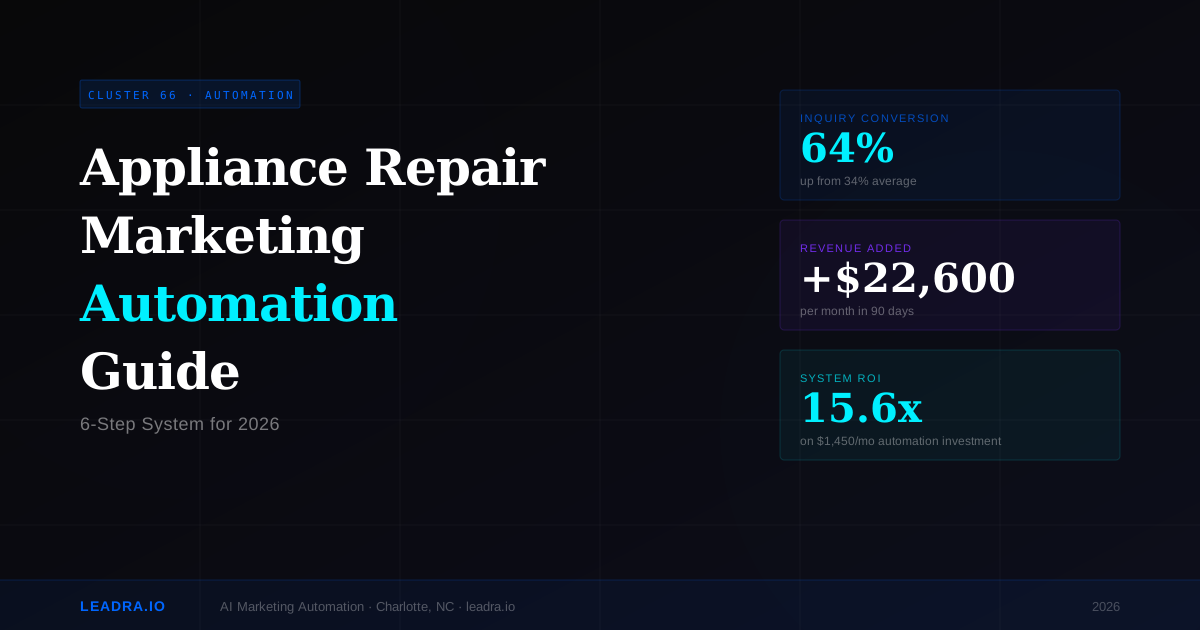
The dormant reactivation campaign, launched at day 21, reached 310 past customers and brought back 41 of them over six weeks for new repairs and seasonal maintenance checks. By day 90, monthly revenue had grown from $18,600 to $41,200. The full automation system cost $1,450 per month. ROI at 90 days: 15.6x. The owner didn't add a truck or hire a dispatcher to get there.
What Appliance Repair Marketing Automation Costs in 2026
Pricing scales with company size and which components you activate. Here's how it breaks down:
Starter
$600–$1,200/mo
- →24/7 AI voice agent for inbound calls
- →Instant text follow-up on quote requests
- →Basic appointment confirmation sequence
- →Best for: solo techs and two-truck operations
Growth
$1,300–$2,000/mo
- →Everything in Starter
- →Lead scoring and warranty qualification
- →Post-repair review automation
- →Dormant customer reactivation campaigns
- →Best for: 3-8 truck companies converting more of existing traffic
Full System
$2,000–$2,800/mo
- →Everything in Growth
- →Monthly local SEO content engine
- →AI Overview and ChatGPT citation optimization
- →Monthly performance reporting with cost-per-lead tracking
- →Best for: established companies targeting compounding lead growth
What to Expect at 30, 60, and 90 Days
- →AI call capture live — inquiries converting at 60-75% vs 30-40% before
- →Quote follow-up cutting response time from hours to under 5 minutes
- →First 10-15 new Google reviews from post-repair automation
- →Initial revenue recovery: $1,500-$3,000 from converted missed calls and faster quote turnaround
- →Dormant customer reactivation campaign launched — 15-25% reactivation rate
- →Review count growth pushing map pack ranking higher in local search
- →No-show prevention recovering 8-12 wasted truck rolls per month
- →Cumulative revenue impact: $4,000-$8,500 over the first 60 days
- →Organic inquiries increasing as local SEO content and reviews compound
- →Full automation running at scale — no manual follow-up required
- →Review count at 60-90 new reviews added since launch
- →Most companies at 8-15x ROI on their monthly automation investment
Frequently Asked Questions
What is appliance repair marketing automation?
Appliance repair marketing automation is the use of AI-driven software to handle the lead capture, follow-up, and customer retention tasks that most repair companies do manually or skip entirely. This includes answering every call and quote request 24/7, sending instant text follow-up on quotes, confirming appointments to prevent no-shows, requesting Google reviews after every completed job, and re-engaging past customers who haven't called back. Instead of relying on a technician or office manager to squeeze these tasks in between service calls, automation runs them continuously without manual input.
How much does marketing automation cost for an appliance repair company?
Appliance repair marketing automation typically costs $600 to $2,800 per month depending on which components you activate. A basic stack covering 24/7 call capture, instant quote follow-up, and appointment confirmations runs $600-$1,200/month. A full system adding lead scoring, dormant customer reactivation, and local SEO content runs $1,800-$2,800/month. Most two-truck companies recover the cost within the first month from recovered missed calls alone.
How long does it take to set up appliance repair marketing automation?
A complete appliance repair marketing automation system typically takes 5-7 days to configure and launch. Days 1-2 cover mapping every channel a customer can reach you through and integrating the AI voice agent with your phone line. Days 3-4 activate instant quote follow-up and appointment confirmation sequences. Days 5-7 build and launch the review automation and dormant customer reactivation campaign. Most companies start capturing recovered calls before the first week is over.
Does marketing automation work for a one-truck or solo appliance repair operation?
Marketing automation works especially well for solo and one or two-truck appliance repair operations. A solo technician loses the most revenue to missed calls, since there's no one else to answer the phone while a repair is in progress. Automation gives a one-person operation the same 24/7 call coverage, instant follow-up, and customer retention infrastructure that a company with a full office staff would have, without adding payroll.
Related Reading
Ready to Build the Full Automation System for Your Company?
Leadra.io builds and manages complete appliance repair marketing automation systems — from 24/7 call capture to dormant customer reactivation to local search ranking. Most companies see positive ROI within the first 30 days.