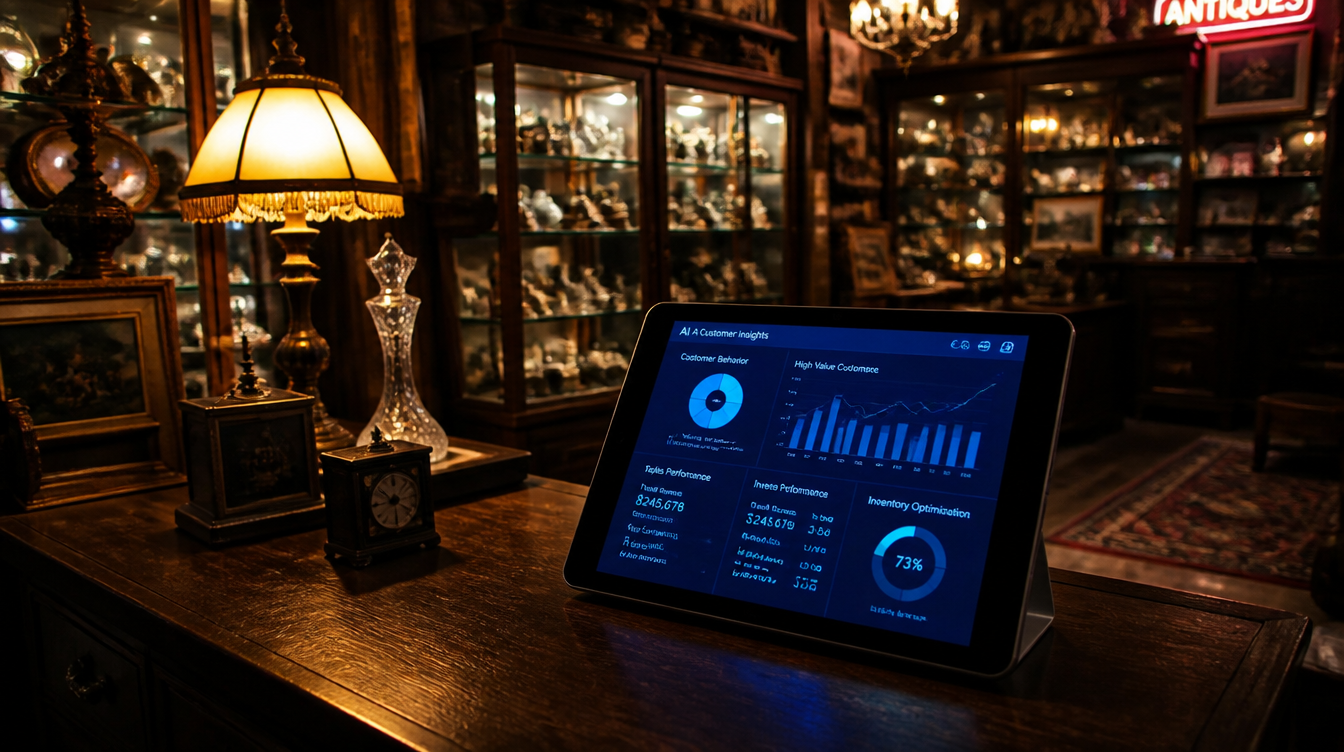
Your antique shop has something most retailers can't match: inventory that people search for by name, by period, by maker, and by city. A buyer in Charlotte who wants a specific Victorian secretary desk is not browsing Instagram. They are typing exactly what they want into Google at 9 PM on a Sunday — and if your shop does not show up, that sale goes to someone who does.
The antique and collectibles market hit $26 billion in the U.S. in 2024, according to IBISWorld industry data, with the strongest growth coming from online and hybrid shop models that combine physical inventory with digital buyer acquisition. The shops pulling ahead are not the ones with the biggest floor space. They are the ones that respond to buyer inquiries at midnight, rank on page 1 for niche collectible searches, and re-engage past customers when new inventory arrives.
The best AI tools for antique shops in 2026 make all of that possible without hiring extra staff or spending hours on marketing you do not have time for. This guide covers the five AI capabilities that move inventory faster, the real numbers from a Charlotte-area antique dealer who deployed them in early 2026, and exactly what to look for when choosing a system for your shop.
At Leadra.io, we have built AI acquisition systems for specialty retailers, dental practices, and service businesses across the country. The antique shop use case is one of the clearest ROI stories we see — because the buyers are already searching for exactly what you have. The only question is whether they find you or someone else.
Why Antique Shops Lose Sales That Should Be Theirs
Independent antique shops run lean. Most have one to three staff members, limited hours, and no dedicated marketing person. The owner buys inventory, manages consignors, handles walk-in customers, and tries to post on Instagram when there is time. That leaves four consistent revenue leaks that AI closes directly.
After-hours inquiries go unanswered
Serious collectors and decorators browse and research outside business hours. A buyer finds your piece at 8 PM, messages your Facebook page or sends a text, and hears nothing until the next afternoon. By then, they have already bought from a dealer who responded. Industry data from Podium's 2024 Local Business Messaging Report shows that 53% of consumers choose the first business to respond — and that window is under five minutes for high-intent buyers.
No Google visibility beyond the homepage
A shop with no blog content ranks only for its own name and maybe a generic 'antique shop Charlotte NC' term. But buyers search for specifics: 'where to buy authenticated vintage Rolex Charlotte', 'art deco furniture dealers Charlotte NC', 'buy Victorian jewelry Charlotte'. These high-converting searches go to dealers who publish content about what they sell. Most antique shops have zero of that content.
Consignment intake eats floor-selling time
Every consignment inquiry that comes in during business hours pulls you off the floor. You answer the same questions about your split, your categories, and your process dozens of times per month. That time adds up — and callers who can't reach you go to the next dealer on their list.
Past buyers are never contacted again
A customer who paid $600 for a piece of mid-century furniture last year is your best next buyer. They already trust your eye, they know your shop, and they have proved they spend money. Most antique dealers never contact them again unless there is a generic sale email. Targeted reactivation based on what they previously bought converts at 3-5x the rate of cold outreach.
None of these are problems that require a marketing degree to solve. They are operational gaps that AI fills automatically — so you can focus on sourcing inventory and serving the customers in front of you.
The 5 Best AI Tools for Antique Shops in 2026
Here is what the best AI for antique shops actually does in 2026. These are not generic chatbot tools — they are purpose-built capabilities that address the specific way antique buyers research, inquire, and purchase.
AI 24/7 buyer inquiry agent
Most antique shops are open 40-50 hours per week. Serious buyers browse at 10 PM on a Tuesday, find a piece they want, and send a message. If no one answers, they move on — to eBay, to the next shop, to anywhere that responds. An AI buyer inquiry agent answers those messages within 60 seconds, around the clock. It answers questions about dimensions, condition, price flexibility, hold policies, and shipping. It captures the buyer's contact information. It flags high-intent leads so you can follow up personally the next morning. Antique shops using AI inquiry agents report capturing 40-60% more serious buyer leads simply because someone is always there to respond.
AI SEO content engine for niche collectibles
The most valuable buyers for your inventory are not browsing Instagram. They are searching Google for exactly what you have: 'Victorian walnut secretary desk for sale Charlotte NC', 'where to buy authenticated vintage Rolex Charlotte', 'mid-century modern credenza North Carolina'. These are high-intent searches from buyers ready to spend. An AI content engine publishes two to four SEO-optimized blog posts per week targeting the specific collectible categories and geographic searches your best buyers use. Each post includes FAQ schema for Google AI Overviews, product-level detail, and internal links to your inventory pages. Within 90 days, most shops appear on page 1 for six to fifteen niche collectible searches — without spending a dollar on ads.
AI consignment and acquisition intake
Consignment sellers and estate clients call your shop during business hours when you are on the floor helping customers. They want to know whether you buy certain categories, what your consignment split is, and when they can bring items in. An AI intake agent handles these calls and texts automatically. It qualifies the consignment by asking about item categories, approximate age, quantity, and condition. It answers your standard rate and process questions. It schedules a drop-off appointment or a home visit directly into your calendar. You spend your time evaluating pieces — not fielding repeat questions about your 60/40 split.
AI customer reactivation for past buyers
Every antique shop has a list of past buyers who came in once or twice, bought something, and disappeared. They are not gone — they just have not had a reason to come back. An AI reactivation system monitors your customer list and sends personalized outreach when you acquire new inventory that matches what a specific buyer purchased before. A customer who bought a mid-century lamp gets a message when you acquire a matching sideboard. A vintage jewelry buyer gets a text when you take in a new estate collection. These targeted, relevant messages generate 20-35% reactivation rates — dramatically higher than a generic email blast because they reference exactly what the customer already bought from you.
AI-powered item descriptions and social content
Writing a compelling product description for each new piece takes 15-25 minutes if you do it well. An AI content tool cuts that to under three minutes per item. You enter the basics — category, period, condition, price — and the AI generates a detailed description with provenance context, period-accurate style notes, condition disclosure, and dimensions formatted for your website, eBay listing, and Instagram caption simultaneously. For a shop that acquires 20-40 pieces per month, this saves 8-15 hours of writing time and produces more consistent, SEO-friendly descriptions than most shop owners write under time pressure.
What to Look For
When evaluating the best AI for your antique shop, prioritize systems that integrate with your existing tools — your POS, your website CMS, and your email list. A standalone chatbot that does not connect to your inventory system or contact database creates more manual work, not less. The best setups in 2026 connect AI agents to your customer records so every interaction is personalized and every follow-up is triggered automatically based on purchase history.
Manual vs. AI: What Running an Antique Shop Looks Like With and Without Automation
Here is a side-by-side look at the same antique shop operations with and without AI tools:
| Factor | Manual Approach | AI System |
|---|---|---|
| After-hours buyer inquiries | Unanswered until next morning | AI agent responds in 60 seconds, 24/7 |
| New customer acquisition | Walk-in traffic + word of mouth | AI SEO content drives 20-50 organic leads/mo |
| Consignment intake calls | Missed calls or 10-min manual screening | AI qualifies and schedules automatically |
| Past buyer reactivation | Quarterly email blast (2-4% open rate) | Targeted AI sequences triggered by new inventory (20-35%) |
| Product descriptions per item | 15-25 min per piece manually | Under 3 min with AI generation |
| Google search visibility | Homepage only, no blog content | Page 1 for 6-15 niche collectible searches at 90 days |
| Monthly cost per sale | $80-$200 (paid ads or print) | $15-$45 at steady state (AI SEO pipeline) |
The cost-per-sale column matters most for shops operating on thin margins. Paid search ads for antique and collectible terms in competitive markets cost $2-$8 per click with 2-4% conversion rates — meaning $50-$400 per sale. An AI-driven SEO pipeline takes 60-90 days to build but then compounds. The content that ranks in month three keeps ranking in month twelve without additional spend. The cost per organic lead drops every month.
Case Study: Charlotte Antique Dealer Grows Revenue 38% in 90 Days
Client Story — Charlotte, NC
A Plaza Midwood antique dealer came to Leadra.io in February 2026. She ran a 2,400 sq ft shop focused on mid-century modern furniture and vintage decorative arts, with three consignors and average monthly revenue around $18,000. She was getting walk-in traffic from the neighborhood and occasional Facebook inquiries, but had no blog content, no after-hours response system, and no structured outreach to past buyers. She was losing evening and weekend inquiries daily without knowing it.
Leadra.io deployed an AI buyer inquiry agent on her website and Google Business Profile SMS number, an AI SEO content engine targeting Charlotte-specific mid-century and decorative arts searches, and a customer reactivation sequence for her 340-person buyer list. Setup took 72 hours. The content engine published its first posts in week one.
By day 30, the AI agent was handling 28-35 after-hours inquiries per week that previously went unanswered. The shop recovered three high-value sales in the first month from buyers who messaged after closing time. By day 60, four blog posts were ranking on page 1 for Charlotte-specific searches. By day 90, monthly revenue had increased to $24,800 — a 38% gain. The consignment intake agent was handling an average of 12 pre-qualification calls per week without any staff involvement.
+38%
Revenue increase
28-35/wk
After-hours inquiries captured
4 terms
Page 1 rankings at 90 days
AI for Antique Shops in Charlotte, NC — and Beyond
Charlotte is a strong market for antique dealers. The city's rapid growth has driven demand for distinctive, non-mass-produced home furnishings — particularly in neighborhoods like Plaza Midwood, Dilworth, Myers Park, and NoDa where homeowners are renovating older properties and furnishing them with period-appropriate pieces. The same buyers who are spending on home renovation are actively searching for antiques online before they visit a shop.
Local AI SEO content targeting Charlotte-specific searches captures this buyer at the research stage — before they visit eBay, before they drive to a competitor, and before they settle for something from a chain furniture store. Searches like "art deco furniture dealers Charlotte NC", "vintage lighting Charlotte", and "where to consign antiques Charlotte" have real monthly search volume and very little quality content competing for them. A consistent content publishing schedule builds that ground in 60-90 days.
The same system works for antique shops in any market. The content engine targets your city, your specialty categories, and the specific searches your buyers use. The AI inquiry agent runs on your existing website and business phone number. You do not need a tech team to deploy it — Leadra.io handles the full setup within 72 hours.
How to Get Started with AI for Your Antique Shop
You do not need to overhaul your entire operation to start seeing results from AI. The highest-leverage starting point for most antique shops is the AI buyer inquiry agent — it captures revenue that is already slipping away every night your shop is closed. From there, the SEO content engine builds long-term organic traffic that compounds over months.
Audit your missed inquiries. Check your Google Business messages, Facebook DMs, and website contact form for the past 30 days. Count how many came in outside business hours. That number is your baseline revenue leak — the minimum value an AI agent adds immediately.
List your top 10 inventory categories. These become the foundation of your AI SEO content strategy. Mid-century modern, Victorian furniture, vintage jewelry, art deco lighting — whatever you specialize in becomes the keyword target set.
Pull your customer list. Even a spreadsheet of past buyers from your POS or a manual list works as a starting point. The AI reactivation system connects to this data and automates personalized outreach when new inventory matches past purchases.
Set a 90-day expectation. AI inquiry response produces results in week one. SEO content takes 60-90 days to rank. Customer reactivation sequences show results within 30 days. The full compounding effect — where organic traffic, past buyer reactivation, and after-hours capture all run simultaneously — shows clearly at the 90-day mark.
Ready to see what AI can do for your antique shop?
Leadra.io builds custom AI acquisition systems for specialty retailers and antique dealers. We handle the full setup — AI inquiry agent, SEO content engine, and customer reactivation — within 72 hours. No tech team required on your end.
Get a free strategy callOr call us directly: +1 (864) 721-8384
Frequently Asked Questions
What is the best AI tool for an antique shop in 2026?
The best AI for antique shops in 2026 combines a 24/7 buyer inquiry agent, an AI SEO content engine for niche collectible searches, and automated customer reactivation based on past purchase history. Leadra.io bundles all three. For shops starting with one tool, the AI inquiry agent delivers the fastest ROI — capturing after-hours leads that currently go unanswered.
Can AI help an antique shop sell more on social media?
Yes. AI content tools cut the time to write product descriptions and social captions from 20 minutes per item to under 3 minutes. More importantly, AI-powered SEO blog content drives Google traffic for niche collectible searches, which converts at higher rates than social followers because the buyer already has purchase intent.
How does AI handle customer inquiries for an antique shop?
An AI chat and SMS agent answers buyer questions about dimensions, condition, provenance, price flexibility, and hold policies around the clock. It captures contact information, qualifies serious buyers, and flags high-intent leads for your personal follow-up. Most shops capture 40-60% more serious buyer leads immediately after deployment.
Is AI affordable for a small antique shop?
Entry-level AI tools for antique shops start at $200-$600 per month. A full AI marketing system from Leadra.io ranges from $600 to $2,500 per month. For a shop selling 15-30 items per month at $200-$800 average, a 10-15% conversion improvement pays for the system in month one.
The Bottom Line
The best AI for an antique shop in 2026 is not a single tool — it is a system that closes the specific gaps where you lose sales: after-hours inquiries, zero Google presence for niche searches, manual consignment intake, and past buyers who never hear from you again.
Every piece in your shop represents a buyer who is actively searching for exactly that item. The shops that show up in that search, respond immediately when the buyer reaches out, and follow up intelligently with past customers are the ones taking market share in 2026. The technology to do all of that costs less per month than one unreturned sale.
If you want to see what an AI system would look like for your specific shop — your categories, your city, your customer list — call Leadra.io at +1 (864) 721-8384 or visit leadra.io/contact. We will show you the revenue gap in your current setup and what closing it looks like in the first 30 days.
Last updated: June 22, 2026 | Leadra.io Content Team, AI Marketing Specialists at Leadra.io