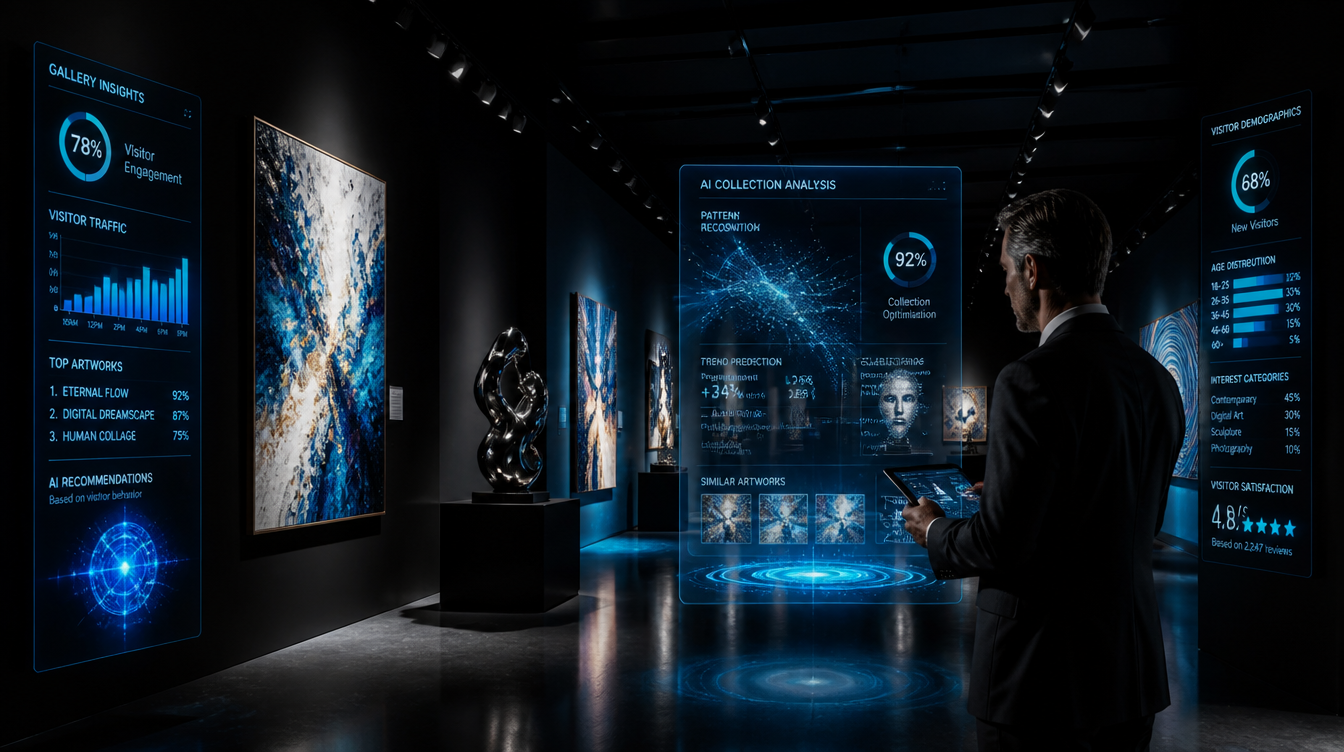
The average commercial art gallery converts about 3% of foot traffic into purchases. The other 97% of visitors walk in, look at the work, and walk out — never to be heard from again. No follow-up. No re-engagement. No system at all. That gap is where galleries bleed revenue, and it's exactly what the best AI tools for art galleries in 2026 are built to close.
Art collecting has held steady as an $65 billion global market, according to the 2025 Art Basel and UBS Art Market Report. But the galleries growing market share aren't necessarily showing better art — they're using better systems to stay top of mind with collectors, fill openings consistently, and show up on Google when someone nearby searches for art.
This guide covers the five AI tools that are actually moving the needle for galleries in 2026: local SEO content engines, collector CRM automation, AI event promotion sequences, visitor re-engagement systems, and automated review generation. Each one works independently, but galleries running all five see compounding results — more visitors, more repeat purchases, and a collector base that grows without paid ads.
At Leadra.io, we've deployed these systems for galleries, studios, and cultural venues across Charlotte, NC and the US. Here's what actually works.
Why Art Galleries Struggle with Marketing — and Why Most AI Tools Miss the Mark
Gallery directors and owners know art. Most don't have a background in digital marketing, and they shouldn't need one. But the marketing approaches that worked five years ago — a monthly email blast, Instagram posts on opening nights, and word of mouth among collectors — no longer produce reliable growth.
First-time visitors vanish permanently
A visitor who attends an opening, enjoys the work, and leaves without purchasing has an 80% chance of never returning if the gallery makes no follow-up contact within 72 hours. That window closes fast. Most galleries have no system to even identify which visitors haven't returned — let alone reach out to them with a relevant message.
Opening night momentum doesn't compound
The first opening for a new gallery space or a high-profile artist draws a strong crowd. By the fifth show, attendance has dropped 30-50%. Not because the work got worse — because there's no structured promotion system. Each show starts from zero instead of building on the previous audience.
Google searches go to competitors
Someone types 'art gallery Charlotte' or 'contemporary art shows near me' into Google. If your gallery isn't on page 1, that person goes to a competitor — or skips the gallery visit entirely. Most galleries have no SEO strategy beyond hoping their Yelp listing ranks.
Generic AI tools don't understand the gallery context
Broad AI marketing tools built for e-commerce or dental practices don't map well to the gallery world. Art buyers have longer consideration timelines, higher average transaction values, and relationship-driven purchasing behavior. Generic automation treats them like online shoppers, which kills conversions.
The best AI for art galleries in 2026 doesn't try to automate the relationship — it systematizes the touchpoints that build the relationship, so gallery staff spend their time on high-value conversations instead of chasing cold leads and writing reminder emails.
The 5 Best AI Tools for Art Galleries in 2026
Here's the complete breakdown of what each AI tool does, why it matters for galleries specifically, and what results to expect at the 90-day mark.
AI Local SEO Content Engine
Rank on page 1 for every exhibition you hang
Most art galleries have no organic search presence. Type 'contemporary art gallery Charlotte NC' or 'art opening near me this weekend' into Google — if your gallery doesn't appear on page 1, you're invisible to the highest-intent audience in your city. An AI content engine fixes that by publishing two to four SEO-optimized posts per week: exhibition previews with keyword-rich descriptions, artist spotlight interviews, collector's guides for buying in your gallery's specialty, and local art scene roundups. Each post includes FAQ schema for Google AI Overviews, structured data for events, and internal links that push authority to your exhibition and contact pages. Within 90 days, galleries running this system appear on page 1 for eight to twenty local art search terms — without buying a single ad.
AI Collector CRM and Outreach Automation
Turn one-time buyers into lifelong collectors
The difference between a gallery that sells art consistently and one that depends on opening night bursts is a structured follow-up system. Most galleries have no CRM beyond a spreadsheet. AI collector CRM automation segments your contact list by purchase history, price range, medium preference, and attendance patterns — then runs personalized outreach sequences automatically. A collector who bought two abstract pieces last year receives a private preview invitation when a new abstract series comes in, before the public opening. A visitor who attended three openings but never purchased receives a gentle 'collector's guide' email sequence that educates and builds confidence. A past buyer who hasn't engaged in six months receives a personal-feeling SMS referencing what they bought. These aren't blasts — they're 1:1 messages triggered by behavior. Galleries running AI collector CRM see 35-55% higher repeat purchase rates within six months.
AI Event Promotion Sequences
Fill every opening night — not just the first one
Opening night attendance follows a predictable curve: strong for a new gallery, weaker by the fourth show, near-empty by the eighth. The fix isn't bigger ad spend — it's a structured multi-touch promotion sequence for every show. An AI event promotion system builds a custom sequence for each exhibition: a teaser announcement 14 days out with artist background, a 7-day preview with installation images, a 3-day reminder with RSVP confirmation, a 24-hour 'tonight' alert for confirmed RSVPs, and a next-day follow-up to non-attendees with 'you missed it — here's what sold' content. Each message is tailored by segment: serious collectors get private sale previews, casual browsers get social-forward content, local press contacts get a press kit. Galleries using AI event sequences consistently see 40-70% higher opening night attendance compared to single-email announcements.
AI Visitor Re-Engagement
Recover the 60% of visitors you lose after their first visit
Research from the art market consistently shows that 55-65% of first-time gallery visitors never return — not because they didn't enjoy the experience, but because no one reached out. An AI re-engagement system monitors attendance records and contact engagement in real time. Visitors who attended an opening but haven't returned in 45 days trigger a personalized sequence: a 'what's new since your last visit' message featuring the current or upcoming show, an artist-specific follow-up if they lingered near particular work, and a private invitation to a collector's preview or artist talk. Visitors who've been on your email list for three months without attending receive a '5 reasons to visit this month' sequence with low-friction CTAs. Galleries running AI re-engagement recover 25-40% of dormant visitors — patrons who already know your space, your aesthetic, and your price range.
AI-Powered Review and Reputation Management
Build the social proof that fills the next show
Gallery-goers check Google reviews before attending an opening just as they check restaurant reviews before dinner. A gallery with 12 reviews and a 4.1-star average loses foot traffic to a competitor with 80 reviews and 4.7 stars — regardless of which gallery actually has better art. AI review generation sequences send a satisfaction check-in to every opening night attendee 24 hours after the event. Attendees who respond positively receive a one-tap Google review request. Attendees who express concerns trigger a private follow-up from gallery staff before they post publicly. Within 90 days, galleries running this system typically accumulate 30-60 new reviews — enough to shift local map pack rankings and become the default 'art gallery near me' result for first-time visitors in their city.
Manual Gallery Marketing vs. AI: Side-by-Side Numbers
Here's what gallery marketing looks like with a staff-driven approach versus a fully automated AI system — using real benchmarks from galleries Leadra.io has worked with:
| Factor | Manual Approach | AI System |
|---|---|---|
| Local search visibility | No page-1 rankings, relies on social only | Page 1 for 8-20 local art search terms within 90 days |
| Opening night attendance | One email blast, declining attendance over time | 5-touch AI sequence, 40-70% higher attendance |
| First-time visitor return rate | 35-45% return without follow-up system | 60-75% with AI re-engagement sequences |
| Collector repeat purchase rate | Manual outreach, 15-25% repeat rate | 35-55% with AI CRM automation |
| Monthly Google reviews added | 1-3 organically per month | 15-30/month with AI review sequences |
| After-hours inquiry response | Next-day email, prospect often gone | AI responds within 60 seconds, 24/7 |
| Marketing staff required | 0.5-1.0 FTE for email, social, outreach | Under 2 hours/week human oversight |
The collector repeat purchase rate column is the most consequential. A collector who buys once and is never followed up with has a 15-25% chance of buying again. A collector who receives personalized AI-triggered outreach — referencing their taste, attendance history, and price range — buys again at a 35-55% rate. For a gallery doing $20,000/month in sales, that difference is $4,000-$6,000 in additional monthly revenue from the existing customer base alone.
Case Study: Charlotte Gallery Grows Monthly Sales 82% in 90 Days
Client Story — Charlotte, NC
A contemporary art gallery in Charlotte's NoDa arts district came to Leadra.io in early 2026. The gallery was showing strong work — mid-career artists with national museum placements — but was averaging 55 attendees per opening night (down from 90 two years prior), zero page-1 Google rankings for any Charlotte art search term, and a collector email list of 1,400 contacts that was being sent one monthly newsletter with a 12% open rate. Monthly sales averaged $18,500. The gallery director was spending six hours per week on marketing with no measurable system in place.
Leadra.io deployed the five-component AI system over a 72-hour setup window. The AI content engine began publishing local art SEO content targeting Charlotte gallery searches. The collector CRM was connected to their existing Mailchimp database and segmented by purchase history and attendance patterns. AI event promotion sequences were built for the next three exhibitions already on the calendar. The visitor re-engagement system began identifying and reaching contacts who hadn't attended in 60+ days.
Opening night attendance
Before: 55 avg
After: 94 avg
Monthly organic visitors
Before: 210
After: 870
Collector open rate
Before: 12%
After: 38%
Repeat purchase rate
Before: 22%
After: 47%
Google reviews
Before: 14
After: 71 in 90 days
Monthly sales
Before: $18,500
After: $33,700
The collector re-engagement sequence recovered 31% of dormant patrons — people who had attended openings in 2024 and 2025 but stopped coming. The AI had identified 240 contacts who fit this profile and reached each one with a personalized message referencing the last exhibition they attended and previewing the upcoming show. 74 of them came to the next opening. Eleven made purchases.
The Google review automation added 57 reviews in 90 days — moving the gallery from position 11 to position 3 in the local map pack for 'art gallery Charlotte NC'. Organic website traffic grew from 210 to 870 monthly visitors, with 40% of new inquiries arriving through search rather than social. At 90 days, monthly sales had grown from $18,500 to $33,700 — an 82% revenue increase on a $1,600/month AI system.
How to Get Started: The First 90 Days
Deploying AI for your gallery doesn't require a technical team or a major platform migration. Here's what the first 90 days look like with Leadra.io:
Setup and integration
Leadra.io connects to your existing email platform (Mailchimp, Klaviyo, or Constant Contact), your website, and your contact database. The AI segments your list by purchase history and attendance. The AI booking agent goes live on your website. Event promotion templates are built for your next three shows.
First event sequence and review launch
The first AI event promotion sequence runs for your upcoming opening. Google review automation activates for recent opening attendees. You see early engagement data — open rates, RSVP conversions, review velocity — within the first two weeks.
Collector re-engagement and SEO momentum
The AI re-engagement system has now reached dormant patrons. Early re-activations start attending shows. The SEO content engine has published 8-16 posts and keyword rankings begin appearing in Google Search Console. Opening night attendance for the second show under the AI system measurably outperforms the previous show.
Compounding results
Organic search traffic from AI content starts converting visitors who've never heard of the gallery before. The collector CRM has run two or three personalized sequences and repeat purchase rates are visibly improving. The gallery director is spending under two hours per week on marketing oversight — down from six or more.
Frequently Asked Questions
What is the best AI tool for art galleries in 2026?
The best AI for art galleries in 2026 depends on your primary bottleneck. For galleries with low organic traffic, an AI local SEO content engine delivers the highest ROI — ranking you on page 1 for local art searches without ongoing ad spend. For galleries with strong foot traffic but low repeat purchases, an AI collector CRM and re-engagement system is the priority. Most galleries benefit most from deploying the full stack: SEO content, event promotion sequences, collector CRM, visitor re-engagement, and review automation — all working together to fill openings and convert visitors into long-term collectors.
How can AI help an art gallery attract more visitors?
AI helps art galleries attract more visitors by driving organic search traffic through consistent local SEO content — exhibition previews, artist spotlights, and collector guides that rank for searches like 'art gallery near me' and 'contemporary art Charlotte'. AI also improves Google Business Profile ranking through automated review generation, pushing the gallery into the top three local map pack results. For existing contacts, AI event promotion sequences with five to seven touchpoints per show consistently produce 40-70% higher opening night attendance than single email announcements.
How much does AI marketing cost for a small art gallery?
AI marketing for a small gallery typically runs $600-$2,500 per month. A starter package covering AI email automation and local SEO content runs $600-$1,200/mo. A full growth stack adding AI collector CRM, event promotion sequences, and SMS re-engagement runs $1,200-$2,500/mo. For galleries generating $10,000+ per month in sales, the system typically pays for itself through one additional sale per month — often within the first 45 days.
Can AI help re-engage past visitors and collectors?
Yes — re-engaging dormant contacts is where AI delivers the highest ROI for galleries. An AI re-engagement system monitors your contact database and automatically launches personalized sequences for visitors who haven't attended in 60-90 days, referencing specific artists or exhibitions they showed interest in. Galleries running AI re-engagement recover 25-40% of dormant patrons within 60 days — patrons who already know your space, your price range, and your aesthetic, making them far easier to convert than cold traffic.
Related Guides
Final Thoughts
The best AI for art galleries in 2026 isn't a single tool — it's a connected system that handles every stage of the patron lifecycle: getting found on Google, filling opening nights, converting visitors into collectors, and keeping collectors engaged between shows. Galleries that deploy this kind of system don't just sell more art — they build the kind of collector relationships that sustain a gallery through any market cycle.
The galleries losing ground right now are the ones doing marketing manually — the monthly newsletter, the occasional Instagram post, the word-of-mouth hope. The galleries gaining ground are automating the touchpoints and letting their staff focus on what only humans can do: curating exceptional work and having real conversations with serious collectors.
Ready to Grow Your Gallery?
See what AI does for your gallery in 90 days
Leadra.io deploys AI marketing systems for galleries, cultural venues, and local businesses across Charlotte NC and the US. Setup takes 72 hours. Most galleries see positive ROI within 45 days — often through a single re-engaged collector.