Every dermatology practice searching for AI tools in 2026 runs into the same wall: dozens of products claim to be "the best AI for dermatologists," but most are generic call center software with a skincare logo pasted on top. None of them explain what actually moves the numbers that matter to your practice — biopsy volume, cosmetic touch-up rebooking, and annual skin cancer screenings.
Dermatology has a revenue pattern that general-purpose AI receptionist tools miss entirely, because it runs two businesses under one roof. Medical dermatology bills insurance for skin checks, biopsies, and condition management like acne or eczema. Cosmetic dermatology is almost always cash-pay — Botox, filler, laser, and chemical peels — and depends on a touch-up cycle that repeats every three to six months. A practice that automates both sides well can grow revenue substantially without spending a dollar on new-patient advertising.
At the same time, patients are often confused about which side of the practice they are calling for. A mole check bills to medical insurance. A lip filler consult does not. Practices that clarify this upfront during the call convert more inquiries into booked appointments than practices that make patients guess or call back with questions.
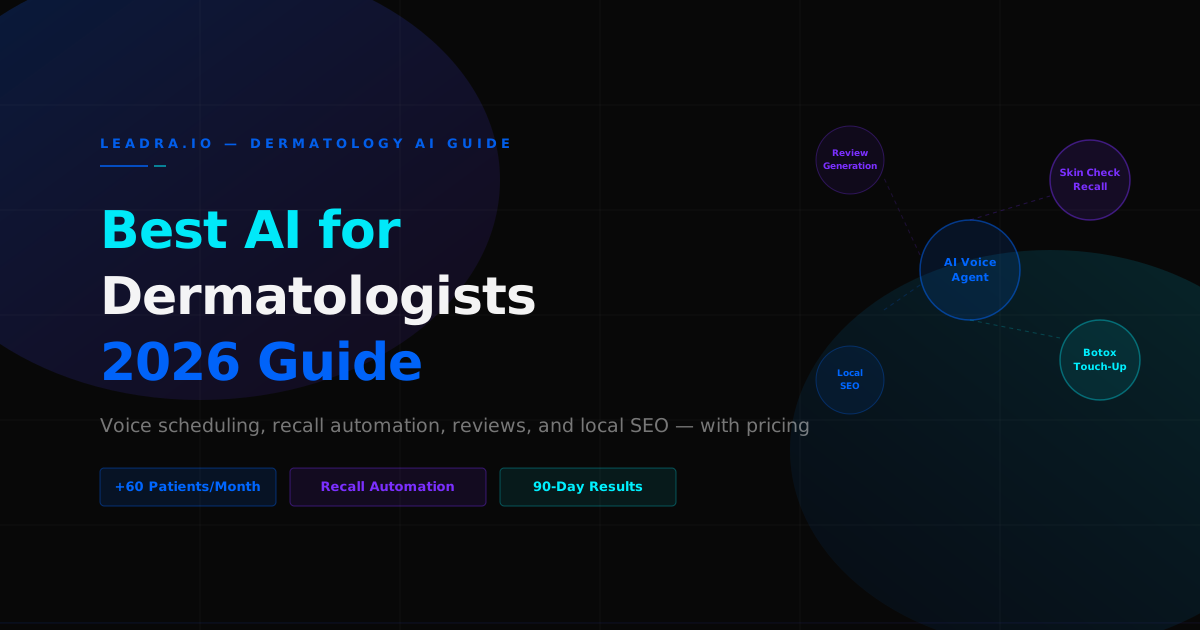
This guide breaks down the four AI components that actually matter for a dermatology practice, what each one should cost, and how to evaluate a vendor before you sign a contract.
What Makes Dermatology Different From Other Healthcare AI Use Cases
Before picking a tool, understand the three things that separate dermatology from general medical or dental AI needs:
The 4 AI Components a Dermatology Practice Actually Needs
Skip the tools built for generic medical or dental offices. Here is what to evaluate for a dermatology practice specifically, in the order it typically gets deployed.
One more thing worth knowing before you evaluate vendors: patients are increasingly asking ChatGPT, Google AI Overviews, and Perplexity questions like "best dermatologist near me" or "how often should I get Botox" before they ever open Google Maps. Practices with clear, well-structured content and schema markup are the ones AI search tools cite and recommend. That is a direct byproduct of Component 4 below, and it is worth weighing alongside the other three when you decide where to start.
Component 1 — 24/7 AI Voice and Scheduling Agent
Most dermatology practices lose calls during lunch, after 5 PM, and on Saturdays when the office is closed but patients are free to call about a new mole, a rash, or a cosmetic consult. An AI voice agent answers every call, collects the patient's name and reason for visit, clarifies whether the request is medical or cosmetic, and books directly into the scheduling system in real time.
The medical-versus-cosmetic clarification step matters more here than in most specialties, since it determines both what insurance information is needed and which provider on staff should see the patient. Practices that deploy AI voice scheduling typically recover 15-25 additional booked appointments per month that previously went to voicemail or a missed call notification nobody followed up on.
Component 2 — Skin Check and Cosmetic Touch-Up Recall
This is the highest-ROI component for almost every dermatology practice, because it works against an existing patient base rather than trying to generate new patients from scratch. The system tracks each patient's annual skin check anniversary and each cosmetic patient's touch-up window, then sends automated reminders by text and email timed to when the patient is actually due — not a generic once-a-year blast.
For Botox and filler patients, the touch-up reminder should trigger a direct booking link, not just a general "time to come back in" message. Practices that implement anniversary-based skin check recall combined with cosmetic touch-up automation typically lift patient return rate by 20-30 percentage points within the first two recall cycles.
Component 3 — AI-Assisted Review Generation
Patients choose a dermatologist largely on local reputation, Google review volume, and before-and-after credibility, since cosmetic results are highly visual and word of mouth spreads fast. An AI review system sends a short, well-timed request after a completed appointment — the moment satisfaction is highest — and routes unhappy patients to a private feedback form instead of a public review, so problems get resolved before they become a one-star post.
Practices running consistent review automation typically add 20-35 new Google reviews per month, which directly improves ranking in the local map pack for "dermatologist near me" and "Botox [city]" searches — often the single fastest lever for new-patient volume on the cosmetic side.
Component 4 — Local SEO and AI Search Content
Patients increasingly search "best dermatologist near me," ask ChatGPT or Google AI Overviews for skin condition or cosmetic treatment recommendations, and compare practices before ever calling. A local SEO content engine builds pages and articles targeting skin condition and cosmetic treatment searches specific to your city, plus structured schema markup that makes your practice eligible to appear as a cited source in AI-generated answers.
This is the slowest component to show results — typically 60-90 days — but it compounds. Practices that combine strong reviews with consistent local content routinely outrank larger dermatology groups for city-level search terms within six months.
What This Looks Like in Practice
Single-Location Practice, 90-Day Results
A single-location dermatology practice with roughly 2,800 active patients across medical and cosmetic services deployed AI voice scheduling and recall automation in week one, review generation in week three, and local SEO content starting in month two. Before deployment, the practice was booking 110 appointments per month and had no structured touch-up recall for cosmetic patients.
By day 90, monthly appointments reached 171 — a 55% increase. Recall automation alone accounted for 38 of the added appointments from cosmetic patients who were overdue for a Botox or filler touch-up. Google reviews grew from 74 to 162, and the practice began appearing in the local map pack for "dermatologist" searches where it previously did not rank on page one.
Monthly appts
Recall-driven visits
Google reviews
Missed calls/mo
Total system cost was $2,200/month. The practice did not add front desk headcount — the AI voice agent absorbed the after-hours and lunch-hour call volume that the existing staff never had time to return. See the complete AI implementation cost guide for healthcare practices.
Common Mistakes Dermatology Practices Make With AI
Most of the failed AI rollouts in dermatology come down to three avoidable mistakes, not the technology itself:
Dermatology AI Pricing: What You Should Expect to Pay
Tier 1 — Call Capture and Scheduling
$1,500 – $2,200/mo
24/7 AI voice agent for calls and online scheduling, plus basic appointment reminder automation. Best for a single-location practice that is losing calls and wants to stop the bleeding before investing in recall or SEO. Setup time: 1-2 weeks.
Tier 2 — Full Growth System
$2,200 – $4,000/mo
Everything in Tier 1 plus anniversary-based skin check recall and cosmetic touch-up automation, AI-assisted review generation, and 4-8 local SEO posts per month. The complete system for practices targeting 40-60 additional appointments per month within 90 days. Setup time: 2-4 weeks.
Tier 3 — Multi-Location Dermatology Group
$4,000 – $7,000/mo
Custom system for multi-location medical and cosmetic dermatology groups. Includes location-level recall tracking, per-location review and reputation dashboards, and localized SEO content for each market served. Setup time: 4-6 weeks.
Infrastructure costs (AI voice minutes, SMS delivery, content publishing) typically add $100-$300/month on top of the retainer and are billed at cost. Most practices recover the monthly investment from the recall-driven touch-up appointments alone within the first billing cycle. See the full AI cost breakdown for small healthcare businesses.
5 Questions to Ask Before You Buy Any Dermatology AI Tool
A tool that cannot answer these five questions clearly is built for general healthcare use and bolted onto dermatology as an afterthought. That gap shows up fast in how well it actually converts calls and recalls into booked appointments on both sides of the practice. Learn how a free AI business audit identifies your biggest automation gap.
FAQ: AI for Dermatologists
What is the best AI tool for a dermatology practice in 2026?
There is no single best tool — the right AI stack combines four components: a 24/7 AI voice and scheduling agent, automated recall for annual skin checks and cosmetic touch-ups, AI-assisted review generation, and local SEO content targeting skin condition and cosmetic treatment searches. Practices that deploy all four together outperform practices that buy a single point solution, because recall, reviews, and search visibility reinforce each other.
Can AI replace front desk staff at a dermatology practice?
No, and that is not the goal. AI handles repetitive volume — after-hours calls, appointment confirmations, cosmetic touch-up reminders, insurance-versus-cash-pay clarification — so front desk staff spend their time on patients in the office and on biopsy follow-ups and consultations that need a person. Most practices keep their existing team and use AI to stop losing calls and recall revenue that were falling through the cracks.
How much does AI cost for a dermatology practice?
A complete AI marketing and automation system for a dermatology practice typically runs $1,500-$4,000 per month depending on patient volume and scope. A single-location practice adding AI voice and recall automation starts around $1,500-$2,200/month. A full system with reviews, recall, and local SEO content runs $2,200-$4,000/month.
How fast do dermatology practices see results from AI automation?
Most practices see measurable results within 30 days. AI voice call capture and online scheduling show impact almost immediately because missed calls and after-hours cosmetic inquiries are recovered right away. Recall automation for overdue skin checks and cosmetic touch-ups typically fills the schedule within two to three weeks. Local SEO content takes longer, usually 60-90 days, before it produces consistent new-patient search traffic.
Built for Dermatology Practices
Ready to Stop Losing Calls and Recall Revenue?
Leadra.io builds AI voice, recall, review, and local SEO systems for dermatology practices. Tell us your current appointment volume and biggest gap — we will give you a system recommendation and 90-day projection.