Search “best AI for elder care service” and you'll find two kinds of results: generic small business AI lists that have never scheduled a caregiver shift, and home care software companies calling an automated email reminder “AI.” Neither answers what agency owners are actually trying to solve.
What you want to know is which AI system moves the numbers that matter for an elder care agency — new family inquiry conversion, caregiver shift-fill speed, missed-visit rate, referral source growth, and paused-client recovery — and what it costs versus what it produces in client revenue.
This guide covers the five AI capabilities that actually drive growth and retention for elder care and non-medical home care agencies in 2026, how they compare to manual operations, what real integration with WellSky, AlayaCare, and AxisCare looks like, and what an agency running the full system produced over 90 days.
Short answer up front: the best AI for an elder care service in 2026 is not a website chatbot, not a scheduling tool with an SMS reminder, and not a CRM with a drip email sequence. It's a connected system — family intake, caregiver shift-fill, visit confirmation, referral follow-up, and paused-client re-engagement — integrated directly with your agency management platform so it acts on live scheduling data and writes results back into your actual caregiver roster.
Why Most Elder Care Agencies Leave 25-35% of Growth on the Table
Elder care has operational and emotional pressures that generic small business software doesn't address. Understanding them is the starting point for evaluating any AI system.
Family inquiries arrive during a crisis, not business hours
Most elder care decisions are triggered by a fall, a hospital discharge, or a sudden decline noticed on a weekend visit. The family member researching options is often anxious, exhausted, and calling at 8 PM after putting the kids to bed. If your office is closed and the call goes to voicemail, that family calls the next agency on their list — and rarely calls back. Agencies without after-hours coverage lose 30-40% of inbound inquiries to a competitor who simply answered first.
Caregiver call-offs put client safety and retention at risk
A caregiver who calls off 90 minutes before a shift leaves an elderly client — often with mobility, medication, or cognitive support needs — without coverage. Filling that shift by manually calling down a caregiver list fills only 20-30% of the time before the shift was supposed to start. Every uncovered shift is a safety risk, a potential state-reportable incident, and a reason for the family to start shopping for a different agency.
Referral relationships decay without consistent follow-up
Hospital discharge planners and skilled nursing facility social workers refer to whichever agency responded fastest and communicated best on the last case — not necessarily the best agency. A single business development coordinator can only visit 15-20 referral sources per month in person. Without automated follow-up between visits, referral volume from even strong relationships drifts downward over time.
Paused clients are treated as lost instead of dormant
A client who pauses care after a hospital stay ends, or reduces hours when a family member temporarily takes over, often isn't gone for good — they just need a reason and an easy path to restart. Most agencies don't track paused clients systematically, so this recoverable revenue simply disappears from the pipeline.
Office staff spend hours on manual scheduling instead of care coordination
Coordinators at agencies without shift-fill automation spend 3-6 hours per day on the phone handling call-offs, confirming shifts, and chasing down caregiver availability — time that should go toward care plan quality, family communication, and caregiver support instead of reactive phone tag.
These five problems compound in the same direction: marketing and referrals bring in new family interest, operational gaps let inquiries and shifts slip away, and the existing client base quietly drifts. AI addresses all five simultaneously — without adding office headcount or changing how caregivers deliver care.
The 5 AI Capabilities That Actually Drive Growth for Elder Care Agencies
These aren't features pulled from a software product page. They're specific capabilities that correspond directly to the five gaps above — each targeting a measurable intake, retention, or revenue outcome. Here's what the best AI for an elder care service does in practice:
24/7 AI family inquiry intake (voice + SMS)
Families searching for elder care rarely do it during business hours. A daughter in another state gets off a call with her father's discharge planner at 9 PM, googles "home care near me," and calls the first agency that answers. Agencies without after-hours coverage lose 30-40% of inbound inquiries to voicemail, and most of those families never call back — they move to the next name on the list. An AI intake agent answers every call and text immediately, asks the right first questions (care needs, hours required, location, urgency of start date), explains your service model in plain language, and books a same-day or next-day care assessment. Because the caller is often stressed, scared, or grieving a recent decline in a parent's health, the AI is trained to lead with empathy before logistics. Agencies deploying 24/7 intake typically convert 20-30 additional inquiries per month into scheduled assessments that were previously lost to voicemail.
Real-time caregiver shift-fill when someone calls off
Caregiver call-offs are the single biggest operational risk in home care — a client with dementia or a fall-risk diagnosis left without coverage isn't a scheduling inconvenience, it's a safety issue and often a state-reportable incident. Manually filling a call-off means an office coordinator working down a printed caregiver list by phone, which fills 20-30% of shifts before start time on a good day. An AI shift-fill engine detects the call-off the moment it's logged, instantly texts every caregiver who is available, geographically close, and matched to that specific client's care plan and preferences, and auto-confirms the first qualified response — writing the new assignment directly back into your scheduling platform. Agencies running this system fill 65-80% of call-off shifts before the scheduled start, protecting client safety, reducing missed-visit liability, and cutting the 5-7 hours per week office staff typically spend on emergency shift coverage.
Care visit and shift confirmation sequences
Beyond outright call-offs, home care agencies lose revenue and client trust to preventable scheduling friction — a caregiver forgets a shift start time, a family isn't told which caregiver is arriving, or a new client isn't reminded about their first assessment visit. A 3-step AI confirmation sequence sends caregivers a shift reminder 24 hours and 2 hours before start, sends families a same-day text naming the arriving caregiver with an ETA window, and flags any non-confirmation to the office immediately rather than after the shift was already missed. Agencies using structured confirmation sequences cut missed and late-start visits by 55-65%, which directly reduces client complaints, care plan disruptions, and the risk of a client cancelling service altogether after a bad experience.
Referral source follow-up with hospitals and discharge planners
The majority of new elder care clients come from a small number of referral relationships — hospital discharge planners, skilled nursing facility social workers, elder law attorneys, and senior living community staff. These relationships decay fast if they aren't actively maintained, and most agencies rely on a single business development person who can realistically visit 15-20 referral sources per month. AI automates the follow-up layer: a same-day acknowledgment to the referral source when a client from their facility is accepted, a status update once care begins, and a monthly touchpoint campaign that keeps the agency top-of-mind without requiring a staff visit. Agencies automating referral follow-up typically see a 25-40% increase in repeat referrals from the same sources within 6 months, because the relationship is maintained consistently instead of only during in-person visits.
Paused-client and reduced-hours re-engagement
A meaningful share of home care clients don't cancel outright — they pause care after a hospital stay ends, reduce hours when a family member temporarily steps in, or go quiet after a rate increase without saying no. Most agencies treat these as lost accounts and stop tracking them. An AI re-engagement sequence checks in at 30, 60, and 90 days after a pause or hours reduction, referencing the client's specific caregiver and care plan, and offers a easy path back to their previous schedule. Agencies running this sequence recover 20-30% of paused clients within a 90-day window — revenue from families who already trust the agency and simply needed a reason and an easy on-ramp to restart service.
Agency Software Integration
All five capabilities connect directly to your agency management platform via API — WellSky Personal Care (formerly ClearCare), AlayaCare, AxisCare, Smartcare Software, or Generations Homecare System. The AI reads live caregiver availability and client schedules, writes confirmed shift assignments directly into your platform, syncs call-offs in real time to trigger shift-fill, and tracks each client and referral source from first inquiry through active service. Your office manages one system, not two. Setup takes 48-72 hours.
Manual Operations vs. AI: The Real Comparison for Elder Care Agencies
Most agency owners know their intake and scheduling process has gaps. What they don't always know is how large those gaps are in client and revenue terms. Here's the side-by-side across the metrics that drive an elder care agency's growth:
| Metric | Manual / No System | AI System |
|---|---|---|
| After-hours family inquiries | Goes to voicemail, mostly lost | AI books the assessment instantly, 24/7 |
| Call-off shift fill rate | 20-30% (manual phone tree) | 65-80% (AI mass-text within minutes) |
| Missed or late-start care visits | Common, discovered after the fact | Reduced 55-65% with confirmation sequences |
| Referral source follow-up | Depends on in-person visit frequency | Automated same-day acknowledgment + monthly touch |
| Paused-client reactivation | 5-10% (rarely tracked) | 20-30% with a 90-day AI sequence |
| Office staff time on scheduling calls | 3-6 hours/day | Under 45 minutes (oversight only) |
| WellSky / AlayaCare / AxisCare sync | Manual, inconsistent | Real-time, bidirectional API sync |
| Monthly system cost | $0 (but 25-35% of inquiries and shifts left uncaptured) | $600-$4,800 |
The shift-fill number in that table matters most to families. An uncovered shift for a client with a fall risk or a medication schedule isn't an inconvenience — it's the reason families leave an agency entirely. Closing that gap from a 20-30% manual fill rate to 65-80% with AI is often the single biggest driver of client retention an agency can implement.
Agency owners who run the system for 90 days consistently report the same shift in their own time: less of it spent on the phone chasing caregiver coverage, more of it spent on care plan quality and family relationships — the part of the job that actually requires a human.
Case Study: Charlotte Home Care Agency Goes from 22 to 41 Active Clients in 90 Days
Client Story — Charlotte, NC
A non-medical home care agency in Charlotte's SouthPark area came to Leadra.io in early 2026. The owner managed 18 caregivers on WellSky Personal Care, serving 22 active clients with a mix of hourly companion care and live-in support. Family inquiries came through the website and a handful of hospital and skilled nursing referral relationships, but after-hours calls went to a general voicemail box that was checked once each morning. Her caregiver call-off fill rate was under 25%, and she had 14 paused clients in WellSky she hadn't followed up with in over 60 days.
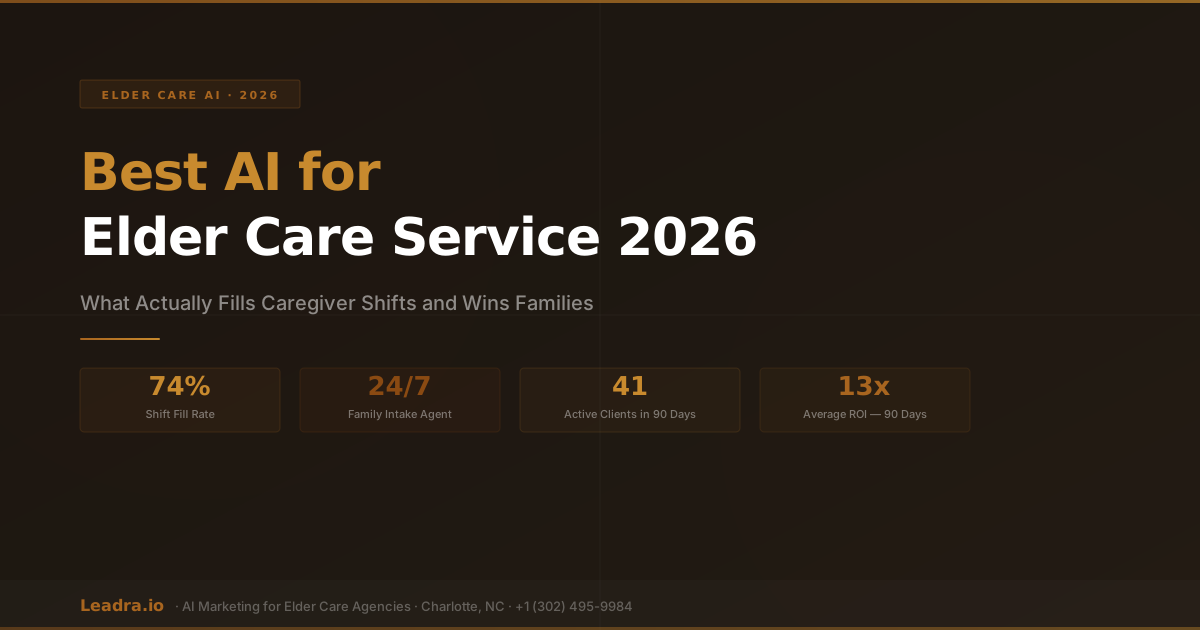
Leadra.io integrated with her WellSky account and deployed all five AI capabilities in sequence. The 24/7 family intake agent launched first — answering after-hours calls and texts, explaining her service model, and booking care assessments directly onto her calendar. The real-time shift-fill engine went live the same week, texting available, matched caregivers the moment a call-off was logged in WellSky. The visit confirmation sequence and referral source follow-up automation launched in week 2. The paused-client re-engagement sequence ran against her 14 dormant accounts in weeks 5 through 9.
Results across 90 days:
Active clients
22
41
Call-off shift fill rate
24%
74%
Family inquiry response time
Next business day
38 seconds
Paused-client reactivations
—
5 in 60 days
System cost: $1,800/month for WellSky integration with voice + SMS family intake, real-time shift-fill engine, visit confirmation suite, referral follow-up automation, and paused-client re-engagement. Growth from 22 to 41 active clients at an average $2,850/month in billable hours per client added roughly $54,000 in monthly recurring revenue against the $1,800 system cost. Primary drivers: 24/7 intake capturing after-hours inquiries that previously went to voicemail, the shift-fill engine protecting client retention during call-offs, and 5 paused-client reactivations restoring an average of $2,200/month each.
The owner's biggest surprise wasn't the new client growth — it was the drop in caregiver call-off chaos. Going from a 24% to a 74% shift-fill rate meant her office coordinator stopped starting most mornings with an emergency scheduling scramble, and clients stopped experiencing the anxiety of an uncovered visit.
The second surprise was the paused-client recovery. She assumed those 14 accounts were effectively closed. The personalized AI re-engagement sequences — referencing each client's specific caregiver and care schedule — brought back 5 of them within 60 days, all without a single cold outreach call from her staff.
How to Evaluate AI for Your Elder Care Agency: 4 Things That Matter
Not every system marketed as “AI for elder care” delivers on the capabilities above. Here's how to filter.
Native integration with your agency management platform
If the system can't write a confirmed shift assignment directly into your WellSky, AlayaCare, or AxisCare account — not a parallel spreadsheet, not a manual sync — it won't hold up at scale. Ask specifically: "Does your system write shift confirmations to my WellSky account in real time?" If the answer involves a manual step or a separate database, the system will create more office work, not less.
Shift-fill notification speed under 5 minutes
The window to cover a call-off safely is short — often under 90 minutes before the shift start. The system must detect the call-off, notify every qualified and available caregiver within minutes, and auto-confirm the first response. If the system batches notifications hourly or requires manual triggering by office staff, it won't fill shifts fast enough to matter. Ask for the exact delay between a call-off being logged and caregivers being notified.
Compassion-trained intake conversation logic, not a generic script
Families calling an elder care agency are frequently in crisis — a recent fall, a hospital discharge, a difficult diagnosis. An intake agent that reads like a call center script will lose that family's trust immediately. Ask to hear an actual sample conversation or transcript. The right system leads with empathy, asks care-need questions in a natural order, and only moves to logistics once the family feels heard.
Personalized paused-client outreach, not a blast
Generic reactivation emails ("We miss you! Come back!") convert under 10% of paused clients. Outreach that references the client's specific caregiver, care schedule, and reason for pausing converts 20-30%. Ask whether the re-engagement system pulls individual client history from your platform or sends the same message to every paused account in a segment. The former works. The latter reads as generic marketing to a family already managing a difficult situation.
What AI for Elder Care Agencies Costs in 2026
Pricing depends on caregiver headcount, client volume, and whether AI voice calling is included. Here are the three tiers most elder care agencies fall into:
Tier 1 — Small agency (under 15 caregivers, single location)
$600-$1,200/monthSMS-based family inquiry capture, basic shift-fill text alerts, visit confirmation reminders, and paused-client check-ins. No AI voice agent at this tier. Best for owner-operator agencies where the owner still handles most family conversations personally and wants to stop losing after-hours inquiries.
Tier 2 — Mid-size agency (15-40 caregivers)
$1,400-$2,600/monthFull 5-capability system: AI voice and SMS family intake agent, real-time shift-fill engine, 3-step visit confirmation sequence, referral source follow-up automation, and paused-client re-engagement. WellSky, AlayaCare, or AxisCare integration included. This is the most common tier for independent home care agencies.
Tier 3 — Large or multi-location agency (40+ caregivers)
$2,800-$4,800/monthAll Tier 2 features plus multi-branch scheduling sync, referral source performance analytics by facility, inbound call overflow management during peak intake periods, and a revenue dashboard showing cost per new client, shift-fill rate by branch, and client retention trends. Best for agencies with 2+ locations or 40+ caregivers.
The ROI math follows the same logic at any tier. Take your current after-hours inquiry loss — monthly inquiries times the share that go unanswered outside business hours — and multiply by your average monthly billing per new client. Add the retention value of closing your shift-fill gap: every uncovered shift you avoid is a client relationship protected. Add your paused-client recovery potential: dormant client count times a 20-30% reactivation rate at average monthly billing. Divide the sum by the system cost to get your projected ROI. For most agencies, it lands between 7x and 13x.
See also: AI marketing for healthcare practices in Charlotte and AI agency vs. hiring an in-house engineer for related reading on evaluating AI systems for service businesses.
Frequently Asked Questions
What is the best AI for an elder care service in 2026?
The best AI for an elder care service in 2026 is a connected system that answers family inquiry calls 24/7 with a warm, compassionate voice agent, fills open caregiver shifts within minutes of a call-off, sends confirmation sequences that prevent missed care visits, automates referral follow-up with hospitals and discharge planners, and re-engages clients who paused care — all integrated directly with WellSky, AlayaCare, AxisCare, Smartcare Software, or Generations Homecare System. A generic chatbot or a basic scheduling reminder does not qualify. The system must write shift confirmations and client status changes into your actual agency management platform, not a separate spreadsheet.
How much does AI cost for an elder care agency?
AI systems for elder care and non-medical home care agencies typically range from $600 to $4,800 per month depending on caregiver headcount, client volume, and whether AI voice calling is included. A Starter tier for agencies with under 15 caregivers costs $600-$1,200/month. A Growth tier for agencies with 15-40 caregivers costs $1,400-$2,600/month. A Full System for agencies with 40+ caregivers or multiple branch locations costs $2,800-$4,800/month. Most agencies see 7-13x ROI within 90 days, driven primarily by faster shift fill, reduced caregiver call-off cancellations, and referral source growth.
Does AI for elder care agencies work with WellSky, AlayaCare, or AxisCare?
Yes. AI systems built for elder care agencies integrate directly with WellSky Personal Care (formerly ClearCare), AlayaCare, AxisCare, Smartcare Software, and Generations Homecare System via API — reading live caregiver availability and client schedules, writing confirmed shift assignments directly into the platform, syncing caregiver call-offs to trigger the shift-fill sequence, and pulling client history to power personalized family follow-up. Setup typically takes 48-72 hours. Once live, the AI operates inside your existing scheduling data — your office staff manages one system, not two.
Can AI help fill open caregiver shifts faster for a home care agency?
Yes. Agencies filling open shifts manually — calling down a list of caregivers one by one — typically fill 20-30% of last-minute call-offs before the shift start time, leaving families without coverage. AI shift-fill systems text every qualified, available caregiver simultaneously the moment a call-off is logged, matching by location, client care plan requirements, and caregiver-client history, and auto-confirm the first qualified responder. Agencies using this system fill 65-80% of call-off shifts before the scheduled start time, compared to 20-30% with manual outreach — a difference that directly protects client retention and revenue.
The Best AI for Your Elder Care Agency Is the One That Keeps Every Shift Covered
The marketing for AI tools in home care overpromises and under-specifies. “AI for elder care” can mean a chatbot widget that answers three FAQ questions, a scheduling app with an email reminder, or a fully connected intake and retention engine that captures every after-hours family call, fills every call-off shift, confirms every visit, and maintains every referral relationship. Only one of those actually protects clients and grows the agency.
The five capabilities in this guide — 24/7 family intake, real-time shift-fill, visit confirmation, referral follow-up, and paused-client re-engagement — address the specific operational and emotional realities of running an elder care agency. They account for the crisis-driven timing of family decisions, the safety stakes of an uncovered shift, and the relationship-based nature of referral growth. Generic AI doesn't account for any of that.
Leadra.io builds and manages AI client acquisition and retention systems for elder care agencies, non-medical home care providers, and senior service businesses. We integrate with your existing agency software, go live in under a week, and back every engagement with a results guarantee — measurable improvement in inquiry response, shift-fill rate, and active client count, or you don't pay.
Free Agency Growth Audit
See How Many Clients Your Agency Can Recover With AI
30-minute audit. We calculate your after-hours inquiry loss, shift-fill gap, and paused-client recovery potential — with a client growth projection specific to your caregiver count and referral volume — before you commit to anything.
Leadra.io
AI marketing agency — Charlotte, NC · Published July 15, 2026