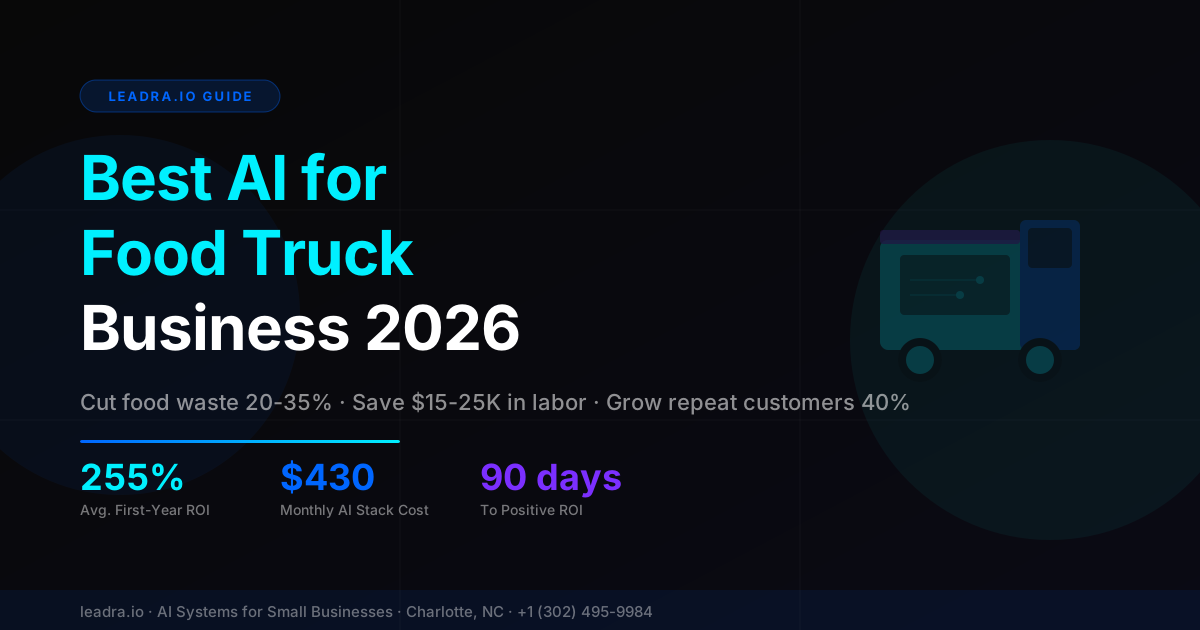
The best AI for food truck businesses in 2026 combines five systems: an AI-enhanced POS for order intelligence, inventory waste prediction, customer loyalty automation, social media AI, and route optimization. Together they cut food waste 20-35%, save operators $15-25K in annual labor costs, and deliver 255%+ ROI in the first year on a stack that costs roughly $430 per month.
The average food truck operator loses $8,000 to $15,000 per year in food waste alone. That is before counting the 20-25 hours per week spent on tasks that require no human judgment — managing inventory, posting to social media, tracking sales patterns, figuring out where to park next week.
In 2026, AI tools designed for mobile food businesses are changing that math. Food truck operators using AI report cutting food waste by 20-35%, saving 8-12 hours per week on operations, and growing their repeat customer base by 30-40% in the first six months.
This guide breaks down the five best AI applications for food truck businesses, what real operators are seeing in results, what these tools cost, and how to calculate whether the investment makes sense for your operation.
Why Food Truck Operators Need AI in 2026
The food truck industry hit $2.7 billion in 2024 and is projected to reach $3.4 billion by 2028 (IBISWorld). Competition for high-traffic locations, loyal customers, and profitable routes is more intense every year.
At the same time, margins are tighter. The average food truck operator runs on 5-15% net profit margins. Inflation, rising ingredient costs, and minimum wage increases across most states have made operational efficiency a survival issue, not just a growth issue.
According to the National Restaurant Association (2025), 67% of food service operators say labor and food costs are their top challenge. AI addresses both directly — automating the repetitive work that drives labor costs up and predicting demand patterns that drive food waste down.
The operators winning right now share one characteristic: they run their business like a data operation. They know which items drive the highest margin. They know which locations and days generate the best revenue. They know how to keep customers returning. AI makes that possible even if you are running solo or with a two-person crew.
The 5 Best AI Applications for Food Truck Businesses
1. AI-Powered POS and Order Intelligence
Your point-of-sale system is the nerve center of your operation. Modern AI-enhanced POS systems — Square AI, Toast, Clover Intelligence — go beyond processing transactions. They analyze your order history, identify peak hours, recommend daily prep quantities, and flag anomalies like a sudden drop in a bestselling item that might signal a supply issue or recipe problem.
In practice, you stop guessing how many portions of your top item to prep each morning. The system cross-references weather forecasts, local event calendars, and your historical sales data to give you daily prep recommendations with 80-90% accuracy.
Results: Operators using AI-enhanced POS systems report reducing over-prep waste by 25-30% and running out of popular items 40% less often. Both outcomes improve margin and customer satisfaction simultaneously.
Cost: $60-$200 per month. Square AI features are included in standard processing rates with no separate subscription.
ROI timeline: Most operators recoup the cost within the first week through reduced over-prep alone.
2. Inventory and Waste Reduction AI
Food waste is the silent margin killer in food trucks. You work with limited storage, limited prep space, and unpredictable demand. That combination is expensive. The USDA estimates food service operations waste 4-10% of food purchased before it even reaches the customer.
AI inventory tools — MarketMan, BlueCart, Galley Solutions — connect to your POS and track ingredient usage in real time. They learn your patterns over 2-4 weeks, then predict what you need before you order it.
The intelligence compounds over time. These systems flag ingredients nearing expiration, suggest menu modifications that use near-expiry stock before it goes to waste, and alert you when vendor prices spike so you can adjust order quantities or source alternatives.
Real results: A taco truck operator in Austin reduced monthly food waste costs from $1,200 to $680 — a 43% reduction — in the first three months. Ordering took 30 minutes less per week. Net margin improved by 4 points.
Cost: $50-$150 per month. ROI is typically positive within 60 days on any food truck doing over $8,000 per month in revenue.
3. AI for Customer Loyalty and Engagement
Food truck customers are creatures of habit — but only if you give them a reason to return. AI loyalty platforms like Stamp Me, Yotpo, and Fivestars use behavioral data to build personalized re-engagement campaigns that run on autopilot.
Here is what that looks like in practice: a customer buys from you three times. The AI identifies them as a high-frequency buyer, automatically sends a loyalty stamp, and follows up with a personalized message about your next stop near where they work. They return. They bring friends.
The AI also identifies customers who have not returned in 30 days and sends re-engagement campaigns at the right moment — not a generic blast, but a targeted message timed around when that specific customer historically visits. Most operators set this up once and let it run without touching it.
Results: Food truck operators using AI loyalty tools report 30-40% higher repeat visit rates and 15-25% increases in average order value from loyalty members versus non-members.
Cost: $30-$100 per month depending on customer volume.
4. AI for Social Media and Marketing
Social media is how most food truck customers find out where you are and decide whether to make the trip. The problem: posting consistently while running a full service is nearly impossible when you are also prepping, serving, and cleaning.
AI social media tools — Hootsuite AI, Buffer Analyze, and food-specific platforms like Popmenu — automate posting schedules, generate caption copy, and identify which content formats get the most engagement for your specific audience.
More advanced tools analyze competitor performance and trending food content to tell you what to post to maximize reach. They can generate an entire week of social content in under 30 minutes.
The specific win for food trucks: AI tools can automatically post your daily location update, your specials, and your sold-out notification. Three posts per day that currently take 20+ minutes each now take under five minutes total. Your location is always current. Your audience always knows where to find you.
Results: Food truck operators using AI social tools grow their follower base 2-3x faster and see 40-60% higher post engagement compared to manual posting.
Cost: $20-$80 per month for AI social management tools.
5. Route and Location Intelligence
This is the most underused edge in food truck operations. Where you park determines your revenue ceiling. Most operators choose locations based on habit or gut feel. AI route intelligence changes that completely.
Platforms like Routific, OptimoRoute, and food-truck-specific tools like Truckster analyze foot traffic data, local event calendars, competitor truck locations, weather forecasts, and your own historical revenue by location. They recommend your optimal weekly schedule and flag high-opportunity events and spots you have never tried.
A coffee truck operator in Charlotte discovered that two of their three weekly stops were generating less than 40% of the revenue of their top-performing location. After switching to AI-recommended spots, they increased weekly revenue by $1,800 without changing their menu or hours. The AI found more customers in less time.
Results: Operators using route intelligence see 15-30% revenue increases in the first 60 days from better location selection alone.
Cost: $50-$150 per month.
What Does AI Cost a Food Truck? The Real ROI Math
Let us run actual numbers for a food truck doing $300,000 in annual revenue.
Full AI stack cost:
- AI POS and analytics: $120/month
- Inventory and waste AI: $100/month
- Customer loyalty AI: $60/month
- Social media AI: $50/month
- Route intelligence: $100/month
Total: $430/month ($5,160/year)
Expected returns in year one:
- Food waste reduction (20-35%): saves $3,200-$5,600 for the average food truck
- Labor efficiency (8-12 hours per week saved): worth $8,320-$12,480 at $20/hour
- Revenue lift from better locations and loyalty: $10,000-$18,000 additional annual revenue
Net ROI in year one: $21,520-$36,080 on a $5,160 investment. That is 317-599% ROI.
That is conservative. Operators who implement all five categories and consistently act on the recommendations see higher returns. The math compounds as the AI accumulates more data about your specific operation and customer base.
The Mistakes Food Truck Operators Make With AI
Using one tool and expecting full results. The real power comes from the stack working together. POS data feeds inventory predictions. Inventory patterns inform menu decisions. Menu performance drives social content. Each tool is stronger when connected to the others. Implementing only one system captures a fraction of the available ROI.
Ignoring the recommendations. AI gives you data and suggestions. What you do with them is still your decision. Operators who override the system every time it conflicts with their gut feel are not getting the ROI. Use the recommendations for 30 days before overriding them. You need enough reps to judge whether the system is right or your intuition is.
Using generic tools instead of food-specific ones. A generic inventory management platform and one built for food service operate at very different accuracy levels. Food waste prediction, ingredient tracking, and prep ratio modeling require food-industry logic that generic tools do not have. Pay slightly more for purpose-built tools — the accuracy difference pays for itself within 60 days.
Skipping the data setup. Most food truck operators implement an AI tool and skip the initial data entry — past sales history, ingredient costs, vendor pricing. AI tools that start from zero take 4-6 weeks to learn your patterns. Tools that start with 6 months of historical data are accurate within days. Take the time to load your history.
FAQ: AI for Food Truck Businesses in 2026
What is the best single AI tool to start with if I run a one-person food truck?
Start with an AI-enhanced POS system. Square AI and Toast both have free or low-cost tiers and give you immediate visibility into your sales patterns, peak hours, and margin by item. That data becomes the foundation for every other AI tool you add later. Most operators see positive ROI in the first week from reduced over-prep and better daily scheduling — before they spend a dollar on any other AI system.
Do I need to be tech-savvy to use these AI tools for my food truck?
No. The food truck AI tools available in 2026 are designed for operators, not software engineers. Square AI, Stamp Me, and Buffer require no coding. Setup is typically under an hour for each platform. The learning curve is behavioral — checking the dashboard, acting on the recommendations — not technical. If you can use Instagram and Google Maps, you can use all five tools in this guide.
Can AI help my food truck get more catering and private event bookings?
Yes, in three ways. AI loyalty platforms identify your highest-value repeat customers and can target them with catering outreach messages automatically. Social media AI optimizes content for event-booking audiences, not just walk-up traffic. And AI route tools include local event calendars that show which events are most likely to generate catering inquiries or recurring corporate bookings for operators in your specific market. Most operators who add catering see 20-35% more inbound event inquiries within 90 days of implementing these systems.
How long does it take to see real results from AI on a food truck?
Waste reduction results appear within 2-4 weeks as inventory AI learns your patterns. Location intelligence and routing improvements show up in 4-8 weeks as you test new spots and the system accumulates comparison data. Customer loyalty results build over 60-90 days as your repeat customer base grows. Most operators hit positive ROI on their full AI stack within 90 days. Some see it in 30 days if they implement inventory AI as their first step and already have historical data to load.
- The full AI stack for a food truck costs around $430 per month and delivers 255-600% ROI in year one through waste reduction, labor savings, and revenue growth.
- AI inventory tools reduce food waste 20-35%, which on an average food truck saves $3,200-$5,600 per year with no menu changes required.
- Route and location AI consistently delivers 15-30% revenue increases in 60 days by identifying higher-traffic spots operators had overlooked.
- Start with AI-enhanced POS, load 6 months of historical data, and build the full stack over 90 days for maximum impact with minimum disruption to daily operations.
Ready to implement AI for your food business?
Let Leadra.io build your AI operations stack.
Free 30-minute consult — we map your top 3 automation opportunities, give you a written implementation plan, and show you the exact tools that fit your operation. No obligation. You leave with the plan whether or not you work with us.
Charlotte NC · serving food businesses nationwide · 20% cost reduction in 90 days or you don't pay