Handyman businesses run on a thin margin for error. A missed call at 7 PM is a job that goes to whoever answers first. A quote that takes two days to send back is a customer who already booked someone else. A technician who shows up to a no-show appointment just lost an hour of billable time they can never get back.
Most solo operators and small crews lose $2,500-$6,000 per month in preventable revenue — missed calls that never get returned, quotes that go stale waiting on a callback, no-shows with no confirmation sequence, and past customers who never hear from the business again after their first job. None of that requires more advertising. It requires a system that catches the work you're already generating.
This guide covers what the best AI for handyman services actually does in 2026: the five components that protect your time and revenue, and what a real Charlotte handyman business produced running the system for 90 days.
The short answer: the best AI for a handyman business combines a 24/7 voice and SMS agent, instant quoting for standardized jobs, automated scheduling synced to technician availability, same-day cancellation fill, and a repeat-customer follow-up system — all running without an office manager, integrated with the tools you already use to run jobs.
Why Handyman Businesses Lose So Much Work to Slow Response Time
Handyman jobs are usually low-commitment for the customer — a homeowner searching "handyman near me" for a leaky faucet has no loyalty yet. Whoever responds first with a clear price and a fast appointment wins the job. That makes response speed the single biggest lever in this industry, more than reviews, more than pricing, more than years in business.
Missed calls are lost jobs, not delayed jobs
Home service research consistently shows the majority of callers who hit voicemail don't leave one — they call the next business on the list. A one or two-person handyman operation working on a ladder or under a sink can't answer every call live. Without an AI agent picking up, every missed call during a job is a job that likely went to a competitor within minutes.
Slow quotes lose to fast ones
Customers requesting a quote for a standard job — TV mounting, a door repair, a faucet swap — often request quotes from 3-4 businesses at once and book with whoever responds first with a real number, not just 'we'll call you back.' A same-day callback quote loses to an instant quote from a competitor almost every time, even when the price is identical.
No-shows waste billable hours that can't be recovered
A technician who drives to an appointment that gets cancelled at the door, or who shows up and nobody's home, has lost that entire time slot — there's no walk-in customer to fill it like a retail business has. Without a confirmation sequence, no-show and reschedule-at-the-door rates run 12-20% for handyman appointments booked without a deposit or reminder system.
Past customers are the cheapest jobs available
A homeowner who had a good experience with a handyman for one job almost always has more work eventually — a different room, a seasonal task, a referral to a neighbor. Without a structured follow-up system, that relationship goes cold and the customer either forgets who did the work or calls someone new out of convenience. Reactivating past customers costs nothing in ad spend and converts at a far higher rate than any new lead source.
These four failures compound each other. A missed call is a lost lead. A slow quote loses the leads that do connect. A no-show wastes the jobs that do get booked. And a business with no follow-up system never turns any of it into repeat revenue. Fixing all four with one system produces results that no single fix can match on its own.
The 5-Component AI System for Handyman Businesses
Here's the full system Leadra.io deploys for handyman service clients. Each component addresses a different revenue leak — and the components compound when they run together.
24/7 AI voice and SMS agent for job requests
Handyman jobs come in at all hours — a homeowner notices a leaking faucet at 9 PM, or someone finally gets around to calling about that fence board on a Saturday morning. If those calls hit voicemail, most callers move to the next name on the search results page instead of leaving a message. An AI agent answers every call and text, captures the job type, location, and urgency, and either books an estimate or gives an instant price range — so the lead is locked in before the homeowner starts calling competitors.
Instant quoting for standardized job types
A large share of handyman work falls into predictable categories: TV mounting, furniture assembly, drywall patching, faucet and fixture swaps, door and lock repair, gutter cleaning. For these, the AI can ask a short set of diagnostic questions — and accept photos via text — to generate a reliable price range on the spot instead of making the customer wait for a callback. Jobs that don't fit a standard pattern get routed to a free on-site estimate instead of a guess, which protects margin on complex work while still winning the easy jobs fast.
Automated scheduling synced to technician availability
Once a job is quoted and accepted, the AI books directly into the technician's calendar — accounting for drive time between jobs, material pickup windows, and existing bookings. Customers get a confirmation text with the arrival window and a reminder 24 hours and 2 hours before the appointment, cutting down on the 'I forgot you were coming' no-shows that waste a technician's morning. For multi-technician crews, the system routes each job to whoever is geographically closest and qualified for the work.
Same-day cancellation fill
When a customer cancels or reschedules, that slot doesn't have to sit empty. The AI checks a list of customers with flexible timing or open quote requests nearby and offers the newly open slot immediately. Filling even 2-3 cancelled slots per week at a $250-$300 average ticket adds $2,000-$3,600 in monthly revenue that would otherwise be lost drive time and downtime.
Repeat customer and seasonal maintenance follow-up
Handyman work is naturally recurring — gutters need cleaning every fall, caulking and weatherproofing before winter, AC servicing before summer, and general 'honey-do list' work that builds up every few months. An AI follow-up sequence checks in 30 days after a job to confirm satisfaction, requests a review at the right moment, and re-engages past customers with seasonal reminders tied to the work they've already had done. This turns a one-time customer into a recurring revenue source without any new advertising spend.
Integration Note
The system connects to the tools most handyman businesses already run on — Jobber, Housecall Pro, or a shared calendar — and to your existing phone number, so customers never notice a change on their end. Technicians keep working the way they already do. The AI manages the intake, quoting, scheduling, and follow-up layer sitting in front of it.
Manual Booking vs. AI: What Changes for a Handyman Business
Most handyman businesses run scheduling through a mix of phone calls, texts, and a paper or spreadsheet calendar with no automation layer. Here's what that costs vs. what a managed AI system produces:
| Factor | Manual / No System | AI Booking System |
|---|---|---|
| After-hours job requests | Go to voicemail, most callers move on | Answered live by AI, quoted or booked immediately |
| Quote turnaround | Callback within hours or next day | Instant range for standard jobs, same-day estimate for complex ones |
| No-show rate | 12-20% with no reminder system | 3-6% with automated confirmation sequence |
| Cancellation recovery | Slot sits empty | Filled from nearby flexible-timing list same day |
| Repeat customer outreach | Rare, word-of-mouth only | Automated 30-day and seasonal follow-up |
| Technician routing | Manual dispatch, drive time not optimized | Geographic and skill-based auto-routing |
| Office/admin time | 2-4 hours/day on calls and scheduling | Under 30 minutes (oversight only) |
| Monthly system cost | $0 (but leads and repeat work lost) | $500-$2,800 |
A two-technician handyman business booking 8-10 jobs per week per tech at a $275 average ticket has roughly 70-80 potential job slots per month. At a 15% no-show and missed-call loss rate without a system, that's 10-12 jobs going to zero every month — $2,750-$3,300 in lost revenue before counting the leads that never called back after hitting voicemail in the first place.
Case Study: Charlotte Handyman Business Adds $9,200/Month in 90 Days
Client Story — Charlotte, NC
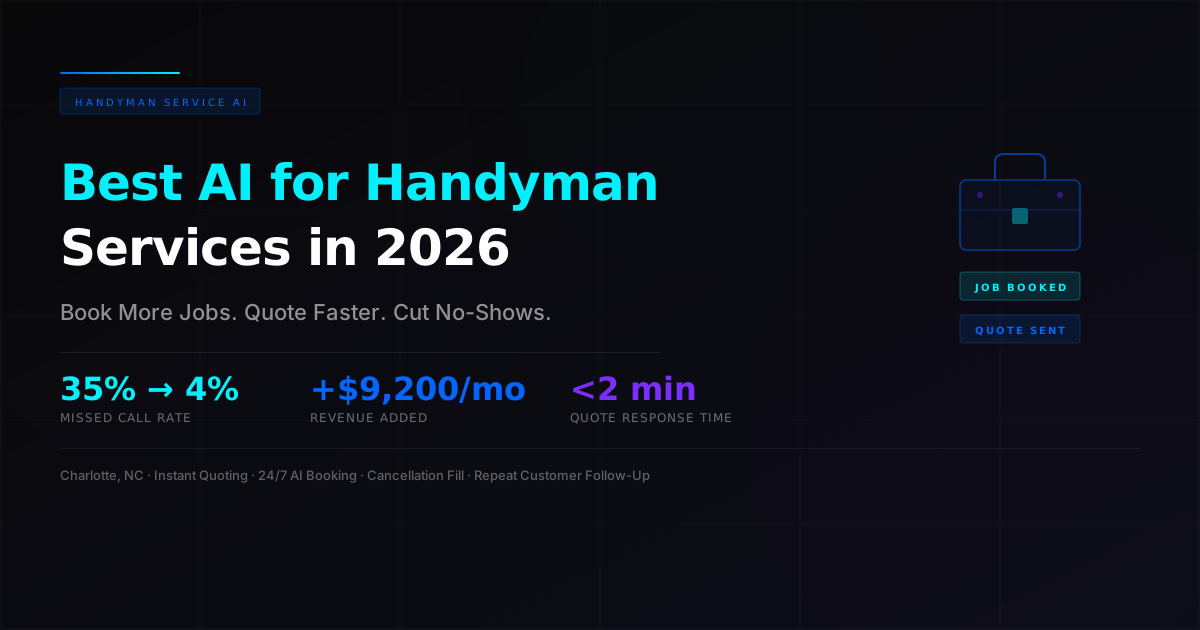
A two-technician handyman business serving south Charlotte came to Leadra.io in early 2026. The owner was fielding calls himself between jobs, tracked roughly 35% of inbound calls going unanswered during work hours, quotes typically took a day or more to get back to customers, and no-shows ran close to 18%. Average job ticket was $260. He had a Jobber account for scheduling but no automated intake, no instant quoting, and no follow-up with past customers.
Leadra.io integrated with Jobber and deployed all five system components over a single week. The AI voice and SMS agent went live within 48 hours — answering every call, capturing job details, and sending instant quotes for standard job types. The confirmation and reminder sequence launched the following week. Same-day cancellation fill was seeded with a list of 40+ customers who had flexible timing. Repeat-customer outreach launched in week 4, targeting 189 past customers from the prior 18 months.
In 90 days:
Missed call rate
35%
4%
No-show rate
18%
5%
Avg. quote response time
24+ hrs
Under 2 min
Monthly revenue lift
—
+$9,200
System cost: $900/month for a 2-technician crew with voice + SMS agent, instant quoting, and reactivation campaigns. Monthly revenue lift of $9,200 driven by: missed-call recovery (14 additional jobs/month at $260 avg = $3,640), no-show reduction (9 recovered jobs/month = $2,340), and repeat-customer reactivation (12 returning customers in month 3 = $3,220). Full-system ROI: 6.4x in month 1, 10.2x by month 3.
The owner noted the biggest shift wasn't just the extra revenue — it was that he stopped losing jobs mid-repair because his phone kept ringing. Before, he'd either ignore calls while working (losing the lead) or stop what he was doing to answer (losing time on the current job). With the AI handling intake, he finished jobs faster and never lost a lead to voicemail again.
The repeat-customer campaign in month 3 — targeting 189 past customers — generated 41 responses and 12 new bookings worth $3,220, entirely from customers who had already worked with the business once. That revenue required zero new ad spend to produce.
What AI Automation Costs for Handyman Businesses (2026 Pricing)
Pricing for AI systems for handyman businesses follows a per-technician model, with the scope of automation (SMS only vs. voice + SMS, instant quoting, reactivation campaigns) determining the tier.
Tier 1 — Solo operator
$500–$900/monthSMS booking agent, automated confirmation and reminder sequence, basic instant quoting for 5-8 standard job types, same-day cancellation fill. No AI voice calling at this tier. Best for solo handymen who need to stop losing calls without the overhead of a full voice agent.
Tier 2 — 2-4 technician crew
$900–$1,700/monthFull AI voice and SMS agent, instant quoting across your full job-type menu, automated scheduling with technician routing, same-day cancellation fill with priority list, and quarterly repeat-customer reactivation campaigns. This is the most common tier for established handyman businesses with steady call volume.
Tier 3 — Multi-crew or multi-location operation
$1,800–$2,800/monthAll Tier 2 features plus multi-crew geographic routing, materials and inventory-aware scheduling, seasonal maintenance reminder automation, revenue analytics dashboard, and monthly reactivation campaigns with A/B tested messaging. Best for operations with 5+ technicians or multiple service areas.
The ROI math for handyman businesses is straightforward: take your current missed-call and no-show rate, multiply by your average job ticket and monthly job count, and you have your monthly revenue loss. If that number is 2-3x the system cost — which it usually is for any crew averaging 6+ jobs a week — the investment pays for itself from response-speed improvement alone, before counting cancellation fill or repeat-customer revenue.
For more on what AI systems actually cost for small service businesses, see AI implementation cost for Charlotte small businesses and AI lead generation systems for local service businesses.
Frequently Asked Questions
What is the best AI for handyman services in 2026?
The best AI for handyman services in 2026 combines a 24/7 AI voice and SMS agent that answers job requests, an instant quoting tool that estimates common jobs (TV mounting, drywall repair, fixture installs) from photos and descriptions, automated appointment scheduling that syncs with a technician's calendar, and a repeat-customer follow-up system that reaches out for seasonal maintenance and referrals. The key difference from a generic answering service is job-specific logic — the AI asks the right diagnostic questions for each job type and gives a realistic price range before a technician ever drives out.
How much does an AI system cost for a handyman business?
AI systems for handyman businesses typically run $500 to $2,800 per month depending on crew size, whether AI voice calling is included, and whether quote automation and reactivation campaigns are built in. A solo operator or two-person crew that captures even 8-10 extra jobs per month at a $275 average ticket adds $2,200-$2,750 in monthly revenue — well above the system cost. Most handyman businesses see the system pay for itself inside the first 30 days from missed-call recovery alone.
Can AI give handyman customers an accurate quote before a technician visits?
Yes, for the majority of common job types. The AI asks structured diagnostic questions (room, fixture type, approximate size, whether materials are already on hand) and can accept photos texted in through SMS. For standardized jobs like TV mounting, faucet replacement, or drywall patch repair, this produces a reliable price range on the first contact. For jobs that need an in-person look — larger renovations, jobs with unknown structural issues — the AI books a free on-site estimate instead of guessing, which keeps quotes accurate and protects the business from underbidding.
How does AI help handyman businesses get repeat customers?
AI reactivation systems track completed jobs and trigger personalized follow-up at set intervals — a 30-day check-in to confirm the repair is holding up, a 6-month seasonal maintenance reminder (gutter cleaning before fall, AC servicing before summer), and a review or referral request timed right after a positive job outcome. Handyman businesses that run this automatically typically convert 20-30% of past customers into a second booking within 12 months, without paying for new lead generation to get that revenue.
Every Job on Your List Should Get Booked. AI Makes Sure It Does.
The revenue your handyman business is losing to missed calls, slow quotes, no-shows, and forgotten past customers isn't gone — it's recoverable. And it doesn't require a bigger ad budget or a full-time office hire. It requires a system that catches what's already falling through the cracks while you're on a ladder or under a sink.
AI automation for handyman businesses works because it removes the two variables that cause revenue loss: response lag (nobody answers a call while wrist-deep in a repair, nobody texts a quote back within two minutes by hand) and process inconsistency (follow-ups only happen when someone remembers, reminders only go out when there's time). The system is always on, always fast, always consistent.
Leadra.io builds and manages AI booking and marketing automation for handyman businesses, home service contractors, and local service providers. We integrate with the tools you already use, deploy the full system in under a week, and back every engagement with a results guarantee — you don't pay if the system doesn't produce measurable improvement in your response rate and job volume.
Free Revenue Leak Audit
See Exactly How Much Missed Calls and No-Shows Are Costing You
30-minute audit. We'll calculate your missed-call revenue loss, no-show impact, and repeat-customer opportunity — and show you the ROI projection before you commit to anything.
Leadra.io
AI marketing agency — Charlotte, NC · Published July 14, 2026