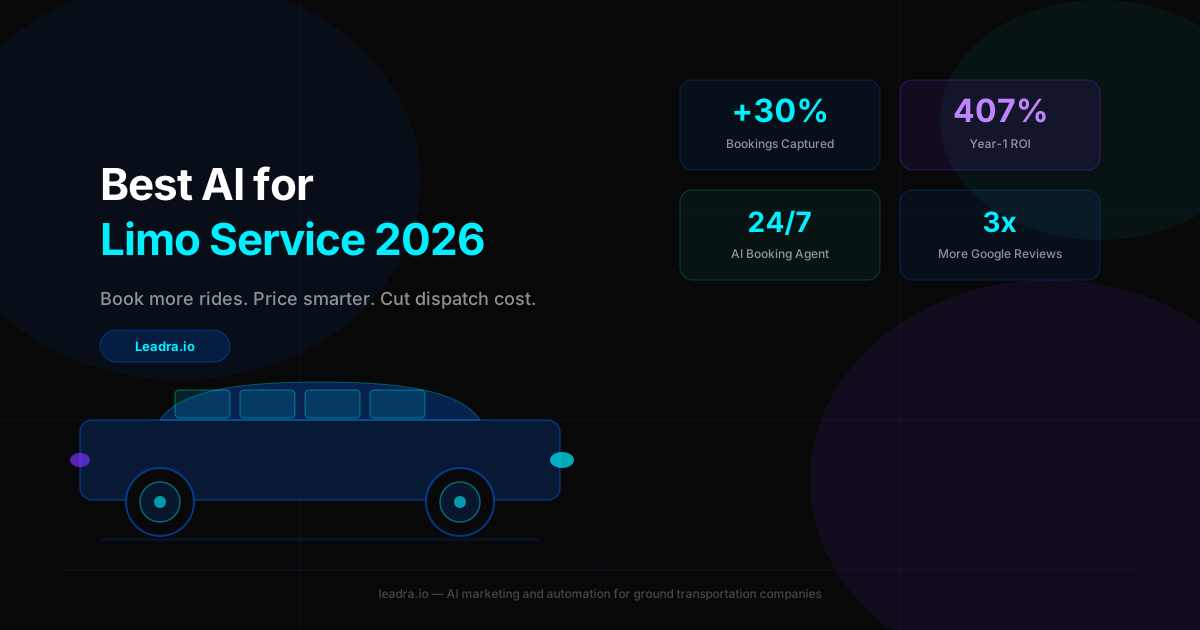
The best AI for limo services in 2026 covers five systems: AI booking management to capture after-hours inquiries, AI dynamic pricing to maximize revenue on peak demand nights, AI dispatch and route optimization to cut deadhead miles, AI customer communication to handle calls and follow-ups 24/7, and AI marketing to generate reviews and repeat bookings. A 10-vehicle limo operation implementing this stack typically adds $140,000+ in annual revenue and savings on a $27,600 investment — a 407% first-year return.
Most limo companies lose their biggest revenue opportunities after 6 PM. A corporate travel manager searches "airport car service Charlotte" at 9 PM, finds your website, fills out the quote form — and hears nothing until the next morning when your dispatcher arrives. By then, they've already booked your competitor.
The second leak is pricing. Prom weekend, New Year's Eve, and major corporate events generate demand spikes that small operators almost never price dynamically. The vehicle that earns $400 on a Tuesday night earns $400 on New Year's Eve too — even when every competitor in your market is sold out at $700.
In 2026, AI for limo services plugs both leaks — and several more. This guide covers the five best AI applications for limousine and ground transportation companies, what these systems cost, and what real operators are reporting in results.
Why Limo Companies Need AI in 2026
The US ground transportation and limousine market generates approximately $14.7 billion annually, according to IBISWorld's 2025 industry report. Corporate travel accounts for 40-55% of revenue for most small and mid-size operators. And corporate travel managers have shifted their expectations: they want instant quotes, digital booking confirmation, and real-time tracking — not a callback the next morning.
Three pressures are making AI adoption urgent:
After-hours inquiries are the majority of lost revenue. Research from transportation software platform Limo Anywhere found that 30-40% of new booking inquiries arrive outside standard business hours. For operators without 24/7 dispatch, that is 30-40% of new revenue opportunities that go unanswered. Corporate accounts especially — whose travel managers book at odd hours and from multiple time zones — gravitate toward services that respond immediately, at any hour.
Dispatcher labor costs are compressing margins. An experienced dispatcher earns $45,000-$65,000 per year. Night and weekend coverage requires overtime or a second hire. For a 10-vehicle fleet generating $900,000-$1.2M in annual revenue, dispatcher labor alone can represent 8-12% of gross revenue before any other expense. AI handles the routine dispatch, booking intake, and customer communication load — so your dispatcher focuses on complex coordination, not answering status calls.
Google reviews now determine who gets the call. Corporate clients and event planners search before they call. A limo company with 150+ Google reviews and a 4.8 rating converts website visitors to bookings at 8-12%. A company with 18 reviews and a 4.1 rating converts at 2-3%. That 4x conversion gap translates directly to revenue — and the fastest way to close it is AI-automated review follow-up.
The 5 Best AI Applications for Limo Services
1. AI Booking and Reservation Management
AI booking tools answer your website chat, web form submissions, and inbound calls — qualifying the inquiry, building the quote, and confirming the reservation without dispatcher involvement. The AI handles the full sequence: collect booking details (date, time, pickup address, destination, vehicle type, passenger count), check availability against your dispatch calendar, generate a quote, and send a confirmation email and SMS with payment instructions.
For limo companies, this capability directly targets the most expensive revenue leak. A Charlotte-area limo operator added an AI booking agent to their website and Google Business Profile messaging in early 2025. Over the following three months, the system captured 14 additional bookings per month from after-hours inquiries that previously received no immediate response. At an average ticket of $310, that is $4,340 in monthly revenue — $52,000 annually — from inquiries the operator had no visibility into before.
The AI booking systems Leadra.io deploys for transportation clients integrate with Limo Anywhere, LMN Connect, and custom TMS platforms. The AI knows your vehicle inventory, pricing rules, and availability in real time — so it never confirms a booking for a vehicle already committed.
Cost: $200-$600 per month for AI booking integrations, depending on TMS complexity and call volume.
2. AI Dynamic Pricing
Fixed-rate pricing is the single biggest revenue leak in the limo industry. Most operators set their rates annually and hold them flat — charging the same hourly rate on a slow Tuesday in February as on prom weekend in May or New Year's Eve.
AI dynamic pricing tools analyze four data inputs to recommend optimal price adjustments 7-30 days out: your own booking calendar density (how full you are for a given date), competitor availability and pricing (via real-time market data), local event schedules (concerts, sporting events, corporate conferences, graduations), and historical demand patterns by day of week and hour.
When the AI detects that your competitors are booking up for a given event weekend and your vehicle calendar is still 40% empty, it surfaces a pricing recommendation. Raise rates 20-30% now while you still have availability — before you're competing only on price against sold-out operators.
Limo operators using dynamic pricing report 15-25% higher average ticket on peak demand nights without losing booking volume. For a 10-vehicle fleet running 60 trips per week at an average of $320, a 15% price increase on just 25% of trips adds $37,440 in annual revenue. The pricing tool subscription cost is $150-$400 per month — the math works in the first month.
Cost: $150-$400 per month for revenue management and dynamic pricing tools.
3. AI Dispatch and Route Optimization
The average limo operator runs 25-35% of total miles empty — deadhead miles between pickups, returning to the garage after a drop, or repositioning vehicles between corporate accounts. AI dispatch reduces this to 15-20% through smarter vehicle sequencing and proactive assignment logic.
Platforms like Limo Anywhere's dispatch module, GroundWidgets, and LMN Connect have AI routing layers that assign the nearest available vehicle to each new booking, sequence multiple pickups to minimize repositioning time, factor in chauffeur preferences (clients who always request specific drivers or vehicles), and flag scheduling conflicts before they happen rather than during the shift.
For a 10-vehicle fleet running 500 collective trips per month at an average of 18 miles per trip, reducing deadhead from 30% to 18% eliminates 1,080 empty miles per month. At current fuel costs for a luxury SUV ($0.28-$0.32 per mile in fuel alone), that is $302-$346 per month in direct fuel savings. More significantly, it frees vehicle hours for additional bookings — each recovered deadhead hour is a billable trip hour at $100-$200 for most limo operators.
Cost: $100-$300 per month as part of dispatch and fleet management platforms.
4. AI Customer Communication
Limo clients expect white-glove communication at every touchpoint: immediate booking confirmation, day-of reminder with chauffeur name and vehicle details, real-time tracking link at pickup time, and post-trip follow-up. Manual execution of this sequence requires someone monitoring communications around the clock. AI automates the entire chain.
The inbound side: an AI voice agent for limo dispatch answers every inbound call — trip status inquiries, modification requests, new bookings, and cancellations — 24 hours a day. It checks your live booking calendar, provides accurate ETAs, logs requests, and escalates to a human dispatcher only when the situation requires judgment that the AI cannot handle (multi-vehicle wedding logistics, last-minute corporate contract changes).
The outbound side: AI handles the full post-booking communication sequence automatically. Booking confirmation → 24-hour reminder → chauffeur introduction message → real-time tracking link at T-30 minutes → post-trip review request 2 hours after dropoff. Companies using AI post-trip review sequences generate 3x more Google reviews per month than those relying on manual follow-up — directly compounding the conversion rate improvement discussed earlier.
Cost: $400-$1,200 per month depending on call volume and communication channel complexity.
5. AI Marketing and Reputation Management
Corporate travel managers and event planners search before they call. Ranking on the first page of Google for "airport car service [city]", "limo service near me", and "corporate transportation [city]" drives a steady stream of high-intent inbound leads — clients who are already researching and ready to book.
AI marketing for limo services works through three channels. First, an AI content engine publishes SEO-optimized guides and articles targeting high-intent searches: airport transportation guides, corporate travel policy content, event transportation planning resources. This builds organic search visibility without a marketing hire. Second, automated Google review follow-up drives review volume consistently — the single highest-impact reputation lever for limo companies. Third, AI-powered ad retargeting on Facebook and Google re-engages website visitors who requested a quote but didn't confirm — often the highest-converting segment in a limo company's marketing funnel.
In Charlotte, NC specifically, limo operators competing for corporate business from Bank of America, Truist, and Atrium Health have seen measurable organic traffic increases within 90 days of deploying AI content marketing. The Uptown corridor drives significant corporate ground transportation demand — businesses visible in search for those queries capture a disproportionate share.
Cost: $500-$2,000 per month for a full AI marketing stack including content, review management, and retargeting.
AI ROI Math for a 10-Vehicle Limo Fleet
Let us run real numbers for a 10-vehicle limo operation running 60 trips per week at an average ticket of $320, generating approximately $998,400 in annual revenue.
Full AI stack investment:
- AI booking agent: $350/month = $4,200/year
- Dynamic pricing tool: $250/month = $3,000/year
- AI dispatch and fleet management: $200/month = $2,400/year
- AI customer communication (voice + automated messaging): $700/month = $8,400/year
- AI marketing (SEO content + review automation + retargeting): $800/month = $9,600/year
Total annual investment: $27,600
Expected returns in year one:
- After-hours bookings captured (14/month at $320 average): $53,760/year
- Dynamic pricing uplift (15% on peak demand — approx. 25% of trips): $37,440/year
- Fuel and vehicle efficiency savings from reduced deadhead: $18,000-$24,000/year
- Repeat booking increase from AI follow-up sequences (30-40% lift in repeat rate): $25,000-$40,000/year
- Dispatcher time savings (equivalent to 0.5 FTE avoided): $22,000-$32,000/year
Conservative total return: $156,000-$187,000. Net ROI on $27,600 investment: $128,000-$159,000. That is a 463-576% first-year return.
Even if you cut every estimate in half — pessimistic assumptions on booking capture, pricing uplift, and dispatcher savings — the AI stack still delivers a positive return in month two or three for most operators.
Where Limo Companies Stall on AI Adoption
Not knowing how many after-hours leads you are losing. Most limo operators have never measured after-hours inquiry volume because those inquiries disappear — no callback, no record. Before deploying AI, install a basic web form or chatbot for one week and count overnight submissions. Operators who do this exercise consistently find 25-40% of their total inquiry volume was invisible to them.
Treating AI as a call answerer instead of a booking engine. An AI that takes messages and promises a callback is not AI — it is an expensive answering service. The goal is full booking capture: the AI qualifies the inquiry, quotes the trip based on your live pricing rules, and confirms the reservation with payment link — all without human intervention. This requires TMS integration. Without it, you get half the value at full cost.
Skipping review automation. Most limo operators are uncomfortable asking for reviews systematically. It feels pushy. AI removes that discomfort entirely — the request goes out automatically two hours after every completed trip, from a number or email clients recognize as your company. Operators who implement this consistently go from 8-12 new Google reviews per month to 30-45 per month. That review velocity is the compounding asset that drives organic search ranking for years.
Waiting to build a full system before starting. The highest-ROI entry point is AI booking capture plus review automation — roughly $600-$800 per month combined. Start there. You will see measurable results in 30 days, and those results fund the next layer of automation.
FAQ: AI for Limo Services in 2026
What is the best AI for a small limo company with 3-5 vehicles?
Start with AI booking intake and post-trip review automation — these address your two highest-impact leaks (after-hours inquiries and review volume) for $400-$700 per month combined. Platforms like Podium AI handle review follow-up well. For booking capture, a Leadra.io AI voice agent integrated with your existing dispatch platform captures and confirms bookings 24/7. Add dynamic pricing and dispatch optimization once booking volume increases enough to justify the additional investment.
Can AI really handle limo booking calls on its own?
Yes, for the majority of booking calls. A trained AI voice agent handles incoming calls, qualifies the booking (date, time, pickup and dropoff, vehicle type, passenger count, any special requests), quotes the price based on your live rate rules, and sends a confirmation with payment link — without dispatcher involvement. Corporate clients and event bookers get an immediate professional response at 2 AM the same as 2 PM. Calls that require judgment the AI cannot handle — complex multi-day itineraries, large fleet contracts, special event logistics — escalate to a human automatically.
How does dynamic pricing work for limo services?
AI pricing tools analyze your booking calendar density, competitor availability and pricing via real-time market data, local event schedules, and your historical demand patterns by day and hour. They surface pricing recommendations 7-30 days out. On New Year's Eve or graduation weekend, if your competitors are already 80% booked at standard rates and you still have open vehicles, the AI recommends a 20-35% price increase — meaning you leave significant money on the table by holding flat. Operators using dynamic pricing consistently report 15-25% higher average ticket on peak demand dates without a drop in bookings.
How quickly does AI marketing improve search rankings for limo services?
AI-driven review automation shows results within 60 days as review volume increases — more reviews improve Google Business Profile ranking almost immediately. SEO content targeting specific search queries ("airport car service Charlotte", "corporate transportation Charlotte NC") typically ranks within 90-180 days depending on competition. Paid retargeting shows results within the first week. Most limo companies see measurable organic traffic increases — 20-40% more website visitors from search — within 90 days of deploying a full AI marketing stack.
- 30-40% of limo booking inquiries arrive after hours — AI booking capture recovers this invisible revenue immediately, typically adding 10-15 confirmed bookings per month from inquiries that previously went unanswered.
- Dynamic pricing on peak demand dates (prom, New Year's, graduations, corporate events) adds 15-25% to your average ticket without losing booking volume — often $30,000-$50,000 in annual revenue for a 10-vehicle fleet.
- AI post-trip review automation generates 3x more Google reviews per month — the compounding reputation asset that drives organic search rankings and converts more website visitors into booked trips.
- Start with AI booking capture + review automation ($600-$800/month) — these deliver measurable results in 30 days and fund the next layers of automation from their own returns.
Ready to automate your limo bookings?
Let Leadra.io build your AI booking and marketing stack.
Free 30-minute strategy call — we audit your current booking process, identify after-hours revenue leaks, and map a specific AI implementation plan with cost and revenue projections. No obligation. You leave with the plan whether or not you work with us.
Charlotte NC · serving limo and ground transportation companies nationwide · 90 clients in 90 days or you don't pay