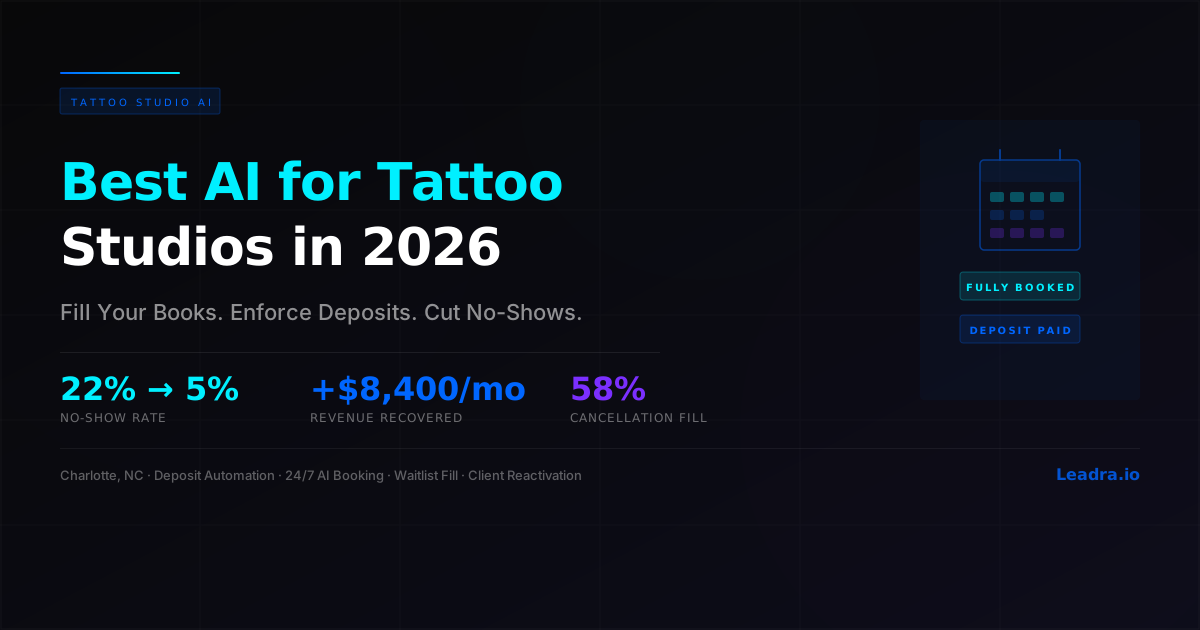
Tattoo studios have a booking problem that most other service businesses don't. The sessions are long, the slots are scarce, and a single no-show can mean a half-day of blocked time with zero revenue. An artist who does 4 sessions per day at $250 average who gets 1 no-show loses 25% of that day's earning potential — every single time it happens.
The average tattoo studio loses $3,500-$8,000 per month in preventable revenue — no-shows with no deposit enforced, cancellations that never get filled, after-hours requests that go to voicemail, and past clients who never came back for a touch-up or second piece. None of that revenue requires new marketing. It requires better systems on the bookings you already have.
This guide covers what the best AI for tattoo studios actually does in 2026: the five components that protect your time and revenue, and what a real Charlotte tattoo studio produced when they ran the system for 90 days.
The short answer: the best AI for a tattoo studio combines a 24/7 booking agent with tattoo-specific intake logic, automated deposit collection, a multi-step confirmation and prep sequence, real-time cancellation fill via waitlist, and a dormant client reactivation system — all running without front desk involvement, integrated directly with your booking software.
Why Tattoo Studios Lose More Revenue Than Most Service Businesses
Most service businesses can absorb a no-show by filling the slot with a walk-in or a shorter appointment. Tattoo studios can't. A 4-hour custom sleeve session blocked off can't be replaced with a 15-minute walk-in. The structural economics are more punishing — which is exactly why a systematic approach to booking protection produces disproportionate results.
No deposit = no-show epidemic
Studios that rely on verbal commitments or waitlist spots without deposit enforcement average 18-25% no-show rates. At a $250 average session ticket and 5 sessions per artist per day, that's 1-2 sessions per day, per artist, going to zero. A studio with 3 artists is losing $750-$1,500 in no-show revenue daily — $15,000-$30,000 per month — without a system that ties booking confirmation to payment. Deposit automation cuts that to 3-7% because clients who paid rarely ghost.
After-hours requests disappear
Tattoo bookings are often impulse-driven: a client sees a piece on Instagram, a friend shows off new ink, or someone finally decides to pull the trigger on a design they've been thinking about for months. That decision happens at 10 PM, not 2 PM. If your studio doesn't have 24/7 booking capability — not just an online form, but a conversational agent that answers questions and captures design context — that client calls two other studios, finds one that answers, and books there. You never know they contacted you.
Cancellations leave permanent holes
A same-day cancellation at a tattoo studio is almost impossible to fill manually. The session is long, the notice is short, and calling through a list of clients who might want a 3-hour slot this afternoon is not productive work for an artist or front desk. Without an automated waitlist system, most studios fill under 15% of same-day cancellations. With one, they fill 50-65% within 90 minutes — because the system texts the right people instantly, not when someone has a free moment to make phone calls.
Past clients are untapped revenue
Tattoo clients are repeat buyers — they come back for touch-ups, additions, and entirely new pieces across different body placements. But they don't self-initiate at a predictable rate. Without a structured reactivation system, clients who loved their last piece drift to whoever comes up in a search or gets recommended by a friend. A personalized outreach message from the studio — referencing their specific artist and last session — recovers 20-35% of dormant clients within 30 days, generating revenue without any new client acquisition cost.
These four failures are all fixable with the right system. And because tattoo sessions are high-value — $150 to $800+ per booking — even a modest improvement in booking capture and no-show prevention produces outsized revenue impact. You don't need to double your client base. You need to stop losing the clients you already have.
The 5-Component AI System for Tattoo Studios
Here's the full system Leadra.io deploys for tattoo studio clients. Each component addresses a different revenue leak — and the components compound when they run together.
24/7 AI booking agent with tattoo-specific intake
Tattoo studios lose bookings constantly to after-hours requests — a client sees a flash piece on Instagram at 11 PM and wants to book before someone else grabs the slot. Generic voicemail loses those leads. An AI voice and SMS booking agent answers every inbound request, captures design details, style preferences, placement, and reference images (via SMS link), and holds the slot pending deposit. It also handles 'how much would a [size/style/placement] cost?' questions with artist-specific pricing logic — reducing back-and-forth that typically takes 3-5 messages before a booking is confirmed.
Automated deposit collection and hold management
A no-show at a tattoo studio is more damaging than at most businesses — the artist blocked 3-6 hours, often turned away other requests for that slot, and may have done hours of prep work on a custom design. Deposit automation solves this at the booking step. The AI sends a payment link immediately after intake is complete, collects a $50-$200 deposit (configurable per artist and session type), and only confirms the booking after payment clears. Slots with no deposit paid within 24 hours reopen automatically and trigger the waitlist. Studios running automated deposits see no-show rates fall from 18-25% to 3-7% within 30 days.
Multi-step appointment confirmation and prep sequence
Even with a deposit, last-minute cancellations happen when clients forget, get anxious about pain or cost, or simply lose track of the date. A structured confirmation sequence reduces those: 72 hours out, a reminder with appointment details and aftercare prep instructions. 24 hours out, a follow-up with a one-tap confirm link and a 'what to do the night before' guide. Morning of, a final confirmation with studio address, parking info, and what to bring. This sequence converts clients who might have ghosted into confident, prepared clients who show up on time — and clients who do need to reschedule do it early enough that the slot can be filled.
Real-time cancellation fill via priority waitlist
When a cancellation comes in — even same-day — the AI immediately works through a priority waitlist: clients who previously inquired about the same artist, clients who requested an earlier date, and clients with flexible scheduling who opted into a 'first available' list. The first person to respond gets the slot confirmed and a deposit link. Most studios fill 50-65% of cancelled slots within 90 minutes using this system. Without it, most tattoo studios fill 5-15% of same-day cancellations by making phone calls — and those calls rarely reach the right person in time.
Dormant client reactivation and touch-up outreach
Every tattoo studio has hundreds of past clients who loved their work but haven't been back in 6-18 months. Some want a touch-up. Some have a new piece in mind but haven't gotten around to booking. Some went elsewhere out of convenience. AI reactivation sequences target all three groups: clients 6 months post-session get a touch-up reminder (most tattoos benefit from a touch-up within 12 months, especially color work). Clients 12+ months out get a 'next piece' outreach with artist availability and a direct booking link. Personalized outreach — referencing their specific artist and session — converts 20-35% of dormant clients within 30 days.
Integration Note
The system connects directly to your booking software — Vagaro, Booksy, Square Appointments, or a custom booking page — and to your payment processor for deposit handling. Artists don't need to change how they work. The AI manages the intake, deposit, confirmation, and follow-up layer. Artists see confirmed, deposit-paid sessions on their calendar with full design context already captured.
Manual Booking vs. AI: What Changes for a Tattoo Studio
Most tattoo studio owners manage bookings through a mix of DMs, phone calls, and an online booking form with no automation layer. Here's what that costs vs. what a managed AI system produces:
| Factor | Manual / No System | AI Booking System |
|---|---|---|
| After-hours booking requests | Go to voicemail or DMs, often lost | Handled by AI agent, booked with deposit |
| Deposit collection | Manual follow-up, inconsistent | Automated payment link sent immediately |
| No-show rate | 18-25% without deposit enforcement | 3-7% with deposit + confirmation sequence |
| Cancellation recovery | Manual calls, 5-15% fill rate | AI waitlist, 50-65% fill within 90 minutes |
| Pre-appointment prep | Varies by artist, often skipped | Automated 3-step sequence for every booking |
| Touch-up outreach | Never or annual mass text | Personalized, automated, 6-month trigger |
| Staff time on scheduling | 3-5 hours/day across front desk and artists | Under 30 minutes (oversight only) |
| Monthly system cost | $0 (but 20-30% revenue lost to gaps) | $500-$2,500 |
A studio with 3 artists doing 5 sessions per day at $250 average ticket has 75 potential session slots per week. At an 18% no-show rate without deposits, roughly 13-14 sessions per week go empty. At a 5% deposit-enforced rate, 3-4 go empty. That difference — 9-10 recovered sessions per week at $250 — is $2,250-$2,500 in protected weekly revenue. Over a month, that's $9,000-$10,000 from no-show reduction alone, before counting cancellation fill and reactivation results.
Case Study: Charlotte Tattoo Studio Recovers $8,400/Month in 90 Days
Client Story — Charlotte, NC
A three-artist tattoo studio in Charlotte's NoDa neighborhood came to Leadra.io in early 2026. The owner tracked her numbers: 22% no-show rate with no deposit system in place, roughly 4-5 same-day cancellations per week that rarely got filled, and about 40% of inbound requests coming in outside business hours via Instagram DMs. Average session ticket was $280. She had a Square Appointments booking page but no automated intake, no deposit flow, and no confirmation sequence.
Leadra.io integrated with Square Appointments and deployed all five system components over a single week. The AI SMS booking agent was live within 48 hours — capturing design details, references, and placement during the booking flow and sending a deposit link ($100 per session) before confirming the slot. The multi-step confirmation sequence went live the following week. A waitlist of 67 clients who had previously inquired was seeded into the cancellation fill system. Dormant client outreach launched in week 5, targeting 214 clients who hadn't booked in 6+ months.
In 90 days:
No-show rate
22%
5%
Cancellation fill rate
11%
58%
After-hours bookings
~0/month
34/month
Monthly revenue lift
—
+$8,400
System cost: $1,200/month for 3-artist integration with deposit automation, no-show sequences, cancellation fill, and reactivation campaigns. Monthly revenue lift of $8,400 driven by: no-show reduction (17 recovered sessions/month at $280 avg = $4,760), cancellation fill (11 additional sessions/month = $3,080), after-hours captures ($560 net-new in month 1). Dormant reactivation in month 2 added 31 returning clients, $8,680 in month 2 sessions. Full-system ROI: 7x in month 1, 14x by month 3.
The owner noted the deposit system alone changed her artists' relationship with their calendar. Before, artists would mentally discount sessions as "likely to cancel" and avoid doing custom prep work until the morning of the appointment. With deposit confirmation in place, every session on the calendar was treated as real — and artists started doing pre-session design refinement earlier, which improved the session quality and the final results.
The reactivation campaign in month 2 — targeting 214 dormant clients — generated 71 responses, 31 bookings, and $8,680 in session revenue in a single month. That campaign ran from existing client data with zero new marketing spend. The studio didn't acquire a single new client to produce it.
What AI Booking Automation Costs for Tattoo Studios (2026 Pricing)
Pricing for AI booking systems for tattoo studios follows a per-artist model, with the scope of automation (SMS only vs. voice + SMS, deposit integration, reactivation campaigns) determining the tier.
Tier 1 — Solo artist or 1-2 chair studio
$500–$900/monthSMS booking agent, automated deposit collection, 3-step confirmation sequence, basic cancellation fill. No AI voice calling at this tier. Best for solo artists or small studios that need deposit enforcement and confirmation automation without the overhead of a voice agent.
Tier 2 — 3-5 artist studio
$1,100–$1,800/monthFull deposit automation suite, AI SMS booking agent with tattoo-specific intake (design details, references, placement), real-time cancellation fill with priority waitlist, multi-step prep sequence, dormant client reactivation (quarterly campaigns). This is the most common tier for established studios with consistent call and DM volume.
Tier 3 — Multi-artist or multi-location studio
$2,000–$3,500/monthAll Tier 2 features plus AI voice agent for inbound calls, per-artist intake customization, multi-location calendar sync, revenue analytics dashboard, flash sale automation (SMS broadcasts to waitlist for last-minute availability), and monthly reactivation campaigns with A/B testing. Best for studios with 5+ artists or 2+ locations.
The ROI math for tattoo studios is simpler than most businesses: take your current no-show rate, multiply by your average session ticket and weekly session count, and you have your monthly no-show revenue loss. If that number is 3x the system cost — which it usually is for any studio averaging more than 3 artists — the investment pays for itself from no-show reduction alone before counting cancellation fill, after-hours captures, or reactivation revenue.
For more on what AI systems actually cost for small service businesses, see AI implementation cost for Charlotte small businesses and AI lead generation systems for local service businesses.
Frequently Asked Questions
What is the best AI for tattoo studios in 2026?
The best AI for tattoo studios in 2026 combines a 24/7 AI booking agent (voice and SMS), automated deposit collection, a no-show prevention sequence, real-time cancellation fill from a waitlist, and a dormant client reactivation system. The key difference from generic booking tools is tattoo-specific logic: the AI captures design details, references, and placement during the consultation intake — not just a date and time. It should also integrate with your booking software (Vagaro, Booksy, Square, or a custom booking page) so appointments write directly to your calendar.
How much does an AI booking system cost for a tattoo studio?
AI booking systems for tattoo studios typically cost between $500 and $2,500 per month depending on the number of artists, whether AI voice calling is included, and whether deposit automation is built in. The ROI calculation is straightforward: a studio with 3 artists averaging 5 bookings per day at a $250 average ticket who cuts no-shows from 20% to 6% recovers 3-4 sessions per day — $750-$1,000 in protected revenue daily. That's $15,000-$22,000 per month in revenue protection from no-show reduction alone.
Can AI help tattoo studios collect deposits automatically?
Yes. AI booking systems can send a payment link immediately after a booking request is confirmed, collect a deposit (typically $50-$200), and hold the appointment slot only after deposit receipt. If the client doesn't pay within the configured window (usually 24-48 hours), the slot reopens and the AI offers it to the next person on the waitlist. Studios using automated deposit collection see no-show rates drop to 3-7% because clients who've paid a deposit almost always show up — or contact the studio in advance to reschedule.
How do tattoo studios use AI to reactivate past clients?
Tattoo studios use AI to reactivate past clients by segmenting their booking history — identifying clients who completed a session 6+ months ago but haven't booked a follow-up, touch-up, or new piece. The AI sends a personalized outreach message referencing their last session and artist, with a direct booking link. Reactivation sequences that include a limited-time booking incentive (priority scheduling, a waived design consultation fee) typically recover 20-35% of lapsed clients within 30 days. For a studio with 200+ past clients, that's a meaningful revenue event without any new marketing spend.
Your Books Should Be Full. AI Makes Sure They Stay That Way.
The revenue your studio is losing to no-shows, missed after-hours requests, unfilled cancellations, and dormant clients isn't gone — it's recoverable. And it doesn't require more advertising spend or a bigger social media following. It requires a system that catches what's already falling through the cracks.
AI booking automation for tattoo studios works because it removes the two variables that cause revenue loss: response lag (nobody answers DMs at midnight, nobody texts the waitlist within 2 minutes of a cancellation) and process inconsistency (deposits only get collected when someone remembers to follow up, confirmations only go out when the front desk has time). The system is always on, always fast, always consistent.
Leadra.io builds and manages AI booking automation for tattoo studios, creative service businesses, and local service providers. We integrate with your existing booking software, deploy the full system in under a week, and back every engagement with a results guarantee — you don't pay if the system doesn't produce measurable improvement in your no-show rate and booking utilization.
Free Booking Gap Analysis
See Exactly How Much Your No-Shows and Cancellations Are Costing You
30-minute audit. We'll calculate your no-show revenue loss, cancellation fill opportunity, and dormant client reactivation potential — and show you the ROI projection before you commit to anything.
Leadra.io
AI marketing agency — Charlotte, NC · Published June 18, 2026