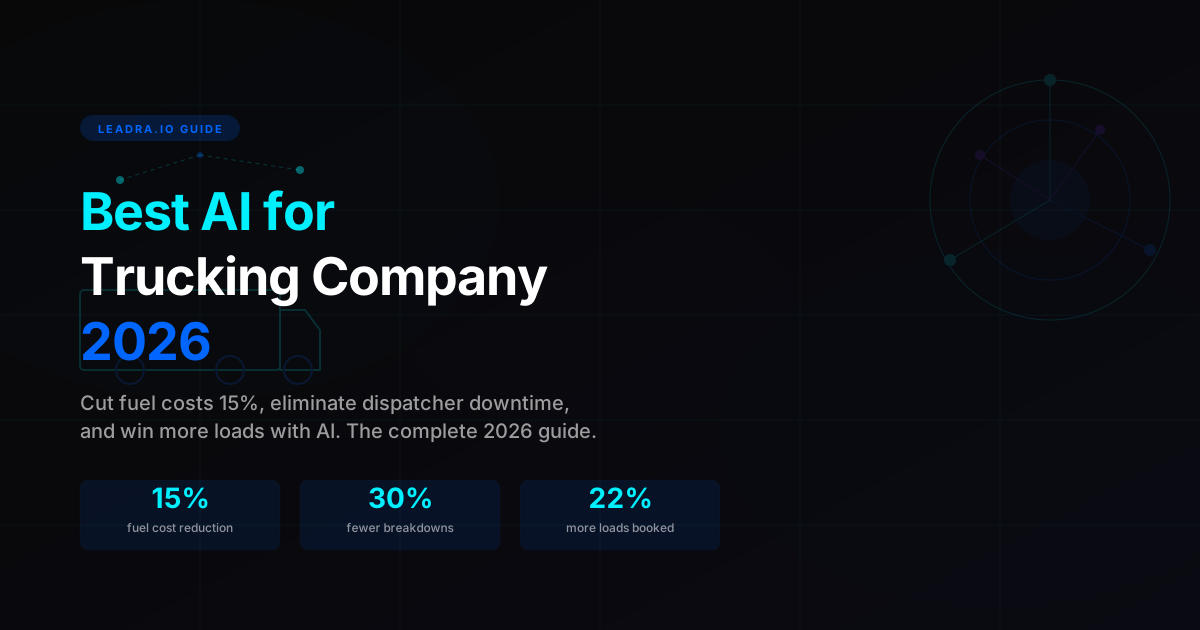
The best AI for trucking companies in 2026 combines five systems: AI route optimization to cut fuel costs 10-15%, predictive maintenance to reduce breakdowns 25-30%, AI freight matching to book more loads, driver safety AI to lower insurance premiums, and AI-powered dispatch communication to eliminate missed shipper calls. A 5-truck fleet implementing this stack typically saves $28,000-$45,000 in year one on a total investment of $8,000-$14,000.
Fuel eats 30-35 cents of every dollar a trucking company makes. Add driver pay, insurance, and compliance costs, and most small carriers are operating on net margins between 4 and 8 percent. One breakdown, one missed load, or one insurance claim can wipe out a month of profit.
In 2026, AI is changing the math for small and mid-size trucking companies. Owner-operators and fleets running 3-20 trucks are using AI to cut fuel costs, predict maintenance failures before they happen, win more loads at better rates, and handle shipper communication without hiring additional dispatch staff.
This guide covers the five best AI applications for trucking companies in 2026, what real fleets are reporting in results, what these tools cost, and whether the ROI makes sense for an operation your size.
Why Trucking Companies Need AI in 2026
The American Trucking Associations estimates there are 3.5 million truck drivers in the US and 500,000 active trucking companies — the vast majority of them small fleets or owner-operators. The industry generates over $900 billion annually but operates under constant pressure from fuel volatility, driver shortages, and rising compliance requirements.
Three forces are making AI adoption urgent rather than optional:
Fuel costs remain unpredictable. Diesel prices swung between $3.40 and $5.70 per gallon in the past three years. A 5-truck fleet running 500,000 miles annually spends $200,000-$400,000 on fuel. A 15% reduction in fuel spend through AI route optimization saves $30,000-$60,000 per year — often more than the fleet's entire annual profit.
Driver shortage puts operations at risk. The ATA projected a driver shortage of 82,000 in 2025, growing to 160,000 by 2031. Small carriers compete with large fleets for the same pool of drivers. AI tools that reduce administrative burden on drivers — automated compliance reporting, simplified log management, voice-activated dispatch communication — are becoming a retention differentiator.
Compliance complexity is increasing. ELD mandates, hours-of-service rules, FMCSA safety scores, and drug testing requirements create a compliance workload that used to require a full-time administrator. AI compliance tools handle the monitoring, alerting, and reporting automatically — so small carriers can stay compliant without adding headcount.
The 5 Best AI Applications for Trucking Companies
1. AI Route Optimization and Dispatch
Route optimization is the highest-ROI AI application in trucking for most small fleets. Instead of dispatchers or drivers choosing routes based on habit or generic GPS, AI route optimization analyzes real-time traffic data, weather forecasts, road restrictions by vehicle class, fuel prices along each corridor, and your specific truck's load weight to calculate the most fuel-efficient and time-efficient path.
Platforms like Samsara, Motive (formerly KeepTruckin), and Optym have AI dispatch layers built into their fleet management systems. Samsara's AI routing engine, for example, accounts for elevation changes, idling patterns, and speed limit data to recommend routes that reduce fuel burn on the specific roads a truck will travel — not just the shortest distance.
The savings are immediate. A fleet running 5 trucks across the Southeast reported cutting fuel costs by $2,800 per truck per month after switching to AI routing — dropping from $0.52 to $0.44 per mile on fuel alone. Over a year, that is a $168,000 reduction for a 5-truck operation.
Additional dispatch benefits: AI dispatch tools auto-assign loads to the nearest available driver, reduce empty miles by 8-12%, and send automated ETAs to shippers without dispatcher involvement. For small carriers, this means one dispatcher can manage twice the load volume.
Cost: $150-$350 per truck per month for full AI fleet management platforms. Most include ELD compliance, route optimization, and basic driver safety features in the base subscription.
2. AI Predictive Maintenance
An unplanned breakdown on the road costs a trucking company an average of $1,700 in roadside repair fees, plus $2,000-$4,000 in lost revenue from a truck sitting idle for 24-48 hours while parts arrive. For a small fleet, two or three unexpected breakdowns per truck per year can erase profit entirely.
AI predictive maintenance platforms — Decisiv, Uptake, and Fleetio with AI analysis — connect to your trucks' engine diagnostic systems (via OBD-II or direct telematics integration) and monitor hundreds of data points in real time. Brake pressure, tire temperature, engine oil viscosity trends, transmission slip patterns, and coolant levels are all tracked and compared against failure models built from millions of fleet data points.
The system flags components that are trending toward failure 2-6 weeks before a breakdown occurs. Instead of an emergency repair at a random truck stop, you schedule a planned maintenance visit at your preferred shop during off-peak hours — at a fraction of the emergency cost.
Real-world result: A North Carolina carrier with 8 trucks implemented predictive maintenance AI and reduced roadside breakdowns from 14 per year to 4 per year across the fleet. Total repair cost savings: $47,000 in year one. The AI subscription cost $8,400 for the year. Net gain: $38,600.
Cost: $50-$120 per truck per month depending on integration depth. Most platforms connect to existing telematics hardware at no additional hardware cost.
3. AI Freight Matching and Load Board Intelligence
Finding loads at good rates is where small carriers lose the most competitive ground to large fleets. Large brokers give volume discounts to big carriers. Load boards show thousands of options but no guidance on which loads offer the best rate-per-mile given your truck's current position, fuel corridor pricing, and return haul availability.
AI freight matching changes this. Platforms like DAT AI, Truckstop.com AI Insights, and Uber Freight use machine learning to recommend loads based on your specific truck's current location, your preferred lanes, historical rate data for those lanes, and predicted rate trends for the next 7-14 days.
The AI also identifies deadhead patterns — if you consistently drive empty from Memphis back to Charlotte, the system proactively flags backhaul opportunities in that lane before you even start looking. Over 60-90 days, it learns your lane preferences and surfaces the best-fit loads first.
Owner-operators using AI freight matching report booking 20-25% more loads per month and increasing average revenue per mile by $0.08-$0.15. For a single truck running 10,000 miles per month, that is $800-$1,500 in additional monthly revenue — while spending less time on the load board.
Cost: $50-$200 per month for AI-enhanced load board subscriptions. Most carriers already pay for DAT or Truckstop.com; the AI tier is typically $30-$80 more per month above the standard subscription.
4. AI Driver Safety and Insurance Cost Reduction
Commercial trucking insurance averages $9,000-$14,000 per truck per year for a small carrier without significant claim history. One at-fault accident can push premiums up 30-50% for three years. AI driver safety monitoring directly reduces both accident frequency and insurance costs.
Platforms like Lytx, Netradyne, and Samsara Safety use AI-powered dash cameras and telematics to monitor driving behavior — following distance, hard braking, lane departure, phone use, fatigue indicators — and score each driver in real time. When the AI detects a safety risk, it alerts the driver immediately and logs the event for coaching.
The insurance math is compelling. Fleets using AI safety monitoring report 20-35% reductions in accident frequency within 6-12 months. Many carriers have negotiated 8-15% insurance premium reductions after demonstrating 12 months of AI safety data to their insurer. For a fleet of 5 trucks paying $11,000 per truck in annual premiums, a 10% reduction saves $5,500 per year — often more than the cost of the safety AI subscription.
Cost: $50-$120 per truck per month including camera hardware amortized over the contract term.
5. AI-Powered Dispatch Communication and Customer Service
This is the most overlooked AI opportunity in small trucking operations. Shippers and brokers call to check load status, confirm pickup windows, report delays, and schedule pickups — often after hours or when your dispatcher is unavailable. Missed calls mean missed loads. Slow responses mean getting cut from preferred carrier lists.
An AI voice agent for trucking dispatch answers every inbound call, 24 hours a day. It checks load status in your TMS in real time, provides ETAs, logs issues, and escalates to a human dispatcher when needed. Shippers get an immediate response at 2 AM the same as they do at 2 PM.
For brokers, this is significant. A carrier that picks up on the first call and provides accurate ETAs consistently moves up the preferred carrier list. An AI answering system gives a 3-truck owner-operator the communication responsiveness of a 50-truck carrier.
Small trucking companies using AI dispatch communication report a 40% reduction in missed shipper calls, faster load confirmations, and measurable improvement in broker relationships within 60 days.
Cost: $500-$2,500 per month depending on call volume and TMS integration complexity.
AI ROI Math for a 5-Truck Trucking Company
Let us run the numbers for a realistic 5-truck fleet running 500,000 total miles per year with $1.8M in annual revenue.
Full AI stack cost:
- AI route optimization and fleet management (Samsara/Motive): $250/truck/month = $15,000/year
- Predictive maintenance AI: $80/truck/month = $4,800/year
- AI freight matching (enhanced load board): $150/month total = $1,800/year
- AI driver safety monitoring: $75/truck/month = $4,500/year
- AI dispatch communication: $900/month = $10,800/year
Total: $36,900/year
Expected returns in year one:
- Fuel savings from route optimization (12% reduction): $28,800-$48,000
- Reduced breakdown costs (from 12 events to 4 per year): $13,600 saved
- Additional load revenue from AI freight matching (20% more loads): $36,000+
- Insurance premium reduction after 12 months of safety data (8%): $4,400 saved
- Dispatcher time savings (equal to 0.5 FTE): $20,000-$28,000 in avoided labor cost
Conservative total return: $102,800. Net ROI on $36,900 investment: $65,900. That is a 179% first-year return.
That math holds even if you discount some categories heavily. Fuel savings alone — the most proven and immediate benefit — often pay for the entire AI stack within the first quarter.
Where Trucking Companies Stall on AI Adoption
Thinking you are too small to justify the cost. The ROI math above applies just as strongly to a 2-truck operation as to a 20-truck fleet. A single-truck owner-operator running 120,000 miles per year can save $8,000-$15,000 in fuel costs alone with AI routing. The entry-level subscriptions for most platforms start at $100-$150 per month per truck, which pays for itself in the first week of fuel savings for most operators.
Buying hardware that does not share data. Many small carriers have ELD units, dash cameras, and GPS trackers from three different vendors that do not talk to each other. AI needs unified data to work. Before buying any AI software, audit your current hardware and prioritize platforms that integrate everything into a single data stream — Samsara and Motive both do this out of the box.
Skipping driver buy-in. AI safety cameras and driver scoring are the most common points of friction with drivers. Carriers that introduce AI monitoring as a coaching tool — not a surveillance tool — see faster adoption and better safety results. Lead with the insurance cost reduction narrative: lower accidents means lower premiums, which funds driver bonuses. That framing changes the conversation.
Not connecting to the TMS. AI dispatch communication without TMS integration means the AI cannot actually answer load status questions — it can only take messages. The full value comes from connecting the AI to your transportation management system so it can pull real-time data. If you are not using a TMS yet, this is the right time to start — options like Axele TMS and Rose Rocket are built for small carriers and integrate with AI communication tools directly.
FAQ: AI for Trucking Companies in 2026
What is the best AI tool for a single owner-operator trucking company?
Start with AI route optimization integrated into your ELD platform. Motive and Samsara both offer single-truck subscriptions at $150-$200 per month that include route AI, fuel efficiency monitoring, and basic driver safety features. The fuel savings alone typically cover the subscription cost within the first two weeks of use. Add AI freight matching (DAT AI or Truckstop AI tier) as your second step — it usually pays for itself in the first month through higher rate-per-mile loads.
Can AI help a trucking company improve its FMCSA safety score?
Yes, directly. AI driver safety platforms like Lytx and Netradyne monitor hours-of-service compliance, flag pre-trip inspection gaps, and document all safety events with video evidence. Carriers using these systems report improving their FMCSA CSA scores within 6-12 months by identifying and coaching the specific behaviors that drive violations — hard braking, lane departure, following distance — before they result in roadside inspections or citations. A better CSA score also reduces insurance premiums, which is a direct financial benefit.
How does AI freight matching differ from a standard load board?
A standard load board shows all available loads in a lane. AI freight matching filters and ranks those loads based on your truck's specific location, your preferred lanes, current market rates versus what shippers are offering, and predicted rate changes over the next 7-14 days. It also learns your lane history and surfaces backhaul opportunities proactively. The result is that you spend 60-70% less time searching and find loads that pay $0.08-$0.15 more per mile on average versus manually searching the board. For most owner-operators, that is $800-$1,500 in additional monthly revenue for a task that takes less time.
How long before a trucking company sees real ROI from AI tools?
Route optimization and freight matching deliver measurable results within the first 30 days — fuel savings show up immediately, and better load rates appear in the first few weeks of use. Predictive maintenance takes 60-90 days to learn your fleet's specific failure patterns before it starts flagging issues with high accuracy. Driver safety results appear in 60-90 days as coaching takes effect and behavior improves. Insurance premium reductions come at the next renewal date after 12 months of documented safety data. Most 5-truck fleets reach positive ROI across the full AI stack within 90 days.
- AI route optimization typically cuts fuel costs 10-15%, which for a 5-truck fleet running 500,000 annual miles saves $28,800-$48,000 per year — often more than the entire AI investment.
- Predictive maintenance AI reduces unexpected breakdowns by 25-30%, saving the average small carrier $13,000-$20,000 per year in emergency repair costs and lost revenue from idle trucks.
- AI freight matching boosts revenue per mile by $0.08-$0.15 and increases monthly loads booked by 20-25% — without adding dispatcher headcount.
- Start with AI routing and ELD integration (Samsara or Motive), add predictive maintenance and freight matching by month two, then build toward AI dispatch communication once your TMS is connected.
Ready to build your trucking AI stack?
Let Leadra.io map your top AI opportunities.
Free 30-minute consult — we audit your current fleet operations, identify your highest-ROI AI applications, and give you a written implementation plan with exact cost and savings projections. No obligation. You leave with the plan whether or not you work with us.
Charlotte NC · serving trucking companies nationwide · 20% cost reduction in 90 days or you don't pay