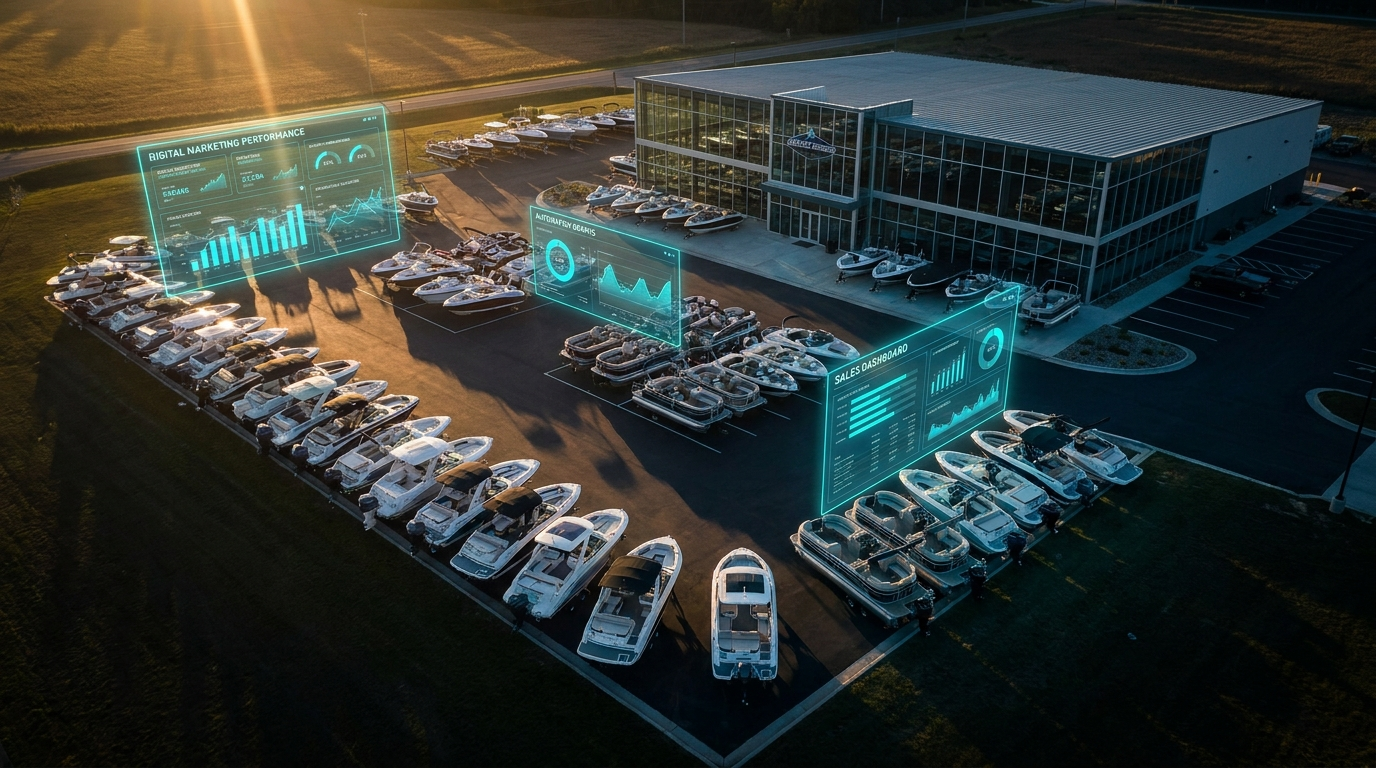
Most boat dealerships run their marketing on manual. Someone on the team sends follow-up texts when they remember. Leads from the website sit in an email inbox until someone checks it. Sea trial reminders go out when a salesperson has time to call. That system works fine when inventory is tight and buyers come to you. It breaks down the moment a competitor gets faster — and right now, a growing number of dealerships are deploying automation that responds in under 60 seconds, follows up for 30 days, and never takes a day off.
This guide covers the five marketing automation systems every boat dealership needs in 2026. Not theory — specific systems, what they do, what they cost, and what results look like after 90 days. Whether you sell pontoons, center consoles, offshore fishing boats, or PWC, the pipeline math is the same: the dealership that responds first and follows up consistently wins the deal.
According to a 2025 Lead Response Management study, companies that respond to inbound leads within 5 minutes are 9x more likely to convert them than those responding after 30 minutes. Boat buyers contact an average of 2.4 dealerships before purchasing. The one that responds first gets the conversation — and closes 71% of the deals it books a sea trial for.
Why Boat Dealer Marketing Runs on Manual — and Why That Is Costing You Sales
Marine retail is a seasonal, high-ticket business with long sales cycles and buyers who research for weeks before contacting a dealer. The combination creates a specific problem: lead volume arrives in bursts (spring launch, boat shows, summer weekends), and each lead requires multiple touchpoints before they commit. That is exactly the environment where manual follow-up fails — not because your team is bad at sales, but because manual follow-up cannot scale to simultaneous bursts, cannot run at 11pm on Saturday, and depends entirely on someone remembering to do it.
Leads arrive when your team is on the floor.
Boat shows generate 40-80 leads in a weekend. A successful Facebook or Google ad campaign can deliver 15-30 inbound contacts in a single day. Your sales team is with customers. No one is responding to the new leads in real time. By the time the rush ends, the window on half those inquiries has closed.
After-hours traffic is your highest-intent traffic.
Boat buyers browse inventory and fill out contact forms evenings and weekends — exactly when your dealership is closed. A 2025 marine retail study found 67% of first contact from boat buyers happens outside of 9am-5pm Monday-Friday. Without automation, every one of those contacts waits until the next business morning for a response. That is a 12-18 hour gap.
One salesperson cannot manage 30-day follow-up for 50 active leads.
A buyer who attended a boat show and asked for a quote is still a warm lead for 3-4 weeks. Consistent, personalized follow-up at day 1, day 3, day 7, day 14, and day 30 is what converts them. Manual execution of that sequence for 50 simultaneous leads is practically impossible without a dedicated person doing nothing else.
Seasonal gaps kill momentum.
The window between a buyer's first interest and their decision is often 2-8 weeks. If your follow-up drops off after the first call, you lose deals that were already yours. Automation maintains that momentum regardless of what else is happening in the dealership — busy season, slow season, staff turnover.
The 5 Marketing Automation Systems Every Boat Dealer Needs
These five systems work together. You can implement them in stages, but the full stack is where the compounding returns show up. Each one plugs a specific leak in the typical boat dealer pipeline.
Instant Lead Response (The 5-Minute Rule)
Every lead that enters your system — website form, Facebook lead ad, Google Business Profile inquiry, boat show list, or inbound call — gets an automated response within 60-90 seconds. For text-based leads, this is a personalized SMS that references the specific boat or inquiry type. For inbound calls, it is a voice AI that answers immediately and begins a qualification conversation.
The response is not a generic "thanks for your inquiry" message. It references what they asked about, asks one qualifying question to start the conversation, and includes a direct link to book a sea trial or call the dealership. The buyer experiences immediate, personal attention — even if your team is on the floor with other customers.
Boat dealers who implement instant lead response consistently see lead-to-appointment conversion increase by 35-55% in the first 30 days. The math is simple: more leads get into a conversation before they contact a competitor.
Lead Qualification and CRM Routing
Not every inbound lead deserves the same salesperson time. A buyer with a $90,000 budget who wants to be on the water by Memorial Day is a different conversation than someone browsing who might buy in two years. Automation handles the qualification layer — asking about budget, boat type, intended use, timeline, and financing preference through a structured conversation over SMS or voice.
The system scores the lead by purchase likelihood based on the answers and routes high-intent buyers directly to your top salesperson with a full briefing: what boat they want, their budget, their timeline, and what they said. Lower-intent leads go into a longer-term nurture sequence so they are not wasted — just not prioritized above buyers who are ready to move now.
Your team spends their time on the conversations most likely to close. Lead volume stops being a problem and starts being an asset.
Automated Sea Trial and Appointment Booking
Once a buyer is qualified, the automation moves them to booking without a salesperson needing to exchange five texts about availability. The system shows open sea trial slots in real time, the buyer picks a time, and both the buyer and the assigned salesperson receive a confirmation with the dealership address, what to bring, and what to expect.
Automated reminders go out 24 hours before and 2 hours before the appointment. If the buyer needs to reschedule, they can do it themselves through the same link — which keeps the appointment on the books instead of becoming a no-show. Show rates for automated-booked appointments average 78-88%, compared to 50-65% for verbal commitments made during a phone call.
The result: your calendar fills with confirmed sea trials instead of uncertain verbal commitments. Your team walks into each day knowing who is coming in and which boat to have ready.
30-Day Follow-Up Sequences for Warm Leads
A buyer who contacts you but does not book immediately is still the most valuable person in your pipeline. They know what they want. They are actively looking. They just need time or one more piece of information. Without a follow-up sequence, that lead goes cold — not because they bought elsewhere, but because no one stayed in front of them consistently.
The sequence sends 5-7 touchpoints over 30 days, each one specific to the boat and use case they asked about. Day 1: direct follow-up referencing the inquiry. Day 3: additional information on the specific model (financing options, comparable boats). Day 7: direct ask — are they still considering this, or should the conversation shift? Day 14: relevant content (a video walkthrough of that boat, a comparison guide). Day 30: a final outreach with a limited-time sea trial offer.
Boat dealers running this sequence recover 18-28% of leads that went quiet after first contact — buyers who were serious but needed consistent touchpoints to move forward. Manual follow-up systems capture roughly 5% of those because they depend entirely on someone remembering to reach out.
Post-Sale Review Generation and Re-Engagement
The sale is not the end of the automation workflow — it is the beginning of two more revenue streams: service department revenue from the buyer you just sold, and referral/review-driven leads from their public feedback. Automated post-sale sequences request a Google review 5-7 days after purchase (when excitement is still high), send service reminders at seasonal intervals, and alert buyers when new inventory matching their preferences arrives.
Google reviews directly affect local search ranking. A dealership that consistently generates reviews after each sale builds a compound advantage: more reviews means higher Local Pack ranking, which means more organic leads who find you before finding the competitor. Dealerships with automated review requests average 3-5x more reviews per quarter than those relying on buyers to leave reviews organically.
The re-engagement sequence keeps past buyers in the pipeline for their next purchase — most boat owners upgrade within 3-5 years. An automated touchpoint at the 2-year mark with a trade-in valuation offer captures that upgrade business before a competitor even gets the call.
What the Full Automation Stack Produces: Before vs. After
| Metric | Manual Operations | With Full Automation Stack |
|---|---|---|
| Lead response time | 4–18 hours average | Under 90 seconds, 24/7 |
| After-hours lead capture | 0% (voicemail or missed) | 100% — immediate response |
| Lead-to-appointment rate | 12–20% | 35–55% (3x improvement) |
| Sea trial show rate | 50–65% | 78–88% with reminders |
| Warm lead recovery | ~5% (if remembered) | 18–28% automated |
| Google reviews per quarter | 3–8 (organic) | 25–60 (automated ask) |
| Service dept. revenue | Reactive only | +22–35% from reminders |
| Monthly boats sold | Baseline | +4–8 from captured leads |
How to Build the Automation Stack: 4-Week Rollout
The biggest mistake dealers make is trying to automate everything at once. The fastest path to ROI is starting with the highest-impact system first, then layering in the others. Here is the sequence that gets most dealerships to positive ROI within 30 days:
Instant lead response and qualification
Connect your lead sources (website, Facebook, Google) to a unified inbox. Set up automated SMS/email response for every inbound lead within 90 seconds. Deploy qualification sequence (5 questions delivered over text). This alone typically produces measurable improvement in appointment bookings within 7-10 days.
Appointment booking integration
Connect your calendar to the automation system. Set up sea trial and showroom booking links that reflect real-time availability. Configure 24-hour and 2-hour reminders. Start routing qualified leads from week 1 directly to booking instead of waiting for a salesperson callback.
Follow-up sequence deployment
Build the 30-day follow-up sequence for leads who engaged but did not book. Load all existing unworked leads from the last 60-90 days into the sequence — these are buyers who expressed interest but were never consistently followed up with. Many will still be in the market.
Post-sale review and re-engagement
Add the post-sale review request sequence triggered 5 days after each boat delivery. Set up service reminders tied to purchase date and seasonal calendar. Load past customers into a re-engagement sequence for trade-in and upgrade offers. This is long-term compounding — the ROI builds over 6-12 months.
What to Look for in a Boat Dealer Marketing Automation Partner
Most marketing automation platforms are built for e-commerce or SaaS. Boat dealership workflows — high-ticket sales, seasonal patterns, multi-channel lead sources, DMS integration, service department scheduling — require a partner who has built these systems specifically for dealers. Here is what to evaluate:
DMS and CRM integration out of the box
The automation system must write lead data into whatever system your team already uses. If the integration requires manual export/import, it will not be maintained. Ask for a live demo of the CRM sync before committing.
Proven marine industry results, not just general metrics
General marketing automation case studies from dentists or law firms do not translate to boat dealer sales cycles. Ask for specific boat dealer references or examples with before-and-after close rate and appointment data.
Multi-channel coverage — not just email
Boat buyers primarily respond to SMS in 2026. A system that only sends email follow-up will significantly underperform one that leads with text and uses email as a secondary channel. Confirm the system supports SMS, email, voice, and Google Business Profile messaging.
Transparent reporting tied to revenue
You should be able to see which automation touchpoint produced each sea trial booking, and which bookings closed. If the reporting only shows opens and clicks without connecting to actual deals, you cannot measure ROI accurately.
Frequently Asked Questions
What is marketing automation for boat dealers?
Marketing automation for boat dealers is a system of connected software that handles repetitive communication tasks automatically: responding to inbound leads within minutes, running follow-up sequences on buyers who went quiet, sending appointment reminders, requesting reviews after a purchase, and re-engaging past customers for service or upgrades. Instead of a salesperson manually sending each text or email, the system triggers the right message at the right time based on buyer behavior — so nothing falls through and response time never depends on whether someone is in the office.
How quickly should a boat dealer respond to a new lead?
Under five minutes. Research shows that responding within 5 minutes makes a lead 9x more likely to convert than one responded to after 30 minutes. Boat buyers typically contact 2-3 dealerships simultaneously. The one that responds first gets the conversation. Marketing automation makes sub-5-minute response time consistent and independent of staffing — so it happens at 10pm on a Saturday just as reliably as Tuesday at 11am.
What CRM do most boat dealers use with marketing automation?
The most common setup combines a dealer management system (DMS) like CDK or Lightspeed with a marketing automation layer such as GoHighLevel, HubSpot, or a custom-built system. The DMS handles inventory and deal tracking. The automation layer handles lead capture, follow-up sequences, appointment booking, and review requests, communicating with the DMS via API or webhook so lead data stays synchronized automatically.
How much does marketing automation cost for a boat dealership?
A basic setup covering lead capture, automated SMS/email follow-up, and appointment booking typically costs $400-$900 per month. A full system with AI voice follow-up, multi-channel lead nurturing, review generation, and CRM integration runs $1,200-$2,800 per month. Most dealerships see positive ROI within 30-60 days from a single additional boat sale that the automation captured and converted.
Related Reading
Ready to Automate Your Boat Dealership Pipeline?
Leadra.io builds and manages full marketing automation stacks for boat dealers — lead response, qualification, booking, follow-up, and review generation. Most dealerships close 4-8 additional boats per month within 90 days of going live. Call us or book a walkthrough of the system.