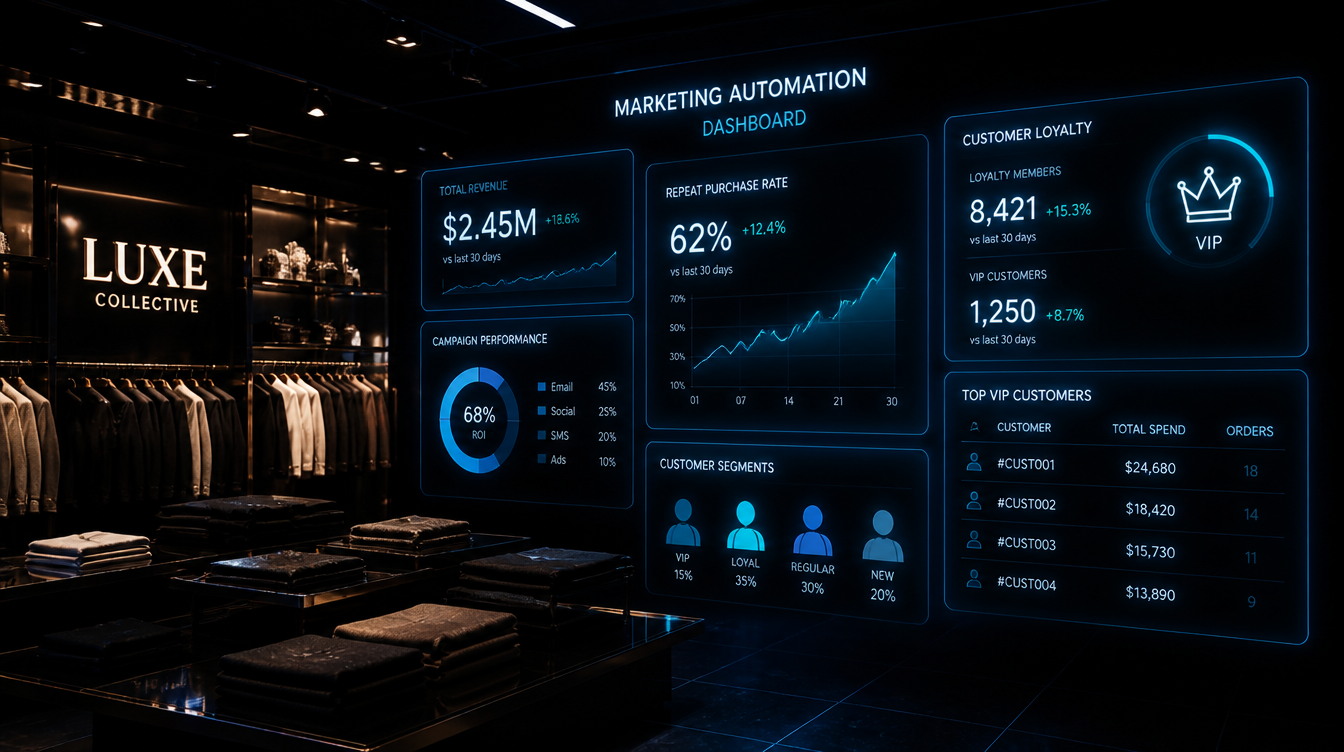
Boutique Retailer Customer Retention Automation Guide: Keep Shoppers Coming Back Without Discounting in 2026
By Leadra.io Team · June 22, 2026 · 9 min read
Boutique retailer customer retention automation uses connected software to send post-purchase follow-ups, trigger new arrival alerts based on what shoppers have bought before, run loyalty rewards automatically, and win back customers who have gone quiet. Done right, it grows repeat purchase rate by 30–50% within 90 days — without discounting away your margins.
Acquiring a new retail customer costs 5 to 7 times more than keeping an existing one. For boutique retailers — where margins are already compressed and marketing budgets are tight — losing 60 to 80 percent of first-time buyers forever is not just painful. It is the single biggest barrier to building a profitable shop.
The boutiques growing in 2026 have figured out that retention is a systems problem, not a personality or effort problem. They are not working harder at staying top of mind — they built automated systems that do it for them. The owner is not sending a personal email every time a new shipment arrives. The software is.
This boutique retailer customer retention automation guide breaks down exactly which five systems move the needle, what each one does, and how to implement them step by step without a technical background or a marketing team.
Why Boutique Retailers Struggle With Retention
Big box stores and online giants retain customers through price, convenience, and scale. Boutique retailers cannot compete on any of those axes — and should not try. The boutique advantage is curation, personal relationship, and the feeling that shopping there means something.
The problem is that relationships require consistent contact. And consistent contact requires time boutique owners do not have. Here is what the retention gap looks like in practice:
- A customer buys a dress in March. She loves it. She tells two friends. Then she forgets about the shop because nothing reaches her again until she happens to drive past it four months later.
- A new shipment of exactly the style a past buyer loves arrives. The owner thinks about reaching out. She is in the middle of a busy Saturday. She means to post something Monday. By Tuesday, three of those pieces are already sold to walk-ins and the past buyer never knew they existed.
- A loyal customer makes six purchases over two years. She feels no different than a first-time visitor — no recognition, no thank you, no VIP treatment. She starts shopping at a competitor that sends her birthday offers and early access to new drops.
These are not problems you solve by caring more. You solve them with boutique retailer marketing automation that runs whether you are on the floor, at a buying trip, or off for the weekend.
Boutiques already using AI for inbound inquiries can connect this retention stack directly to that system. Our guide on AI receptionists for boutique retailers covers the inbound side in detail.
The 5 Retention Automation Systems Every Boutique Needs
You do not need a large tech stack. Five connected systems handle 90 percent of the retention gap. Each one closes a specific leak between a first-time purchase and a loyal repeat customer.
1. Post-Purchase Follow-Up Sequence
Most boutiques send a receipt email and go silent. A post-purchase follow-up sequence turns the 7 days after every sale into a relationship-building window.
The sequence has three emails. Day 2: a genuine thank-you with a style tip for the specific item they bought — not a generic “thanks for shopping.” Day 5: a “you might also love this” email showing two or three items that pair with their purchase, pulled from your current inventory. Day 10: a soft invite back — “new arrivals just dropped, come see what's new.”
This sequence is built once in an email platform like Klaviyo or ActiveCampaign and triggers automatically from every sale. No manual sending. No forgetting. Boutiques running this sequence report that Day 5 product suggestion emails alone convert at 8–12% — higher than any cold promotional email.
A 2023 Shopify study of independent retailers found that customers who received a post-purchase sequence returned for a second purchase within 90 days at 2.4 times the rate of customers who received only a receipt.
2. Personalized New Arrival Alerts
Generic “new collection is here” emails perform poorly because they treat every customer the same. Personalized new arrival alerts — sent only to buyers whose purchase history matches the new inventory — perform 3 to 5 times better in click-through and purchase rate.
The setup requires tagging your customers by what they have bought: style (boho, classic, minimalist, statement), category (dresses, tops, accessories, shoes), and price range. When a new shipment arrives, you send the new-arrival alert only to buyers tagged for that style and category. A customer who has bought two boho maxi dresses gets the email when the new boho line drops — not the email promoting structured blazers she has never shown interest in.
Tools like Klaviyo make this straightforward with product-based segmentation. You build the template once. You add one additional step to your receiving process: tag the shipment with the relevant customer segments. The right alert goes to the right people automatically.
Boutiques using segmented arrival alerts vs. unsegmented blasts consistently see open rates 20–30 percentage points higher and conversion rates 3–5x higher on the same email budget.
3. Loyalty and VIP Program Automation
Manual loyalty programs — punch cards, spreadsheet tracking, owner remembering who gets what — either get abandoned or create more work than they are worth. Automated loyalty changes the math.
A basic automated loyalty system tracks cumulative spend per customer and triggers tier upgrades, reward emails, and exclusive access automatically. When a customer hits $500 in lifetime purchases, she gets an automated email welcoming her to your VIP tier with a small reward: early access to new drops, free shipping on her next order, or a $20 credit. When she hits $1,000, another tier upgrade with better perks.
This does not require an expensive loyalty platform. Klaviyo handles this with custom properties and automation flows. Shopify merchants can use LoyaltyLion or Smile.io with reasonable monthly costs. The key is that every milestone triggers without any manual intervention from the owner.
The psychological impact of acknowledged loyalty is significant. A customer who knows she is 2 purchases away from VIP status buys again specifically to hit that milestone — a behavior documented across loyalty programs in retail, hospitality, and subscription products alike.
4. Birthday and Anniversary Triggered Campaigns
Birthdays and purchase anniversaries are the two highest-converting trigger events in retail email marketing. A birthday email with a small, personalized offer (10% off her next purchase, a $15 gift card) sent 5 days before the customer's birthday consistently outperforms all promotional emails by a wide margin.
The numbers: birthday emails average a 481% higher transaction rate than standard promotional emails, according to Experian data. For boutique retailers where average order value runs $80 to $180, a birthday campaign that moves even 15% of your customer list converts to meaningful revenue with zero marginal effort once built.
The setup is simple: collect birth month at checkout (not the full date — most customers will share a month, fewer will share the full date). Add a “member since” date automatically when they first purchase. Build two automation flows in your email platform: one that triggers when the current month matches birth month, one that triggers 365 days after first purchase for the anniversary. Both send a single, warm email with a personalized subject line and a small offer.
These are set-and-forget automations. Once built, they run forever for every customer in your list who has a birth month on file.
5. Win-Back Campaigns for Lapsed Customers
A customer who has not purchased in 6 months is not lost — she just has not had a compelling reason to come back. A well-timed win-back campaign provides one.
The sequence has two emails. The first, at 90 days of inactivity: “We miss you — here is what just dropped.” Show 4–6 pieces in her preferred style. No discount, no urgency. Just relevance. The second, at 120 days if she still has not purchased: a single, genuine offer — “It has been a while. Here is 15% off, valid this week only.” Include the same style-matched selection.
The first email converts a meaningful percentage of lapsed customers without sacrificing margin. The second catches the remainder who need a nudge. Both are automated and trigger per-customer based on her specific last-purchase date — not a mass send to everyone who is “cold.”
Win-back campaigns for boutique retailers typically recover 15–25% of lapsed customers who engage with the first email. That is revenue that would otherwise require acquiring entirely new customers at 5–7 times the cost.
| Automation System | When It Triggers | Avg. Conversion Lift |
|---|---|---|
| Post-purchase sequence (3 emails) | Immediately after every sale | 2.4x repeat purchase rate |
| Personalized new arrival alerts | Each new shipment, by customer tag | 3–5x vs. unsegmented blast |
| Loyalty tier upgrade notifications | On hitting spend milestones | Drives milestone-motivated purchases |
| Birthday and anniversary emails | Birth month / 1-year anniversary | 481% higher transaction rate |
| Win-back campaign (2 emails) | 90 days + 120 days of inactivity | 15–25% lapsed customer recovery |
Real Example: A Charlotte Boutique Increased Repeat Purchases 42% in 90 Days
(This example represents the type of results our clients achieve.)
A women's clothing boutique in Charlotte, NC had been in business for four years. Their customer database had grown to 1,100 email contacts. Their average first-time buyer had purchased once. Repeat purchases — defined as two or more purchases from the same customer — represented only 18% of their monthly revenue.
We built a full retention automation stack over three weeks:
- Tagged all 1,100 contacts by purchase history style category using order data from their Shopify store
- Built a 3-email post-purchase sequence triggered from every new sale
- Configured segmented new-arrival alerts for three style segments (boho/casual, classic/preppy, statement/occasion)
- Added a birthday automation collecting birth month at checkout and emailing 5 days before with a $15 gift credit
- Set up a 2-email win-back sequence for anyone inactive 90 days
Results after 90 days: repeat purchase rate climbed from 18% to 26% of monthly revenue — a 42% increase. Revenue from email alone went from $1,200 to $4,800 per month. The win-back campaign alone recovered 67 lapsed customers, generating $8,100 in recaptured revenue in the first two deployments.
The owner reported spending less than 30 minutes per week on email marketing — mostly approving new-arrival photos. The rest ran automatically.
I knew my customers liked us. I just was not staying in front of them. This fixed that without me having to do anything different day to day.
How to Build Your Boutique Retention Stack in 4 Steps
Step 1: Choose your email platform and migrate your list. Klaviyo is the best choice for boutique retailers on Shopify — it syncs order data automatically, enabling purchase-based segmentation without manual tagging. ActiveCampaign is better if you need a built-in CRM for tracking customer conversations. Mailchimp works for smaller lists under 500 contacts but lacks the advanced automation triggers that make this stack work at scale. Import every email address you have — past receipts, sign-in sheets, loyalty cards — into one place first.
Step 2: Tag your customer list by purchase history. This step takes 2–4 hours once and powers everything after it. Go through your last 2 years of order history. Create 3–5 style tags that match how your inventory is actually organized. Assign each customer their purchased categories. In Klaviyo, this can be done via a CSV import with custom properties. In Shopify, product tags flow directly into Klaviyo segments if set up correctly from the start.
Step 3: Build the post-purchase sequence and win-back flows first. These two automations have the highest ROI and require no ongoing attention after setup. Post-purchase sequence: email 1 at Day 2 (thank you + styling tip), email 2 at Day 5 (you might also love this — pull 2–3 products from current inventory), email 3 at Day 10 (new arrivals invite). Win-back: email 1 at 90 days inactive (style-matched new arrivals), email 2 at 120 days (15% offer, valid 7 days).
Step 4: Layer in birthday and arrival alerts. Add a birth month field to your checkout form — a simple dropdown for month is enough. Build the birthday automation: trigger when current month matches birth month field, send 5 days into that month, include a $10–$15 reward valid for 30 days. For arrival alerts, establish a process: every time a new shipment is received, identify the relevant style tags, select the matching segment in your email platform, and send the pre-built alert template. The template is built once. The sending is a 5-minute task per shipment.
If you want the full stack built and managed for you, Leadra.io handles everything — list segmentation, automation build-out, copywriting, and ongoing optimization. Call +1 (864) 721-8384 or visit our contact page to book a free strategy call.
Frequently Asked Questions
What is customer retention automation for boutique retailers?
Customer retention automation for boutique retailers is a connected set of software systems that automatically follow up with buyers after a purchase, send personalized new-arrival alerts based on past buying behavior, manage loyalty tier upgrades, trigger birthday and anniversary offers, and run win-back sequences for lapsed customers. These systems run on triggers without manual attention from the owner — a sale fires the post-purchase sequence, a 90-day gap fires the win-back, a birth month match fires the birthday email.
How much does boutique customer retention automation cost?
Software costs run $100–$300 per month for a boutique with a list of 500–2,000 contacts, depending on the platform (Klaviyo starts at $20/month for small lists, scales with contact count). Professional implementation by an agency like Leadra.io typically runs $1,000–$2,000 as a one-time setup fee. Most boutiques generate enough additional revenue from their first win-back campaign alone to cover setup costs within 60 days.
Should boutique retailers discount to retain customers?
Not as a primary strategy. Discounting trains customers to wait for sales and erodes the perceived value of your curation. Effective retention automation creates repeat purchases through relevance and timing — sending the right product to the right person at the right moment — not by cutting margin. Discounts in the context of win-back campaigns or birthday rewards (where the trigger is relationship, not urgency) perform differently from blanket promotional emails. Reserve discounts for win-backs and loyalty milestones where they feel like a reward, not a sign that inventory is moving slowly.
How long until boutique customer retention automation shows results?
Post-purchase sequence results are visible within the first 2–3 weeks as early buyers re-engage with the Day 5 product suggestion email. Birthday campaigns show up in monthly revenue within 30 days if your list has birth months on file. Win-back campaigns typically deploy in batch, so their impact is measurable after the first run at the 90-day inactive mark. Full stack results — combining all five systems — are usually clear by 60–90 days. The pattern is consistent: retention rate climbs month over month as more customers move through the automated flows and more purchase data sharpens the segmentation.
- Boutiques lose 60–80% of first-time buyers to silence — not bad service. Retention automation closes that gap without requiring the owner's manual attention.
- Customers who receive a post-purchase sequence return for a second purchase at 2.4 times the rate of customers who only receive a receipt email.
- Segmented new-arrival alerts — sent only to buyers whose purchase history matches the new inventory — convert 3–5 times better than generic blast emails.
- Birthday emails average a 481% higher transaction rate than standard promotional emails — and require zero recurring effort once the automation is live.
- Win-back campaigns recover 15–25% of lapsed customers who engage with the first email — at a fraction of the cost of acquiring new ones.
What to Do Next
Start with your post-purchase sequence. It is the highest-leverage automation you can build because it targets buyers who are already engaged — they just made a purchase and have your brand top of mind. A 3-email sequence built this week will be generating repeat purchases 30 days from now with no further effort.
Once that is live, pull your email list and spend 2 hours tagging customers by purchase history. That single step unlocks personalized arrival alerts and targeted win-back campaigns — the two systems that scale your retention without scaling your workload.
At Leadra.io, we build and manage the full boutique retailer retention automation stack from day one. Call +1 (864) 721-8384 or visit our contact page to book a free 30-minute strategy call. We audit your current setup, identify your biggest retention leak, and give you a written implementation plan — no commitment required.
Ready to stop losing repeat customers?
Get a free boutique retention audit from Leadra.io.
30-minute strategy call — we review your current customer list, identify where repeat buyers are falling off, and show you exactly which automation to build first. No obligation. You leave with a written action plan.
Charlotte NC · serving boutique retailers and small businesses nationwide
Written by the Leadra.io Team. Leadra.io is an AI marketing and automation agency helping boutique retailers, dental practices, and small businesses grow with AI-powered systems. Based in Charlotte, NC — serving clients nationwide.