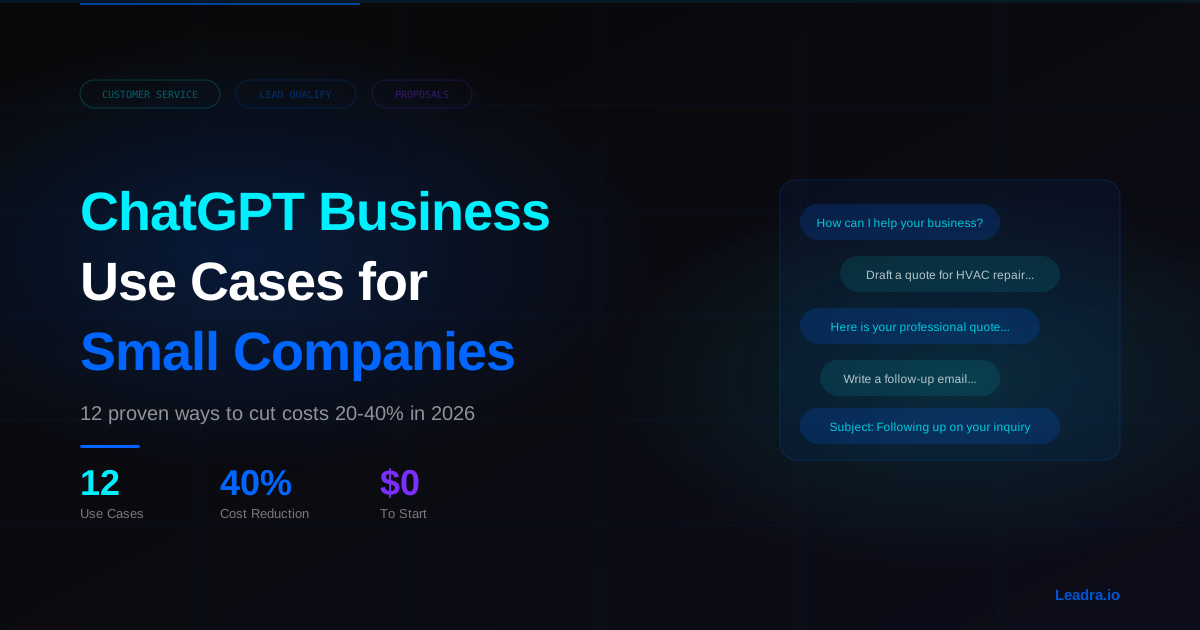
Small businesses using ChatGPT strategically — not just for writing emails — cut operational overhead by 20-40% within 90 days. The 12 use cases below are the ones generating real ROI right now, with numbers to back them up.
Most small businesses are using ChatGPT wrong. They fire it up, ask it to write a few emails, and wonder why it isn't making a dent in their workload.
The small businesses pulling real ROI from AI aren't using it as a fancy search engine. They're plugging it into their operations — their follow-up sequences, their customer intake, their content pipeline, their admin hours — and watching costs drop.
According to McKinsey's 2025 AI adoption report, businesses that integrate AI into core workflows (not just productivity tasks) see 3-5x higher ROI than those using it for isolated tasks. The gap between "I tried ChatGPT" and "ChatGPT saves us $8,000/month" is entirely about where you plug it in.
Here are the 12 ChatGPT business use cases generating real returns for small companies right now.
1. Customer Inquiry Handling (24/7, No Extra Staff)
The average small business misses 40% of inbound calls and messages outside business hours. Each missed inquiry costs between $150 and $400 in lost potential revenue, depending on your industry.
ChatGPT integrated with your website chat or SMS line handles:
- Pricing questions
- Service availability checks
- Appointment scheduling prompts
- FAQ responses
A plumbing company in Charlotte running this setup captured 23 additional service calls per month that previously went to voicemail. At $350 average job value, that's $8,050/month in revenue that used to walk out the door.
2. Lead Qualification Before Your Sales Team Touches It
Your salespeople spend roughly 60% of their time on leads that will never buy. ChatGPT can screen inbound leads in real time — asking budget, timeline, decision-making authority, and specific need — before a human ever picks up the phone.
The setup: a web form or chat widget feeds lead responses into a ChatGPT prompt that scores the lead and flags qualified ones. Tools like Zapier connect this to your CRM automatically.
One HVAC company using this approach cut their sales team's time-per-qualified-appointment from 45 minutes to 11 minutes. The same team now closes 40% more deals per month without working more hours.
3. Proposal and Quote Drafting
Writing a detailed service proposal takes most small business owners 45 minutes to 2 hours. ChatGPT cuts that to under 10 minutes.
The workflow: fill in a simple intake form (project type, client name, scope, price), and a pre-built ChatGPT prompt generates a professional, branded proposal you can send in minutes.
Landscaping companies, contractors, and consultants using this approach report sending 3x more proposals per week — which directly correlates to winning more business. More quotes out the door means more revenue, even with the same close rate.
4. Email Follow-Up Sequences That Actually Sound Human
The average purchase requires 5-7 touchpoints. Most small businesses send one follow-up and give up. ChatGPT can generate a 7-email nurture sequence in 15 minutes, customized to your service, your city, and your customer type.
Plug those sequences into any email platform (Mailchimp, ActiveCampaign, Go High Level) and your pipeline runs automatically.
A dental practice in Indianapolis set up a 6-email sequence for patients who hadn't scheduled in 12+ months. The campaign recovered 38 dormant patients in the first 60 days — at an average value of $1,200 per patient, that's $45,600 in reactivated revenue from a 15-minute ChatGPT session.
5. Google Business Profile and Review Response Automation
Responding to every Google review takes time you don't have. Ignoring them costs you ranking and reputation. ChatGPT solves this.
Feed your reviews into a ChatGPT prompt that generates personalized, professional responses — thanking happy customers by name and addressing complaints with empathy. Batch this weekly (takes 20 minutes) or automate it via Zapier + Google Business API.
Google ranks businesses higher when they respond to reviews consistently. One Charlotte restaurant that started responding to 100% of reviews within 48 hours saw a 31% increase in profile views and a 19% jump in calls over 90 days.
6. Social Media Content Batching
Most small business owners post sporadically because creating content takes too long. ChatGPT can generate a full month of social posts — 20 to 30 pieces — in about an hour.
The key is a proper prompt template that includes your brand voice, your target customer, your city, and your core services. Don't use generic prompts. Generic prompts produce generic content that gets ignored.
A Charlotte-based salon using this approach went from posting twice a week to posting daily. Their Instagram following grew 280% in 6 months and they attribute 14 new client bookings per month directly to social content. That's $2,800+ in monthly revenue from one system.
7. Job Description Writing and Hiring Funnel Copy
Writing job postings, screening questions, and offer letters pulls owners away from revenue-generating work. ChatGPT does all of it in minutes.
Beyond writing, ChatGPT can generate the first-round phone screen questions, draft rejection emails, and write your employee handbook sections. Small businesses report saving 8-12 hours per hire by automating the paperwork side of recruiting.
8. SOPs and Training Documentation
The #1 reason small businesses can't scale: everything lives in the owner's head. When a new hire starts, you spend 3 weeks re-teaching everything you already know.
ChatGPT converts voice memos, rough notes, and bullet points into polished Standard Operating Procedures. Record yourself explaining a process for 5 minutes, transcribe it, paste it into ChatGPT, and get a formatted SOP with numbered steps, decision trees, and checklists.
Business owners using this approach cut new hire onboarding time by 40-60% and report that employees reach full productivity in half the time.
9. Customer Complaint Resolution Scripts
One bad Google review or social media complaint can cost a small business thousands. ChatGPT generates situation-specific de-escalation scripts your team can use in real time.
Describe the complaint scenario, and ChatGPT produces a word-for-word response that's empathetic, professional, and resolves the issue without admitting liability. Your front desk and customer service staff stop winging it and handle difficult conversations correctly, every time.
10. Local SEO Blog Content at Scale
Google rewards businesses that publish consistent, high-quality content. A weekly blog post targeting local keywords — "best HVAC company in Charlotte NC," "dental implants cost Charlotte" — builds organic traffic that compounds over time.
ChatGPT drafts a 1,500-word blog post in under 5 minutes. With light editing for accuracy and brand voice, a small business can publish 4 posts per month for roughly 2 hours of total effort. Traditional content agencies charge $800-$2,000 per post for the same work.
At Leadra.io, we run this exact system for clients and routinely see first-page Google rankings within 90 days for competitive local keywords.
11. Invoice and Contract Template Generation
Legal and financial documents eat hours. ChatGPT drafts service agreements, payment terms, scope-of-work documents, and invoice templates in minutes. You still need a lawyer to review anything high-stakes, but ChatGPT handles the first draft — which cuts legal review time (and legal bills) by 50-70%.
Contractors, consultants, and service businesses using AI-drafted contracts report fewer scope disputes and faster payment cycles because expectations are clearly documented upfront.
12. Competitive Research and Market Intelligence
Understanding what your competitors are doing, what customers are complaining about, and where the market is moving used to require expensive consultants or hours of manual research. ChatGPT summarizes competitor reviews, analyzes industry trends from public data, and identifies gaps in your market.
Feed ChatGPT a list of your top 5 competitors and their Google review summaries. It produces a competitive analysis in 3 minutes — highlighting what customers love and hate about each, and where you can position to win.
The ROI Math: What ChatGPT Actually Saves a Small Business
Let's put numbers on this. A typical small service business with 5 employees using ChatGPT across these use cases:
- Customer inquiry handling: $6,000-$10,000/month in recovered after-hours revenue
- Lead qualification: 40% more closed deals from the same lead volume
- Proposal drafting: 6 hours/week saved at $50/hour value = $1,200/month
- Email sequences: $2,000-$8,000/month in reactivated dormant customers
- Content creation: $1,600-$3,200/month in avoided agency costs
Conservative total: $8,000 to $18,000 per month in combined recovered revenue and cost avoidance. ChatGPT Plus costs $20/month. The API adds $50-$200 depending on volume. The ROI is not subtle.
How to Actually Implement This (Not Just Read About It)
Reading a list of use cases doesn't move the needle. Implementation does. Here's the 3-step approach that works:
Step 1 — Pick one use case. Don't try to automate everything at once. Start with the one that costs you the most time or money. For most small businesses, that's customer inquiry handling or lead qualification.
Step 2 — Build the prompt template. Write a detailed prompt that includes your business name, city, services, tone, and what you want the output to look like. Test it 10 times. Refine it until outputs are 80%+ usable without editing.
Step 3 — Connect it to your tools. Use Zapier, Make.com, or a platform like Go High Level to automate the trigger → ChatGPT → output workflow. Once it runs without you touching it, you've built an asset.
Most small businesses can have their first ChatGPT automation live and generating ROI within 2 weeks. The businesses that wait lose ground to competitors who act.
Frequently Asked Questions
What is the best ChatGPT use case for a small business with limited budget?
Customer service automation delivers the fastest ROI. A small business spending $2,000/month on part-time customer support staff can cut that by 60-70% using ChatGPT to handle FAQs, quote requests, and appointment inquiries — while the human team focuses on closing deals.
How much does it cost to use ChatGPT for a small business?
ChatGPT Plus costs $20/month per seat. The ChatGPT API (for building automations) runs $0.15 per million input tokens and $0.60 per million output tokens for GPT-4o. Most small businesses spend $50-$300/month total on AI tools once integrated into their workflows.
Can small businesses use ChatGPT without a developer?
Yes. Tools like Zapier, Make.com, and n8n connect ChatGPT to your CRM, email, and booking software without writing code. Most small business automations — follow-up emails, lead qualification, invoice drafting — can be set up in a few hours with no technical background.
What are the risks of using ChatGPT in a small business?
The main risks are hallucinations (AI making up facts), data privacy concerns (never enter customer PII without reviewing OpenAI's data policies), and over-reliance without a human review step. The fix: always add a human approval layer for customer-facing outputs and never feed ChatGPT sensitive financial data.
Ready to Build This Into Your Business?
At Leadra.io, we build and deploy AI systems for small businesses — from automated lead qualification to 24/7 customer inquiry handling. We handle the setup. You get the results.
Our clients in Charlotte, NC and across the country typically see the first results within 14 days of launch.