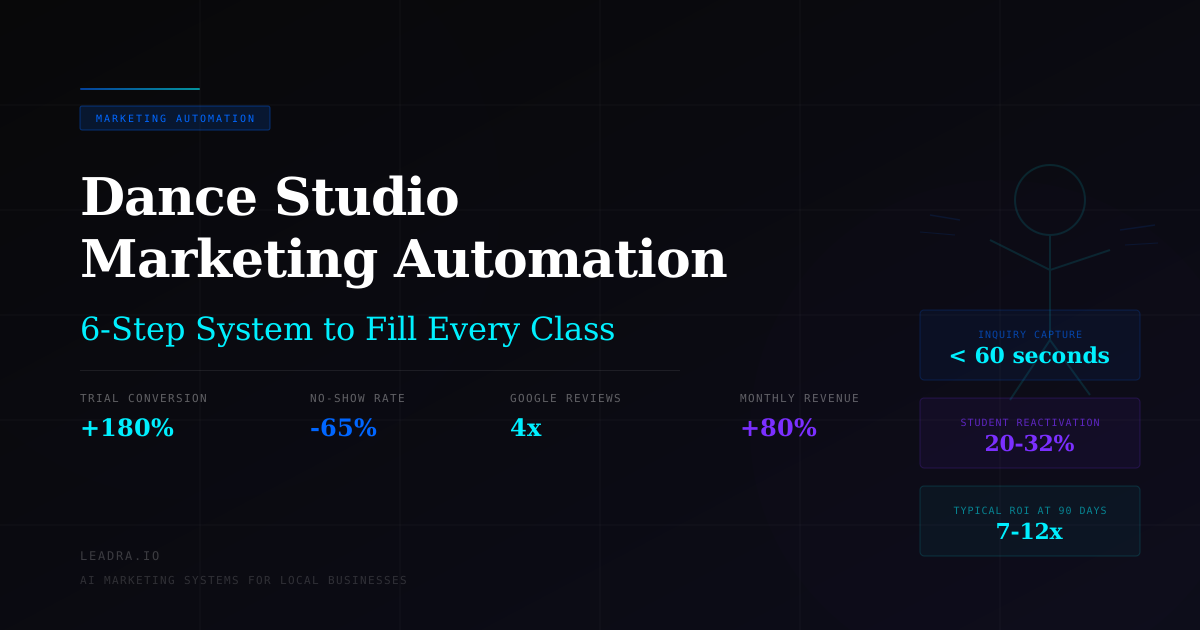
Dance studios run on word of mouth, seasonal enrollment surges, and the owner doing almost everything. You answer inquiry calls between classes, follow up with trial students when you remember, chase down late tuition payments, and post to Instagram when you have a spare 20 minutes. The result is a studio that grows slowly — not because the teaching is bad, but because the follow-up is inconsistent.
Marketing automation changes that. Not by replacing the personal relationships that make a great dance studio — but by handling the inquiry capture, trial conversion, and student retention work on autopilot so those things happen every single time, not just when you have bandwidth.
This guide walks through the full six-step dance studio marketing automation system: what each component does, how to set it up, what it costs, and what results look like in practice. By the end you'll know exactly which pieces to build first and what to expect at 30, 60, and 90 days.
Why Most Dance Studio Marketing Fails to Convert
Dance studio owners who invest in marketing — Instagram ads, Google ads, flyer campaigns — run into the same wall. They generate interest, but interest doesn't become enrollment automatically. Someone clicks the ad, fills out the contact form, and then waits 6 hours for a response because the instructor was teaching back-to-back classes. By the time you call back, they've already signed their kid up at the studio down the street.
The problem isn't visibility. It's speed and consistency. Studios with manual follow-up convert 15-25% of trial class inquiries into enrolled students. Studios with automation convert 40-60%. That gap is entirely response time and follow-up persistence — not the quality of the teaching or the facility.
There are three revenue leaks in most dance studios. Missed or slow inquiry responses. Trial students who attended but never enrolled because no one followed up. And dormant students who took classes for a season, stopped, and never got a reason to come back. Automation plugs all three — permanently.
The 6-Step Dance Studio Marketing Automation System
Build this in order. Each step compounds on the one before it. Most studios see measurable ROI from steps 1-3 within the first two weeks.
AI Inquiry Capture — Every Channel, Instant Response
Every web form submission, inbound call, text message, Instagram DM, and Google Business Profile message gets answered within 60 seconds — even at 10pm on a Tuesday. The AI knows your class schedule, age groups, dance styles, and current openings. It answers questions, handles objections, and books the trial class in the same conversation.
Set this up first. This is the single highest-leverage change you can make because most dance studio inquiries come in at night and on weekends when no one is available to respond. Studios that move from manual response to AI capture typically see a 40-60% increase in trial class bookings within 30 days — not from more inquiries, but from dramatically better conversion of the ones already coming in.
Trial Class Confirmation and Preparation Sequence
Once a trial is booked, the system runs a three-touch sequence: a personalized confirmation text with class details and what to wear, a reminder 24 hours before, and a day-of message with parking info and what to expect. Each message uses the student's name, the class name, and their instructor's name.
Trial no-shows are one of the biggest silent revenue killers in dance studios. A booked trial that doesn't show is a lost enrollment opportunity plus a wasted spot in the class. This sequence reduces trial no-shows by 50-65% on average, which means more students actually experience the studio — which is the only thing that converts them to paying enrollments.
Post-Trial Enrollment Follow-Up
Within one hour of a completed trial class, the system sends a personalized follow-up message referencing the specific class and instructor. It includes a direct enrollment link, answers common questions about tuition and schedules, and offers a limited-time discount or free uniform with immediate sign-up.
If the family doesn't enroll within 48 hours, a second message goes out with a different angle — a testimonial from another family in the same style or age group. At day 5, a third message follows up. Studios running this sequence convert 38-52% of trial attendees into enrolled students, compared to 15-22% without automated follow-up. For a studio doing 20 trials per month, that difference is 4-6 additional enrolled students every single month.
Class Reminder and No-Show Prevention
For enrolled students, the system sends automated class reminders 24 hours and 2 hours before every scheduled session. Reminders include the student's name, class time, instructor, and any prep notes (recital costume reminder, bring your tap shoes, etc.). If a student misses a class, the system sends a brief check-in and offers make-up options automatically.
Attendance consistency directly affects retention. Students who miss frequently fall behind and quit. Reducing missed classes by 30-40% through reminders keeps students progressing, which is the strongest retention driver a dance studio has. It also reduces the administrative burden of manually tracking attendance gaps and reaching out to families who went quiet.
Dormant Student Reactivation
Every dance studio has a list of past students who took classes for a season, stopped, and never came back. For a studio with 100 active students, that list is typically 80-200 people — families who liked the studio, liked the instructors, and just drifted because no one gave them a reason to return.
The automation identifies students who have been inactive for 60 days or more and sends a personalized message referencing the style they studied and the instructor they worked with. A two-touch sequence runs over 10 days. Studios running this reactivate 20-32% of dormant students — which for most means $1,200-$3,500 in recovered monthly tuition from a list that was previously just sitting there doing nothing.
Review Automation and Google Business Profile Content Engine
After each recital, milestone class, or enrollment anniversary, the system sends a personalized review request to the student's family with a direct link to your Google review page. No generic ask — it references the specific class or performance moment. This generates 10-20 new Google reviews per month from a studio that was getting 1-3 before.
Simultaneously, an automated content engine publishes weekly posts to your Google Business Profile — class spotlights, recital announcements, enrollment openings, and style-specific content that keeps the profile active. Active profiles with strong review counts consistently rank higher in "dance classes near me" searches and push into the Google Maps pack, where 70% of local search clicks go. Most studios see a meaningful organic inquiry increase within 60-90 days of activating this step.
Manual Operations vs. Automation: What Actually Changes
| Activity | Manual | Automated |
|---|---|---|
| Inbound inquiry response | 2-8 hrs — often missed at night | Under 60 seconds, any channel |
| Trial class booking | Manual back-and-forth, 1-3 days | Booked in the first message |
| Trial no-show rate | 25-40% without reminders | 10-15% with 3-touch sequence |
| Post-trial enrollment follow-up | One call if you remember | 3-touch sequence over 5 days |
| Trial-to-enrollment conversion | 15-22% | 38-52% |
| Dormant student follow-up | Never, or seasonal bulk blast | Personalized 2-touch reactivation |
| Google review generation | Ask verbally — 1-3/month | Post-milestone text — 10-20/month |
| GBP content posts | Occasional, irregular | Weekly, auto-published |
Case Study: Charlotte Dance Studio Adds $11,400/Month in 90 Days
A Charlotte, NC dance studio offering ballet, hip-hop, and contemporary for ages 4-18 was running 68 enrolled students with a consistent waitlist for Saturday classes and empty slots on weekday evenings. Monthly tuition revenue was $14,200 — enough to cover costs but not growing. The owner was answering every inquiry manually, following up with trial families by hand, and doing zero outreach to the 140 past students in the system who had stopped attending.
Trial conversion rate
18%
51%
Trial no-show rate
31%
11%
Google reviews
22
79
Monthly tuition revenue
$14,200
$25,600
Leadra.io deployed the full six-step system in 6 days. The AI inquiry capture went live first. In the first week alone it handled 28 inbound inquiries — 19 of which came in after 7pm — converting 16 of them into booked trial classes. The same 28 inquiries would have generated 5-7 bookings with manual follow-up.
The trial confirmation sequence cut the no-show rate from 31% to 11% within three weeks. The post-trial enrollment follow-up converted 51% of trial attendees to enrolled students — up from 18%. Over the first 60 days, 22 new students enrolled directly from trials that would have previously been lost in the follow-up gap.
The dormant reactivation campaign at day 30 reached 140 past students and brought back 38 of them over six weeks. The review automation added 57 new Google reviews in 90 days, moving the studio from position 8 to position 2 in local search results for "dance classes Charlotte." By day 90, monthly tuition revenue had grown from $14,200 to $25,600. The automation system cost $1,200/month. ROI at 90 days: 9.5x.
What Dance Studio Marketing Automation Costs in 2026
Pricing scales with which components you activate and the size of your student roster. Here's how it breaks down:
Starter
$400–$800/mo
- →AI inquiry capture via web form, SMS, and GBP chat
- →Trial class booking automation
- →3-touch trial confirmation and reminder sequence
- →Post-visit review automation
- →Best for: studios under 50 students with an existing booking system
Growth
$800–$1,500/mo
- →Everything in Starter
- →Post-trial enrollment follow-up sequences
- →Class attendance reminders and no-show check-ins
- →Dormant student reactivation campaigns
- →GBP content engine (weekly posts)
- →Best for: studios with 50-120 students replacing manual follow-up
Full System
$1,500–$2,500/mo
- →Everything in Growth
- →AI voice receptionist for inbound calls
- →Multi-channel: phone, SMS, Instagram DM, GBP chat, email
- →Seasonal enrollment campaign automation
- →Monthly performance reporting and optimization
- →Best for: studios with 120+ students or multiple locations
What to Expect at 30, 60, and 90 Days
- →AI inquiry capture live — response time drops from hours to seconds
- →Trial bookings increase 40-60% from better inquiry conversion
- →Trial no-shows fall 50-65% from confirmation sequences
- →Post-trial follow-up converting 38-52% of attendees to enrolled students
- →Revenue impact: $1,500-$3,500 from converted trials and recovered bookings
- →Dormant student reactivation campaign launched — 20-32% reactivation rate
- →Review count growing — GBP ranking starting to climb in local search
- →Class attendance rates up 20-35% from automated reminders
- →Cumulative revenue impact: $4,000-$8,500 over first 60 days
- →Organic inquiries increasing as GBP rank improves
- →Full automation running at scale — no manual follow-up needed
- →30-60 new Google reviews added since launch
- →Most studios at 7-12x ROI on monthly automation investment
Frequently Asked Questions
What is dance studio marketing automation?
Dance studio marketing automation is the use of AI-driven software to handle the marketing and student management tasks that studio owners currently do manually — or skip entirely. This includes instantly responding to class inquiries from any channel, booking trial classes without back-and-forth, following up with trial attendees who didn't enroll, sending class reminders to reduce no-shows, reactivating students who stopped attending, and keeping your Google Business Profile active with weekly posts. Automation runs all of these on autopilot so the studio owner and instructors can focus on teaching.
How much does marketing automation cost for a dance studio?
Dance studio marketing automation typically costs $400 to $2,500 per month depending on which components you activate. A starter stack covering AI inquiry capture, trial booking, and no-show reminders runs $400-$800/month. A full system adding enrollment follow-up sequences, dormant student reactivation, voice AI for inbound calls, and a content engine runs $1,500-$2,500/month. Most studios recover the full cost within the first 30 days from trial-to-enrollment conversions alone — converting even 2-3 additional trial students per month at $100-$200/month tuition covers the tool cost many times over.
How long does it take to set up dance studio marketing automation?
A complete dance studio marketing automation system typically takes 5-7 days to configure and launch. Days 1-2 cover connecting the AI to your booking software (Jackrabbit Dance, Mindbody, Pike13, or iClassPro) and activating inquiry capture across all channels. Days 3-4 set up the trial class follow-up sequences and enrollment nudges. Days 5-7 build the dormant student reactivation campaign and Google Business Profile content automation. Most studios start seeing recovered trial conversions before the second week ends.
Does marketing automation work for small dance studios or just large ones?
Marketing automation works especially well for small and mid-size dance studios. Smaller studios have stronger community relationships, which means personalized AI messages using the student's name and their specific style or instructor see significantly higher response rates than generic outreach. Small studios also have the most to gain from plugging inquiry and trial-conversion leaks because every lost enrollment directly hits the owner's monthly revenue. A 10-student gain on a 60-student roster is a 16% revenue increase — automation makes that consistently achievable.
Related Reading
Ready to Build the Full System for Your Dance Studio?
Leadra.io builds and manages complete dance studio marketing automation systems — from AI inquiry capture to trial conversion to dormant student reactivation. Most studios see positive ROI within the first 30 days.