Dormant Corporate Car Rental Accounts: How AI Turns Lapsed Business Clients Into Recurring Revenue (2026 Playbook)
Pull up your CRM right now and filter for corporate accounts with zero bookings in the last 90 days. If you run a mid-size car rental operation, you will find somewhere between 20 and 80 business names sitting there. Each one of those accounts used to pay you money. Some of them went dark because a travel manager left. Some switched to a competitor on price. Some just got busy and never came back.
What almost nobody in the car rental business does is run a systematic corporate account reactivation campaign. Not a generic email blast. Not a sales rep cold-calling through a list over three weeks and giving up. A real, AI-driven win-back system that scores each account by recovery potential, personalizes outreach to the current decision-maker, runs the right sequence of touchpoints, and closes the loop with an actual booking.
This playbook covers exactly how to build that system in 2026. You will learn how AI identifies which dormant accounts to prioritize, what the win-back sequence looks like at each step, what CRM integration is required, what real win-back rates look like, and how to calculate whether the investment makes sense for your operation.
The Hidden Revenue Problem Inside Every Car Rental CRM
Corporate accounts are the most valuable customers a car rental company has. A business traveler who rents weekly for 48 weeks generates $6,000-$18,000 per year from one relationship. When that account goes quiet, the revenue loss is not just the last booking. It is the entire future spend you were counting on.
The problem is invisible until you measure it. Most car rental operators track new account acquisition obsessively. They run ads, attend chamber events, offer introductory rates. They measure cost per new account to the dollar. But they rarely measure the value of accounts that went quiet six months ago because nobody assigned that job to anyone.
Research on B2B churn across service industries consistently shows that 20-40% of dormant accounts will return if contacted within 18 months with a relevant offer and a human-feeling touchpoint. After 24 months the reactivation rate drops to under 5%. That 18-month window is where the money is. Most car rental companies let it close without a single outreach attempt.
The reason is capacity. A sales rep handling new business development does not have time to also run a structured win-back program for 60 dormant accounts. A front desk team focused on daily reservations is not making outbound calls to lapsed corporate clients. The work falls through the cracks because no one owns it.
AI fixes the capacity problem. It does not get distracted by today's walk-in traffic. It runs the win-back sequence in the background while your team handles the operation.
How AI Scores Dormant Corporate Accounts for Recovery Potential
Not every dormant account is worth the same effort. A company that booked weekly for two years and went quiet 4 months ago is a completely different opportunity from a one-time account that rented twice during a conference and never came back. Running the same sequence on both wastes outreach budget and dilutes your message.
AI account scoring builds a priority rank for every dormant account in your CRM using four data points:
- →Peak annual spend. Total revenue from the account in its best 12-month period. Accounts that spent $8,000 or more in a single year get highest priority. This is the number you are trying to recover, not the last booking amount.
- →Days since last booking. Accounts dark for 90-180 days reactivate at 2x the rate of accounts dark for 12-18 months. The AI weights recency heavily because the switching cost for a travel manager is still fresh — they remember you, they know your process, they just need a reason to come back.
- →Historical booking frequency. A weekly renter has muscle memory around your brand. A monthly renter has a habit. A quarterly renter is more likely to have switched permanently. Frequency predicts behavioral inertia — high-frequency accounts are easier to reactivate because the behavior pattern still exists.
- →Contact data quality. The AI flags accounts where the contact information has not been verified recently. A travel manager who left 18 months ago has a 40% chance of having moved to a different company. Reaching out to a dead contact is wasted effort. Accounts with verified current contacts score higher and get prioritized for immediate outreach.
The scoring model outputs a ranked list. The top 20-30% of dormant accounts go into the active win-back sequence. The middle tier gets a lighter 2-touch check-in. The bottom tier moves to a quarterly newsletter cadence and gets flagged for human review if they ever re-engage on their own.
The 5-Step AI Win-Back Sequence for Corporate Car Rental Accounts
The sequence below is built for high-priority accounts — the top tier your scoring model identifies. Each touch has a specific job. The combination covers the three channels business contacts actually respond to: email, SMS, and phone.
| Day | Channel | Message Focus | Goal |
|---|---|---|---|
| Day 1 | Reference last booking, rate lock offer | Open + click | |
| Day 3 | SMS | Short check-in, link to booking portal | Direct reply or click |
| Day 7 | Fleet update, new service area or vehicle category | Re-engage non-openers | |
| Day 12 | AI Voice Call | Personalized check-in, live offer delivery | Conversation + booking |
| Day 18 | SMS | Offer deadline, direct booking link | Last-chance conversion |
The Day 1 email is the most important touch in the sequence. It needs to reference something specific about the account's history — not "we miss your business" but "your team made 34 rentals with us last year, most of them Tuesday pickups from our South Boulevard location." AI pulls this detail from your booking history and personalizes each email automatically. Generic win-back emails get deleted. Specific ones get read.
The Day 3 SMS is conditional. It only fires if the email was opened but the account did not click or reply. If the email was not opened at all, the SMS message changes to a slightly different hook that doesn't assume awareness of the email. AI tracks open data and branches the sequence accordingly.
The Day 12 AI voice call is the highest-converting touch for accounts that have not responded to email or SMS. An AI voice agent calls the travel manager, introduces itself as following up from your company, references the account relationship, and delivers the offer in a 60-second conversation. It can answer basic questions about rates, fleet, and availability. If the travel manager asks for a human, the call transfers live. If they want information emailed, the AI logs the request and triggers a follow-up email within 5 minutes.
Any account that books at any point in the sequence exits immediately and moves into your standard corporate account nurture flow. You do not want to send Day 12 outreach to someone who already rebooked on Day 4.
CRM and Reservation System Integration: What the AI Actually Needs
A corporate account reactivation system only works if it has access to the right data. Here is what the AI needs to connect to before a campaign launches:
- →Booking history by account. Total rentals, dates, pickup locations, vehicle categories, and spend per account. Most car rental reservation systems — RentWorks, Navotar, TSD Rental, HQ Rental Software — export this via API or CSV. This data feeds the scoring model and personalizes every outreach message.
- →Contact records with role tags. The system needs to know who the travel manager or accounts payable contact is — not just the company name. If your CRM stores contacts without role tags, that is the first cleanup job before any campaign runs. Outreach to a generic company email gets ignored at 3x the rate of outreach to a named decision-maker.
- →Real-time booking status. The AI needs to check whether an account booked through any channel — website, phone, walk-in — so it can exit the sequence on a live booking. Without this integration, you risk sending Day 12 win-back outreach to a company that booked with you on Day 5 through your website.
- →Email and SMS delivery credentials. The system uses your domain for outreach so replies land in your inbox, not a third-party platform. This keeps the relationship in your name and avoids spam filtering that catches bulk sender domains.
Setup typically takes 10-14 days for a car rental operator with clean CRM data. Operators with disorganized contact records or booking histories split across multiple systems should budget an extra 5-7 days for data consolidation before the AI can score accounts accurately.
What Real Win-Back Numbers Look Like for Car Rental Operations
Win-back rates vary based on how long accounts have been dormant and the quality of your contact data. Here is what operators using AI-driven reactivation programs consistently see:
| Dormancy Period | Win-Back Rate | Primary Obstacle | Best Touchpoint |
|---|---|---|---|
| 90-180 days | 18-24% | Competitor rate | Rate lock email |
| 6-12 months | 12-18% | Changed travel manager | AI voice call |
| 12-18 months | 7-12% | Competitor relationship formed | Fleet update + offer |
| 18-24 months | 3-7% | Contact data stale | LinkedIn + email combo |
| 24+ months | Under 3% | Company restructured or moved | Quarterly drip only |
Those percentages translate directly into revenue. A car rental operator with 50 dormant accounts that went quiet in the past 12 months — targeting the top 30 by score — can realistically expect 4-7 reactivations from a single campaign cycle. At an average annual account value of $9,000, that is $36,000-$63,000 in recovered recurring revenue. The campaign cost runs $1,500-$3,000 for setup and execution. The ROI math is hard to argue with.
Case Study: Charlotte-Based Car Rental Operator Recovers 9 Corporate Accounts in 60 Days
A Charlotte, NC car rental operator running 28 vehicles and 6 active corporate accounts came to Leadra.io with a specific problem: they had signed 19 corporate accounts over three years, but only 6 were still booking. The other 13 had gone quiet at various points — some after staff changes, some after a brief rate dispute, some for no clear reason.
The CRM data was partially clean. Contact records for 9 of the 13 dormant accounts were current and verified. The other 4 had outdated travel manager contacts. Leadra.io scored all 13 accounts, prioritized the 9 with verified contacts, and launched the 5-step AI win-back sequence.
Results over 60 days:
- →9 accounts contacted through the full sequence
- →5 accounts reactivated — 3 during the email sequence, 2 after the Day 12 AI voice call
- →1 account replied to Day 3 SMS asking to be removed — removed immediately, no complaint escalation
- →$71,000 projected annual revenue recovered from the 5 reactivated accounts based on their historical booking rates
- →$2,200 total campaign cost including AI setup, sequence creation, and all outreach execution
The 4 accounts with stale contact data were not included in the main campaign. Leadra.io ran a separate LinkedIn + email combination to try to identify current travel managers at those companies. Two responded with updated contacts and were added to a second campaign cycle 45 days later.
What This System Is Not
A few clarifications before you evaluate whether this makes sense for your operation:
This is not a mass email campaign. Mass email to a corporate account list with a generic message performs at a 1-3% reactivation rate because it feels like spam. AI-driven reactivation averages 12-22% for high-priority accounts because each message is specific to that account's history. The technical difference is data access and personalization at scale — which only AI can execute without a full sales team.
This is not a replacement for account management. Once an account is reactivated, a human relationship still matters — especially for accounts spending $10,000 or more annually. The AI handles the reactivation work. Your team handles the ongoing relationship. That division is intentional.
This is not a one-time fix. Corporate account churn is a recurring problem. An operator who runs one reactivation campaign and then ignores the dormant list for another two years will be back in the same position. The highest-performing operations build quarterly account health reviews into their process — flagging any account that misses two consecutive expected booking cycles before it fully goes dark.
Cost Ranges and What to Ask Before You Start
AI-driven corporate account reactivation for car rental companies runs in three tiers based on the size of the dormant account list and integration complexity:
- →Entry tier ($900-$1,800): Up to 25 dormant accounts, CRM data export by CSV, email and SMS sequence only. No AI voice call component. Best for operators with a smaller corporate book who want to test the system before committing to full integration.
- →Standard tier ($2,000-$3,500): Up to 60 accounts, API integration with your reservation system, full 5-touch sequence including AI voice calls, real-time booking exit logic. This is the tier where ROI is most predictable.
- →Enterprise tier ($4,000-$7,000+): Multi-location operators with 100+ corporate accounts, multiple reservation systems, Salesforce or HubSpot CRM integration, custom scoring models by market segment. Full data cleaning included.
Before you evaluate any provider, ask three questions: Can the AI pull personalization data directly from my reservation system, or does it require manual data export every time? Can the sequence branch based on engagement behavior — so a non-opener gets a different Day 3 message than an opener who did not click? And can it exit an account from the sequence automatically the moment they book, regardless of which channel they use?
If the answer to any of those questions is no, the system will either underperform or require too much manual oversight to run reliably.
Frequently Asked Questions
How does AI identify which dormant corporate car rental accounts are worth reactivating?
AI scores dormant accounts using four variables: peak annual spend, recency of last booking, booking frequency before going quiet, and contact data quality. Accounts scoring above a defined threshold move into the active win-back sequence. Accounts below it get a lighter touch or quarterly drip so your outreach budget focuses on revenue most likely to return.
What is the typical AI win-back sequence for dormant corporate car rental accounts?
A proven sequence runs 5 touches over 18 days: Day 1 personalized email with a specific offer, Day 3 conditional SMS, Day 7 second email with a new angle, Day 12 AI voice call to the travel manager, Day 18 final SMS with a deadline. Any account that books exits the sequence immediately.
What win-back rate should a car rental company expect from AI corporate account reactivation?
Accounts dormant under 12 months reactivate at 12-22%. Accounts dormant 12-24 months reactivate at 5-9%. The quality of your contact data — specifically whether you have the current travel manager's name, email, and direct phone — is the single biggest predictor of win-back rate.
How much revenue can a car rental company recover from a corporate account reactivation campaign?
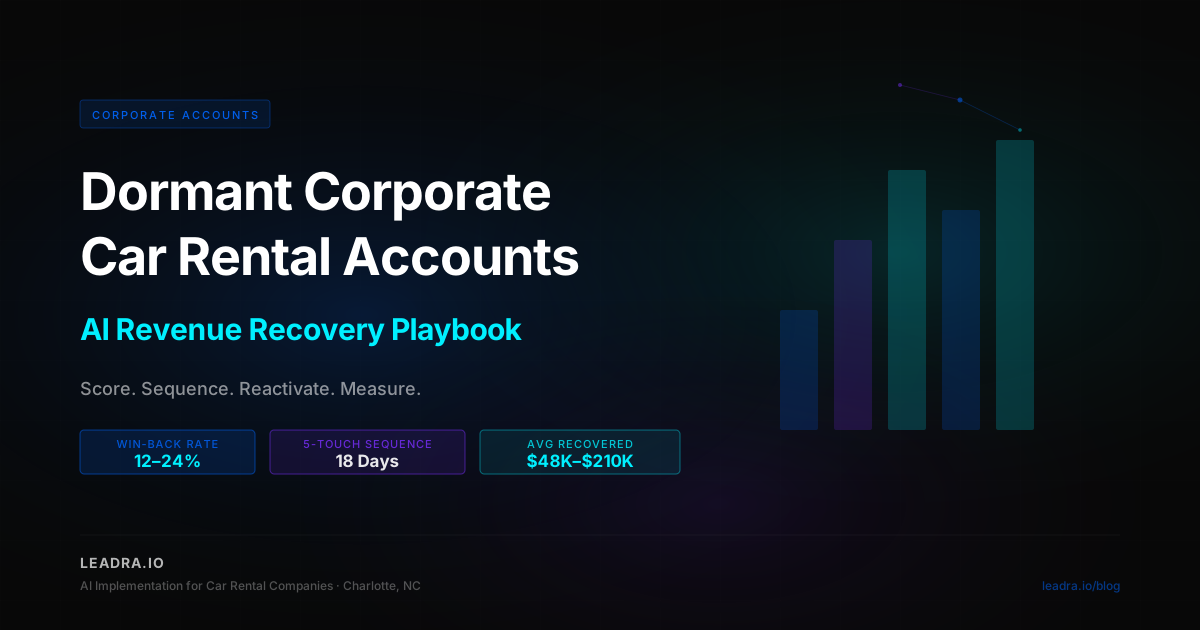
A mid-size operator with 40-80 dormant accounts from the past 18 months should expect to recover 8-15 accounts per campaign cycle. At an average annual account value of $6,000-$14,000, that is $48,000-$210,000 in recovered recurring revenue. The campaign typically costs $1,200-$3,500 total.
See What's Sitting in Your Dormant Account List
Leadra.io runs corporate account reactivation campaigns for car rental operators across the US. We start with a free account audit — pull your CRM data, score your dormant accounts, and give you a realistic revenue recovery projection before you commit to anything.
Most operators are surprised by how much is recoverable. Call us at +1 (864) 721-8384 or visit our contact page to schedule the audit.
Get My Free Account Audit