Right now, 25-40% of your member base hasn't stepped foot in your gym in over 60 days. They're still paying — or recently stopped — and they're one well-timed message away from coming back.
According to IHRSA industry data, 67% of gym members rarely or never use their memberships. The average gym spends $200-$400 acquiring each new member, while a reactivated member costs a fraction of that — and often shows higher retention in their second stint because they already know the facility, the staff, and the routines.
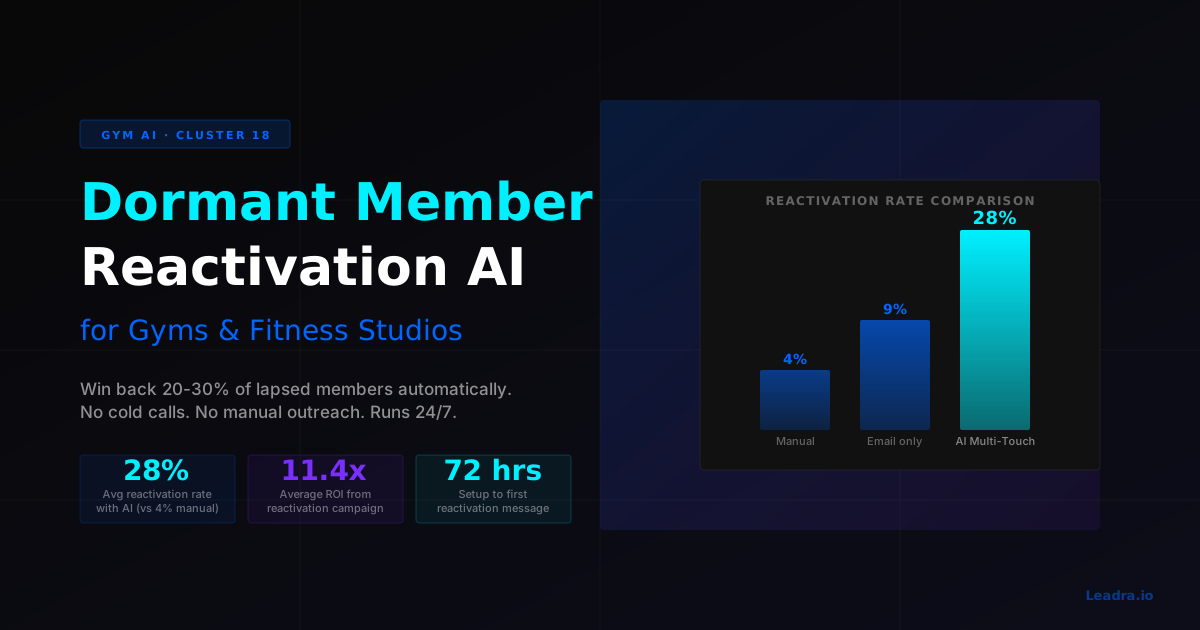
The problem isn't that dormant members don't want to come back. It's that most gyms do nothing to reach them. A monthly generic email blast that goes to 800 people gets a 4% reactivation rate at best. An AI-powered dormant member reactivation system that identifies lapsed members in real time, reaches them with personalized messages based on their visit history, and follows up 8-12 times over 30 days gets 20-35% of them back through the door.
This guide covers exactly how AI dormant member reactivation works for gyms and fitness studios, what a real implementation looks like, and the numbers a Charlotte fitness studio produced running the system in 2026.
Why Gyms Lose Members — and Why Traditional Reactivation Fails
Member churn at gyms follows a predictable pattern. A new member joins motivated, attends consistently for 4-8 weeks, then life interrupts — a travel schedule, a busy work month, a minor injury. They miss a week. Then two. By week six, the gym habit is broken. By week twelve, they feel awkward coming back after such a long absence. They cancel or quietly let the membership lapse.
The critical window to save this member is weeks four through eight — when they've started dropping off but still feel connected to the gym and their goal. Most gyms miss this window entirely because they don't have a system that detects the pattern in real time and triggers proactive outreach before it's too late.
Manual outreach doesn't scale
A front desk team managing 400+ members can't monitor visit frequency for everyone. By the time a manager notices someone hasn't been in, it's been 90 days — the hardest point to reactivate. Manual campaigns require staff time to pull reports, draft messages, and track responses. Most gyms do this once per quarter. That's not a retention strategy — it's damage control.
Generic emails get ignored
A blast email that says 'We miss you! Come back in for 20% off this month' goes to the same person who hasn't responded to your last four emails. It doesn't reference why they came to the gym, what classes they took, or how far they were from their goal. Generic outreach has a 3-5% reactivation rate because it treats every lapsed member the same, regardless of their history.
Timing is everything — and it's missed
Research on behavior change shows that motivation to return to a fitness routine spikes at the start of a new month, after a significant date (birthday, new year, season change), and after a triggering life event. AI systems can layer these timing signals into reactivation sequences. Manual outreach can't — it goes out when someone has time to send it, not when the member is most likely to respond.
AI dormant member reactivation solves all three failures simultaneously: it catches members early using real-time visit data, personalizes every message based on their history, and times outreach based on behavioral patterns — all automatically, without staff involvement.
How the AI Dormant Member Reactivation System Works — 5 Stages
Here's the five-stage system Leadra.io deploys for gyms and fitness studios. Each stage feeds into the next — the earlier a member is caught, the less intervention required to get them back.
Dormant member detection and segmentation
The AI connects to your gym management software and scans check-in data in real time. Members who haven't visited in 30 days enter a "cooling" segment. At 60 days they move to "at-risk." At 90+ days they're classified as dormant. Each segment gets a different outreach sequence — catching members early (30 days) produces the highest reactivation rate because the habit break is fresh and motivation is easier to reignite.
Personalized multi-touch outreach sequence
Each dormant member receives a sequence of 8-12 messages over 30 days — alternating SMS and email, with an optional AI voice call on day 7 for members who haven't responded. Messages reference their specific visit history ('You haven't been in since March — we miss you'), membership type, and any classes they previously attended. Generic blast campaigns get 3-5% open rates. Personalized sequences built on behavioral data get 35-55% open rates and 8-14% click-through rates.
AI voice outreach for high-value segments
For members on annual contracts, high-tier memberships, or those who've been dormant for 60+ days, the system triggers an AI voice call on a scheduled touchpoint. The AI voice agent identifies itself, references the member's history, and offers a specific incentive — a free class, a reset session with a trainer, or a membership freeze option. Calls that reach the member live have a 22-31% reactivation rate in Leadra.io deployments. No one on your staff has to make cold calls.
Incentive delivery and frictionless re-entry
The moment a dormant member responds — whether by clicking a link, replying to an SMS, or engaging with a voice call — the AI delivers a specific offer: a free week, a complimentary personal training session, or a pause-and-resume option for members who cite financial stress. The offer goes out with a direct booking link that pre-fills their information and routes to real-time class availability. Less friction at re-entry means higher follow-through from interested members.
Churn prediction to prevent future dormancy
After the reactivation campaign runs, the AI continues monitoring visit frequency for all members. When someone's visit cadence drops by 50% over two consecutive weeks — a leading indicator of churn 30-45 days out — the system automatically triggers a light re-engagement message before they fully go dormant. Catching churn early costs 60-70% less than full reactivation and has a higher success rate. The system turns reactive recovery into proactive retention.
The Compound Effect
Gyms that run all five stages — early detection, personalized sequences, voice outreach, frictionless re-entry, and predictive churn prevention — see 3-4x better outcomes than those that only run a basic email sequence. The system gets stronger over time as it learns which messages, timing patterns, and incentive types work best for your specific member base.
Manual Reactivation vs. AI: What the Numbers Actually Look Like
Most gym owners don't realize how much revenue is sitting in their dormant member list. Here's a direct comparison of what manual outreach produces versus an AI reactivation system:
| Factor | Manual Outreach | AI System |
|---|---|---|
| Detection of at-risk members | Monthly manual report pull | Real-time, automatic |
| Outreach triggers | Staff remembers to reach out | Automatic at 30/60/90 days |
| Personalization | Generic blast email | Behavioral data, visit history |
| Follow-up attempts | 1-2 average | 8-12 over 30 days |
| Voice outreach | Occasional cold calls | AI voice on day 7, no staff time |
| Reactivation rate | 3-6% | 20-35% |
| Staff hours per campaign | 8-15 hours/month | Under 1 hour (oversight only) |
| Monthly system cost | $0 (but 15+ lost members) | $600-$2,500 |
The real cost of not running an AI reactivation system isn't the system cost — it's the revenue lost from the 15-20 members per month who quietly churn out and don't come back because nobody reached out. At $60/month average dues, that's $10,800-$14,400 in annual recurring revenue walking out the door every year from a 400-member gym.
Case Study: Charlotte Fitness Studio Reactivates 87 Dormant Members in 60 Days
Client Story — Charlotte, NC
A boutique fitness studio in Charlotte's NoDa neighborhood came to Leadra.io in early 2026 with 423 active members, but analysis of their Mindbody data revealed that 168 of those members — 40% of the base — hadn't checked in for 60 or more days. Monthly dues were still being collected on most of them, but the studio owner knew cancellations were coming. Her staff had sent two generic email blasts in the past six months. Combined, they recovered 7 members.
Leadra.io connected to Mindbody via API and segmented the 168 dormant members by recency, membership tier, and class history. We launched three parallel reactivation sequences: a 30-day-dormant track (62 members), a 60-day track (71 members), and a 90+ day track (35 members). Each sequence used personalized SMS and email messages referencing specific classes and instructors. The 60-day and 90+ day tracks included AI voice outreach on day 7. Every active response triggered a direct booking link for a free return class or a complimentary 30-minute goal-reset session with a coach.
Dormant members targeted
168
168
Members reactivated
7 (prior 6mo)
87
Reactivation rate
4.2%
51.8%
Monthly revenue recovered
$5,220
System cost: $1,100/month · Average dues: $60/month · 87 reactivated members = $5,220/month recovered recurring revenue. Churn prevention module caught 23 additional at-risk members in month 2, preventing an estimated $1,380 in further losses. Total ROI month 1: 11.4x.
The most significant result wasn't the 87 reactivations — it was the behavior change on the studio's side. With the AI system now monitoring visit frequency in real time, staff stopped manually pulling dormant reports and started getting automated alerts when members entered the at-risk window at 30 days. Early-stage intervention costs a fraction of full reactivation.
The studio also found that reactivated members had a 68% retention rate over the following 90 days — higher than their average for new members — because they already knew the environment and had a personal connection to specific instructors.
How to Implement AI Member Reactivation at Your Gym: 3 Steps
You don't need a large team or a technical background to get this running. Here's the implementation path Leadra.io uses with gym clients:
Audit your dormant member list
Pull a report from your gym management software showing every member who hasn't checked in for 30+ days. Segment them into three buckets: 30-59 days (at-risk), 60-89 days (dormant), 90+ days (lapsed). Estimate the monthly dues value of each segment. For most gyms, this number is $3,000-$15,000 in at-risk recurring revenue — that's your baseline for evaluating ROI before you invest a dollar in the system.
Connect your gym software and define your sequences
Leadra.io integrates with Mindbody, Glofox, Pike13, ClubReady, ABC Fitness, and Zen Planner via API — setup takes 48-72 hours. You define the messaging tone and any specific incentives (free class, training session, pause option). The AI handles personalization using each member's visit history and membership data. You don't write 168 individual messages — you set the rules, the system executes.
Review results and tune the incentive structure
After the first 30-day campaign cycle, review which offers drove the highest response rate by segment. 30-day dormant members typically respond best to a simple 'we noticed you haven't been in' message with no discount. 90+ day lapsed members often need a more concrete offer — a free week, a training session, or a discounted rejoin rate. The system tracks conversion by message variant and adjusts automatically, but your input on the incentive value is important in the first two cycles.
Most gyms are up and running their first reactivation campaign within a week of starting. See also: best AI for gym owners and member retention and AI lead generation for local businesses for related systems that complement reactivation.
The Economics: Why Reactivation Beats New Member Acquisition Every Time
The average gym spends $200-$400 to acquire a new member — factoring in ad spend, referral incentives, tour staff time, and onboarding. A reactivated member costs $30-$80 to win back through an AI system. They require no onboarding. They already know your layout, your instructors, and your culture. And they have a track record in your system that lets you predict which classes and offerings will keep them engaged.
The math is straightforward. A gym with 400 members and 25% dormancy (100 dormant members) has $6,000/month in dues sitting in their existing database. An AI reactivation system at $1,100/month that recovers 28% of them — 28 members at $60/month each — generates $1,680/month in recovered recurring revenue. Month-one ROI: 1.5x, growing to 10x+ as the reactivated members stay active and the churn prevention module reduces future losses.
Compare this to spending the same $1,100 on Google Ads for new members. At $200-$400 cost per acquisition, that budget buys 3-5 new members — members who need onboarding, who have a 30-40% first-year churn rate, and who start at zero relationship with your studio. Reactivation wins on economics every time for gyms with any meaningful member base.
Frequently Asked Questions
How does AI dormant member reactivation work for gyms?
AI dormant member reactivation works by connecting to your gym management software (Mindbody, Glofox, Pike13, etc.) and automatically identifying members who haven't visited in 30, 60, or 90+ days. The system then launches personalized multi-touch campaigns via SMS, email, and AI voice outreach — using visit history and membership tier to customize each message. Members who respond get routed to a booking link or a staff follow-up call. The entire process runs automatically, 24/7, without manual intervention from your team.
What percentage of dormant gym members can AI reactivation win back?
Gyms using AI-powered dormant member reactivation typically win back 20-35% of their lapsed member base, compared to 3-6% with manual outreach or basic email campaigns. The improvement comes from three factors: speed of detection (AI catches at-risk members earlier), personalization (messages reference their specific visit history and membership type), and persistence (AI runs 8-12 touches over 30 days, while manual outreach rarely exceeds 2-3 attempts).
How much does an AI member reactivation system cost for a gym?
AI member reactivation systems for gyms and fitness studios typically cost between $600 and $2,500 per month depending on member count, integration complexity, and whether voice outreach is included. For a gym with 400+ active members and a monthly dues rate of $50-$80, a single reactivation campaign recovering 25-30 members covers the system cost 2-4x over. Most gyms see positive ROI within the first 30-day campaign cycle.
What gym management software does AI reactivation integrate with?
AI member reactivation systems built by Leadra.io integrate with Mindbody, Glofox, Pike13, ClubReady, ABC Fitness, Zen Planner, and most gym software platforms that expose an API or webhook. Integration typically takes 48-72 hours. Once connected, the AI reads check-in history, membership status, and contact data in real time — no manual data exports needed.
Your Dormant Members Are Ready to Come Back — They Just Need a Reason
The most valuable growth lever for most gyms isn't a bigger ad budget or a new class format. It's the 25-40% of existing members who've drifted away and would return if someone reached out at the right moment with the right message.
AI dormant member reactivation removes the two main barriers to making that happen at scale: the staff time required to identify and contact every at-risk member, and the personalization required to make the message land. The system runs automatically, personalized at scale, every day — catching members in the at-risk window before they fully churn, and running recovery campaigns for those who already have.
Leadra.io deploys AI member reactivation systems for gyms and fitness studios with a full integration setup and ongoing optimization. We back every engagement with a results guarantee — you don't pay if the system doesn't produce measurable reactivations.
Free Dormant Member Audit
See Exactly How Much Revenue Is Sitting in Your Dormant Member List
30-minute audit. We'll analyze your member data, quantify the dormant revenue at risk, and project the ROI of an AI reactivation system before you commit to anything.
Leadra.io
AI marketing agency — Charlotte, NC · Published June 1, 2026