Single-practice ROI case studies get thrown around a lot. What doesn't get discussed enough is what happens when you try to run the same AI marketing system across five locations with five different front desk teams, five PMS configurations, and five different starting points.
This post walks through a 6-month AI marketing rollout for a 5-location dental support organization (DSO) in the Carolinas — three general practices and two pediatric offices under shared ownership. It covers the group-wide numbers, the location-by-location variance, the specific mistakes that slowed month one and two, and the corrected playbook that got every site producing by month four.
If you operate more than one dental location, the single-practice math in most ROI content doesn't translate directly. Multiplying one location's results by five is not how DSO rollouts actually perform — this case study shows why, and what to do about it.
The Group: 5 Locations, 3 PMS Configurations, One Front Office Standard
Locations
5 sites
Combined monthly collections
$610K/mo
Active patients
~9,200
PMS platforms
Dentrix + Open Dental
The group had grown through three acquisitions over four years. Two original locations ran Dentrix with clean, consistent data entry going back a decade. Two acquired locations ran Open Dental with inconsistent patient status tagging. The fifth — the most recently acquired pediatric office — had a mix of paper charts and PMS records that had never been fully reconciled. Corporate wanted one AI marketing system across all five sites, with one dashboard, one reporting standard, and predictable per-location economics.
That single-dashboard goal is exactly where most DSO rollouts run into trouble — and exactly where this one did too.
Months 1-2: What Actually Slowed the Rollout
Corporate wanted a simultaneous launch across all five locations on day one. That decision cost roughly six weeks of underperformance before the group pivoted to a phased approach.
Bad phone numbers at the two Open Dental sites
A data audit run after week two found 14% of active patient records at the two acquired locations had disconnected or wrong phone numbers, versus 3% at the original Dentrix sites. Every automated SMS and voice touchpoint sent to a bad number wasted the sequence and inflated apparent failure rates.
Duplicate patient records at the pediatric acquisition
The fifth location had roughly 380 duplicate patient entries from the incomplete PMS migration. Dormant patient reactivation campaigns contacted some families twice with different offers, creating confusion and two written complaints in the first three weeks.
Front desk teams not briefed before launch
Two locations' front desk staff didn't know the AI voice system was going live and were caught off guard when patients mentioned it on calls. Staff buy-in matters — a front desk team that doesn't understand the system will undermine it, intentionally or not.
One blended dashboard hid two failing locations
The group-wide dashboard showed a respectable 7x ROI at day 30 — but that blended two strong-performing original locations with two underperforming acquired sites and one location that hadn't meaningfully launched yet. Corporate didn't see the per-location gap until location-level reporting was requested in week five.
None of these problems were caused by the AI systems themselves. They were rollout sequencing mistakes — launching everywhere at once before verifying data quality and briefing staff. Every one of them was fixable, and fixing them became the actual playbook for months 3-6.
The Correction: Pausing, Cleaning Data, and Phasing the Relaunch
At the start of month two, the group paused new automated outreach at the two underperforming locations and ran a two-week data cleanup: a full phone number verification pass, a duplicate-record merge at the pediatric site, and a 30-minute staff briefing at every location explaining what patients would experience and how to answer questions about it.
The relaunch was phased instead of simultaneous. The two original Dentrix locations — already performing well — kept running and became the reference benchmark. The two Open Dental sites relaunched in week seven with clean data. The pediatric site relaunched last, in week nine, once the record merge was verified complete.
This staggered approach meant no location launched on unverified data twice. By month four, all five locations were running the same core stack: AI voice answering with PMS integration, treatment plan follow-up sequences, dormant patient reactivation, and AI-managed Google review collection. The pediatric site added a fifth layer — automated appointment reminders tuned for parent schedules rather than patient schedules.
6-Month Results by Location
| Location | Launch cohort | Month 6 added revenue | Month 6 ROI |
|---|---|---|---|
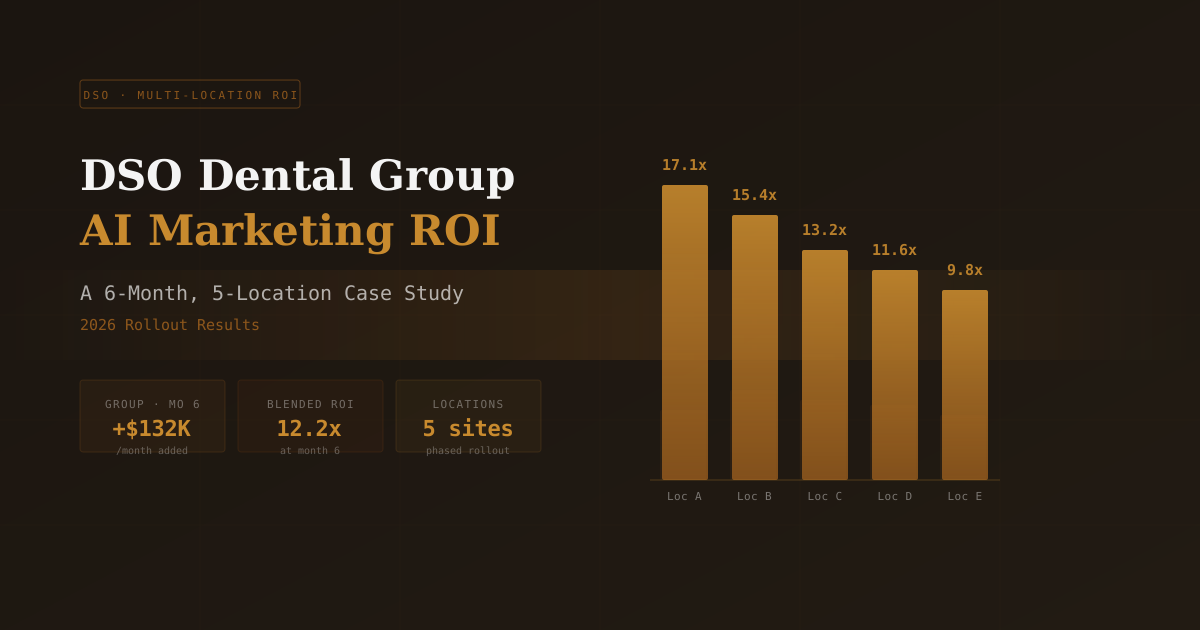
| Location A (Dentrix, original) | Week 1 | $34,200 | 17.1x |
| Location B (Dentrix, original) | Week 1 | $29,600 | 15.4x |
| Location C (Open Dental, acquired) | Week 7 | $26,800 | 13.2x |
| Location D (Open Dental, acquired) | Week 7 | $22,100 | 11.6x |
| Location E (pediatric, acquired) | Week 9 | $19,400 | 9.8x |
Group-wide month 6 added revenue: $132,100 against a blended monthly investment of $10,850 across all five locations (per-location retainers scaled with size, from $1,650 to $2,600, plus shared infrastructure and reporting costs). Blended group ROI: 12.2x.
The 7.3-point spread between the top location (17.1x) and the bottom location (9.8x) is the number corporate cares about most going into year two. It is not a failure — it is the expected gap between a decade of clean data and a nine-week-old data cleanup. The trend line matters more than the snapshot: Location E's ROI grew from 4x in month 4 to 9.8x in month 6 and is still climbing. See the full multi-location rollout framework.
What This DSO Would Do Differently Next Time
The group's ops director summarized the lesson for the next acquisition rollout in four points, and they apply to any multi-location dental group considering AI marketing:
None of these fixes require slowing the AI marketing rollout down significantly — a data audit and staff briefing add roughly one week per location. What they prevent is the six weeks of underperformance this group experienced by skipping straight to a simultaneous five-location launch. See how to evaluate a vendor's DSO rollout process.
FAQ: AI Marketing ROI for DSOs and Multi-Location Dental Groups
How is DSO AI marketing ROI different from a single dental practice?
A single practice measures ROI against one PMS, one front desk, and one patient base. A DSO measures ROI across a portfolio — the average across five locations means little if two locations are producing 20x and one is producing 2x. DSO ROI reporting needs location-level breakdowns, not just a blended group number, or underperforming sites stay hidden inside a good-looking average.
What causes the slow start most DSOs see in month one and two of an AI marketing rollout?
Inconsistent PMS data across locations is the most common cause. Practices acquired at different times, using different PMS platforms or configurations, have data quality gaps — missing phone numbers, outdated patient statuses, duplicate records. Cleaning this data before automation goes live prevents wasted outreach and inflated failure rates in the first 60 days.
Should a DSO roll out AI marketing to all locations at once or phase it in?
Phase it in. Deploy to one or two pilot locations first, fix data and workflow issues discovered there, then roll the corrected playbook to the remaining locations over 30-45 days. A simultaneous all-location launch multiplies any configuration mistake by the number of sites before anyone notices the problem.
What ROI should a multi-location dental group expect by month six?
A well-executed rollout typically reaches 10x-16x blended ROI by month six, after a slower first two months during data cleanup and phased deployment. Individual locations vary — high-backlog sites with large unscheduled treatment lists outperform newer or smaller locations early on, and the gap narrows as recall and acquisition systems mature across the group.
Get Your Multi-Location Rollout Plan
Rolling Out AI Marketing Across Multiple Dental Locations?
Share your location count, PMS platforms, and acquisition history — Leadra.io will build a phased rollout plan and per-location ROI projection built around how your group actually operates.