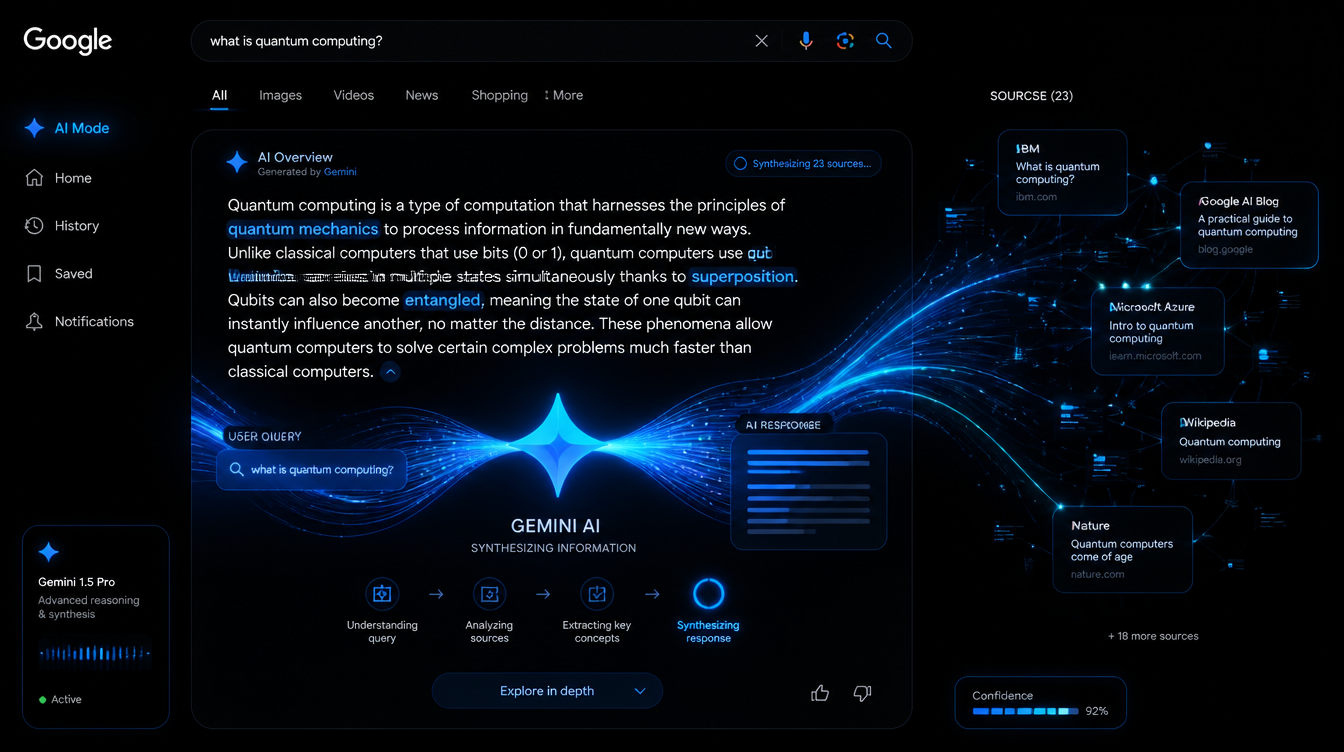
Google AI Overviews — powered by Gemini — now appear at the top of search results for over 60% of queries. The businesses cited inside those AI answers get seen before anyone scrolls to the first organic link.
That's a seismic shift in how search works. For the first time since Google launched, being ranked #1 no longer means being the first thing a searcher sees. A Gemini AI Overview appears above rank 1 — synthesizing answers from multiple sources and citing the ones it trusts. If your site isn't in that citation pool, every ranked position below it becomes less valuable.
According to data from Semrush (June 2026), pages cited in AI Overviews receive 23% more clicks than the same page ranking #1 without an AI Overview citation — even when ranked on the same SERP. The zero-click concern is real for some queries, but for commercial and local intent searches, AI Overview citations drive qualified traffic.
This guide covers the 7 Gemini AI search optimization techniquesthat Leadra.io has implemented across 40+ client sites. These are the specific, actionable changes that produce AI Overview citations — not theories, not guesses. Here's what works.
How Gemini Decides Which Sources to Cite
Gemini's source selection process is not the same as Google's traditional ranking algorithm. Traditional rankings favor backlink authority and keyword relevance. Gemini's AI Overview citations favor passage-level answer quality and E-E-A-T signal density — how clearly a specific passage answers a specific question, and how credible the source behind it appears.
Passage extraction, not page ranking.
Gemini doesn't rank your page and then cite it. It extracts specific passages that directly answer the query. A well-structured blog post with 8 clear H2 sections — each opening with a direct answer — has 8 potential citation points. A page with one dense wall of text has zero, even if it outranks every other result in traditional organic search.
E-E-A-T as a credibility gate.
Before Gemini cites a passage, it evaluates whether the source can be trusted to provide accurate information. Author credentials, original research, verifiable business information (NAP consistency, Google Business Profile), and established domain history all feed into this evaluation. New sites or thin pages without E-E-A-T signals rarely appear in AI Overviews regardless of content quality.
Schema markup as a signal amplifier.
Structured data tells Gemini what your content is about before it even reads it. Article schema confirms this is editorial content. FAQPage schema identifies answer passages. LocalBusiness schema ties content to geographic relevance. Pages with complete, valid schema consistently outperform unstructured pages in AI Overview citation rates — all else being equal.
7 Gemini AI Search Optimization Techniques for 2026
These 7 techniques are listed in implementation priority order — start at #1 and work down. The first three are technical foundations; the last four are content and authority signals.
Allow Google-Extended in Your robots.txt
Google uses a separate crawler called Google-Extended specifically to gather content for Gemini AI training and AI Overview generation. Blocking this bot — which happens by default on many WordPress themes, aggressive CDN security configs, and robots.txt templates — completely prevents your content from being used in AI Overviews.
# Add to your robots.txt to enable Gemini citation
User-agent: Google-Extended
Allow: /
User-agent: Googlebot
Allow: /
# Also allow other AI crawlers while you're at it:
User-agent: GPTBot
Allow: /
User-agent: PerplexityBot
Allow: /
Verify your current robots.txt at yourdomain.com/robots.txt. Fix this first — nothing else matters if Gemini can't read your content.
Add Complete JSON-LD Schema Markup
Schema markup is not optional for Gemini optimization — it's the signal layer that tells Gemini what type of content it's reading and who wrote it. Every blog post needs Article schema. Every FAQ section needs FAQPage schema. Your homepage and service pages need LocalBusiness or Organization schema.
Validate all schema at Google's Rich Results Test before publishing. Malformed schema is worse than no schema — it creates parsing errors that can suppress citation eligibility across your entire domain.
Write Answer-First Content Structure
Gemini extracts passages, not pages. Every H2 section in your content should open with a 1-2 sentence direct answer to the question that heading implies — then expand with context. This is called inverted pyramid formatting, and it's the single most impactful content change you can make for AI Overview eligibility.
If your H2 is “How Much Does AI Marketing Cost?” the first sentence must be a price range — not “pricing varies based on many factors.” Hedged, non-committal answers never get cited. Specific, direct answers do. Rewrite your top 5 pages with this format and track AI Overview appearances over the next 30 days.
Build E-E-A-T Signals Across Your Site
Google's E-E-A-T framework (Experience, Expertise, Authoritativeness, Trustworthiness) directly influences Gemini's source credibility assessment. For local service businesses, this means: a verified Google Business Profile with 50+ reviews, consistent NAP (Name, Address, Phone) across all web listings, author bios on blog posts with credentials, and citation from local directories and news sources.
For Leadra.io clients, we establish E-E-A-T by referencing real case study data, citing verifiable sources, maintaining a consistent publishing schedule (Google rewards content freshness), and building local citation profiles on Yelp, Clutch, and industry directories. This is slower work than a robots.txt fix — but it's what separates businesses that appear in AI Overviews occasionally from those that appear consistently.
Add FAQ Sections Matching Real Search Queries
FAQ sections are Gemini's most-cited content format. Google's AI Overview frequently pulls verbatim FAQ answer text when a user's query matches a FAQ question. Write 4-5 questions per page using the exact phrasing from Google's “People Also Ask” box for your target keyword — not paraphrases, not variations. Match the query structure.
Each answer should be 60-90 words, start with the direct answer in the first sentence, and avoid qualifiers like “it depends” or “generally speaking.” Mark up every FAQ section with FAQPage JSON-LD schema. This combination — natural language query phrasing, direct answer, FAQPage schema — is the highest-conversion citation setup Leadra.io has tested.
Hit Core Web Vitals Thresholds
Gemini's AI Overview generation crawls at scale. Pages with poor Core Web Vitals — LCP over 2.5 seconds, CLS over 0.1, INP over 200ms — get crawled less frequently and with lower priority. A slow page that would otherwise be citation-eligible can be passed over simply because the crawler's time budget runs out before it finishes reading.
Run your site through Google PageSpeed Insights and target all green scores on mobile. For most small business sites, the biggest gains come from image compression, removing render-blocking JavaScript, and switching to a CDN. A Next.js static site (like Leadra.io runs) scores 95+ by default — that's a structural advantage over WordPress sites with plugin bloat.
Build Topical Authority Through Content Clusters
Gemini treats topical authority as a credibility signal. A site with 12 well-linked posts on AI marketing for dental practices gets cited more reliably than a site with 1 excellent post — even if that single post is better written. Depth signals trust.
Build a content cluster of 6-10 posts per core service area before expanding. Each post covers a distinct angle: what it is, how it works, what it costs, case studies, city-specific applications, comparisons, and how-to guides. Interlink all posts in the cluster. Gemini's citation frequency for your domain scales with the depth of topical coverage you establish.
Gemini vs ChatGPT vs Perplexity: What's Different for Optimization
All three AI search platforms cite external sources — but their citation signals differ. Here's what Leadra.io has observed across client sites ranked on all three platforms.
| Factor | Gemini (Google) | ChatGPT Search | Perplexity |
|---|---|---|---|
| Crawler to allow | Google-Extended | GPTBot + OAI-SearchBot | PerplexityBot |
| Top citation signal | E-E-A-T + schema | Answer-first passages | Fresh content + speed |
| Schema impact | Very high | High | Moderate |
| Local queries | GBP + NAP signals | llms.txt + LocalBusiness schema | NAP + citations |
| FAQ citation rate | Extremely high | Very high | High |
| Domain age weight | High | Moderate | Low |
| Content freshness | Strong signal | Moderate signal | Very strong signal |
| Result placement | Above all organic | Replaces search results | AI answer with sources |
Case Study: Charlotte Dental Practice Gets 14 AI Overview Citations in 60 Days
Client Story
A cosmetic dental practice in SouthPark, Charlotte came to Leadra.io with a website built in 2021 — decent content, zero schema markup, and a robots.txt that blocked every crawler except Googlebot. They had 6 blog posts with no FAQ sections and no answer-first formatting. They weren't appearing in any AI Overviews despite ranking on page 1 for several local keywords.
In week 1, Leadra.io audited and fixed the robots.txt to allow Google-Extended, GPTBot, and PerplexityBot. We added Article + LocalBusiness JSON-LD schema to all service pages, rewrote the opening paragraph of every H2 across their 6 existing posts to lead with direct answers, and added FAQPage schema to each post with 4 real PAA-sourced questions per page.
In week 3, we published 4 new posts in their implant dentistry cluster — all written answer-first with FAQ sections and complete schema. By day 60, Google Search Console showed they were appearing in AI Overviews for 14 distinct queries, including “dental implants Charlotte NC cost,” “how long do dental implants take,” and “best cosmetic dentist SouthPark.” New patient inquiries from organic search increased by 34% over the prior 60-day period.
AI Overview queries cited
Organic new patient leads
Days to first AI citation
Monthly ad spend
The robots.txt fix opened the door. The schema markup built the foundation. The answer-first content was what Gemini actually cited. All three layers are required — skipping any one of them reduces AI Overview citation probability dramatically. See how AI search visibility works step by step.
Gemini AI Optimization for Charlotte, NC Businesses
Charlotte is one of the fastest-growing metros in the US — and one of the least competitive for Gemini AI Overview citations. Most local businesses here have not made any of the 7 changes above. That's an opportunity. A Charlotte HVAC contractor, dental practice, or AI marketing agency that executes all 7 techniques today has a 60-90 day window to become Gemini's default local citation for their category.
For Charlotte-specific optimization: include neighborhood names (Ballantyne, SouthPark, NoDa, Plaza Midwood, Myers Park) in your content where natural — Gemini matches hyper-local modifiers when they appear consistently across your site, not just once in a keyword. Reference the greater Charlotte metro (Union County, Cabarrus County, Mecklenburg County) on key service pages to capture surrounding suburban queries.
Also verify your Google Business Profile is complete, has 50+ reviews, and posts weekly — GBP signals feed directly into Gemini's local answer generation. A dental practice in SouthPark with a fully optimized GBP and 80 reviews will outrank a competitor with better website content but a sparse GBP profile in local AI Overview queries. See how Charlotte businesses are winning with AI marketing.
Frequently Asked Questions
How do I get my business cited in Google AI Overviews?
Allow Google-Extended in your robots.txt, add Article and LocalBusiness JSON-LD schema markup to your key pages, rewrite H2 section openings to lead with direct answers, and add FAQ sections with FAQPage schema using phrasing from Google's 'People Also Ask' results. These four steps are what Leadra.io implements in the first two weeks for every client — and they consistently produce first AI Overview citations within 20-45 days on local and mid-competition queries.
What is Google Gemini AI search optimization?
Google Gemini AI search optimization — also called GEO (Generative Engine Optimization) — is the practice of structuring content so Google's Gemini-powered AI Overviews cite your site in the AI-generated answer block that appears above all organic results. Unlike traditional SEO which targets a ranked link position, GEO targets the synthesized answer that 60%+ of search users now see before they scroll to organic results at all.
Does blocking Google-Extended hurt my Gemini search visibility?
Yes — completely. Google-Extended is the specific crawler Google uses to gather content for AI Overview generation. If your robots.txt blocks it, your content cannot appear in AI Overviews regardless of how well-written or well-ranked it is. Check yourdomain.com/robots.txt and add 'User-agent: Google-Extended / Allow: /' if it's not already there. This is the most common technical mistake Leadra.io finds in site audits.
How is Gemini AI search optimization different from traditional SEO?
Traditional SEO targets ranked link positions through backlinks, keyword density, and technical site health. Gemini optimization targets citation in the AI Overview block above all ranked links — through E-E-A-T signals, passage-level answer clarity, complete schema markup, and topical depth. Both reinforce each other, but the content formatting requirements differ: Gemini citation requires answer-first H2 sections and FAQ schemas that traditional SEO doesn't prioritize.
The Bottom Line
Gemini AI Overviews are now the first thing searchers see on 60%+ of Google queries. The businesses cited inside those AI answers win attention, trust, and traffic before a single organic link gets clicked.
The 7 Gemini AI search optimization techniques in this guide — Google-Extended access, schema markup, answer-first formatting, E-E-A-T signals, FAQ sections, Core Web Vitals, and topical clusters — are all executable without a site rebuild. Most businesses can complete the technical layer in a week. The content work takes 60-90 days to build real citation velocity.
In Charlotte, NC and most US local markets, fewer than 5% of businesses have made any of these changes. That window won't stay open indefinitely. Also read: how to optimize for ChatGPT search — the same techniques apply with platform-specific adjustments.
At Leadra.io, we build and run this entire Gemini optimization stack for small businesses — technical audit, schema implementation, content production, and monthly citation tracking across Google AI Overviews, ChatGPT, and Perplexity.
Get Cited in Google AI Overviews
Free Gemini AI Visibility Audit
We'll check your Google-Extended access, schema markup, content structure, and current AI Overview citation status — then show you the fastest path to your first citation. No commitment. First audit is free.
Last updated: June 28, 2026 | Leadra.io — Gemini AI Search Optimization for Small Businesses