You searched “GoHighLevel vs HubSpot vs Salesforce for small business” because you're tired of managing leads in spreadsheets, losing follow-ups, and watching competitors book the clients you should be closing. The question is which platform solves that — and whether any of them are worth the setup headache.
The short answer: GoHighLevel wins for most local service businesses on paper, HubSpot wins for B2B companies with marketing teams, and Salesforce is almost never the right call for a small business. But there's a more important question underneath all three: are you buying a tool you'll actually use, or a tool that sounds impressive in a demo and sits half-configured six months from now?
At Leadra.io, we've worked with dental practices, law firms, HVAC companies, and service businesses across the US who tried all three of these platforms before coming to us. We've seen what works, what gets abandoned, and what the actual cost difference is once you account for setup time and ongoing management. Here's the real comparison.
If you want us to assess which system makes sense for your specific business, book a free 30-minute audit at Leadra.io. But first — the full breakdown.
GoHighLevel: Built for Agencies, Adapted for Service Businesses
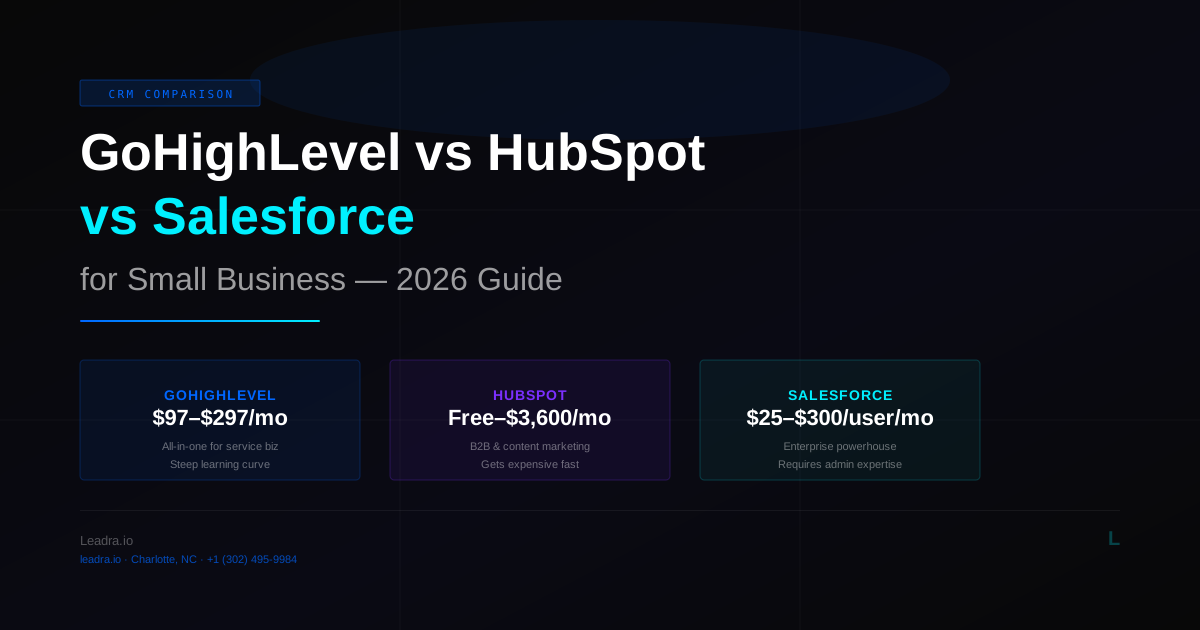
GoHighLevel launched in 2018 as a white-label platform for marketing agencies. It bundles CRM, email, SMS, two-way texting, funnels, website builder, call tracking, appointment scheduling, and reputation management into a single dashboard at $97-$297/month.
For a service business comparing GoHighLevel vs HubSpot vs Salesforce, the pricing is hard to beat. At $297/month, you get SMS automation, missed call text-back, review request sequences, and a functional CRM — tools that would cost $800-$2,000/month on HubSpot or require custom Salesforce development.
The catch is setup complexity. GoHighLevel has a steep learning curve. Most service business owners need 20-40 hours just to configure the automations correctly, set up their phone number, connect their calendars, and build their first follow-up sequence. If you make a mistake — and most first-timers do — leads fall through the cracks before you notice.
GoHighLevel — Bottom Line
Best option among the three for local service businesses that have a technical team member or agency partner to build and maintain the system. Not a good fit for owners who want plug-and-play results without ongoing configuration time.
HubSpot: The Polished Platform That Gets Expensive Fast
HubSpot is the best-designed CRM on this list. The interface is clean, onboarding is smoother than competitors, and the free tier is genuinely useful for basic contact management. It excels for B2B companies that rely on content marketing — blogs, email newsletters, gated offers — to attract and nurture leads over longer sales cycles.
For service businesses, HubSpot has a pricing problem. The features a dental practice or law firm actually needs — automated follow-up sequences, custom lead scoring, call logging, advanced reporting — require HubSpot Sales Hub Professional or higher, which starts at $800-$1,600/month and scales up with contact volume. By the time you add the marketing tools, you're looking at $2,000-$3,600/month for a complete stack.
HubSpot also doesn't include SMS automation, voice, or reputation management natively. You need third-party integrations — which add cost and create sync issues. For an HVAC company or dental practice where SMS response speed is the difference between winning and losing a client, that's a meaningful gap.
HubSpot — Bottom Line
Good fit for B2B service businesses (consultants, agencies, SaaS companies) with dedicated marketing staff and budgets above $1,500/month. Not cost-efficient for local service businesses where SMS, voice, and appointment booking are primary requirements.
Salesforce: Enterprise Software That Most Small Businesses Shouldn't Touch
Salesforce is the most powerful CRM on this list and the worst fit for most small businesses. It was built for enterprise sales organizations with dedicated Salesforce admins, six-figure implementation budgets, and complex, multi-stage sales pipelines. A small service business using Salesforce is like buying a semi-truck to deliver pizza — technically works, but you're paying for capacity and complexity you'll never use.
The pricing tells the story. Salesforce Starter runs $25/user/month but is so limited it's essentially a contact list. Sales Cloud Professional — the minimum tier with real automation — costs $75-$150/user/month. At three users, that's $225-$450/month before integrations, before SMS tools, before implementation costs. A certified Salesforce administrator charges $75-$150/hour, and a basic small business setup typically takes 40-80 hours.
A 2024 Gartner survey found that 55% of CRM implementations fail to meet their stated goals — with failure rates highest among small businesses deploying enterprise platforms. The reason is almost always the same: the platform was configured once, rarely maintained, and the team reverted to spreadsheets within six months.
Salesforce — Bottom Line
Appropriate for companies with dedicated sales teams of 10+, complex multi-stage pipelines, and budget for ongoing admin support. Almost never the right call for local service businesses with under 5 salespeople and under $5M revenue.
GoHighLevel vs HubSpot vs Salesforce: Full Comparison Table
| Metric | GoHighLevel | HubSpot | Salesforce |
|---|---|---|---|
| Starting price | $97/mo | Free (very limited) | $25/user/mo |
| Full feature cost | $297/mo | $800–$3,600/mo | $150–$300/user/mo |
| Setup time | 20–40 hours | 10–20 hours | 40–100 hours |
| SMS automation | Built in | Paid add-on | Separate product |
| Voice / call tracking | Built in | Paid integration | Comm. Cloud ($$$) |
| Reputation management | Built in | Not included | Not included |
| Funnel builder | Built in | Basic (paid) | Not included |
| Admin required | No (but technical) | No (if basic) | Yes (certified) |
| Best fit | Agencies, local service | B2B, content marketing | Enterprise sales teams |
The table above shows the on-paper comparison. The column you don't see is “time you personally spend managing this system every month.” For a small business owner, that number is real — GoHighLevel typically requires 5-10 hours/month of active management, HubSpot 3-7 hours, Salesforce 8-15 hours if you're maintaining it yourself. That's time away from running your business.
The Real Problem: All Three Require You to Build the Automations
Here's the part the platform demos don't show you: GoHighLevel, HubSpot, and Salesforce are all tools. They don't come with working automations for your industry. You have to build your lead capture workflows, write your follow-up sequences, configure your appointment reminders, and test everything before a single real lead goes through the system.
Then you have to maintain it. When a campaign underperforms, you diagnose it yourself. When a third-party integration breaks, you fix it. When your team grows and your pipeline changes, you reconfigure the system. Most small business owners don't have the bandwidth for this — which is why so many CRM implementations end with the platform open in a browser tab that nobody looks at.
According to Salesforce's own 2025 State of CRM report, only 47% of CRM features purchased by small businesses are actively used. The rest sits idle. You're paying for capability you never capture because you ran out of time to build it.
That's the gap between a CRM platform and a done-for-you AI automation system. The platform gives you the tools. The system gives you the result — without requiring you to become a marketing automation specialist to use it.
Case Study: Charlotte HVAC Company Ditches GoHighLevel for AI Automation
Client Story — Charlotte, NC
A Charlotte HVAC company signed up for GoHighLevel in 2024 after seeing it recommended in a contractor Facebook group. They paid $297/month and spent 30+ hours with a freelancer building out their workflows. The result: a system that mostly worked, except for a SMS opt-out issue that got flagged by their carrier and paused their outbound texting for three weeks during peak summer season.
After the carrier issue, they never rebuilt the SMS flows correctly. They were using GoHighLevel as a contact list and manually calling leads — the exact problem they were trying to solve. They were generating 55 inbound leads per month and closing 14 of them.
We audited their lead flow, found that 60% of non-closed leads had received zero follow-up after the first call attempt, and deployed Leadra.io's AI system: sub-60-second text response, a 10-touch follow-up sequence over 14 days, and an AI voice agent for after-hours calls. We handled the carrier compliance, the sequence writing, and all ongoing maintenance. Monthly cost: $1,800.
Leads/month
55
55
Close rate
25%
48%
Jobs booked/mo
14
26
Days to ROI
31
12 additional jobs/month at $1,400 average ticket = $16,800 additional monthly revenue. Monthly Leadra.io cost: $1,800. ROI: 9.3x by month 2.
The problem wasn't GoHighLevel. It's a capable platform. The problem was that running GoHighLevel correctly is a part-time job — one this HVAC owner didn't sign up for. The platform was right. The model was wrong.
Which Platform to Choose: A Decision Framework
Here's how to think through the GoHighLevel vs HubSpot vs Salesforce decision for a small business:
Choose GoHighLevel if:
You run a local service business (home services, medical, legal, fitness)
You have a technical team member or an agency to build and maintain it
You want SMS, voice, funnels, and reputation in one tool under $300/month
You can invest 20-40 hours in initial setup and 5-10 hours/month ongoing
Choose HubSpot if:
You run a B2B company with a dedicated marketing or sales coordinator
Content marketing (blog, email, gated offers) is a primary acquisition channel
Your sales cycle is 30-90+ days and relationship-driven
Your budget for software is $1,500+/month and you want a clean UX
Choose Salesforce if:
You have 10+ salespeople with complex, multi-stage pipeline requirements
You need deep ERP or enterprise system integrations
You have budget for a certified Salesforce admin (full-time or contracted)
You are scaling toward $10M+ revenue and need enterprise-grade infrastructure
Consider a done-for-you AI system instead if:
You want results without becoming a CRM administrator
You need lead response under 60 seconds — automated, every time
You want 24/7 AI voice coverage for missed calls
You want everything built, maintained, and optimized for you
The fourth option is what most service business owners actually want but don't know exists: an AI-powered system where the automations are built for your industry, maintained by a team, and optimized based on real results. See how our AI marketing automation approach works, or review what AI implementation costs for a small business to understand the full comparison.
Frequently Asked Questions
Is GoHighLevel better than HubSpot for small service businesses?
For local service businesses — HVAC, dental, law firms, home services — GoHighLevel is generally the stronger fit because it was built for that use case. It includes SMS, voice, funnels, and reputation management in one platform. HubSpot is more powerful for B2B companies with content marketing teams and longer sales cycles. The catch with GoHighLevel is the setup time: expect 20-40 hours before you have working automations, and ongoing maintenance if your team isn't technical.
Why do most small businesses fail with Salesforce?
Salesforce is enterprise software priced and structured for large sales organizations. Small businesses typically pay $150-$300/user/month, require a certified Salesforce admin to configure it, and spend 40-100 hours on initial setup. Most small business owners end up using 10-20% of the platform's features while paying full price. A 2024 Gartner survey found that 55% of CRM implementations fail to meet their stated goals — and the failure rate is highest among small businesses deploying enterprise-grade tools.
How much does GoHighLevel vs HubSpot vs Salesforce cost for a small business?
GoHighLevel costs $97-$297/month for full features. HubSpot starts free but the features service businesses actually need (sequences, custom reporting, sales automation) require the Professional plan at $800-$1,600/month. Salesforce ranges from $25/user/month (Starter, very limited) to $150-$300/user/month for Sales Cloud Professional or Enterprise. Factor in setup time — 10-40+ hours — and the real cost of any of these platforms is significantly higher than the sticker price.
What do service businesses use instead of GoHighLevel, HubSpot, or Salesforce?
Many local service businesses — dental practices, HVAC companies, law firms, med spas — are moving to AI-powered automation platforms instead of DIY CRMs. Rather than building and managing their own sequences inside GoHighLevel or HubSpot, they use a done-for-you AI system that handles lead response (under 60 seconds), multi-touch follow-up, appointment booking, review collection, and SEO content. Leadra.io is one such platform, built specifically for service businesses in Charlotte NC and across the US.
The Honest Answer for Service Business Owners
Comparing GoHighLevel vs HubSpot vs Salesforce for small business isn't really a software question. It's a time question. All three platforms can work. None of them work without someone actively building and maintaining them. The business owners who get real results from CRM platforms are the ones who have a dedicated team member — internal or outsourced — doing that work.
If that's you, GoHighLevel is your best starting point for under $300/month. If it's not, the smarter move is a done-for-you AI system that generates the results — lead response, follow-up, bookings, reviews — without requiring you to become a platform expert.
Leadra.io builds and operates these systems for service businesses across Charlotte and the US. We back every engagement with a simple guarantee: 90 new patients or clients in 90 days, or you don't pay. Read more about what ROI to expect from AI marketing automation to see what the numbers look like in practice.
Free CRM Audit
Not Sure Which System Fits Your Business?
30-minute call. We'll look at your lead volume, close rate, and current tools — then tell you exactly which platform or system will generate the best ROI for your situation. No pitch. No obligation.
Leadra.io
AI marketing automation — Charlotte, NC · Published July 4, 2026