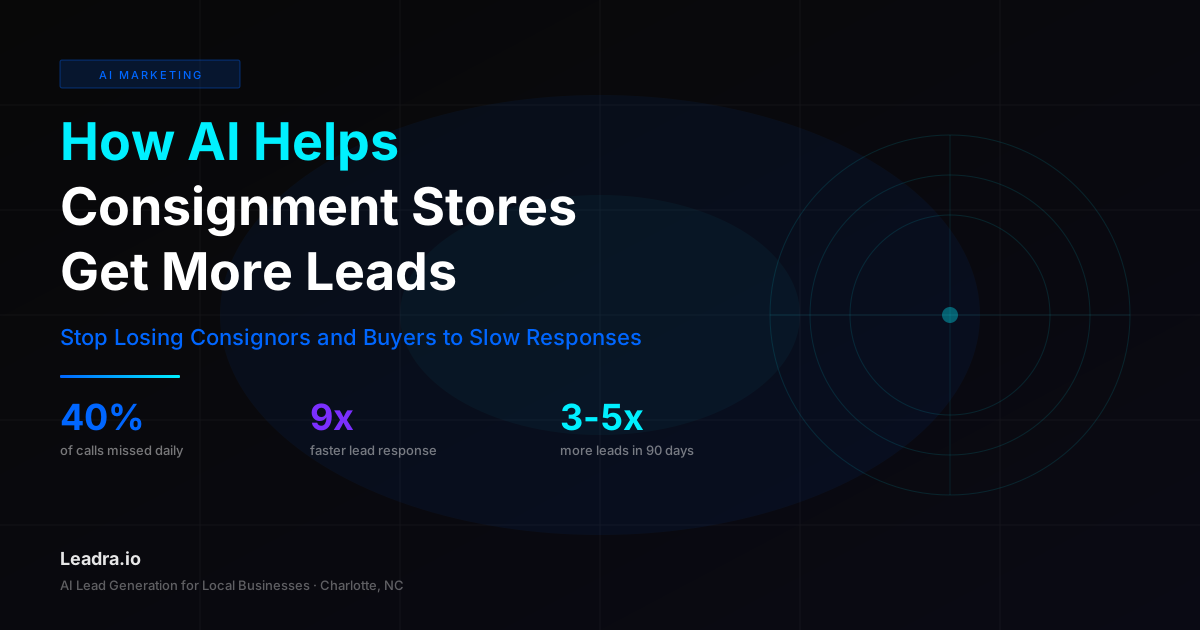
A person cleaning out their parents' house calls three consignment shops to find out who takes furniture. The first shop doesn't answer. The second goes to voicemail. The third picks up, asks a few questions, explains the commission structure, and books a drop-off appointment for Thursday. That third shop just got access to an entire house worth of inventory. The other two never knew the call came in.
Consignment stores face a lead problem that most retail businesses don't: it's two-sided. You need a constant flow of consignors bringing quality inventory, and you need buyers showing up to purchase it. Lose leads on either side and the whole model stalls. Research from Missed Call Text Back data shows the average small retail business misses 35-40% of inbound calls during business hours — and virtually all calls after 5pm. For consignment stores, every missed call is potentially a consignor with a houseful of items or a buyer ready to spend.
AI changes both sides of that equation. Modern AI lead systems answer every call, respond to every online inquiry, and follow up with both consignors and buyers automatically — 24 hours a day, without adding staff. This guide breaks down exactly how AI helps consignment stores get more leads and what results you can realistically expect in the first 90 days.
Why Consignment Stores Lose Leads From Both Sides
The two-sided model is what makes consignment stores unique — and it's also what makes lead management harder. A clothing boutique only needs to attract buyers. You need to attract the people who bring the inventory AND the people who come to buy it. When you drop the ball on either side, the business suffers.
On the consignor side: people ready to drop off items are impatient. They're often in the middle of a move, an estate cleanout, or a closet purge. They call a few shops, and they go with whoever responds fast and makes it easy. A missed call or a slow response means your competitor gets the inventory and the eventual commission on every sale.
On the buyer side: consignment buyers are thrifters, collectors, and deal hunters. They browse Marketplace, search Google for "consignment shops near me," and send DMs asking if you have specific items. They're not patient. If you don't respond quickly, they find the answer somewhere else — often from a competitor who has the same item or something close enough.
Where Consignment Store Leads Disappear
4-10
Calls missed per day (avg. consignment store)
65%
Inquiries that wait over 1 hour for a reply
71%
Consignors who go to a competitor after no answer
5 Ways AI Captures More Leads for Consignment Stores
Here are the five lead channels where consignment stores consistently lose business — and how AI closes each gap.
AI Voice Agent — Every Call Answered, 24/7
The single highest-impact change for most consignment stores. An AI voice agent answers every call — whether it's a consignor calling at 8pm after work to ask about drop-off hours, or a buyer calling Saturday morning to check if you have vintage Levi's. The AI handles questions about what you accept, your commission structure, pricing policy, and current inventory categories. For consignors, it books drop-off appointments. For buyers, it captures contact info and what they're looking for, then notifies you by text.
Consignment stores using AI voice agents typically recover 35-50% of previously missed calls as captured leads. If your store misses an average of six calls per day — half from consignors, half from buyers — and your average commission per consignor is $180 over 30 days, recovering even three consignor calls per day adds $16,000+ per month in gross merchandise value flowing through your store.
Facebook Marketplace and Messenger Automation
Consignment stores live on Facebook Marketplace. You're listing dozens of items per week, and every listing generates inquiries. "Is this still available?" "Can you hold it?" "What's the lowest you'll go?" Responding manually means someone on your team is tied up in Messenger all day — or worse, messages sit for hours while buyers go to the next listing.
AI Messenger automation responds to every inquiry within 60 seconds using pre-approved scripts. It confirms availability, answers pricing questions, handles holding requests, and asks when the buyer wants to come in. Research consistently shows a 9x higher inquiry-to-visit conversion rate when response time drops from hours to under five minutes. Stores running this automation see 30-50% more Marketplace inquiries convert to in-store sales visits.
Website Chatbot — Capture After-Hours Interest
Most consignment store websites show photos and list hours. Someone visits at 10pm after finding you on Google, browses your gallery, gets interested in a category — vintage clothing, mid-century furniture, designer bags — and has no easy way to signal intent. The contact form feels formal. They're not going to fill it out to ask if you have more Chanel pieces coming in. They just leave.
A website chatbot catches that moment. When a visitor spends time on a category page, the chatbot opens: "Looking for something specific? Tell me what you're after and I'll check what we have and what's coming in." It captures their name, email, phone, and what they want — then sends you an alert and drops them into a follow-up sequence. Stores with chatbots capture 4-6x more website contacts than those relying on contact forms alone. The same chatbot also handles potential consignors asking "do you take baby clothes" or "how does consignment work?" at midnight.
Consignor Reactivation — Your Warmest Inventory Source
Every consignment store has a list of past consignors — people who've already proven they trust you with their items. Most of them have more to sell. Life keeps generating stuff: seasonal wardrobe changes, kids growing out of clothes, home renovations, estate items, hobby gear that no longer gets used. The question isn't whether they have more to consign. It's whether they think of you first when they do.
AI reactivation campaigns reach out to past consignors who haven't brought items in 60-90 days with a personalized message: "We're actively looking for [their category] right now — bring in 15 or more items this month and we'll bump your commission to 55% for that batch." These campaigns convert at 25-35% because the message is relevant, the relationship already exists, and the incentive is concrete. The AI personalizes and sends 300 versions of that message in the time it takes your team to write one text.
Local SEO Content — Free Leads From Google
When someone searches "consignment stores near me," "where to sell used furniture in Charlotte," or "designer consignment shops [city]," they are a high-intent lead ready to take action. They're either a buyer with a specific item in mind or a consignor ready to drop something off. The stores that appear on page one of Google get those leads for free, every single day.
AI content systems publish 3-4 SEO-optimized blog posts and location pages per week targeting the searches your buyers and consignors actually make. Over 90 days, this builds rankings for 15-30 local search terms. Each new visitor from Google lands on your site and encounters the chatbot from channel three — turning organic search traffic directly into captured contact leads with zero additional ad spend.
The Full AI Lead Flow for Consignment Stores
Each channel works independently. But the real compounding effect happens when they feed into a single pipeline that handles both consignors and buyers — capturing intent and routing to you at exactly the right moment.
Discovery
A potential consignor finds your store through a Google search for 'where to sell vintage clothing near me.' A buyer finds a Marketplace listing. Both arrive through channels that AI keeps active and optimized around the clock.
Capture
First contact is captured — via AI voice agent, Messenger automation, website chatbot, or a social DM. The AI collects name, phone, email, and their intent (consignor or buyer). This data flows into your CRM automatically with a label indicating which side of the market they represent.
Qualify
For consignors, the AI asks qualifying questions: what category of items, approximate quantity, condition. For buyers, it asks what they're looking for and their budget range. High-intent contacts — a consignor with 50+ items, a buyer asking about a specific brand — get a real-time notification to your phone.
Follow Up
Leads who don't convert immediately enter automated sequences. Consignors get a follow-up 48 hours later with a reminder about your current commission rates and a booking link. Buyers get a message when new inventory in their category arrives. Each sequence runs on its own without anyone on your team managing it.
Convert
When a lead re-engages — a consignor clicks your booking link, a buyer replies asking if a piece is still available — you get a notification with their full history. You know exactly what they want and what stage they're at before you pick up the phone. That context closes more deals faster.
Retain
After a transaction, both consignors and buyers enter retention sequences. Past consignors get seasonal outreach when you're actively sourcing their category. Past buyers get alerts when relevant new inventory arrives. Repeat relationships are significantly cheaper to maintain than acquiring new ones, and the AI keeps them warm automatically.
What Consignment Stores Actually See After 90 Days
These aren't projections. These are the ranges consignment stores see when they replace reactive lead handling with an active AI system covering both sides of the market.
35-50%
Missed calls recovered
AI voice agent captures consignors and buyers who would have called a competitor next
9x
Higher Marketplace conversion
when response time drops from hours to under 60 seconds on buyer inquiries
25-35%
Consignor reactivation rate
within 60 days of launching personalized drop-off incentive campaigns
200-500
New monthly organic visitors
from AI-published local SEO content ranking for consignment searches on Google by month 3
The economics work fast. If your store does $25,000 per month in gross merchandise value and you keep 40% as commission, you're keeping $10,000. Adding 15 more consignors per month through AI reactivation and voice recovery — at an average of $180 per consignor in monthly commission — adds $2,700 in recurring monthly revenue. The AI system costs $600-$1,200 per month. Most consignment stores reach positive ROI within 30-45 days, and the numbers compound as SEO content ages and ranks.
What You Need to Run This System
You don't need a tech background. The core AI lead stack for a consignment store runs on connected tools that work in the background while your staff focuses on the floor and the buying desk.
Each tool can be set up separately if you have a team to manage them. Leadra.io connects and runs the full stack for consignment stores — configured for your specific categories, consignor commission structure, and buyer base — so you get results without managing six different platforms.
What This Looks Like in Practice
Consider a mid-size consignment store — clothing and home goods — with two staff members handling about 35 inbound contacts per week through calls, messages, and walk-ins. Before AI, they're converting roughly 20% of those contacts into transactions — seven sales or consignor drop-offs per week at an average combined value of $220. Weekly revenue: ~$1,540.
After 90 days of AI lead capture: the voice agent recovers 10 calls per week that were previously missed. Facebook Marketplace automation responds to 22 buyer messages that previously waited hours. The website chatbot captures 9 evening inquiries. The consignor reactivation campaign reached 120 past consignors and converted 35 of them into new drop-offs that month. That's 41 additional contacts per week on top of the existing 35 — and a one-time surge of 35 new consignors with fresh inventory.
Even converting 20% of recovered contacts — conservative — adds eight more transactions per week. At $220 average, that's $1,760 in added weekly revenue. Monthly: $7,040 more on top of existing sales. Add the consignor reactivation inventory and you have merchandise to actually sell. The AI system costs $800-$1,200 per month. The math is straightforward.
How Leadra.io Builds This for Consignment Stores
Leadra.io is an AI marketing agency that builds complete lead generation systems for local retail businesses, including consignment stores, thrift shops, and specialty resale. We handle the full setup — AI voice agent, Messenger automation, website chatbot, CRM pipeline, email and SMS sequences, consignor reactivation campaigns, and SEO content — then hand it to you as a running system.
You don't manage any of it. We configure the tools, write the scripts for both consignors and buyers, and set the automation rules based on how your store actually operates. You review the setup and approve the messaging. Then it runs. We monitor performance monthly and adjust based on what's converting on both sides of your market.
We back it with a results guarantee: if you don't see measurable lead growth in the first 90 days, you don't pay for the next month. That commitment exists because we've seen what happens when a consignment store stops losing calls and slow responses — and we know you'll see it too.
Ready to stop losing consignors and buyers to unanswered calls?
Leadra.io builds AI lead generation systems for consignment stores. Full setup for both sides of your market. First captured leads within 48 hours.
Frequently Asked Questions
How does AI help a consignment store get more leads?
AI helps consignment stores get more leads by closing five high-leak areas: a 24/7 AI voice agent that answers every call so no consignor or buyer goes to voicemail, a website chatbot that captures visitor intent after hours, Facebook Marketplace and Instagram DM automation that responds within 60 seconds, consignor reactivation campaigns that bring dormant sellers back with new drop-off incentives, and local SEO content that ranks for searches buyers and consignors make every day. Stores running all five channels typically see a 3-5x increase in qualified monthly leads within 90 days.
What is the biggest lead generation problem for consignment stores?
The two-sided nature of the lead challenge. Most consignment stores focus on buyer traffic but forget that inventory comes from consignors — and losing a consignor call means losing inventory. When a person with a houseful of items calls three shops and only one answers, that shop gets the inventory and the eventual commission on every sale. Research shows small retail businesses miss 35-40% of inbound calls during business hours and nearly all calls after closing. An AI voice agent solves both sides: it captures consignors who want to bring items in and buyers who want to shop, 24 hours a day.
Can AI help consignment stores attract more consignors?
Yes, and this is often the highest-ROI application for consignment stores. AI reactivation campaigns identify past consignors who haven't brought items in 60-90 days and send personalized messages with a specific incentive to return. These campaigns convert at 25-35% because the message is relevant and the relationship already exists. AI also handles inbound calls from new potential consignors — explaining your terms, answering questions about what you accept, and booking drop-off appointments — without a staff member tied up on the phone.
How long does it take AI to generate leads for a consignment store?
Most consignment stores see their first AI-captured leads within 24-48 hours of setup — the voice agent recovers calls the same day it goes live, and the website chatbot captures evening inquiries immediately. Facebook Marketplace automation begins converting social inquiries within the first week. By 60-90 days, local SEO content starts ranking for searches like 'consignment stores near me' and 'sell used clothes [city]', driving consistent organic traffic. Consignor reactivation results typically appear within 30 days of launching the first campaign.