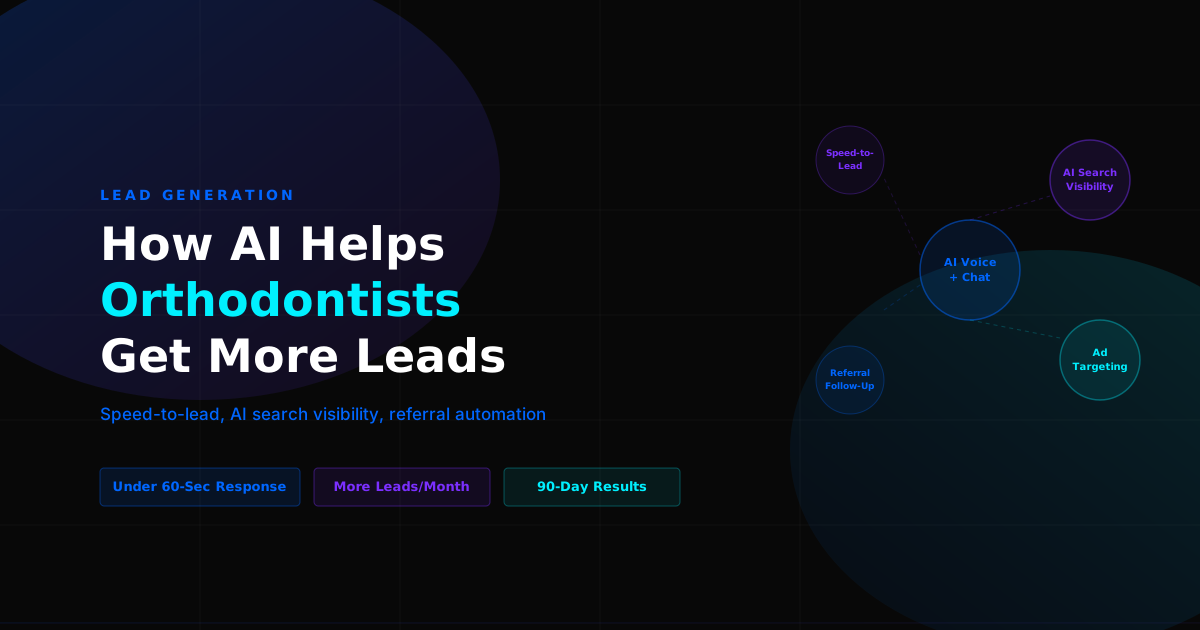
Most orthodontic practices do not have a marketing problem. They have a leak problem. Ads are running, the website gets traffic, and referrals still come in from local dentists — but a large share of that interest never turns into a booked consult. It disappears into an unanswered form, a missed call during lunch, or a slow follow-up that lets the parent book with a competitor first.
AI closes that leak instead of trying to buy more traffic to compensate for it. The practices generating the most new consult leads in 2026 are not necessarily spending more on ads than everyone else — they are capturing and responding to a much higher percentage of the interest they already generate, and layering in visibility inside AI search tools that a growing share of parents now use before they ever open Google Maps.
This guide walks through exactly how AI generates more leads for an orthodontic practice, in the order it typically gets deployed, with the numbers to expect at each stage.
Why Most Orthodontic Practices Lose Leads They Already Paid For
Before adding AI, it helps to understand exactly where leads go missing. Three patterns show up in almost every practice we audit:
5 Ways AI Generates More Leads for an Orthodontic Practice
Each of these works on its own, but they compound when deployed together — faster response feeds better ad performance, which feeds more search visibility, which feeds more referral trust. See the full breakdown of why speed-to-lead under 60 seconds matters.
1 — AI Voice and Chat Capture Every Inquiry, 24/7
An AI voice agent answers every call the front desk cannot get to, and an AI chat widget engages every website visitor who lands on a treatment page but leaves before filling out a form. Both collect the parent or patient's name, treatment interest, and preferred contact method, then book the consult directly into the scheduling system or hand off a warm lead to staff.
Practices deploying 24/7 AI capture typically recover 15-25 additional booked consults per month that previously went to voicemail, an abandoned form, or a chat window nobody staffed after 5 PM.
2 — Sub-60-Second Response Beats Every Competitor Still Checking Voicemail
When a parent submits a form or misses a call gets returned, an AI system triggers an immediate text or call back — typically under a minute, day or night. That speed alone often decides which practice gets the booking, since parents comparing providers rarely wait around for a callback the next business day.
Practices that cut response time from hours to under a minute typically see their lead-to-booked-consult rate improve by 20-30% without spending another dollar on new traffic — the leads were already there, they just were not getting contacted fast enough to convert.
3 — AI Search Visibility Puts You in Front of Patients Before Google Maps
A growing share of parents now ask ChatGPT, Google AI Overviews, or Perplexity questions like "braces vs Invisalign cost" or "best orthodontist near me" before they ever search Google Maps directly. AI tools cite pages that give clear, direct answers to real questions and carry schema markup identifying the content as trustworthy and structured.
A local content program built around real patient questions — cost, timeline, insurance, treatment comparisons — makes a practice eligible to be cited as a source inside those AI answers, generating leads from patients who never click a traditional search result at all. Learn how to get your business cited in ChatGPT answers.
4 — AI-Optimized Ad Targeting Lowers Cost Per Booked Consult
AI-managed Google and Meta campaigns continuously test audiences, creative, and bidding based on which leads actually convert into booked consults, not just which ads get clicks. This matters more in orthodontics than most industries because the buyer is often a parent, not the patient, and the right audience signals — household income, parents of teens, local geography — differ from generic dental targeting.
Practices running AI-optimized campaigns typically see cost per booked consult drop 20-35% within the first 60 days as the system learns which combinations of audience and creative actually produce consults rather than just cheap clicks.
5 — Automated Referral Follow-Up Protects and Grows Your Dentist Pipeline
AI automation confirms receipt of every referral from a general dentist within minutes, contacts the referred patient the same day, and sends the referring office a status update once the consult is booked. That closes the loop that most practices handle manually and inconsistently.
Practices that automate referral follow-up typically see referral-to-booked-consult rates improve because referring dentists send more patients to practices they can see are responsive, creating a compounding lead source that costs nothing in ad spend.
What This Looks Like in Practice
Two-Location Practice, 90-Day Lead Volume Results
A two-location orthodontic practice running paid ads and a standard contact form deployed AI voice and chat capture in week one, sub-60-second response automation in week two, and AI-optimized ad management starting in month two. Before deployment, the practice generated roughly 60 raw leads per month from ads, referrals, and organic traffic combined, but only converted 34 of them into booked consults.
By day 90, monthly lead volume grew to 78 as ad targeting improved and AI search content began driving organic inquiries, and the lead-to-booked-consult rate climbed from 57% to 79% because every lead now got a response in under a minute regardless of when it came in. Total booked consults nearly doubled without a proportional increase in ad spend.
Raw leads/month
Lead-to-consult rate
Booked consults/mo
Avg. response time
The practice did not add front desk headcount to handle the extra volume — the AI voice and chat layer absorbed the after-hours and overflow inquiries that staff never had bandwidth to catch consistently.
Common Mistakes That Cap Lead Volume Even With AI in Place
What AI Lead Generation Costs for an Orthodontic Practice
Tier 1 — Capture and Response Automation
$1,500 – $2,000/mo
24/7 AI voice and chat capture plus sub-60-second response automation for every existing lead source. Best for a practice that already generates decent traffic but converts too little of it. Setup time: 1-2 weeks.
Tier 2 — Full Lead Generation System
$2,000 – $3,500/mo
Everything in Tier 1 plus AI-optimized Google and Meta ad management, local AI search content, and automated referral follow-up. The complete system for practices targeting real growth in booked consult volume, not just conversion rate. Setup time: 2-4 weeks.
Tier 3 — Multi-Location Practice
$3,500 – $6,500/mo
Custom system for multi-location groups, including per-location lead tracking, localized ad campaigns and SEO content for each market, and location-level referral dashboards. Setup time: 4-6 weeks.
Ad spend runs separately from the management fee and scales with the practice's growth goals. Most practices offset the monthly investment within the first billing cycle from the additional booked consults alone.
FAQ: AI Lead Generation for Orthodontists
How does AI actually generate more leads for an orthodontic practice?
AI generates more orthodontic leads in four ways: capturing every website visitor and phone call in real time instead of losing them to a contact form nobody checks, appearing as a cited source when parents ask ChatGPT or Google AI Overviews questions like 'braces vs Invisalign cost,' automating faster follow-up with referring general dentists so more referred patients actually book, and using AI-optimized ad targeting to lower the cost per booked consult. Practices that combine capture, search visibility, and ad optimization see the largest lead volume increase, because each channel feeds the others.
What is speed-to-lead and why does it matter for orthodontic practices?
Speed-to-lead is how fast your practice responds to a new inquiry — a form fill, a missed call, or a chat message. Contacting a new lead within 5 minutes makes them far more likely to book than waiting even 30 minutes, because parents comparing orthodontists are usually contacting more than one practice at the same time. An AI voice or chat agent responds in under a minute, 24/7, which is the single biggest lever most orthodontic practices are missing.
Can AI help an orthodontic practice show up in ChatGPT and AI Overviews?
Yes. AI tools like ChatGPT, Google AI Overviews, and Perplexity pull answers from pages with clear structure, direct answers to common questions, and schema markup that labels the content as trustworthy. A practice that publishes well-structured content answering real patient questions becomes eligible to be cited as a source, putting the practice in front of patients before they ever open Google Maps.
How much does AI lead generation cost for an orthodontic practice?
Most orthodontic practices invest $1,500-$3,500 per month in AI-driven lead generation, covering AI voice and chat capture, ad management, and local SEO content. The exact cost depends on ad spend and how many channels are running. Practices typically see the cost offset within the first month, since a single additional treatment start is worth thousands of dollars in case value.
Built for Orthodontic Practices
Ready to Generate More Booked Consults?
Leadra.io builds AI capture, response, ad, and search visibility systems for orthodontic practices. Tell us your current lead volume and conversion rate — we will give you a system recommendation and 90-day projection.